
By WHF Trustee Christopher Sanders, VMH
It’s well known that some Mexican species and their hybrids such as P. maculatus, P. mexicanus and P. ‘Belle Etoile’ possess a gene for the colour pink, but this is manifested as a more or less basal blotch on the inner surface of the petals, resulting in a central ring of pink or purplish-pink in the heart of the flower. However, those present at the recent Philadelphus Study Day at White House Farm were intrigued when shown a young shrub recently planted out in the Wood, which was clearly exhibiting pink-flushed flower buds and whose petals had faint pink streaks on their exterior.

Maurice told us that he had been given this as a cutting under the name of Philadelphus aff. delavayi “pink form” during an RHS Woody Plant Committee visit to Bodnant in North Wales a few years ago. The name seems somewhat doubtful, given that P. delavayi is an early-flowering species; other examples of P. delavayi in the collection (a fine melanocalyx B & L collection and the Nymans form, for example) had mostly finished flowering by the study day (17th June), although a longer-lasting P. delavayi flavescens was still going strong into July. It reminded me that I had once seen something similar many years ago on a visit to Highdown, the famous chalk garden near Worthing, Sussex, created by Sir Frederick and Lady Stern. It bore no label, but at the time I attributed it to P. tomentosus.
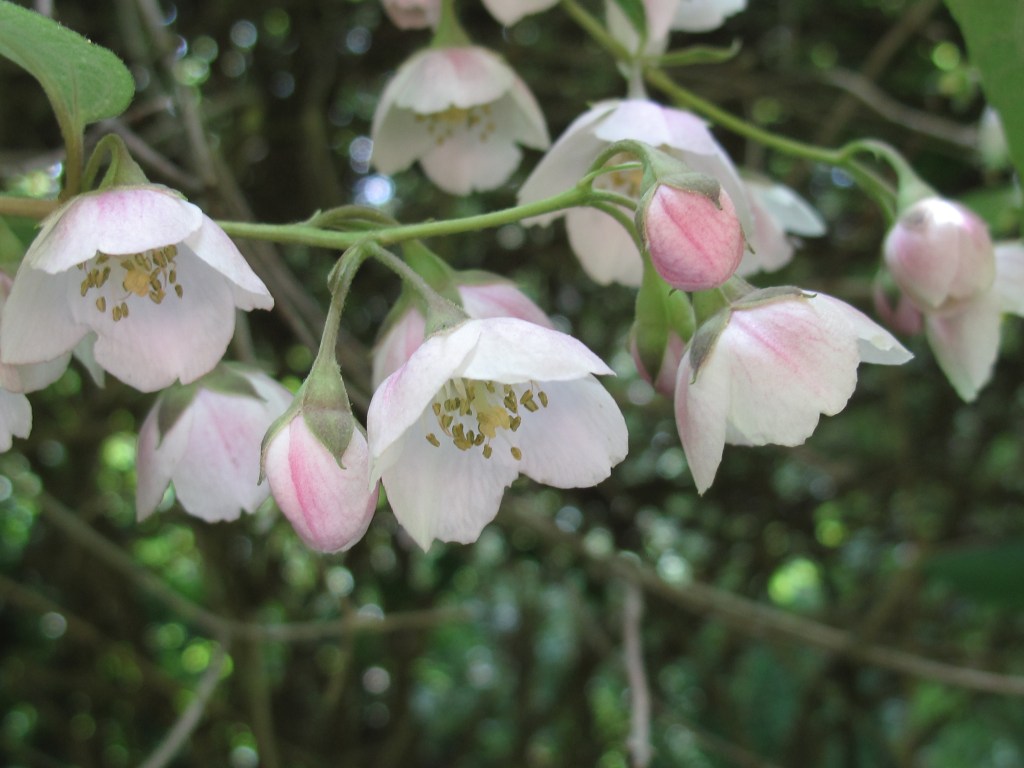
Fortunately, I took photographs of it because on a more recent visit I found that the border where I last saw it had become a dense, overgrown thicket and there was no sign of the pink philadelphus. Hopefully it is still there, but the whole border is in desperate need of drastic pruning in order to give it a chance to recover. In the meantime, fellow trustee Jack Aldridge found in the Wisley library the following brief reference in EXTRACTS from the Proceedings of The Royal Horticultural Society, Vol. LXXXI, 1956, Part Two:
Referred to Scientific Committee and to be seen at a future meeting:
Philadelphus L. & S. 17408 (pink form) exhibited by Sir Frederick Stern O.B.E., M.C., Highdown,
Goring-by-Sea, Sussex.
This must be the same thing I saw at Highdown. Further research revealed that L. & S. 17408 was collected by Frank Ludlow in Gyasa Dzong, NW Bhutan, on Oct 3rd 1949. Frank Ludlow and George Sherriff (L. & S.) collected mainly in Bhutan and SE Tibet, and P. tomentosus is native to the Himalaya. More details have been requested on the precise origins of both this and the Bodnant plant, and I’ll report back here as more information comes in.
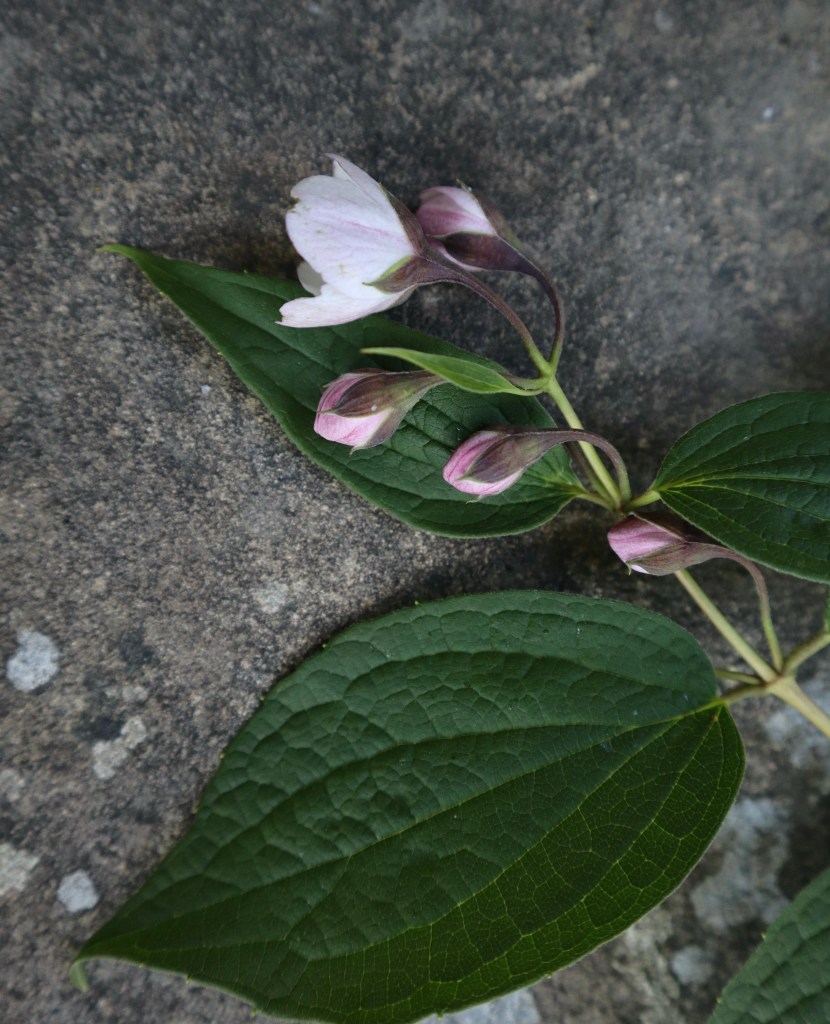
Might there be a connection between the Highdown and Bodnant plants? Back in the 1950s at the regular RHS fortnightly shows at Vincent Square, there would have been much keen but friendly competition involving many of the great gardeners of the time, including Sir Frederick Stern from Highdown and Lord Aberconway from Bodnant. Plants and/or cuttings were likely freely exchanged afterwards, so the Highdown philadelphus could well have found its way to Bodnant.
It is, then, not inconceivable that the pink genes of the Mexican plants could be married to species like these from the Himalaya, and maybe after a couple of generations we might see a really pink philadelphus.
 White House Farm Garden and Arboretum