
Join us for our spring Open Days to see our 200+ magnolias, 140 camellias and other spring-blooming genera on
Mother’s Day, Sunday March 30th and Wednesday April 9th. (£15).
To reserve a space, email whitehousefarmarb@gmail.com
Magnolia campbellii occurs right along the Himalaya, from Nepal to SE Tibet. Moving further east, into W. China, in the spring of 1904, George Forrest discovered, on the western side of the Mekong valley in Yunnan at 10,000 ft in snow drifts, a magnolia with an affinity to, but distinct from, M. campbelli. This was named as M. campbellii ssp mollicomata.
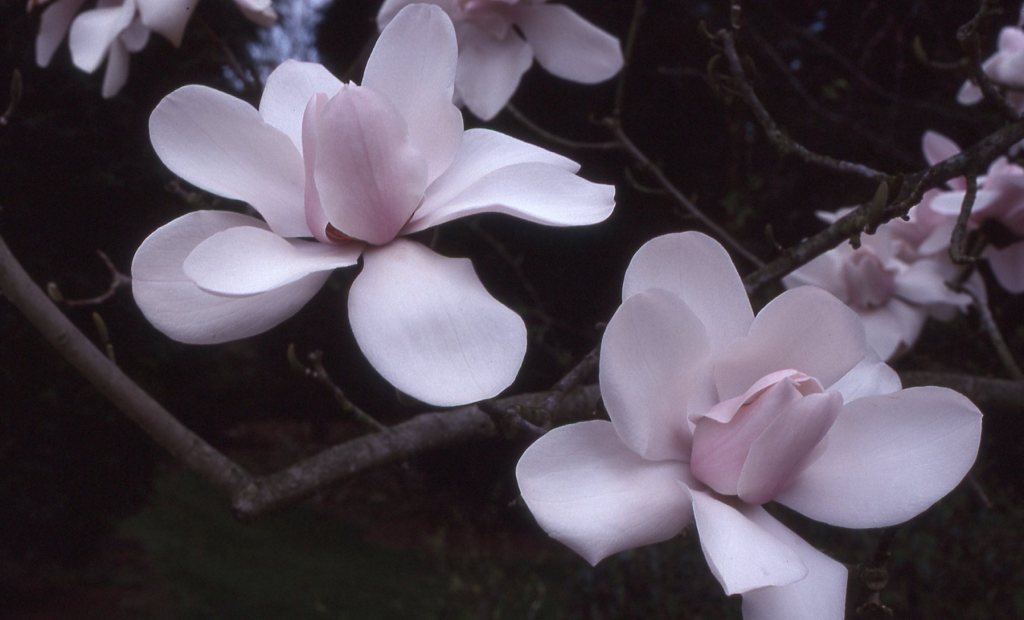
Botanists now vary as to the status of mollicomata. TSO treats it as a horticultural ‘group’ within campbellii, holding that it forms a meaningful entity only within gardens. Others still maintain it as a variety, or a subspecies. Botanically, it may not differ sufficiently to separate it from campbellii, but horticulturally the differences are real:
- The pedicels and perules are notably hairy (hence mollicomata – the ‘downy magnolia’)
- The buds are bullet-shaped, with a little pinched waist, as against ovoid for M. campbellii
- The shape of the open flower is different: M. mollicomata is invariably some form of cup and saucer but, while M. campbelli is quite often in this style, it can vary, sometimes with looser cup-shaped flowers.
- The flower is a different and for some a less pleasing colour; jt has a more fuchsia tone, with a bluish colour base. Gardeners expecting the clean clear pink of the campbelli type might be disappointed.
- It flowers from seed in half the usual time of M. campbellii – after 10 or 12 years. It took 12 years to flower from seed at both Bodnant and Windsor.
- White flowers are rare.
- It flowers two weeks or more later than typical M. campbellii and is thus more likely to avoid frost damage in the garden.
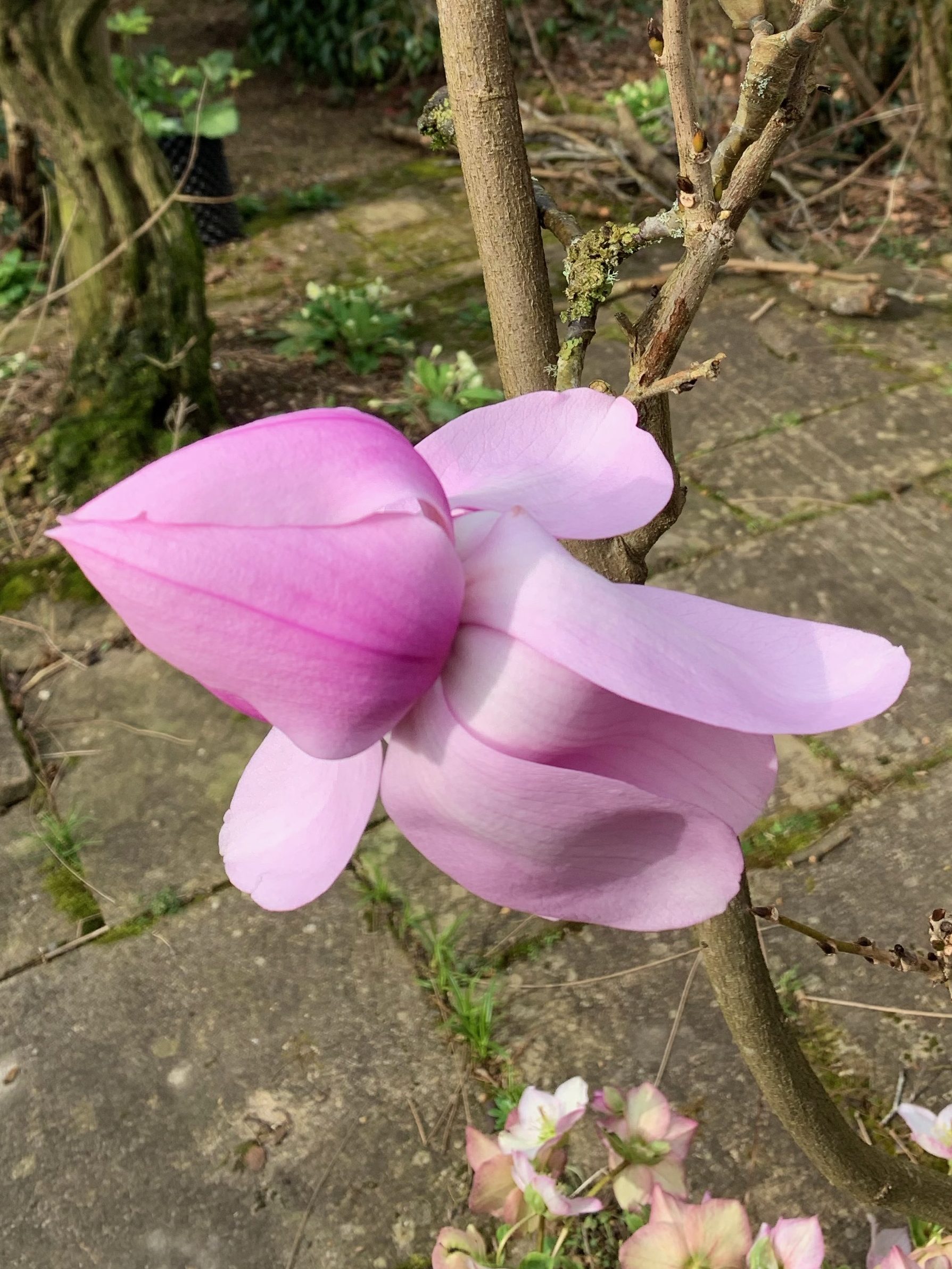
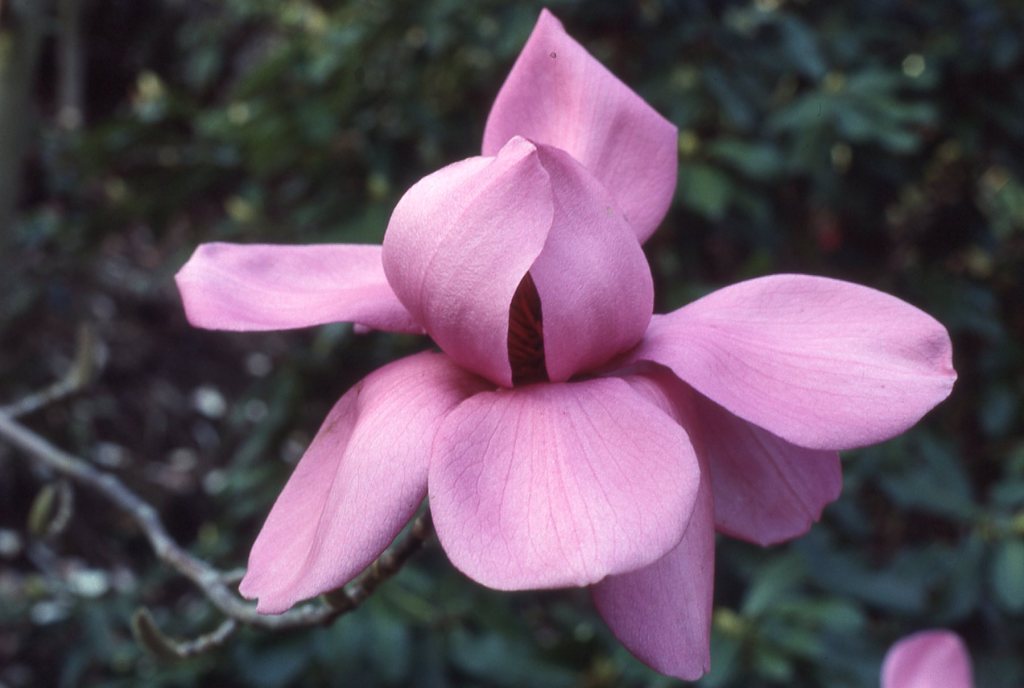
This is a typical flower from the Salween drainage of the Salween/Mekong divide in far N.Yunnan, where it is locally frequent in silver fir forest. Forrest thought it favoured the western aspect, exposed to the wetter conditions of the monsoon. Note the sharp reflexing of the outer tepals.
Incidentally, in the wild, a white form of M. mollicomata is as rare as the (wild) pink form of M. campbellii. I don’t know of a true white mollicomata in cultivation – but readers may have seen one?
It is rare now to find a plant in flower in the wild because the buds appear to be taken for medicinal purposes, along with young bark and young shoots. Even in very remote areas huge trees are still found climbed high, with not one bud left. It seems as much in demand for this purpose as M. officinalis, especially in Yunnan. So it is rare to see a large tree smothered in flower.
Its relative lateness is a virtue in the garden; and there are forms that are even later than the type. Some of these offer wonderful colour, and for the garden are a massive improvement on the type. For those uneasy about the early flowering and frost susceptibility of typical M. campbellii, these later forms are not only superb for their colour, but generally April flowering, and thus escaping the occasional cold snap of late winter and early spring.
Darjeeling is one such, and high on my list of top 10 magnolias. The exceptionally rich red/purple colour with the outer whorl of tepals reflexed to show a paler inside, together make an unforgettable picture. This is an even richer colour in the warmer climate of New Zealand, as appears to be the case with other ‘red’ magnolias. The colour seems to be fugitive to cold. It was named by Hilliers as long ago as 1987 and grafted from a tree growing in the Lloyds Botanic Garden, Darjeeling. A fabulous flowering tree.

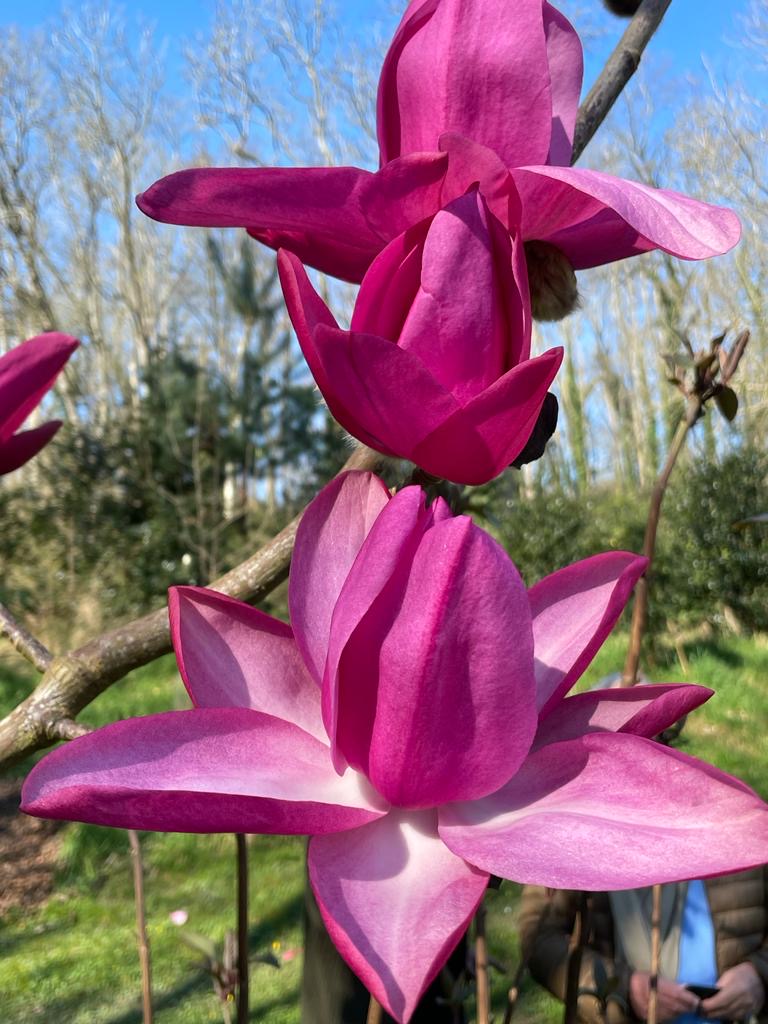
And Betty Jessel is a seedling raised by Sir Charles Jessel in Kent from M. mollicomata ‘Darjeeling’, and is also a remarkably rich colour, almost crimson in effect, during open weather. It does not appear to graft as easily as other cultivars and this is maybe why it is less often seen.

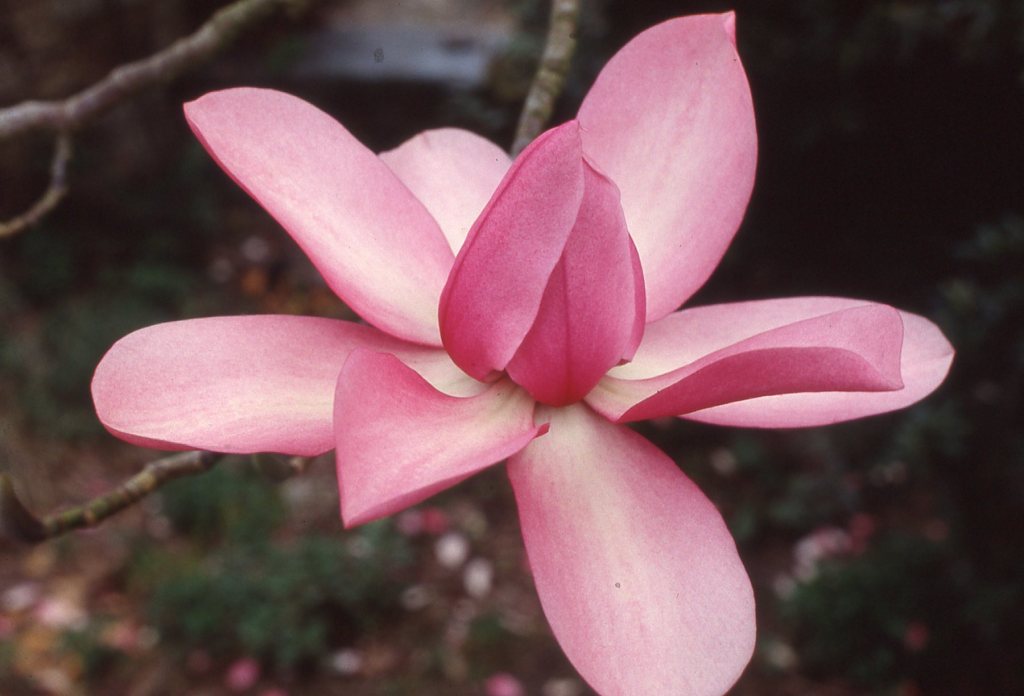
Latest of all to flower is Peter Borlase, a little-known seedling from Lanhydrock. This is an unusual colour, a warm rose with a paler bar down the centre of the tepal. It was named for the head gardener at Lanhydrock and selected from a row of open-pollinated seedlings planted as a shelter belt. It flowers in April and as late as into May, on a sturdy upright medium-sized tree. It leafs out late; so late, it can appear to have died, like Acer pentaphyllum or Sorbus keenanii.
And of course there is the ‘Lanarth’ group, collected by Forrest in 1924, which tend to flower later than typical M. campbellii and from an earlier age. All have the remarkable and unique episcopal purple colour, fading to magenta/violet. It comes more or less true to colour from seed.
Forest never saw ‘Lanarth’ in flower, his note just said ‘only M. mollicomata, I think. GF’. When it was first introduced it was known as the ‘telephone number Magnolia’, because its collection number was F25655, typical of the then five digit phone number. Three seedlings were raised. One went to Lanarth, one to Werrington, the other to Borde Hill.
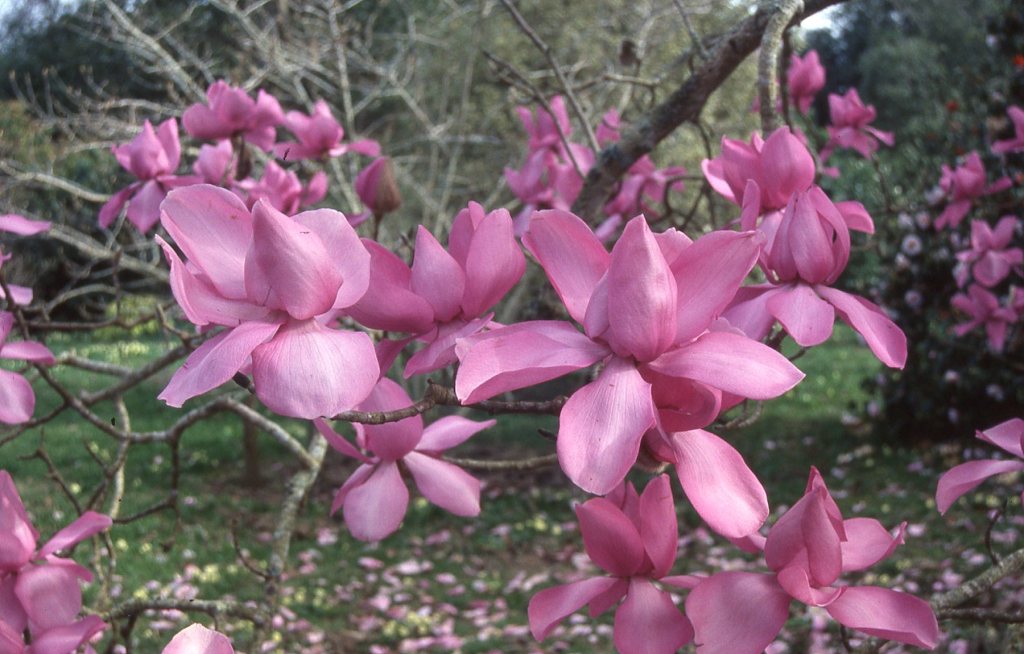
The original raising took 20 years or so to florescence, but seedlings from it have flowered sooner, such as ‘Trewidden Belle’, almost certainly a hybrid, below:
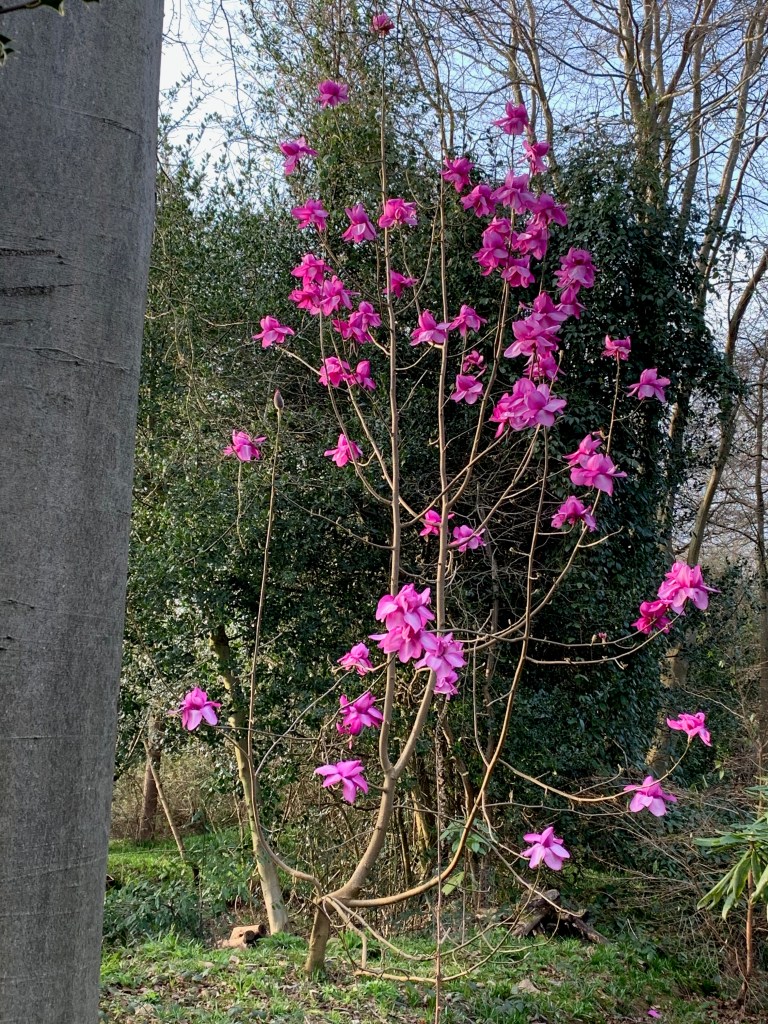
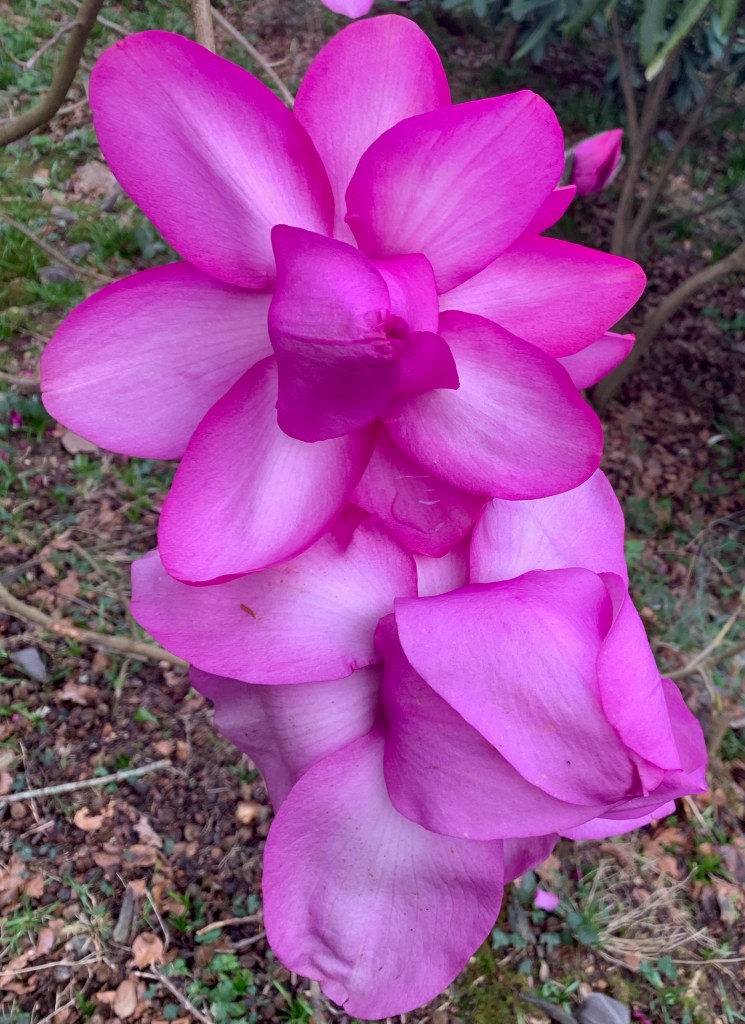
At White House Farm this took some 15 years to flower from grafting, but it was moved as a small tree of about 2.5m which set it back. The colour has something of the magenta/purple tone of‘Lanarth’ but with more red and and brighter.
Another group that brings in the 3 elements of later flowering, a cup and saucer shape, and improved cold hardiness is the hybrid between the type campbellii and mollicomata, the Raffillii Group. Charles Raffill at Kew made this cross in 1946 and distributed up to 100 plants to gardens across the country. It flowered first at Windsor and this plant was named ‘Charles Raffill’. A subsequent cultivar flowered at Caerhays and was named ‘Kew’s Surprise’.
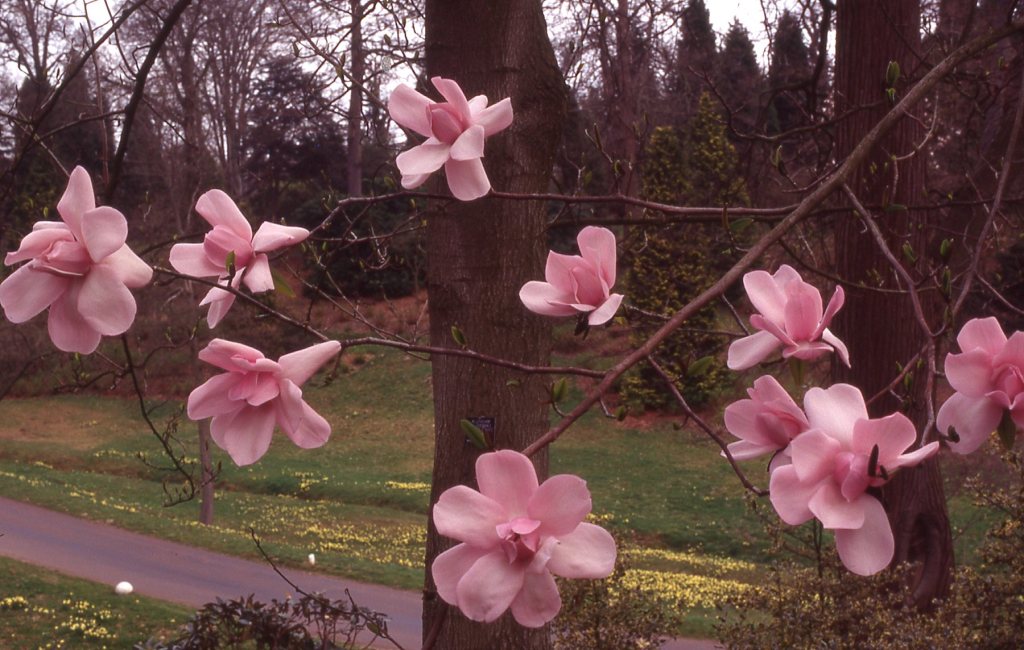
The quality of the flower may be just short of the class act of M. campbellii, but it is a first rate plant for those who fear the species may be susceptible to frost damage.
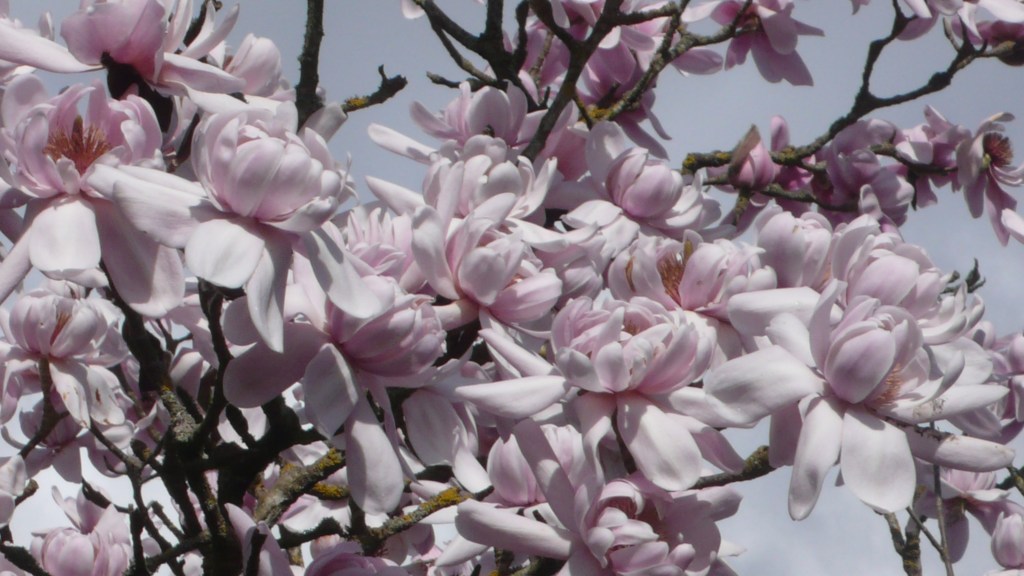
Lastly, the M. campbelli mollicomata Group includes a wonderful double form – as far as Jim Gardiner knows, the only one – aptly named M. mollicomata ‘Jim Gardiner’, pictured above at Borde Hill in 2014 another variety well worth watching….
Maurice Foster
Featured image at top: M. mollicomata ‘Werrington’ at Tregrehan.
 White House Farm Garden and Arboretum