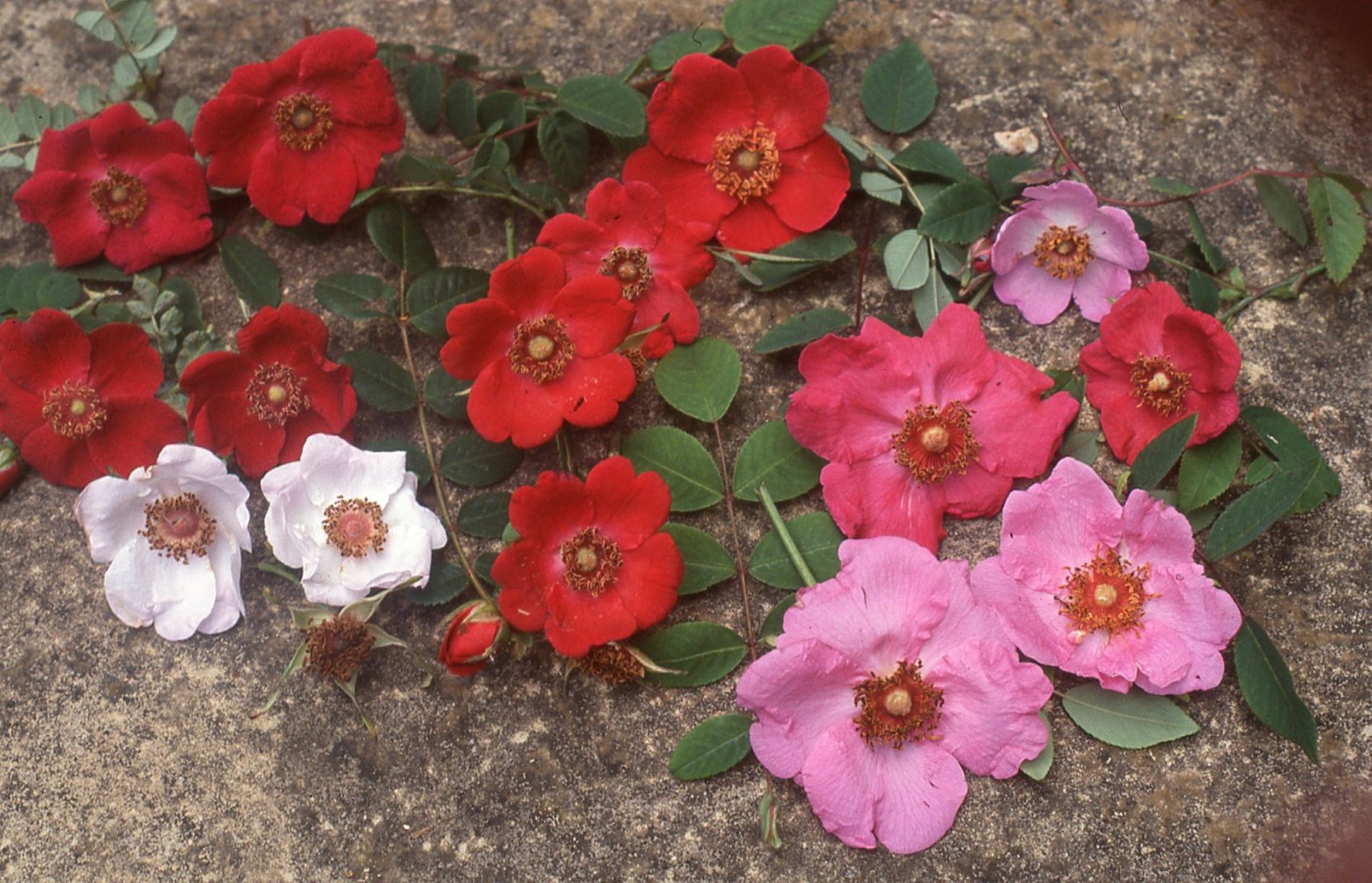
For those like William Robinson whose taste is inclined away from ‘fat, complex and overbred roses’, rose species can be a very satisfying contrast. Where there is space for them to flourish, they are a good enough reason on their own to justify a remark allegedly made by one of the Rothschilds, that ‘every garden, no matter how small, should have at least 15 acres of natural woodland’. But not all species roses climb, scramble or ramble (for a few of my favourites that do, see my blog ‘Four super-performing tree-climbing roses at WHF‘). There are plenty of modest growers available to grace small and medium-sized gardens, and they can play a very useful role in layouts featuring both flowering shrubs and herbaceous plants. I have come to view them as flowering shrubs – in other words, as giving their best when associated with complementary or contrasting plants in habit, foliage and flower. As with other genera, species appear to be more disease resistant, making these good choices in places prone to black spot and mildew. Here I make an argument for their versatility: as a resource in landscaping, in planning for year-round colour and interest, and offering low-maintenance effective (sometimes spectacular) displays.

There are about 150 species of rose, though disagreement among taxonomists remains. There is a concentration of species in China, and since it opened up in 1980 we have been privileged to have access to a far greater range of rose species and forms than at any other time in history. I can only offer a brief selection here of a handful of personal suggestions; many, although with plenty of appeal, such as our native dogrose, R. canina, would not be a high priority for most gardens. So what follows is a horticultural, not botanical selection, and I have attempted to create some horticultural categories to simplify matters a little. Bearing in mind that all classification is by definition an artificial device, I’ve settled on six categories as a way of thinking about different kinds of species roses’ garden potential.
- The colonisers (speaks for itself)
- The early birds (performing in May before the great mass of roses are flowering, useful in combination with other late spring plants)
- The double whammies (the engine room of species for garden performance, following effective flowering in summer with an equally valuable autumn fruit and foliage effects)
- The scramblers (big flowing flowering shrubs that need space) – as someone remarked of R. multiflora, ‘horse high, bull strong, and goat tight’.
- The high fliers (Invaluable for vertical gardening and fit only for large trees. Use on walls or buildings at your peril)
- The individualists (in both senses – with striking individual character, and for use as specimen plants).
The Colonisers
These are rampant growers that sucker freely and in time will form colonies that can cover considerable areas, of course only if on their own roots. Generally they don’t require fertile ground, and are useful for difficult sites in the garden like banks, cuts, dry sandy areas and rooty areas. You must prepare the ground first though and get rid of any nasty perennial weeds or you will be stacking up disaster for the future. Some good species in this category are:
Rosa rugosa – a vigorous and easy, healthy and green rose making a bush up to 8ft generally well clothed with foliage. From Japan, Korea, and East China, mainly coastal, and now naturalised in the northeastern United States – so will tolerate salt spray and salinity. Found growing on dunes and often best in low nutrient conditions once established: in Japan the species is known as ‘sea tomato’ on account of its large red fruits.
Rosa pimpinellifolia – a suckering rose with tiny leaves, forming mound-like thickets about a meter high, often wider in diameter; symmetrical, low habit, profusely flowering, easy to cultivate, with many varied flower forms. Excellent for use as ground cover and for mass planting.
Rosa asicularis – another suckering rose with blueish green foliage, good on poor soil, and tolerating low temperatures such as those on the Mongolian steppe. Flowers are 1.5 to 2 inches across; in good soil will grow up to 8 feet. The N. American variety nitida has shining smaller attractive foliage, will tolerate wet poorly-drained situations and offers good autumn colour. The variety nutkana has nice heps – but watch this one, it can really spread.
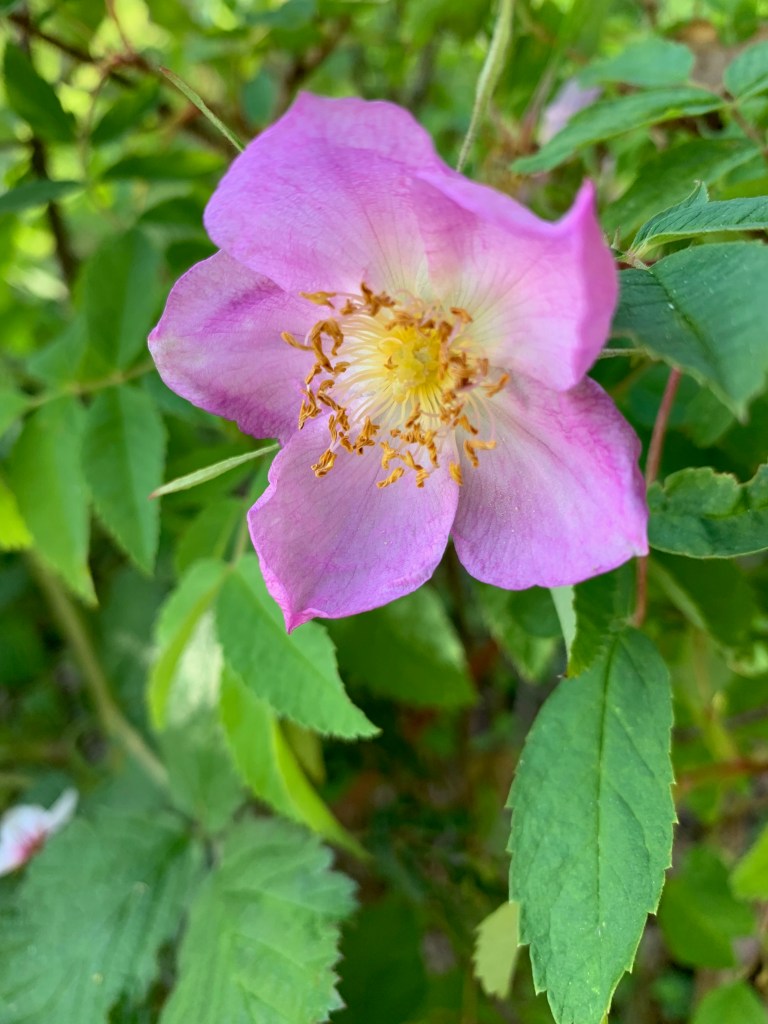
Rosa gallica pumila – some think this is close to the wild European form of Gallica: it makes a suckering shrub from 1.5 to 4 feet tall.
The Early Birds
These are like a stimulating aperitif combined with what the French call ‘une amuse-bouche’, and to thoroughly mix metaphors, the May overture to the big trombones of the midsummer band. The yellow species, forms and hybrids are first class flowering shrubs, some particularly enticing – and there are some modest growers for the small garden. There are also plenty of other plants to combine with. For example, yellows with clematis alpina, purple lilacs or white viburnums, blue ceanothus or wisteria.
Among them are Rosa chinensis, according to Bean “essentially a race of garden roses”. There are very many forms of R. chinensis, most continuously flowering. The wild species can climb great heights into a tree. I have been collecting different forms of R. chinensis for many years and they give a handsome and generous return, typically blooming for many months.
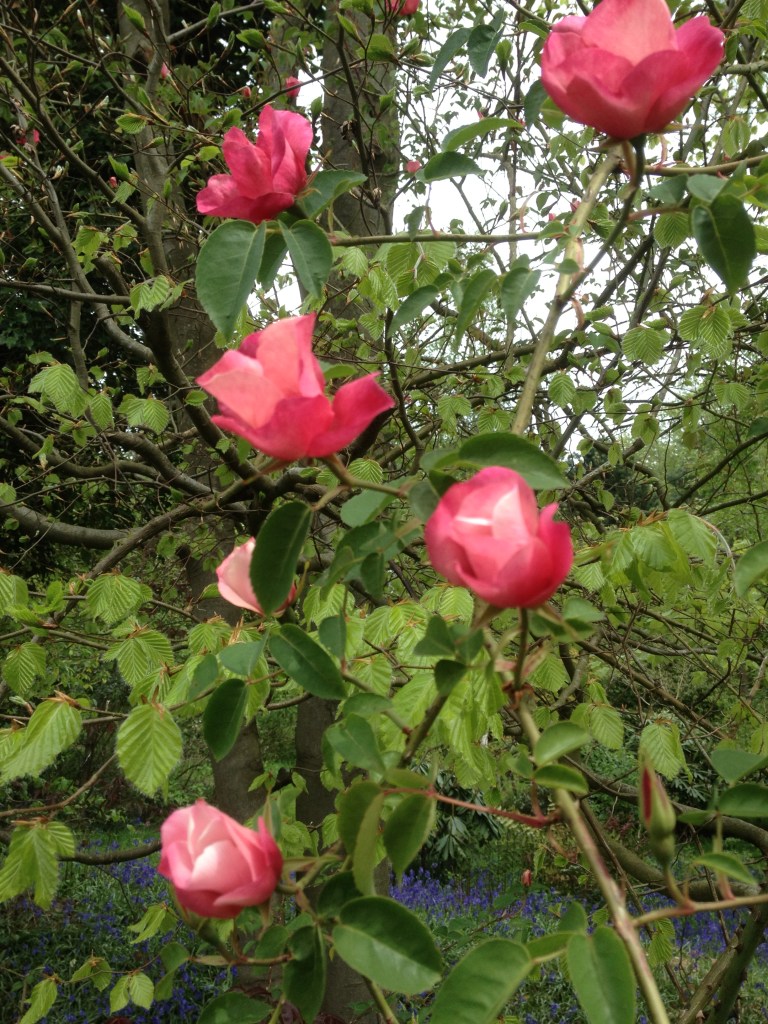
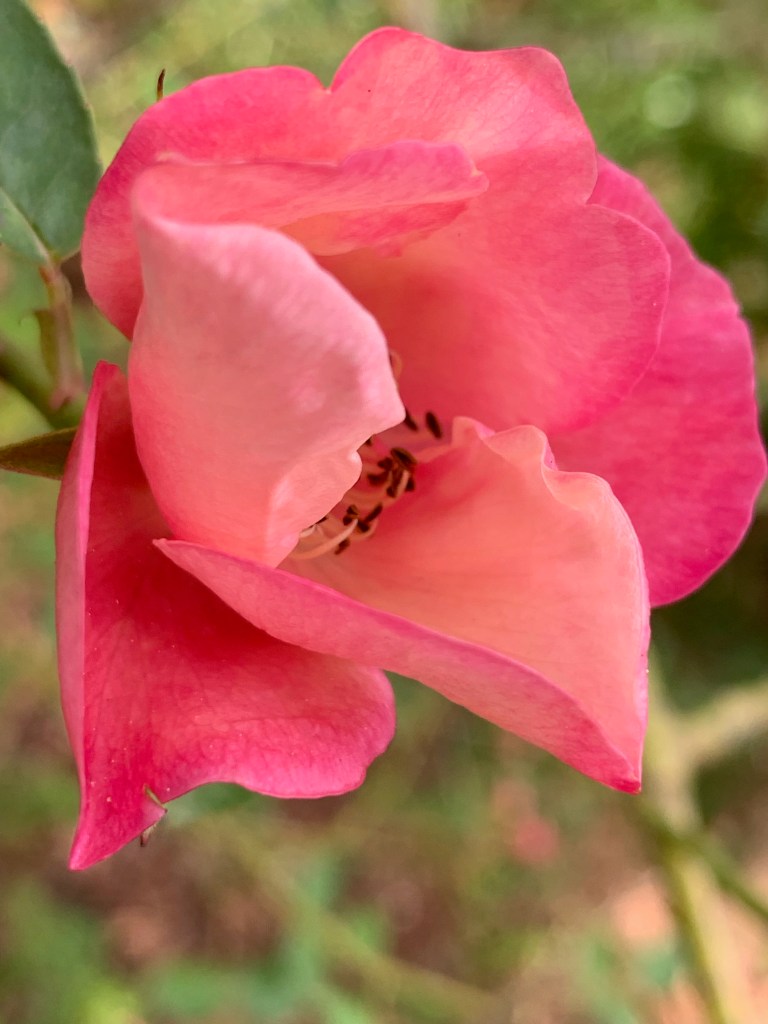
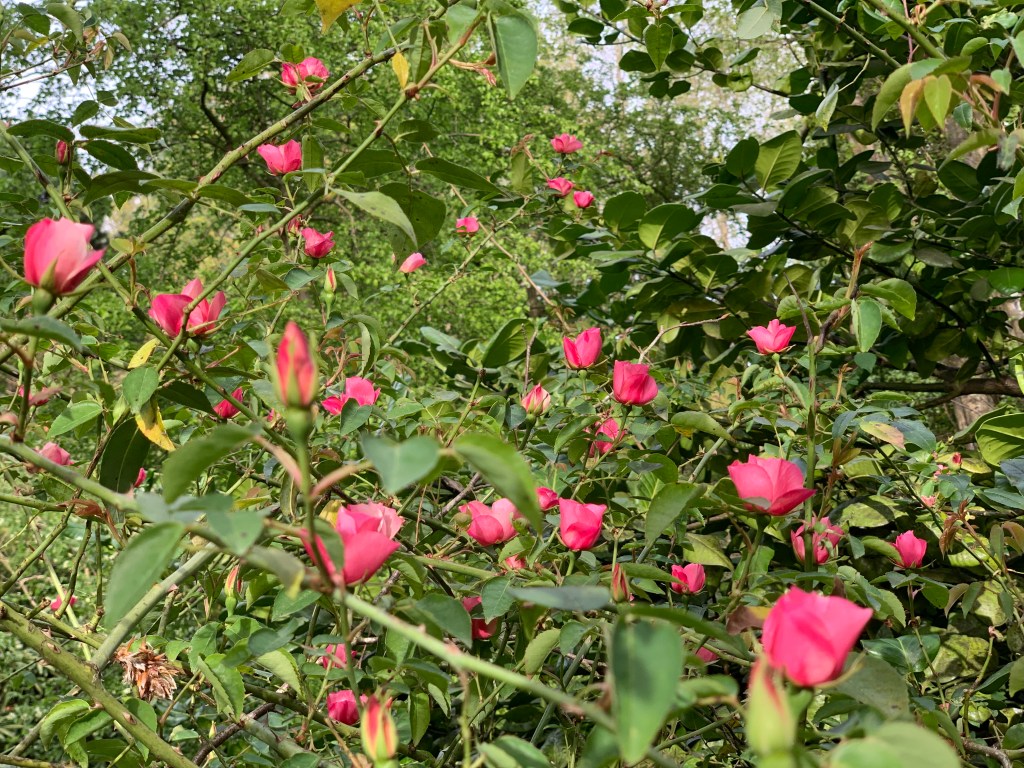
Rosa xanthina – solitary flowers 1.5 inches across, close in form to Pimpinellifolia but yellow (hence the name), and without bristles on the shoots. ‘Canary Bird’ is its best known cultivar.
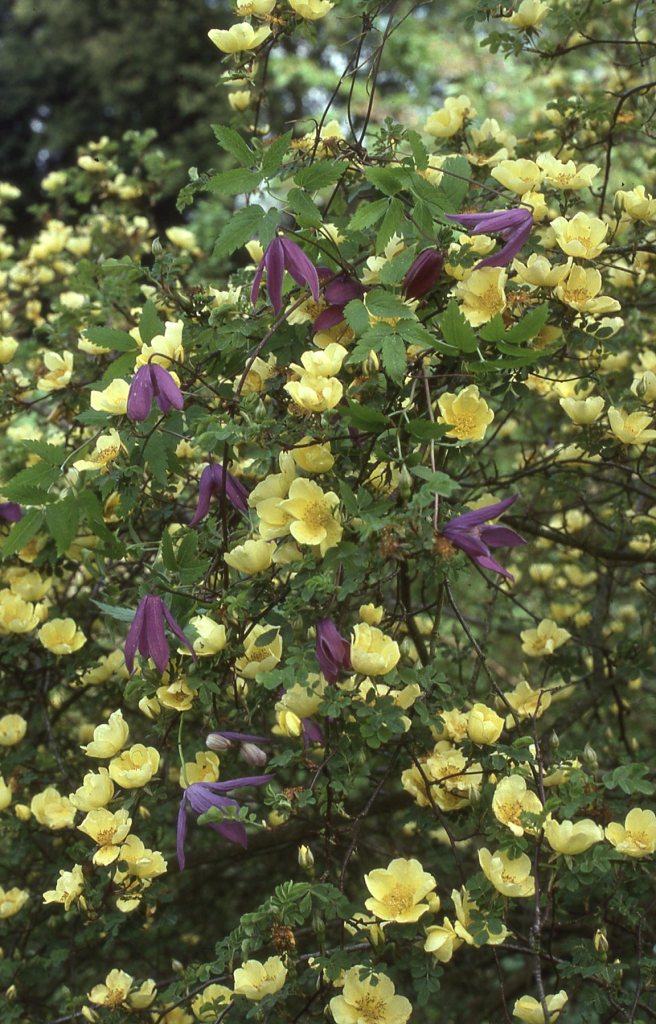

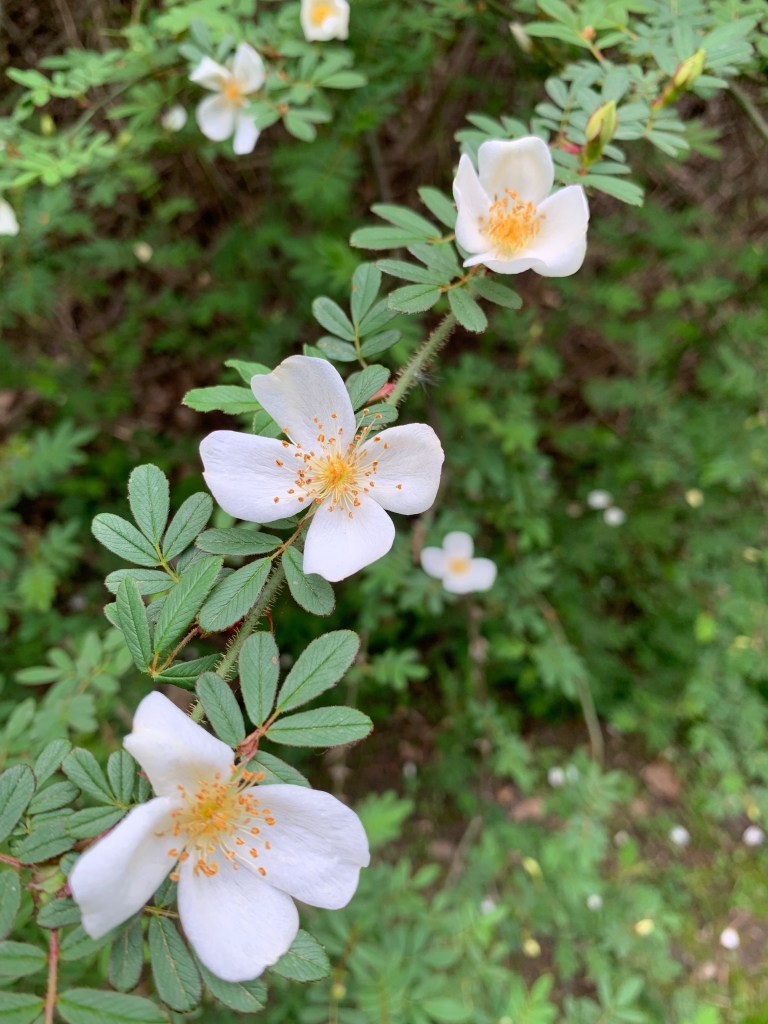
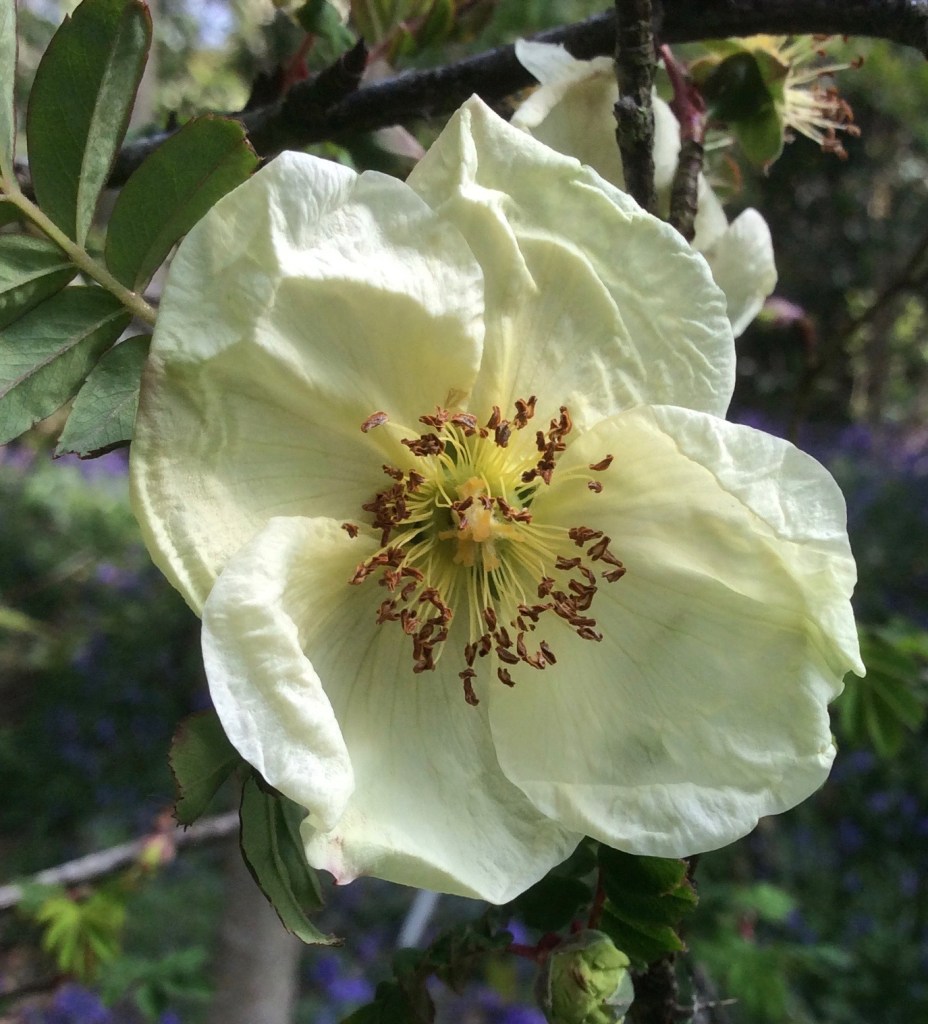
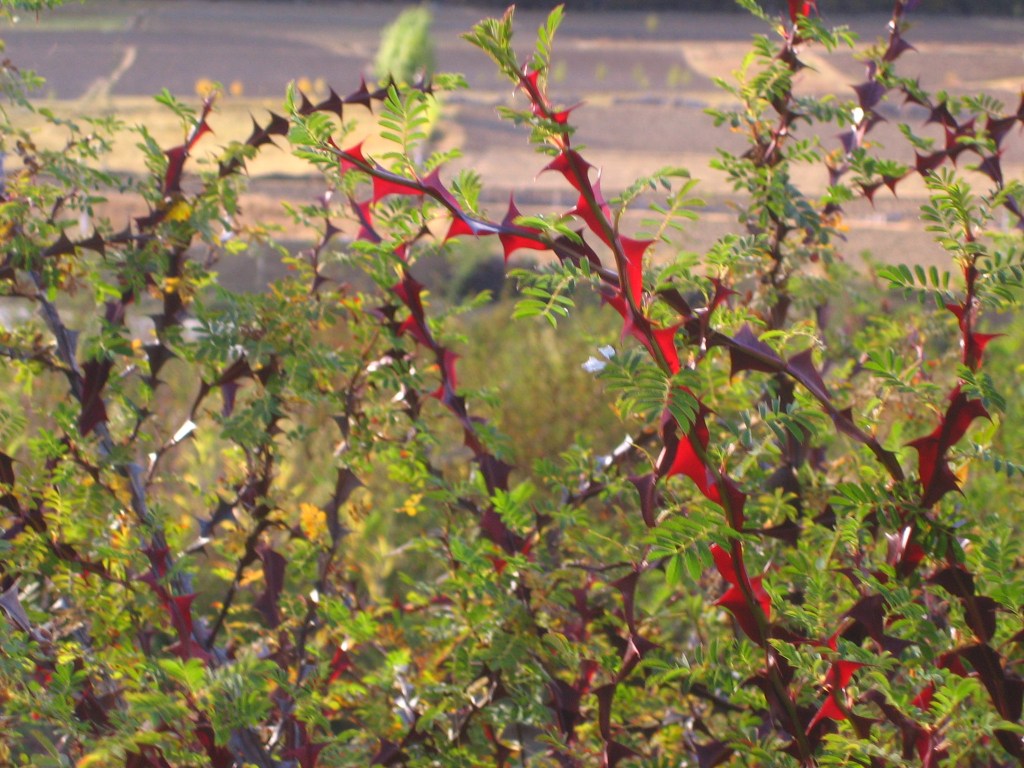
Rosa sericea – a white to cream rose, the only rose with 4 petals (see above) followed by usually bicoloured (yellow and red) urn-shaped hep: one variety, R. sericia var pteracantha, also has attractive red thorns. Altitudinally and geographically it’s the most widespread of all species, and one of the earliest rose species to flower (see above).
The Double Whammies
These are roses that both flower and fruit in sufficient profusion to create two different garden effects, in summer and autumn. Mostly growing to about 8 feet by 10 feet, they offer benign shelter for companion plantings, and are typically a large spreading mound. It is good to avoid pruning back to restrict size if you can, as it spoils the attractive natural form. Jack Harkness wrote: ‘The fruit of these roses is such a harvest festival as to send us into winter singing. Why no jeweller has copied them I cannot understand. They are nature’s perfect pendants.’ R. virginiana arguably offers some of the best autumn colour of any flowering shrub. R. moyseii (below) and others mentioned elsewhere fall into this category, with heps and autumn colour sometimes the main feature.
The Scramblers/Sprawlers
These roses really fit the bill for the wild garden; they need space to achieve their full effect. They will climb when given half an opportunity, some to 25 feet or more. Left to themselves in the open, they’re usually twice as wide as high. You must clear the land of all perennial weeds before planting. For foliage effect consider R. fedschenkoana (sea green), R. glauca (‘greyish-green with a mauve tinge in shade’ – Hiller’s Manual of Trees and Shrubs – hence it’s other name, rubrifolia) or R. soulieana (grey-green foliage).
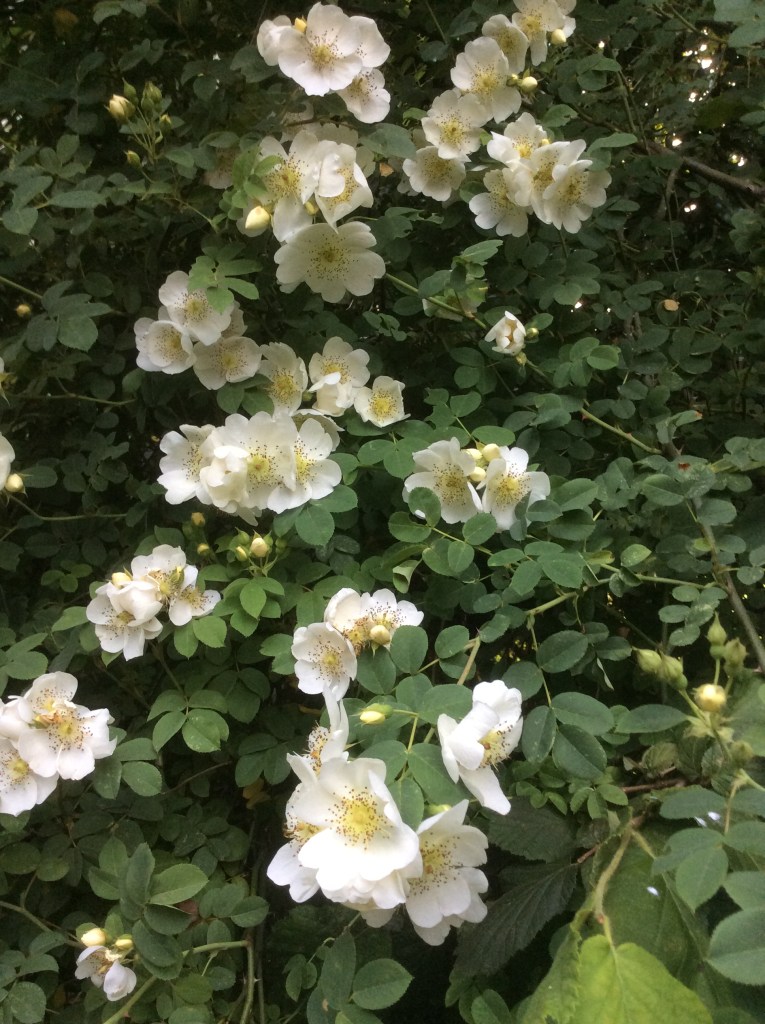
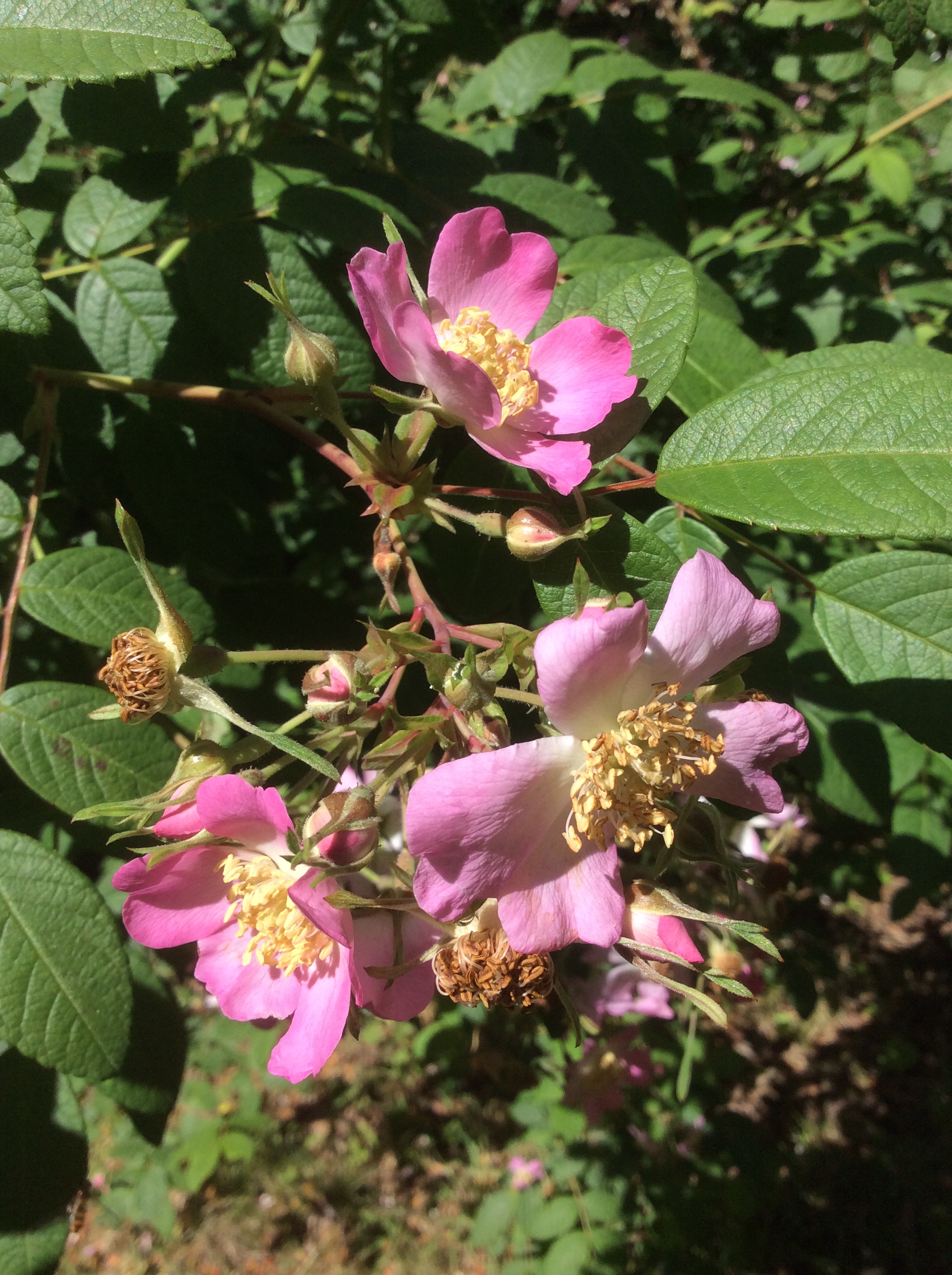
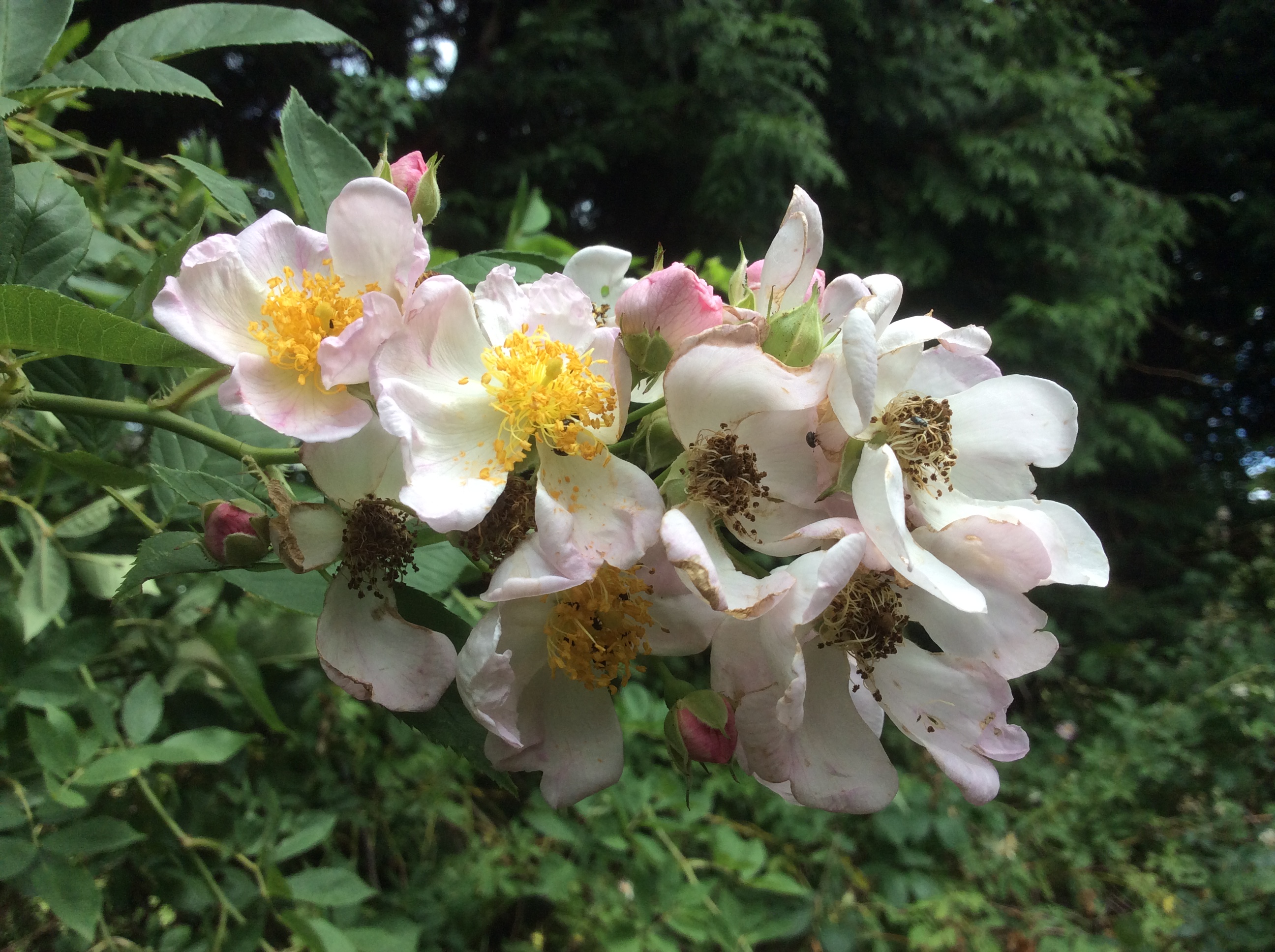
Rosa multiflora – ‘an impenetrable tangle of brush fit only for burning’ according to Michael Dirr. It is greedy and invasive; you can see whole fields taken over by it in nature. In the species, the leaves are dull, flowers small and it tends to drop petals quickly; I have got rid of most species multifloras in the arboretum as they were taking over. But it is an influential parent of very many excellent hybrids, like ‘Rambling Rector’ and ‘Violette’ (aka ‘Violetta’), and has a ‘profound influence on garden roses in many ways…and the main ancestor of the ‘rambler’ group of roses’ (Graham Stuart Thomas) among many other corymbose ‘polyantha’ types, such as R. wichurana, sempervirens, filipes. Below are two Chinese collections from a pink form.
Rosa wichurana – a glossy, disease-proof, late flowering Japanese species.
Rosa cymosa – with prickly stems, colourful young growth and larger compound corymbs with smaller flowers – hence its colloquial name ‘The Elderflower rose’.
The High Fliers
‘The musk and banksian roses often scale tall trees and a tree thus festooned with their branches laden with flower is a sight to be remembered. To walk through a Glen in the early morning or after a slight shower, when the air is laden with the soft delicious perfume from myriads of rose flowers, is truly a walk through an earthly paradise…’
-Ernest Wilson
These are the roses I have in mind when applying my five ‘F’s rule for trees: if a tree doesn’t offer excellent form, fragrance, foliage, fruit, or flower, put a rose up it. Some are so vigorous they can easily smother and kill a small tree.
Among them are R. banksiae, with four varieties in cultivation, all flowering in May.
Rosa banksiae var lutea – ‘one of the world’s choice plants’ – Jack Harkness.
Rosa banksiae The species, a single white. There are thornless examples.
Rosa banksiae var banksiae The double white. Our plant is 60ft into an old Lawson.
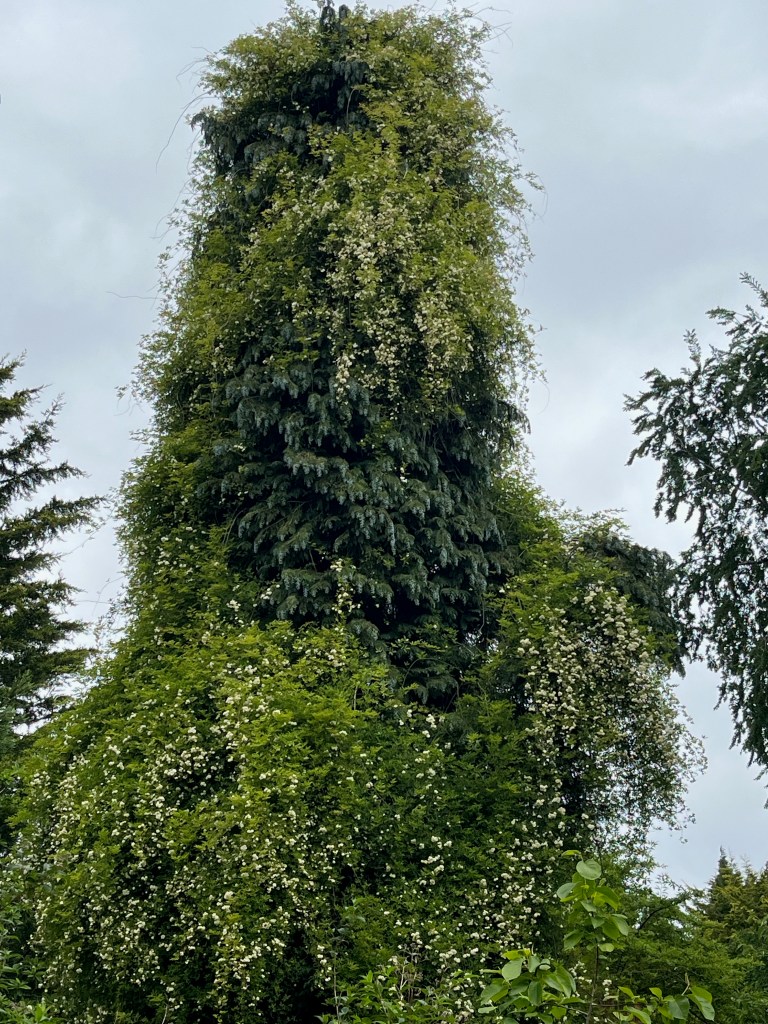
Rosa banksiae var lutescens Single yellow and often seen in the Italian Lakes and the South of France but hardy enough here in Kent. We lost our 50ft plant to honey fungus.
Rosa banksiae lutea – the yellow double form.
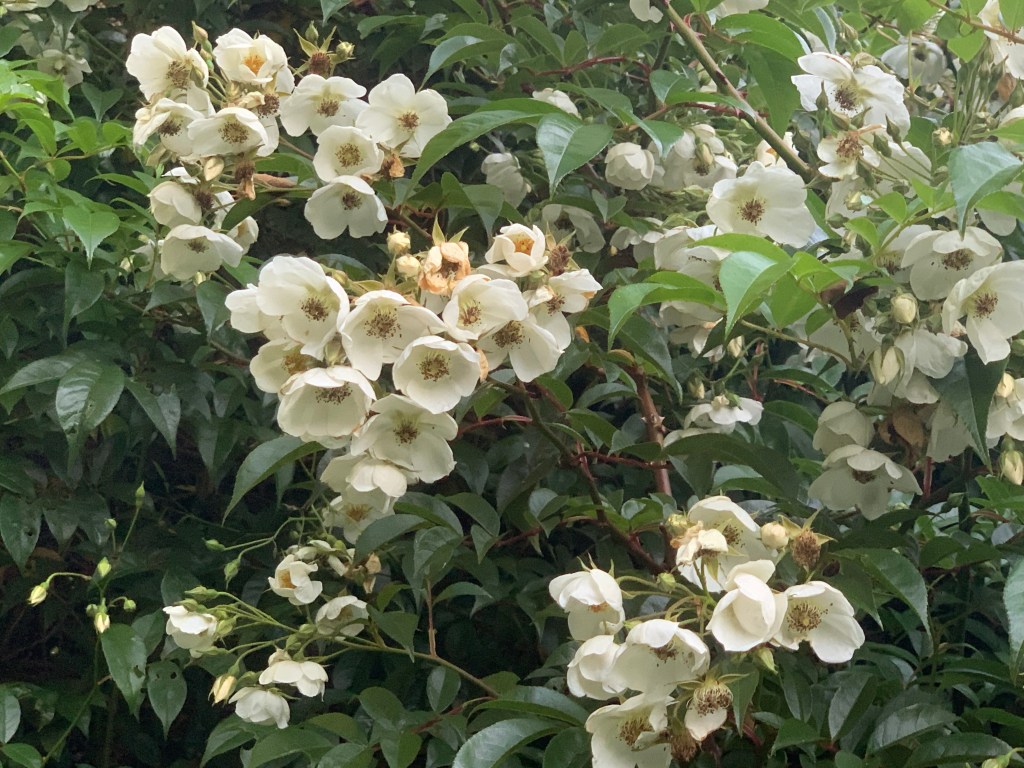
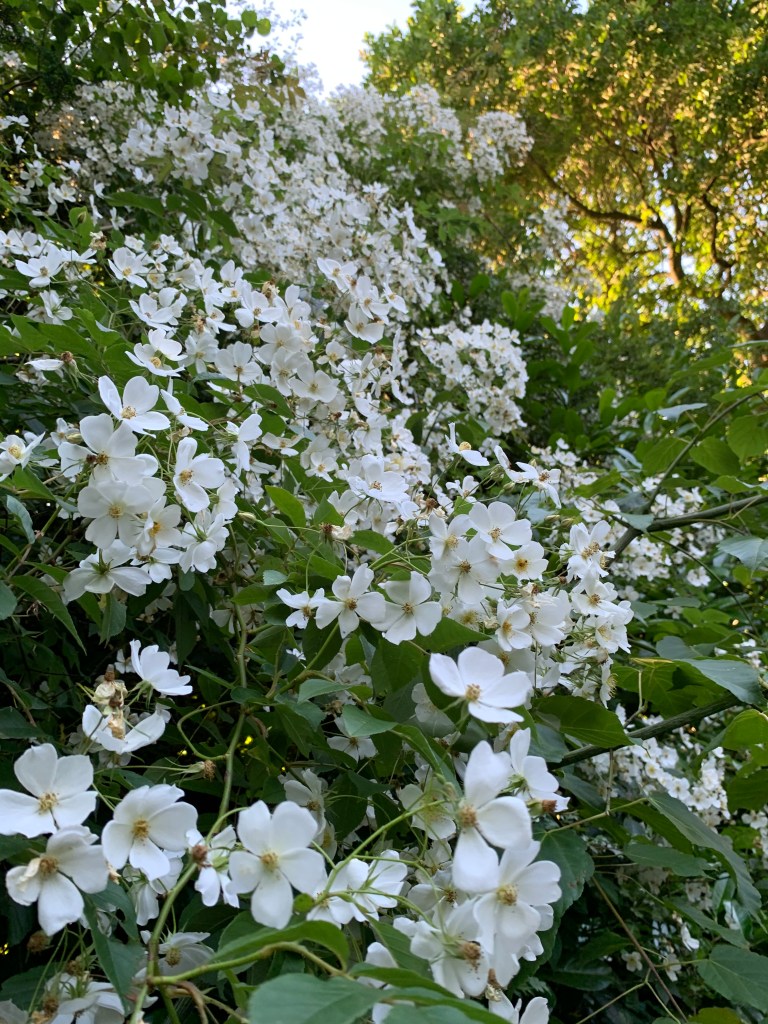
Also in the ‘High Fliers’ category should be Rosa gigantea – the largest flower of all wild rose species, with flowers up to 5 inches across. At White House Farm we have one at over 10 years old that’s topped out a mature native holly, proving that this is a species that will take some frost; and the synstylae roses, which I’ve written about here.
Synstylae roses (with styles fused into a single column, hence the name) cross-fertilise readily, are promiscuous, and one species, R. longicuspis, is a genuine glossy evergreen. Great for growing into screen trees. Other good roses from the synstylae section are:
R. brunonii – an almost impossibly vigorous rose, even in poor soil – as are the more delicate looking R. filipes, and R. glomerata.

The Individualists
These roses have character and are suitable for specimen planting. Among them: Rosa moyesii – variable in colour from deep blood red to pink, a flower of classical form. Some are obtainable from nurseries – what’s offered in the trade is usually red, as are some of its hybrids, such as Rosa x moyseii ‘Eos’. Good forms are usually selected for the quality of their flowers, the form R. moyseii ‘Geranium’ was named at Wisley in 1938 for its compact form and quality of heps as well as flowers.

Rosa wilmottiae – elegant greyish foliage, lilac pink, 6 foot by 6 foot when fully grown.
Rosa webbiana – solitary flowers on short laterals, lacy twigs and foliage “like a graceful lady in lacy crinoline”.
Rosa laevigata, and ‘Coopers Burmese’ – with flowers 2 to 3 inches across.
A few spaces are left for our Open Day on June 14th, with a focus on species roses!
to reserve a space, email us at whitehousefarmarb@gmail.com
Coffee and intro talks at 10.30, tours at 11am and 2pm – tea and Q & As at 4.30pm. Bring your own picnic lunch, we provide biscuits and drinks
Our next Open Day when the WHF hydrangea serratas are at their best is Weds June 25th – also with some spaces available. Just email us to make a reservation and get further details for either event: whitehousefarmarb@gmail.com.
 White House Farm Garden and Arboretum