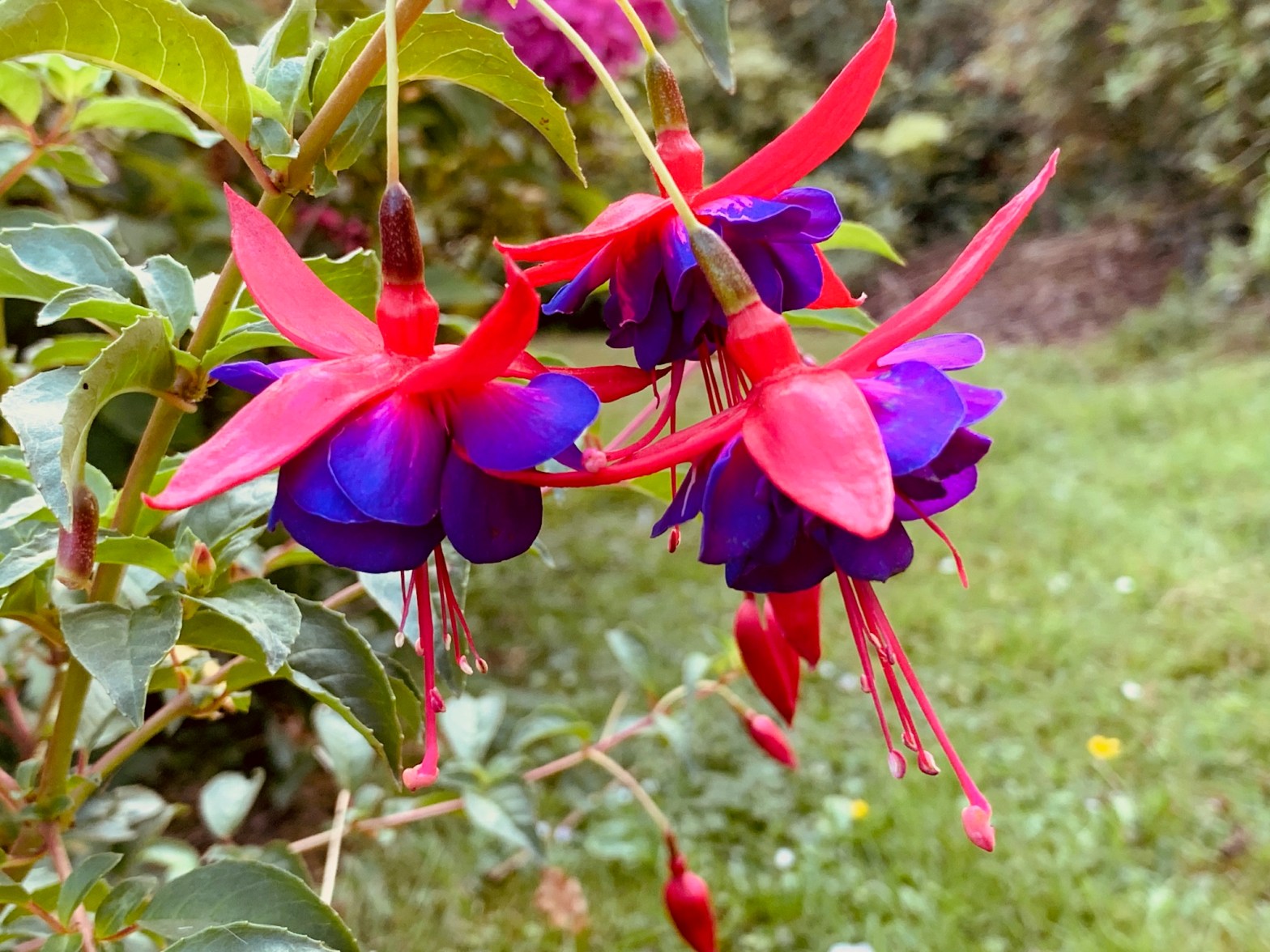
The heat and drought of this summer has seen some rather unexpected successes. For example, here we are in mid-October with both fuchsias and indigoferas still effective in the garden, having excelled themselves since June. I’ll write more on indigoferas later, but the humble hardy fuchsia is making such a splash at this time of year, as winter draws in, and the clocks go back, I feel it warrants special mention now. There are also, now, plenty of fuchsias to choose from, many in a wide range of colours and many with an RHS AGM, and some that warrant status as effective flowering shrubs.

Curiously, fuchsias were allegedly originally introduced from Latin America for their sweet fruits, rather than their flowers; conversely runner beans were brought in from the same source for the quality and rich colour of their flowers, rather than their fruits.
‘Hardy ‘ fuchsias are easy to grow in any soil that retains moisture in summer, but which doesn’t keep their feet wet in winter: they need good drainage. They perform best with plenty of sun providing that there is moisture at the root; and their tolerance of dry periods improves with age as they develop thick and deepening root systems. They will also tolerate part shade and still perform well.
Once established, they will readily survive winter cold, especially with the help of a protective surface mulch – which also contributes to feeding the soil and restricting water loss. Some have cold-resistant top growth that survives through the winter, and may be pruned up into small trees; others may be cut right down, either by winter cold, or by pruning, like a herbaceous plant. These will make up to 4/5ft of growth by August, flowering all the time. Other fuchsias are quite dwarf – useful for peeping out of a border wherever there is a small space available. All fuchsias repay good treatment (fertilizer, mulch) handsomely, and will flower freely from June to November, gradually diminishing as daylight length shortens. Some are highly effective in the garden landscape, providing splashes of vivid colour into October and November; others are less of a landscape feature but have a great deal of charm at close quarters.
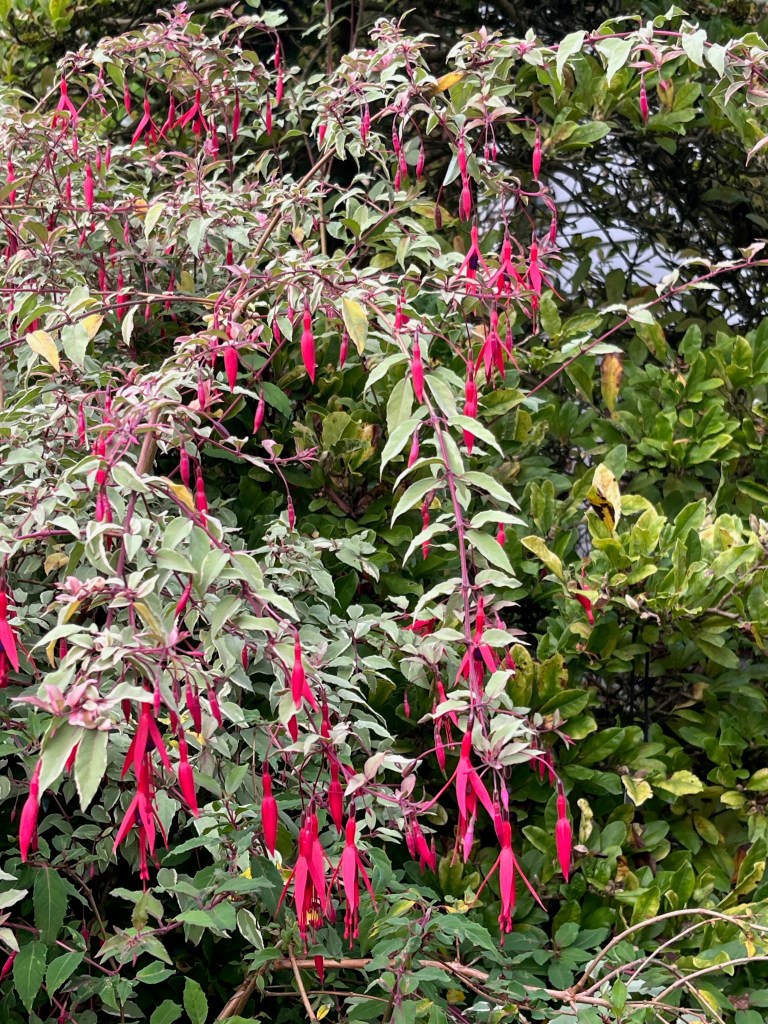
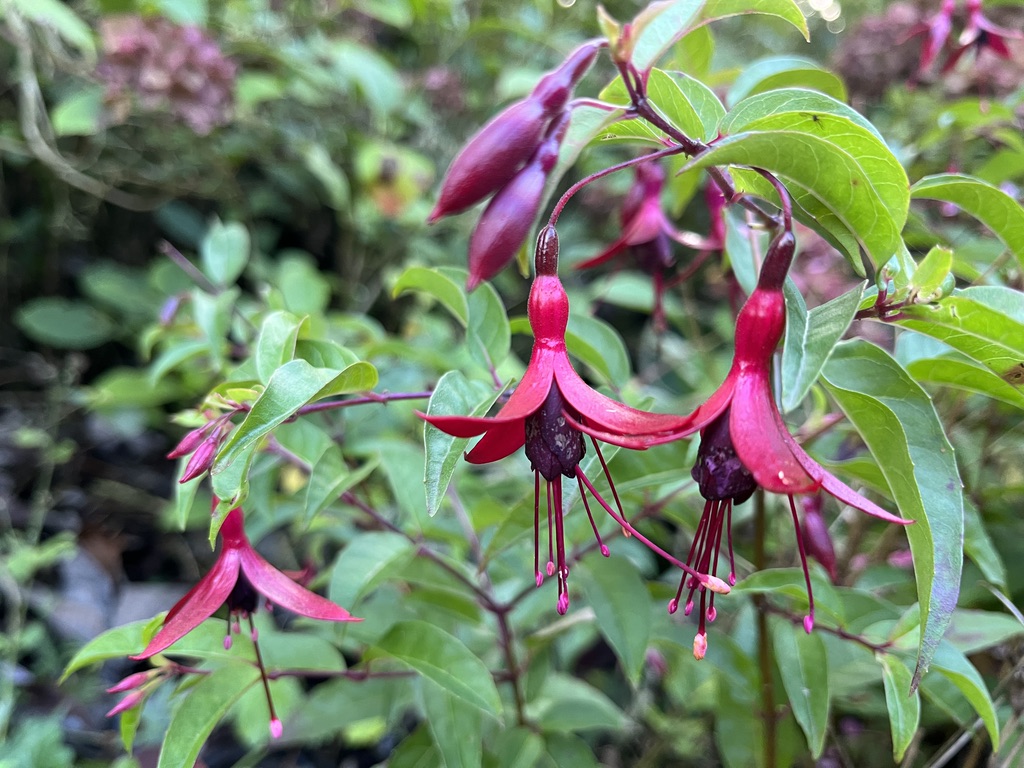
Of the species, F. magellanica var gracilis (left, in the variegated form) is worth growing as a shrub, making a 3ft light twiggy plant, with narrow flowers of the traditional turkey red sepals with purple petals. The variegated form, if such is your taste, is as hardy, as long as you are prepared to cut out the reversions to green (which caused its AGM to be rescinded in 2012). There are various other forms of this species in similar mould, all of which are reliable and hardy.
F. haschbachii, is similar in flower, and less often seen – but is a perfectly hardy plant of greater vigour that we have sprawling through a large hydrangea at the edge of the arboretum. It seems rarely out of flower.

Of the many hybrid cultivars (the specialist nursery Roualeyn in N. Wales, for example, lists more than 70) the toughest and most vigorous we grow is ‘Lady Bacon’ which here shrugs off winter cold and makes a 10 x 10ft bush dripping with flower for many months. She seeds herself freely in our gravel paths and is perfectly at home.
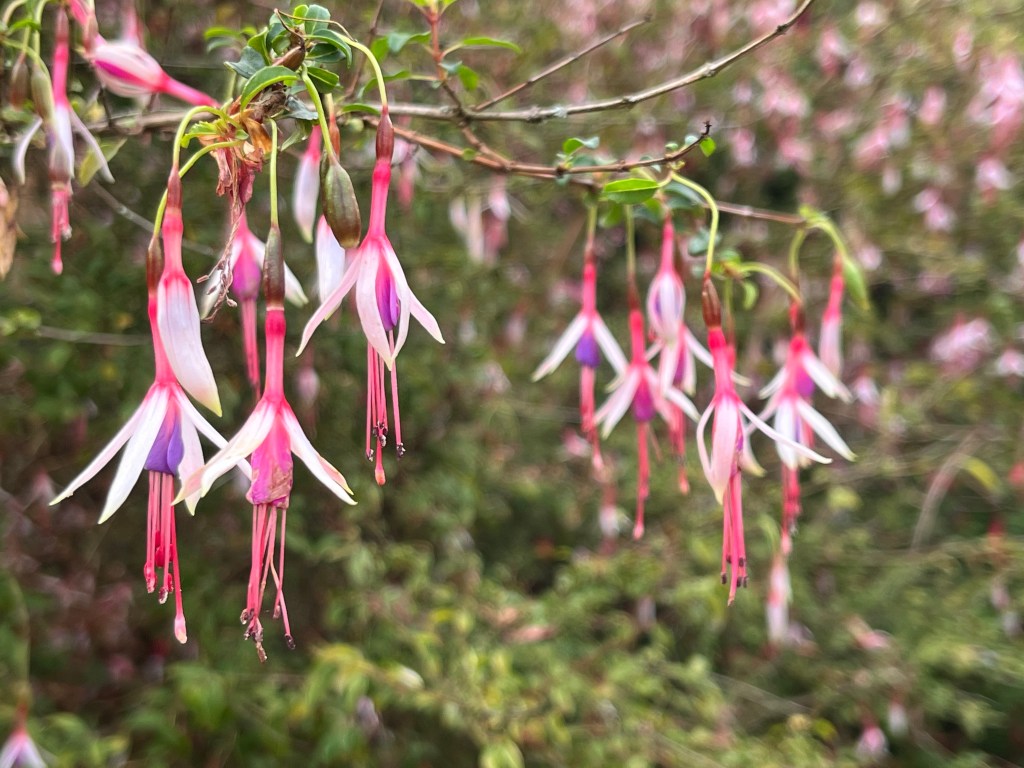
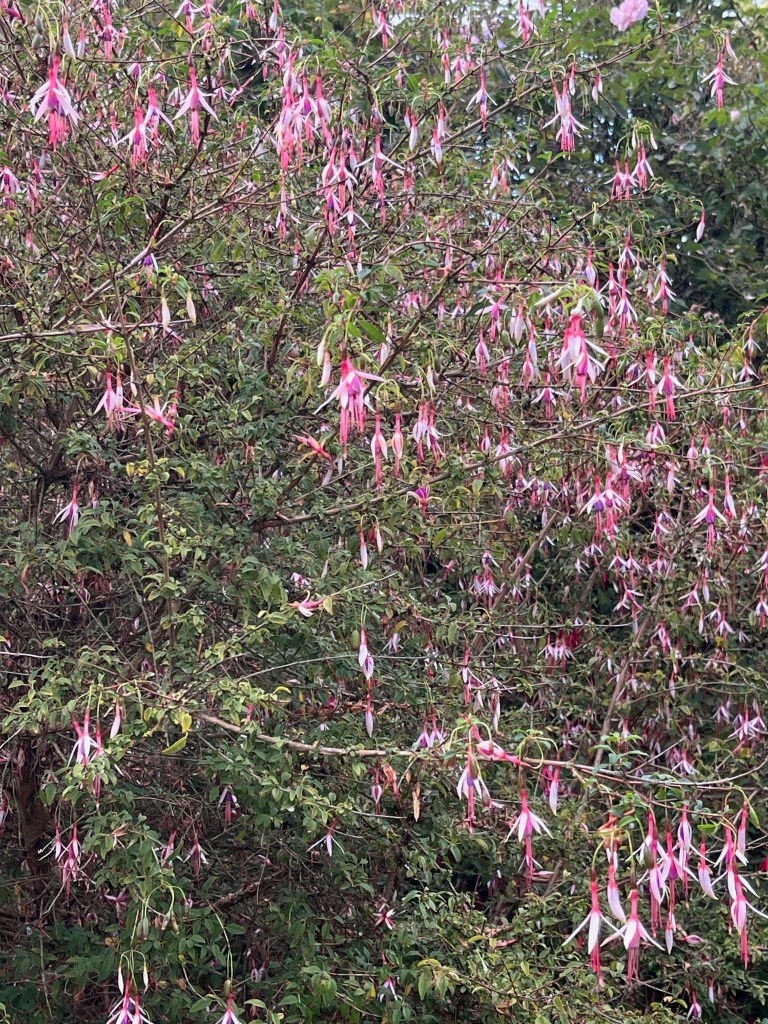
All elements of the flower are narrow, rather like the species, from the narrow pink tube opening into off-white linear sepals to the narrow blue/violet petals fading to magenta, with long protruding stamens and stigma. The profusion of flower makes up for its rather subdued colour in the landscape.
‘Hawkshead‘ (AGM 2002) is another fuchsia that comes through winter with only minor twig damage, and its myriad effective white flowers show up in the garden scene for weeks, well into the winter. It makes a shrub of about 5/6ft.
But perhaps the star of the RHS AGM (1999-2005) was ‘Baby Blue Eyes’ (AGM 2004). It, too, comes through winters with minor twig damage, is easily cleaned up with a pair of secateurs, and offers a vivid mass of bright pink sepals and blue/violet petals into November. ‘Baby Blue Eyes’ is perhaps the most colourful and free flowering hardy fuchsia of all, lighting up any corner of the garden in sun or shade. It is a first class flowering shrub with more and brighter flowers than the healthy and easy semi-double scarlet and bluish/violet ‘Margaret’ – which is also vigorous and hardy, growing to 5ft in a season if pruned to the ground.


The veteran ‘Mrs Popple’ (AGM 1993) introduced in 1900, is similar to the ancient (1830) ‘Riccartonii‘ (AGM 1993) but with flowers a darker violet/purple and about twice the size, her skirts a rich dark violet with stamens protruding prominently. She grows to about 4ft.

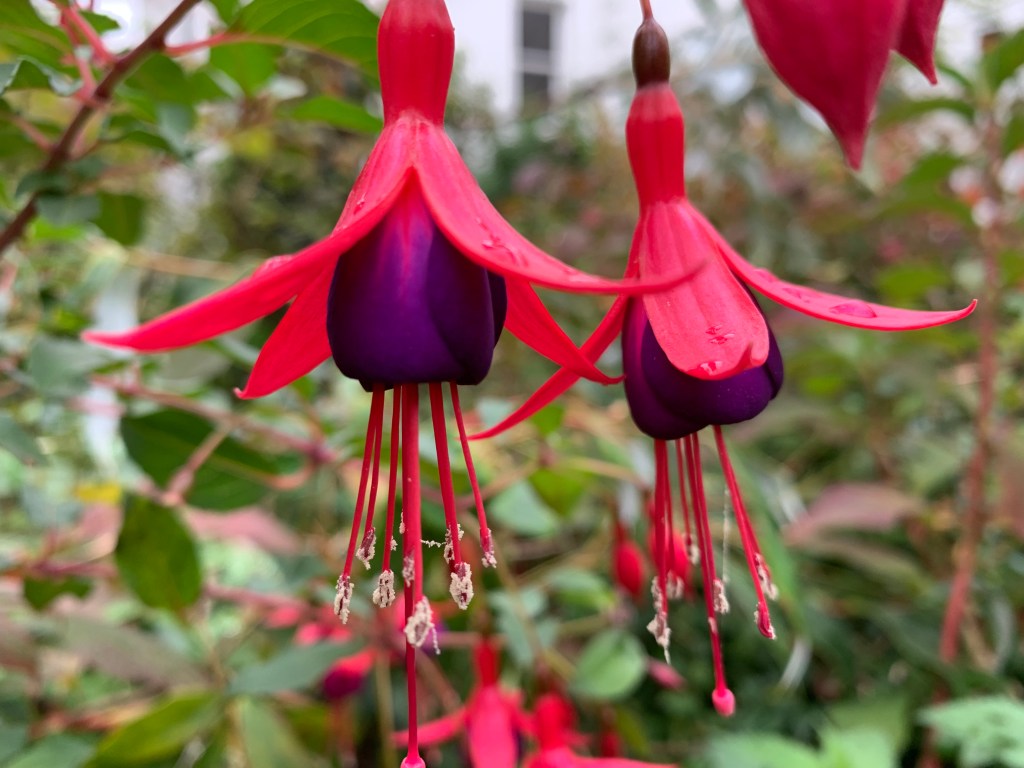

I’ve seen ‘Riccartonii’ making large bushes up to 5/6ft and as much across along the coast, and near old abandoned cottages in the West country, where it continues to thrive unattended for decades. It can make a strong and effective flowering shrub, and is sometimes used as hedges, clipped but still flowering. It is perhaps the classical fuchsia’s fuchsia of popular imagination, with its mixture of red and violet/purple.
A plant of similar colouring, but if anything a more striking dark blue/violet, and with notably semi-double skirts, is ‘Army Nurse’ (AGM 1993), introduced just after the war and appropriately named for its red and blue colours (blue skirt and red cape). It is a less vigorous, and a smaller but upright plant, at its best later in the summer.
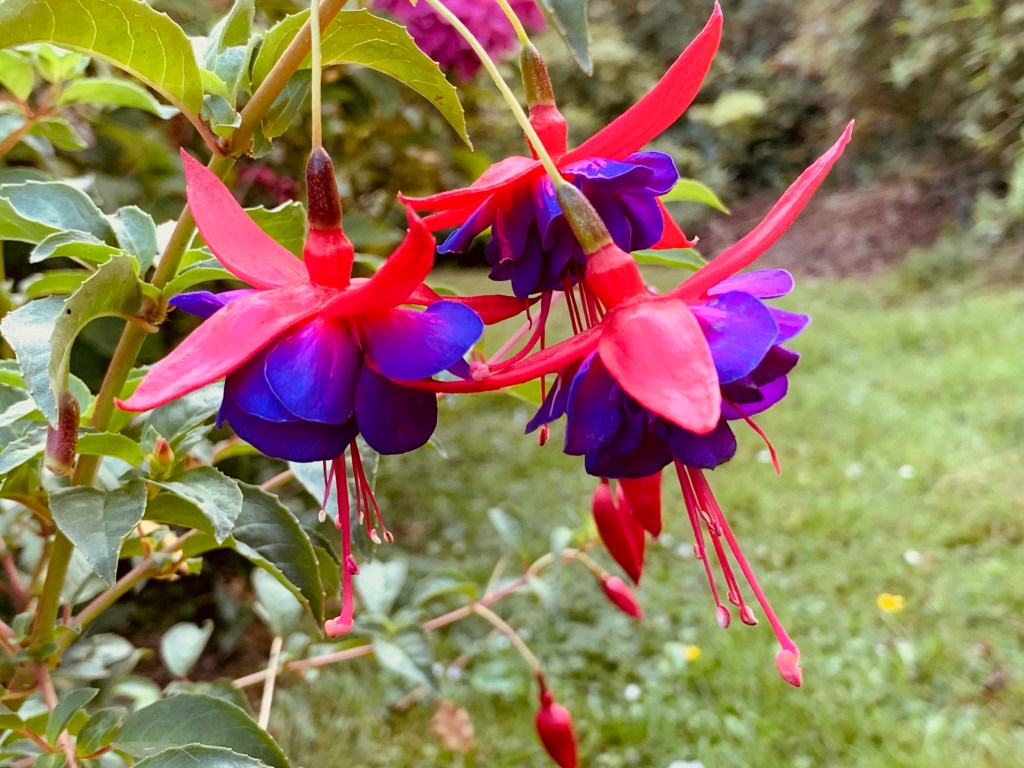
In contrast to these ‘traditionally ‘ coloured fuchsias is a medium-sized spreading plant from 1871 called ‘Rose of Castile Improved’ (AGM 2002). This has large flowers of an unusual colour – with the palest pink tube, and pink-stained white sepals crowning petals of a reddish/violet, fading to a paler reddish/purple. I have propagated this from a plant in my grandmother’s garden over decades, and it holds its vigour well, and performs every year in spite of being cut to the ground in winter. Its survival in lists for over 150 years is the best testimony to its distinctive quality.
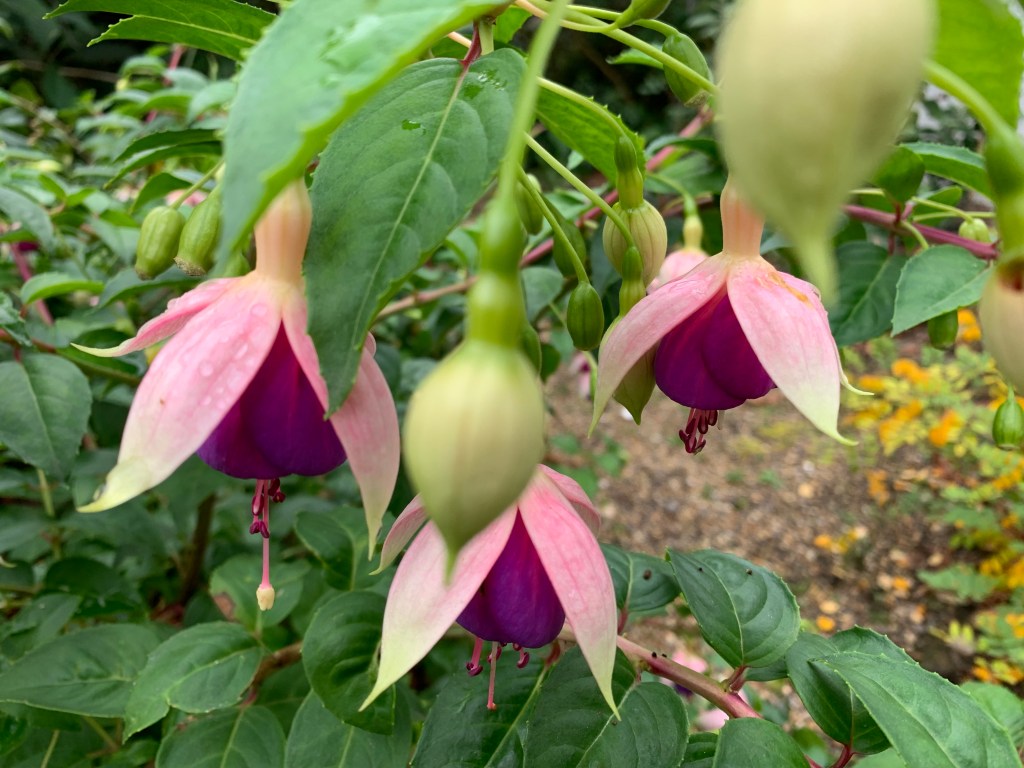
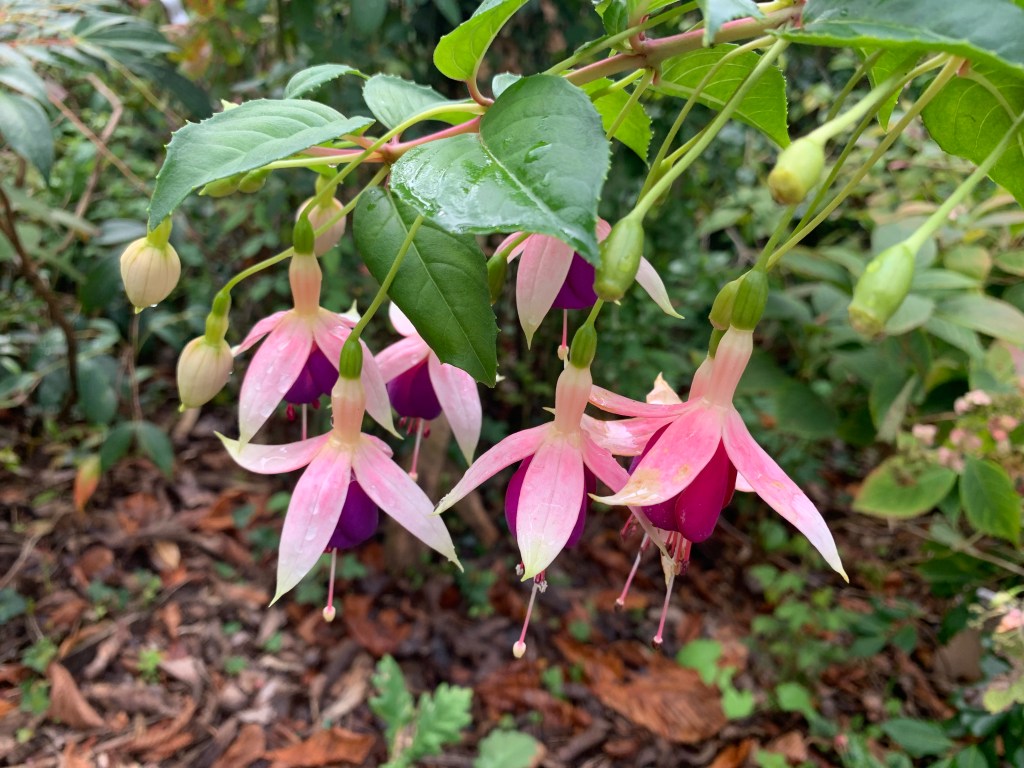
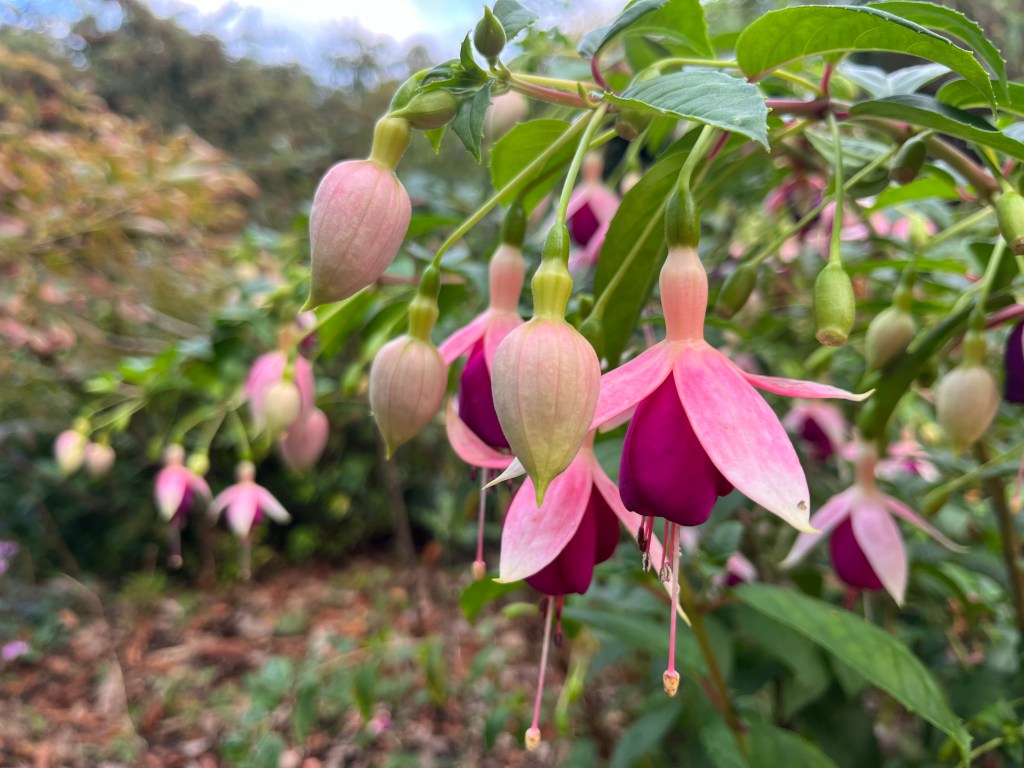
The closest to blue we grow here is ‘Sarah Delta‘, which has large flowers scattered freely on a 4ft spreading bush. The white sepals are faintly brushed with pink and reflex strongly to promote the untidy semi-double skirt that’s a pleasing blue violet with a white stain spreading from the base, red stamens and a white pistil. At dusk, in a soft evening light, they appear a true blue. They fade to a mauve/pink quite quickly in strong sun. It is a soft, fast growing plant that continues to produce buds and flowers all along the shoots until the November weather closes in.
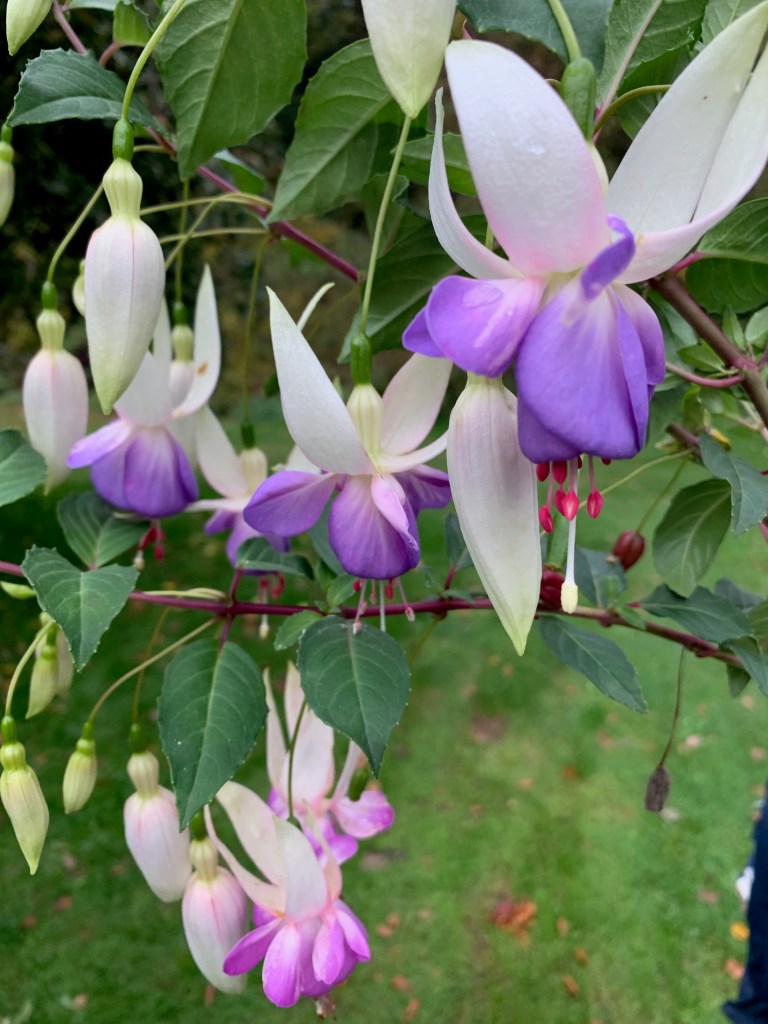
‘David’ (AGM 2004) is close to the species in flower size and colour, and in garden effect, but the petals and sepals are a little shorter and broader. Here it grows and flowers freely in part shade, making a bush about 5x5ft and has never been cut by frost. It gained an AGM after trial. It makes a good flowering shrub.

Also with an AGM after trial is ‘Saturnus’ (AGM 2004). This is usually cut to the ground by frost, but is quick to recover in spring to make a low , multishoot , upright, twiggy sub-shrub flowering freely for many weeks, with a skirt of soft mauve/violet capped by strongly reflexing turkey red sepals. It is useful where space is limited and associates well with Japanese azaleas or small hydrangea serratas. A Chris Lane favourite.

The only pest to have significant impact on fuchsias at White House Farm is the capsid bug: this eats young buds and shoots, preventing flowering and distorting growth. A couple of timely applications of any systemic insecticide soon solves this problem.
Fuchsias are among the easiest plants to propagate, either from summer cuttings under plastic or mist, or from bits of hard twigs simply stuck in the soil. Indeed a few stout twigs may well root in a glass of water on a warm but shady windowsill.
We intend to plant more hardy fuchsias. We find them a versatile, easygoing, generous group of plants that provide colour and form throughout the summer and extend their colourful bounty deep into autumn, when most flowering plants are hunkering down for the dark anonymity of winter.
 White House Farm Garden and Arboretum
I rather suspect that what is masquerading as F. Dark Eyes may be F. Dying Embers.
Peregrine Massey
http://www.boldshaves.co.uk
Sent from Outlook for iOShttps://aka.ms/o0ukef
LikeLike
Could the mystery fuchsia be F. ‘Dying Embers’ ?
LikeLike