
Only a handful of the more than 750 species of Indigofera (mainly tropical and subtropical) will survive in the open in the UK, and of these only a small proportion are worth growing as ornamentals. But those that are worthwhile are excellent shrubs for any garden, flowering for months through summer into autumn if given the right spot – for the most part, in a warm, sheltered situation. Their performance through the hot, dry summer of 2025 gives ample testimony of their robustness and dependability, with a few still flowering at the end of October, holding out against heavy rain, gusty wind and cold wet lengthening hours of darkness. They will grow in any soil, but are completely intolerant of winter wet, demanding free drainage.
With a couple of exceptions, both species and cultivars in UK gardens are for the most part small shrubs or sub-shrubs, most with dainty pinnate leaves and the flowers appearing from the leaf axils along the shoots as they grow, providing continuous flowering through summer. They are quite easy to propagate from conventional summer cuttings, though care must be taken to keep them dry over their first winter, and it is best to leave them undisturbed in the cuttings tray.
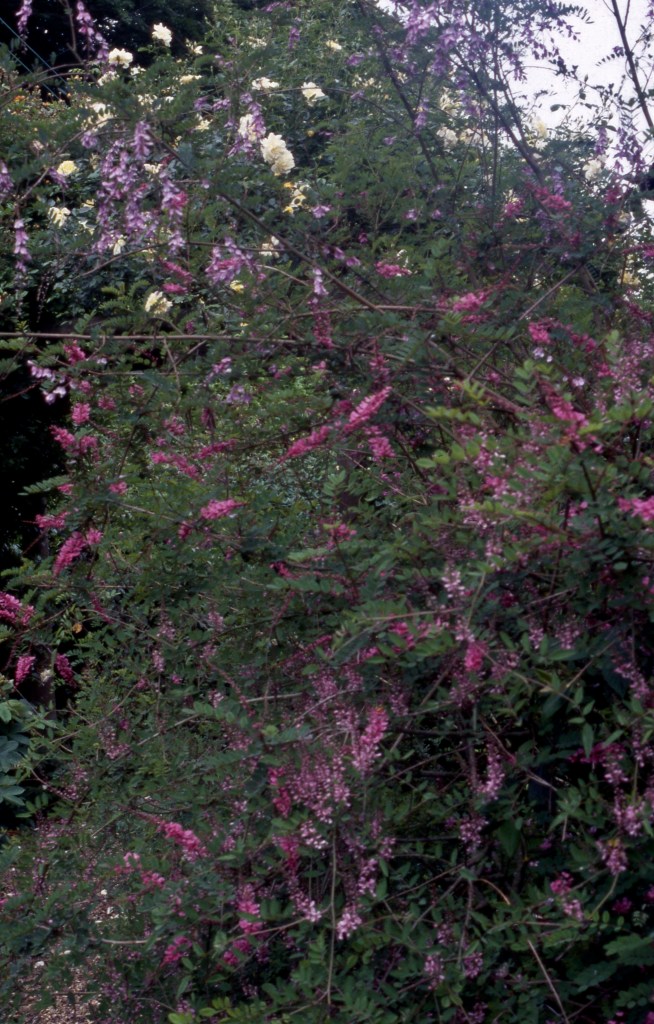
One exception to this small shrub habit is a vigorous tall upright shrub or small tree with long arching branches that is rarely seen. Indigofera pendula seems rather fastidious as to position and has failed to establish in a number of gardens, probably due to exposure. In the wild in W. Yunnan it grows in light woodland or scrub, scrambling over and through evergreens and rhododendrons, its long pendulous flowers hanging daintily through its host’s branches. In cultivation it does best in a similar scandent situation of part shade and effective shelter from wind. Its racemes go on extending with the upper flowers dropping away or seed forming before the growing tip flowers have opened. I have measured one such raceme in the autumn at 22 inches, with the final 6 inches still bearing flowers in October. In general effect the flowers are a pale lilac, with a deeper pink within, and a greyish tone on the outside of the wings – but effective in good clusters.

I. pendula performed well in the 2011 RHS AGM trial at Wisley, and a White House Farm seedling gained an AGM under the cultivar name of ‘Shangri-La’. The late Peter Catt produced a large batch for sale, but few, if any, now seem to have survived, including my own. My existing plant, a sister seedling, is now 20 years old and a small tree, growing rather stiffly and untidily to 15ft, with pendulous branchlets. It is sited near a South wall, but in part shade. It breaks new flowering shoots from the old wood, so there is always plenty going on. It is well worth growing if you can find the right spot.
For me star of the RHS AGM trial was Indigofera howellii from northern China, still my first choice – and its correct name. It was grown initially as I. potaninii, then as I. subverticillata and you might still find it under these names in the occasional old garden. It makes a tidy shrub, bushy and upright to about 2 metres. It was introduced by George Forrest, raised by Reginald Cory (of Cory Cup fame, an award given every year to a hybridiser) who gave it to Charles Eley in Suffolk who then passed it around. Hilliers listed it in 1925, but most plants in circulation seem to have spread as a clone from Hergest, and it appears its distribution was more or less confined to that single source. So for a flowering shrub of the first rank, it has a messy history in cultivation, and has never really rooted firmly in the trade.
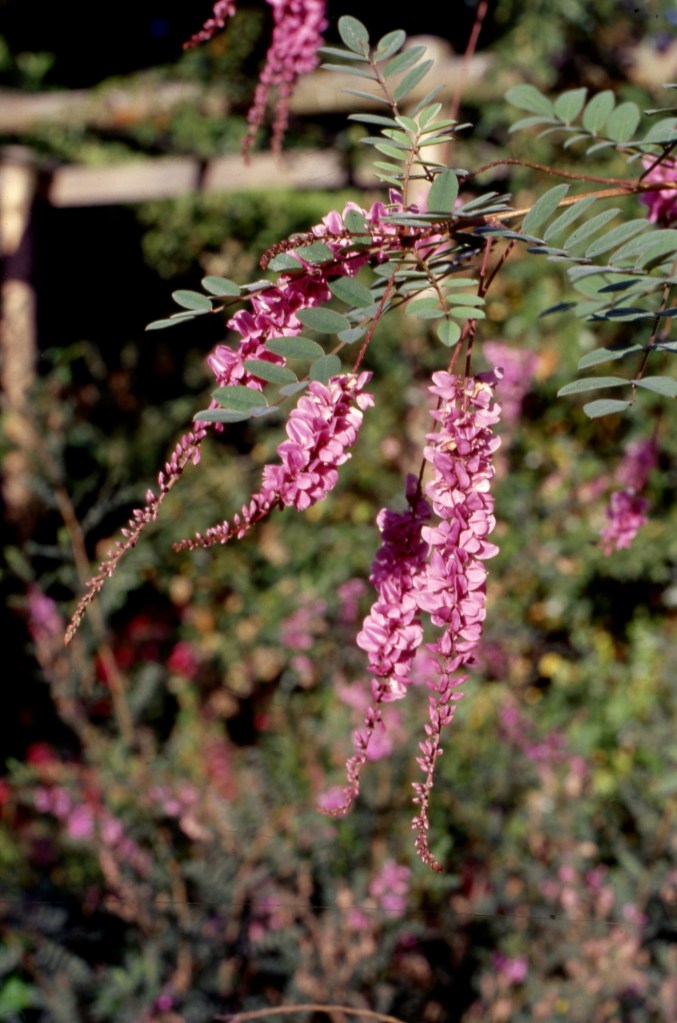
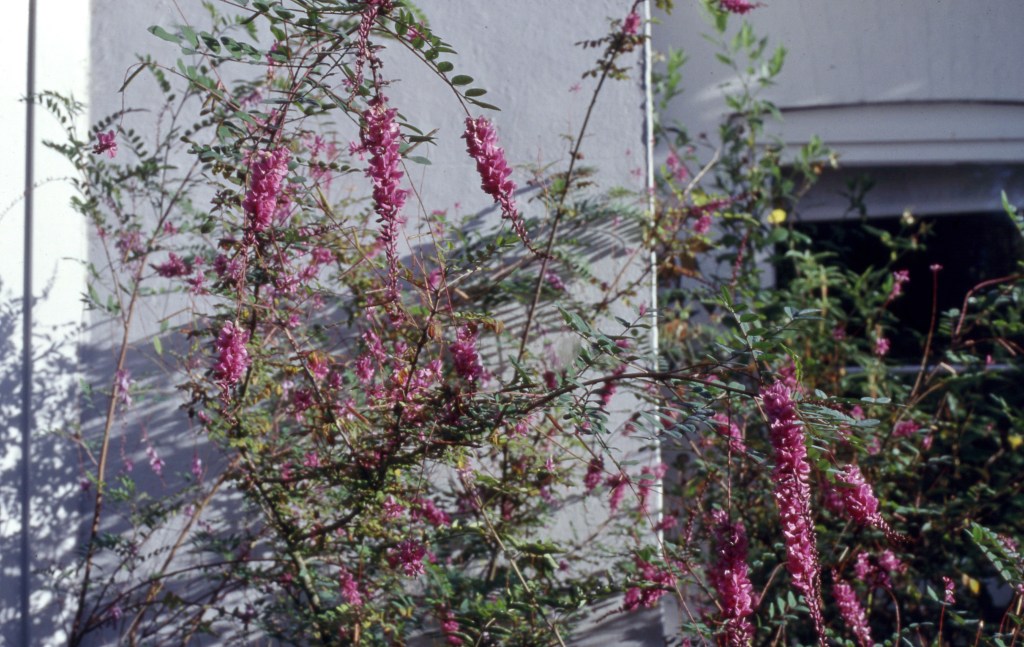
The flowers are in close-set long racemes, held horizontally or semi-pendulous, a deep crimson pink and the brightest in the genus; and freely produced from June to September. Chris Sanders is quoted at the trial ‘Always been an outstanding plant’. To receive an AGM it was felt necessary to give it a clonal name (plants from seed could vary) so the WHF plant in the trial (ex Hergest) was selected for distribution as Indigofera howellii ‘Reginald Cory’.
Indigofera ‘Claret Cascade’ is a howellii x pendula hybrid, and a close intermediate between the two species, according to Dr Brian Schrire, who was the trial’s botanical advisor and whose taxonomic input was essential to its ultimate value. It was raised by Tom Wood at Oakover nursery from WHF seed, where the two species are growing in close proximity. It was first known in the trade as a dark form of pendula. The flower racemes are angled, but so densely packed with florets that they are often weighed down to the perpendicular, and close to pendula in style, but deeper and richer in colour, a dark purplish red. It makes a tidy, bushy shrub to about 2m.
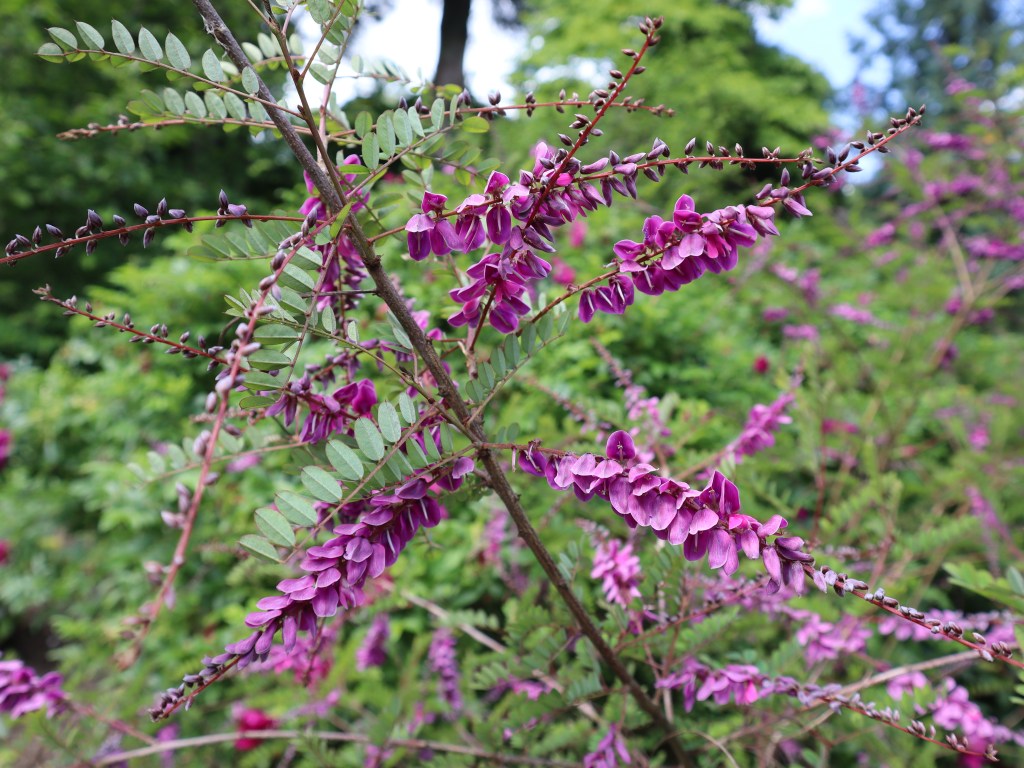
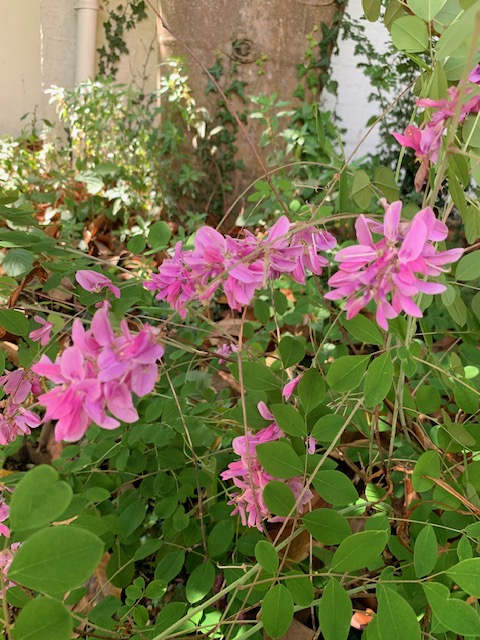
Indigofera kirilowii is an altogether smaller plant, with a dense, bushy habit, sprawling to a height of about 0.75m and as much across, with large, broader leaflets that are a showy yellow in autumn over a long period. Flowers are a bright rich pink, the largest individual florets in the genus, produced not only from the old wood, but also in a second flush from the same year’s young growth, which gives it exceptional continuity. A useful front of border plant with interest and colour over several months. And a useful ‘filler’ of small spaces anywhere in the garden.
There is a little seen white form – var alba – identical to the type, including its bright autumn yellow leaves, except that its flowers are white. Both the species and its white form are happy in any soil and best with plenty of sun and altogether undemanding plants needing little attention for a good return, and thus to be warmly recommended.
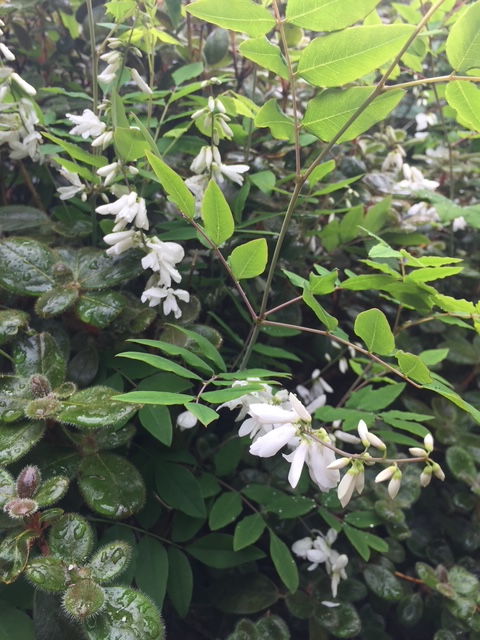

There is also a white form of another species – Indigofera fortunei – and for those readers interested in the detail of taxonomy, it differs from I. kirilowii in that it has greater vigour, and smaller flowers, with rounder rather than elliptical standards (the floral element behind the wings and the keel), and shorter racemes. Leaflets are thicker in texture, more overlapping and with a less acute apex. It is less hardy, originating from S. and S.E. China, while I. kirilowii hails from the tougher climes of E. and N.E. Korea and Japan.
Perhaps the ‘cleanest’ pink in colour is Indigofera amblyantha. Michael Hayworth-Booth of hydrangea fame maintained there was no such colour as what we perceive as ’true’ pink, but the closest was in fact a white background uniformly covered with myriad red dots – the depth of colour dependent on the concentration of the dots, rather like the pixels in an old newspaper black and white picture. Be that as it may, in a good form, I. amblyantha is an attractive almost salmon pink, but the flowers, though borne over a long period, are too scattered and too small to make much of an impact in the garden, unless carefully sited. Plant it where you pass it closely every day and enjoy a certain individual delicate beauty; or at a distance, looking into the light. With its ‘see-through’ habit, it looks like a pale pink cloud, with a nice small tree appearance. It is perfect for shading Japanese azaleas and Hydrangea serrata, as root competition is minimal with its downward-thrusting thong-like roots. The flowers are variable in quality from seed – so propagate via cuttings.

Another pleasing pink, also rarely seen, possibly because it needs some attention (frost protection and watering until established) and is not the hardiest of the ‘hardy’ species, is Indigofera decora. To be at is best, about a foot high, with large bright pink bicoloured flowers, it needs sun, warmth and perfect drainage. I saw it in suburban Sydney in a narrow strip of a border a bit over a foot wide, running alongside a path from street gate to house and flanked by a baking low wall. It had suckered for years and taken over the ground completely, covered in flower, a tight monoculture. What a picture! Here at WHF it is less generous, but grows and flowers.

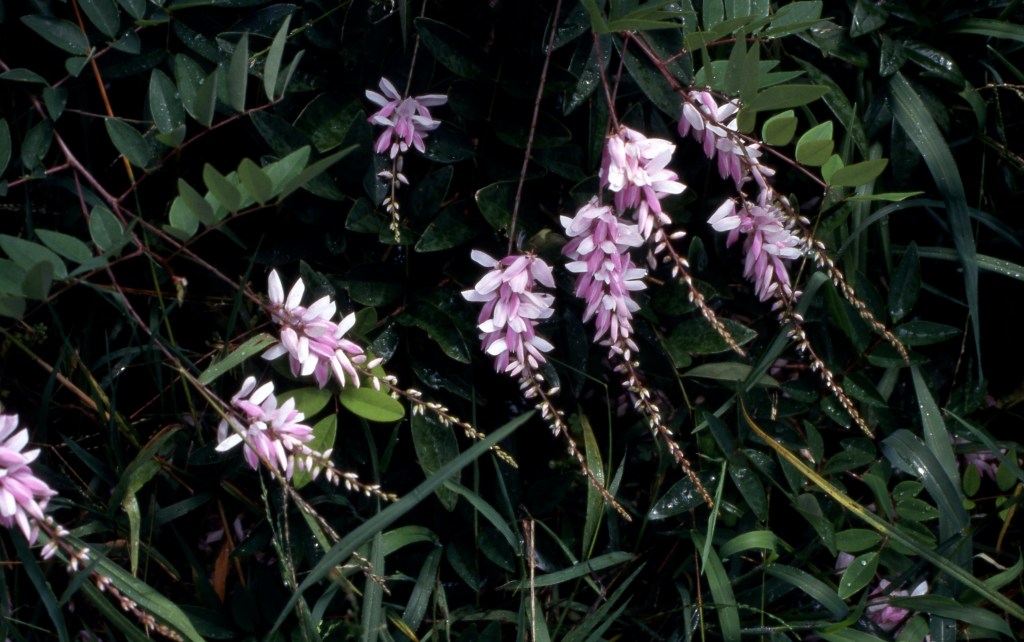
I have a plant in my conservatory that flowers very well (above) and one at the base of a south wall, outside, suckering gently along with Mahonia fortunei, but blooming less conspicuously. It is full of charm and a lovely colour. Perhaps the best way of growing it is in a large pot where it can be enjoyed all summer and brought in for the winter. It is worth the trouble.
The indigofera most frequently seen both in gardens and in its natural habitat in the Himalaya, is Indigofera heterantha. It makes a strong upright bush up to about 2m, and because it flowers on new wood it benefits from being trimmed. It has a relatively compact, blunt flower raceme, and small, neat, elegant leaves. It is the hardiest species in the UK and thus the most widely available in nurseries. But caveat emptor, as this species is very variable from seed, so you should take care to acquire a good form rather than any old dog. An excellent form from the Bulk Nursery in Boskoop was awarded the AGM. The flowers are a bright purplish pink and freely produced throughout the summer. If it is reliability you are looking for, this is your plant.
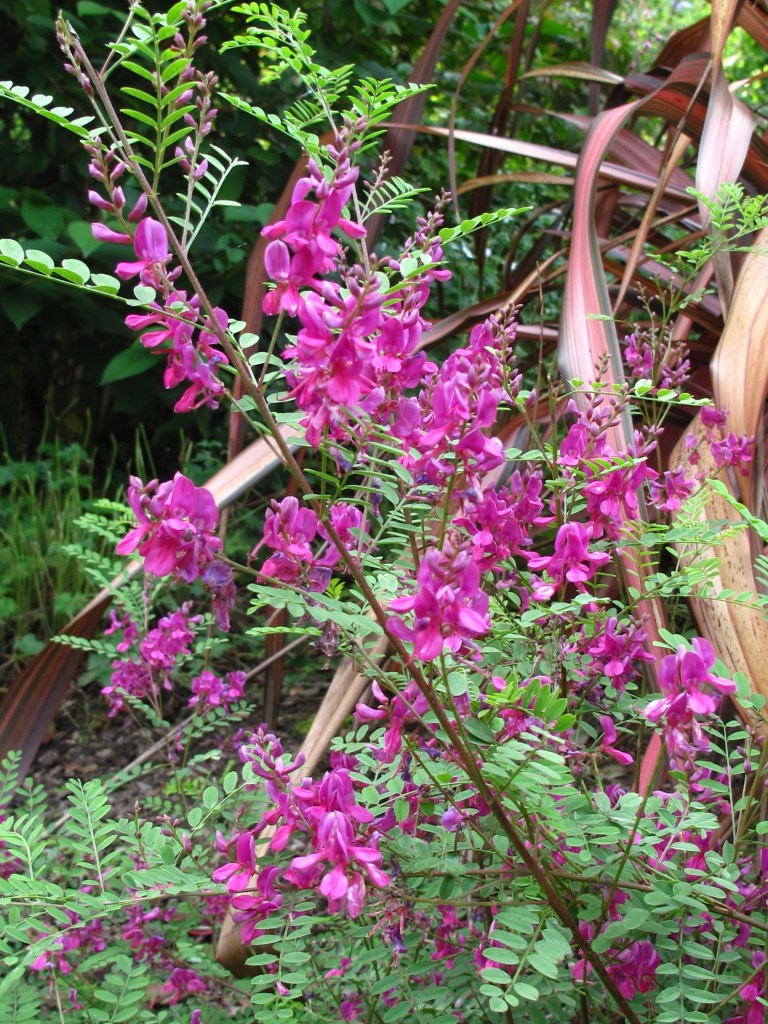
There are one or two other species worthy of note. Indigofera himalayensis in its cultivar named form of ‘Silk Road’ has pretty foliage, but with me is not a generous plant with its flowers: it flowers early in May, with no repeat flowering. My plant here for 6 years in part shade has failed to impress. Perhaps part shade has an influence.
Jack Aldridge tells us that there is an excellent form of I. himalayensis, rarely seen, and known as I. dielsiana. It is the first indigofera to flower, in early to late spring, and develops into a lovely vase shape. Brian Schrire eulogises two old plants near Jermyns House at Hilliers which reached 2m high and 3m wide “and what a sight they were in full go”. Jack is equally enthralled by a plant he saw at Stone House Cottage and his photograph certainly reflects his excitement and he describes the overall effect as ‘fantastic’.
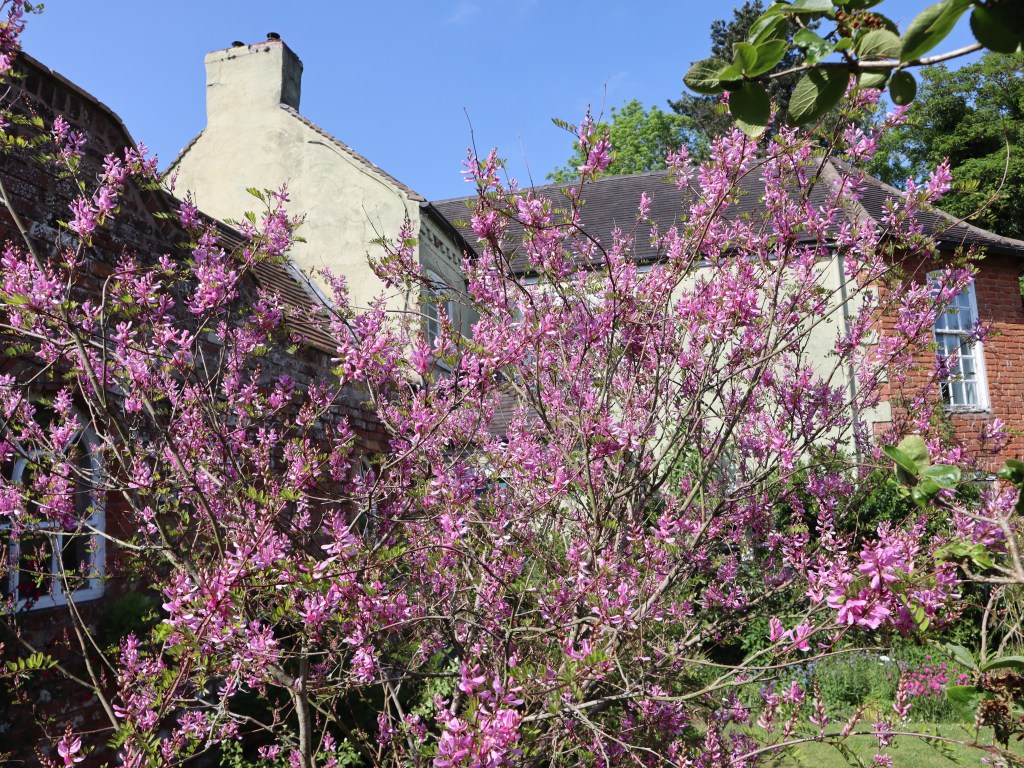
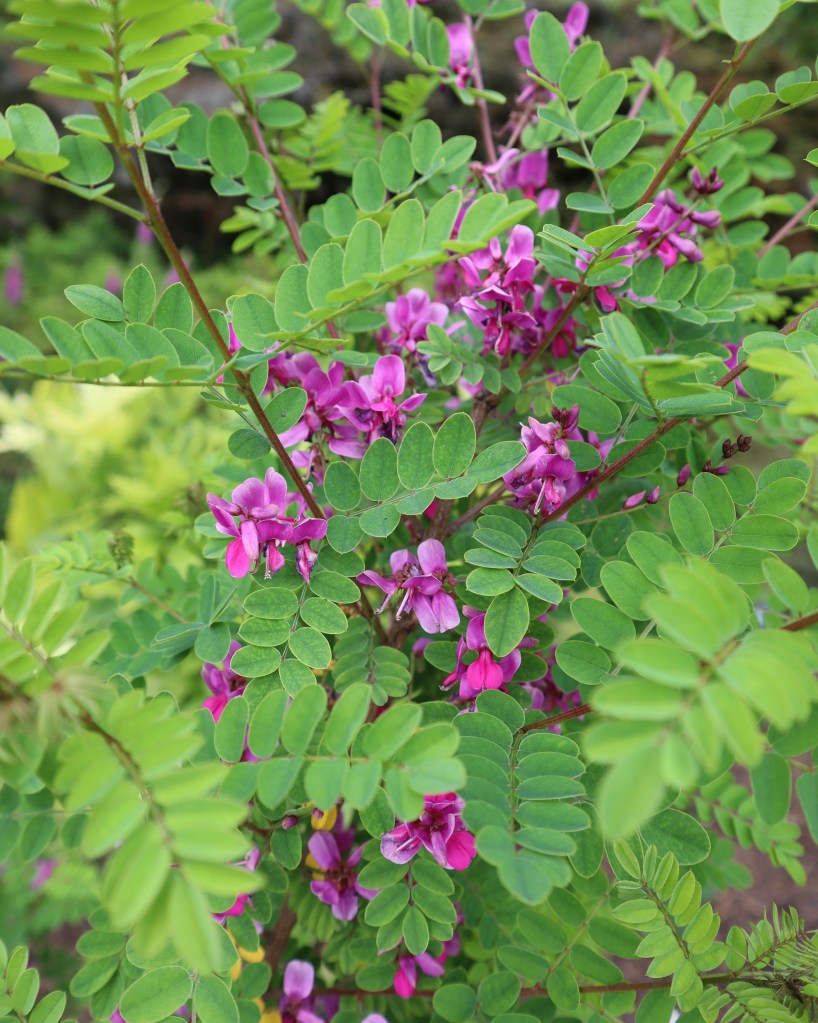
Indigofera hebepetala has the darkest flowers of all, a very distinctive deep pink with a rich crimson standard. The habit of the plant I grew was stiff and gawky, but the flowers at close quarters quite striking. I lost mine to honey fungus. A species I introduced from W. Yunnan, Indigofera hancockii, reached an AG, but failed to get the vital -M in the RHS AGM trial, but was thought by Chris Lane to be worth growing. It is certainly hardy, and a good foliage plant with a fresh look throughout the summer.
Maurice Foster
 White House Farm Garden and Arboretum
Lovely interesting email as always. Many thanks
Such great plants – we have a couple of 12year old Indigofera heterantha which have loved this year’s sunshine in the north of Scotland. Like Paulownia sps they break so late that there is no risk of them being got by late frost …. Clever plants that they are!
Panny Laing,
Relugas House
Forres
Moray IV36 2QL
http://www.logie.co.ukhttp://www.logie.co.uk/
LikeLike