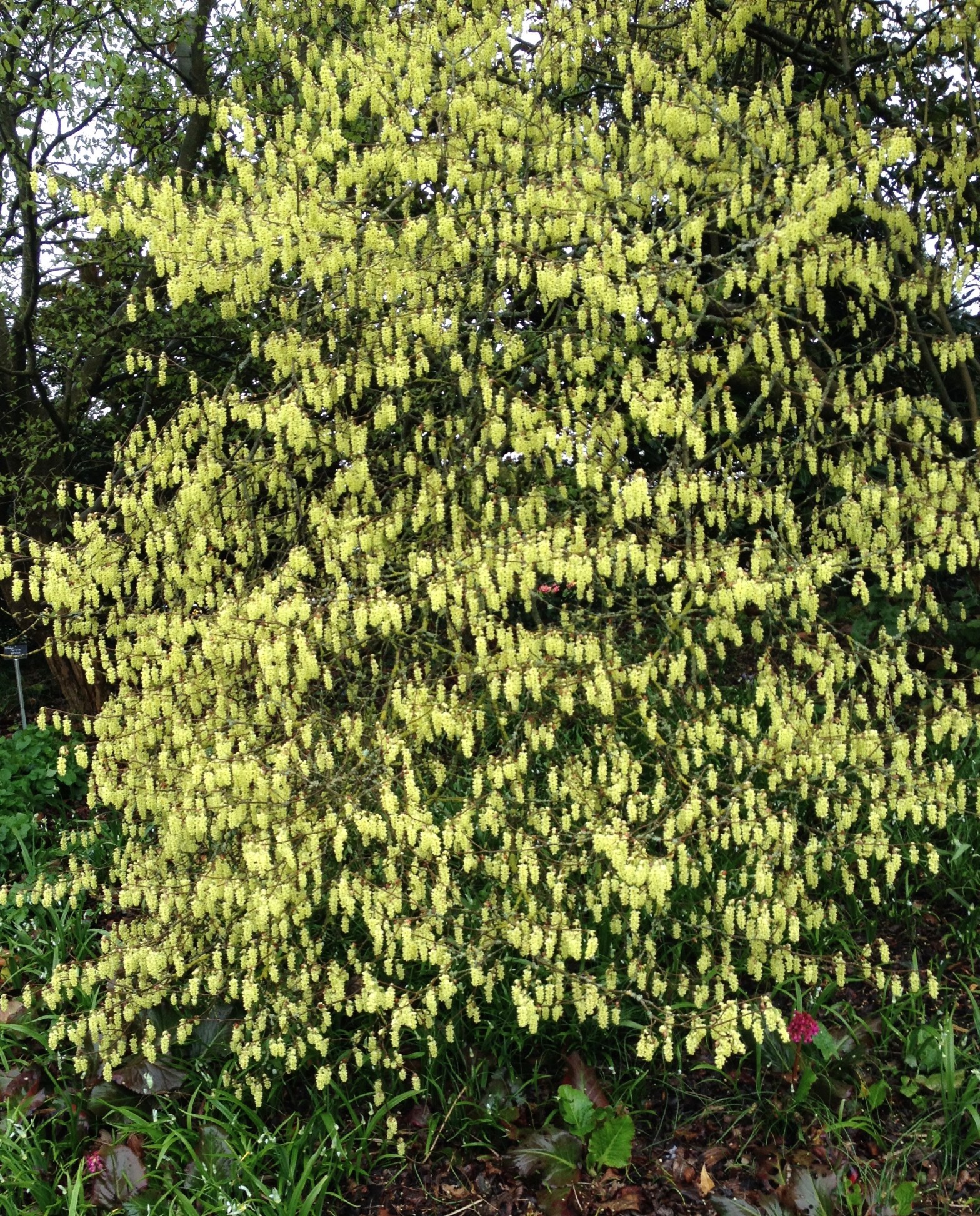
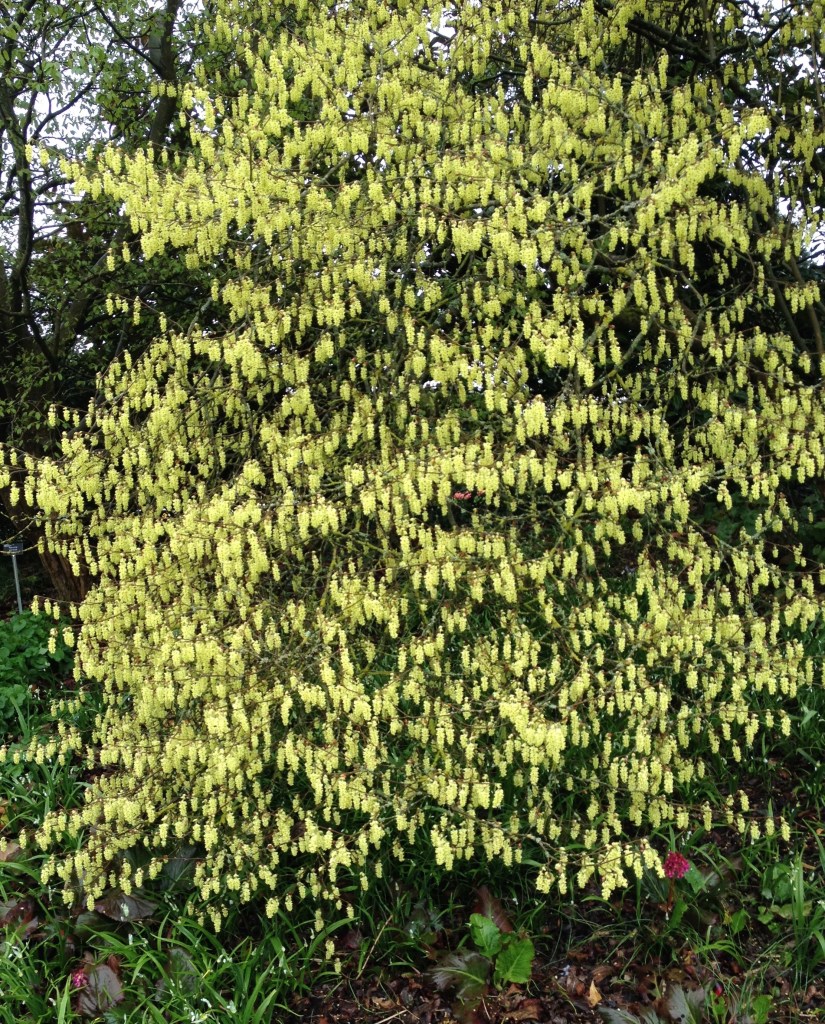
When I mentioned to Chris Sanders I planned to write a blog on Corylopsis, another genus that is vastly underappreciated and undervalued as a garden plant, he said ‘You’re a braver man than I am’. The taxonomy and nomenclature in Corylopsis is a constant source of discussion and debate, and too often so confusing it is difficult to pin down a name on a plant with absolute certainty: some species can be very hard to tell apart. Taxonomy is meant to make a name secure, so we know that we’re all talking about the same thing. However there is sometimes a gap between the botanists’ technical criteria for species definition, and gardeners’ often long held perception of comparative morphological differences – added to which collective long term historical usage is not easy to change. Will Mahonia ever be known by most people as Berberis in gardens?
However, I am happy to be brave, as I would never ever be without a Corylopsis in my garden: the genus is a wonderful breath of spring. Besides, this might even start an interesting discussion, and there may exist some phylogenetic DNA laboratory exploration of evolutionary relationships not yet published, to throw some light on where lines should be drawn. So please comment below if have anything to add.
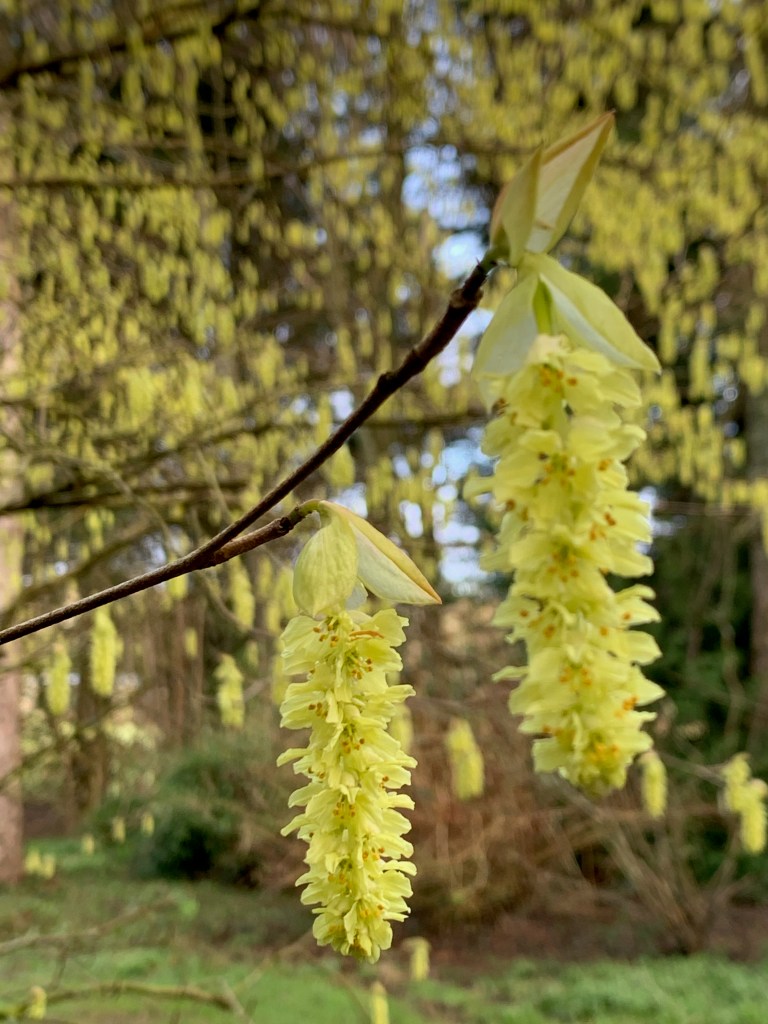
Only a few species of Corylopsis are usually recognised in cultivation, all from East Asia. Nodding or pendulous racemes of small funnel- or bell-shaped flowers, generally weatherproof, in various tones of yellow, typically add life to accompanying daffodils and other bulbs. Corylopsis can also complement companion plants with contrasting colours, like hellebores, pulmonaria, camellias and early rhododendrons. The yellow tones are altogether softer and more subtle than, for example, the often seen more strident forsythia.
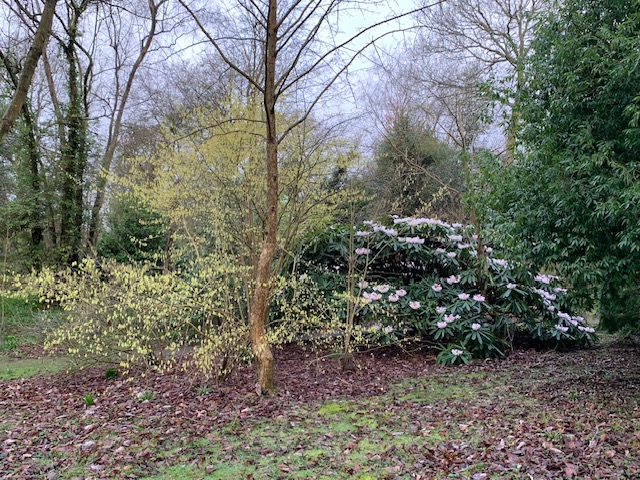
The name derives from its leaves, which resemble those of a Corylus: but the two genera are unrelated. Corylopsis is a member of the Hamamelideae, as easy to grow as Parrotias, and will thrive in any soil suitably improved with compost and kept well mulched to maintain a degree of moisture during the growing season. A sheltered sunny spot, or partial shade is best, with protection from cold winds: like all spring flowers, they will not enjoy complete exposure or a frost pocket. Given sympathetic siting, most are perfectly hardy.
Although the genus is largely one of multi-stemmed trees and spreading bushes that can take up considerable space, there is one unmistakeable species ideal for the small garden, rarely exceeding 2x2m. This is Corylopsis pauciflora AGM, a mound of soft primrose yellow, with clusters of up to 5 fragrant blooms. Bursting with light in the late March sunshine, when in bloom its emerging delicate leaves, tinted purply pink and deeply veined, are scarcely visible. It has been awarded the highest encomium for vase display, with a First Class Certificate (FCC) as well as an Award of Garden Merit (AGM). I walk past my plant daily and it provides me with a month of spring delight, growing through a twiggy plant of contrasting mauve/violet Rhododendron ‘Praecox’.
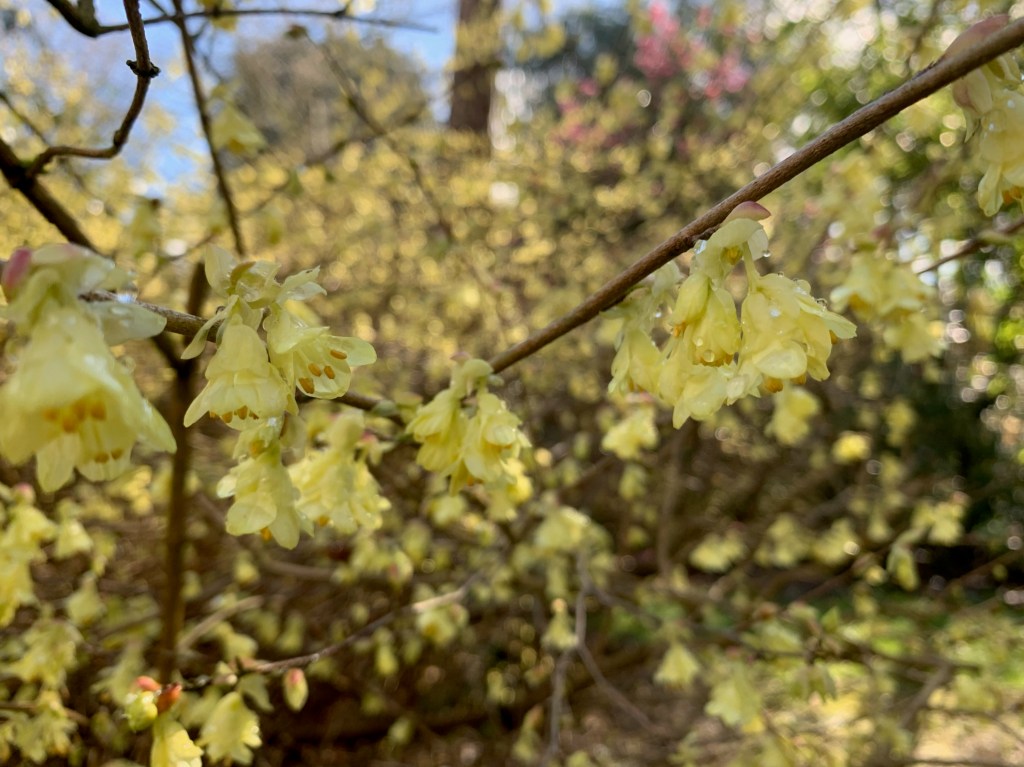
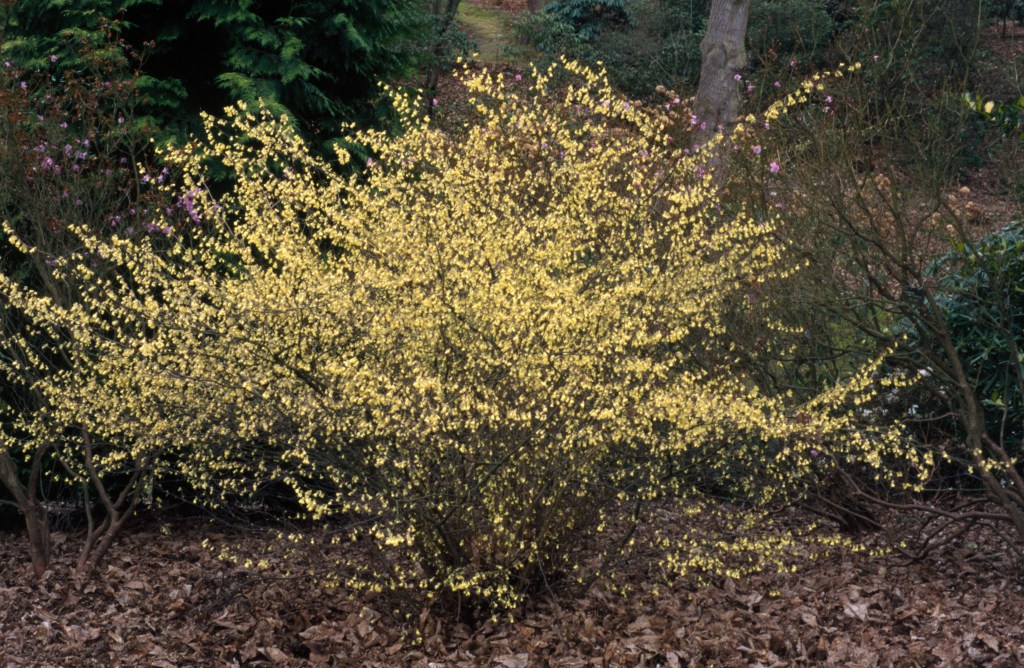
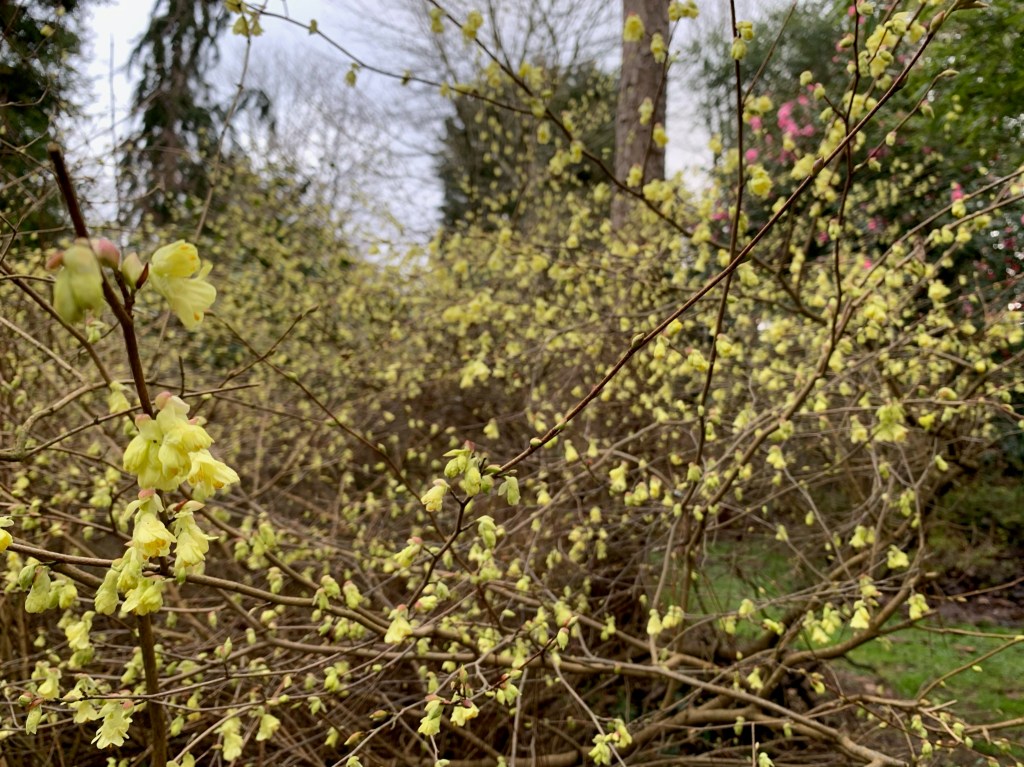
A second species of reasonably moderate size is Corylopsis spicata, a native of Japan and Korea. One of the first species to flower (in early March), it has a low spreading habit, usually no more than 2m in height and with stout twigs. The flowers are soft yellow with 7-10 flowers in the cluster and the protruding anthers are a conspicuous red/brown. I find it does not flower freely in shade, and evidently needs good light to perform well in the garden.

The best of the larger species and my first choice of all, is Corylopsis sinensis AGM. A Wilson introduction, and widespread in West and central China, this will grow to over 4m, upright at first and eventually spreading with a full crown. When ideally placed, and in good soil, it will thrust up cane-like shoots from the base to fill out the centre and flower freely. It usually bears pendulous clusters of some 20 blooms that crowd the slender twigs and fill the air with sunshine. The underside of the young shoots and tinted obovate leaves is pubescent, softly hairy along the veins and on the flowers. Corylopsis sinensis var calvescens, (syn. C. platypetala) is very similar in the garden landscape, differing in only being glabrous or pubescent along the veins on the leaf reverse. The epithet means ‘balding’.
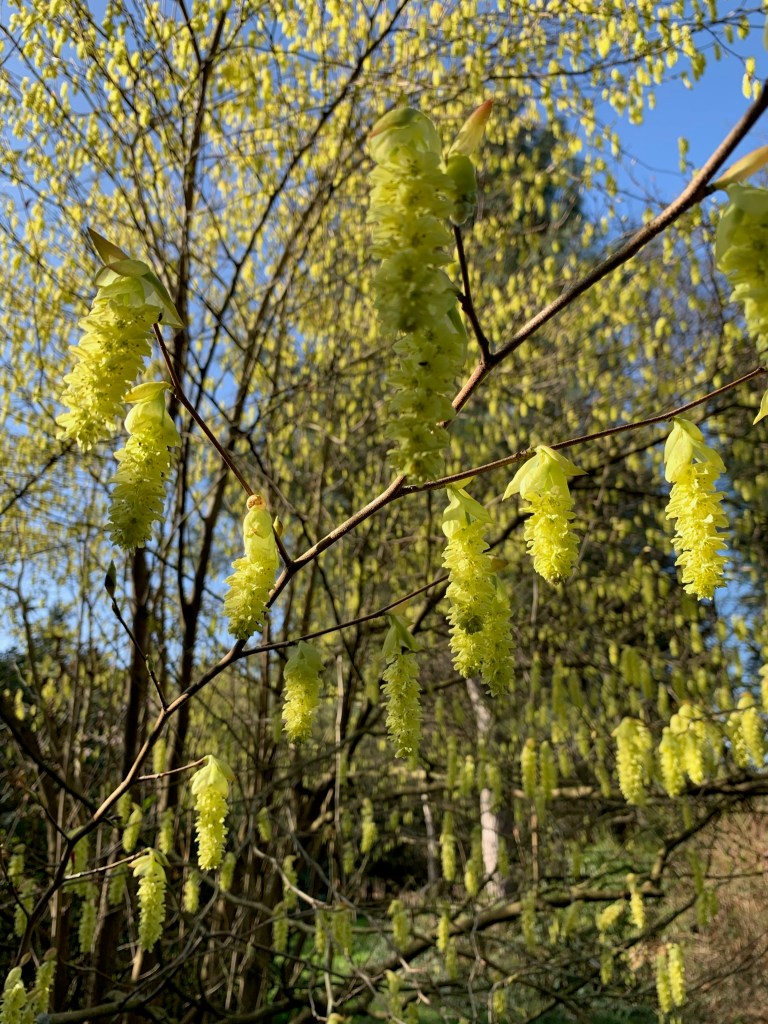
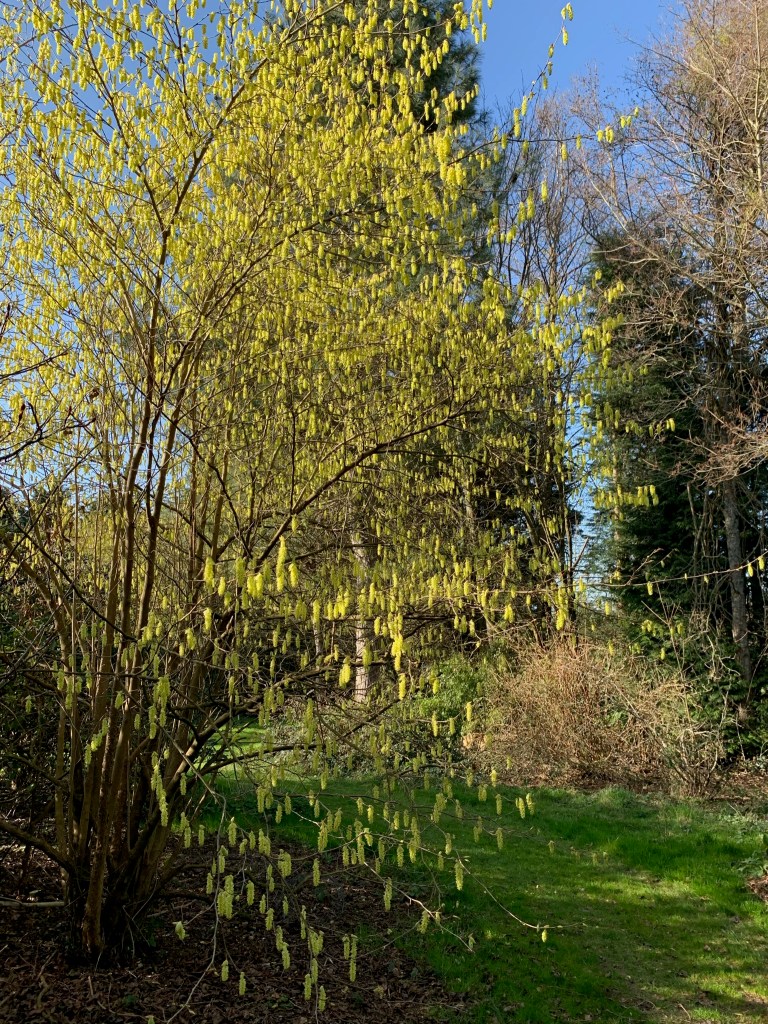
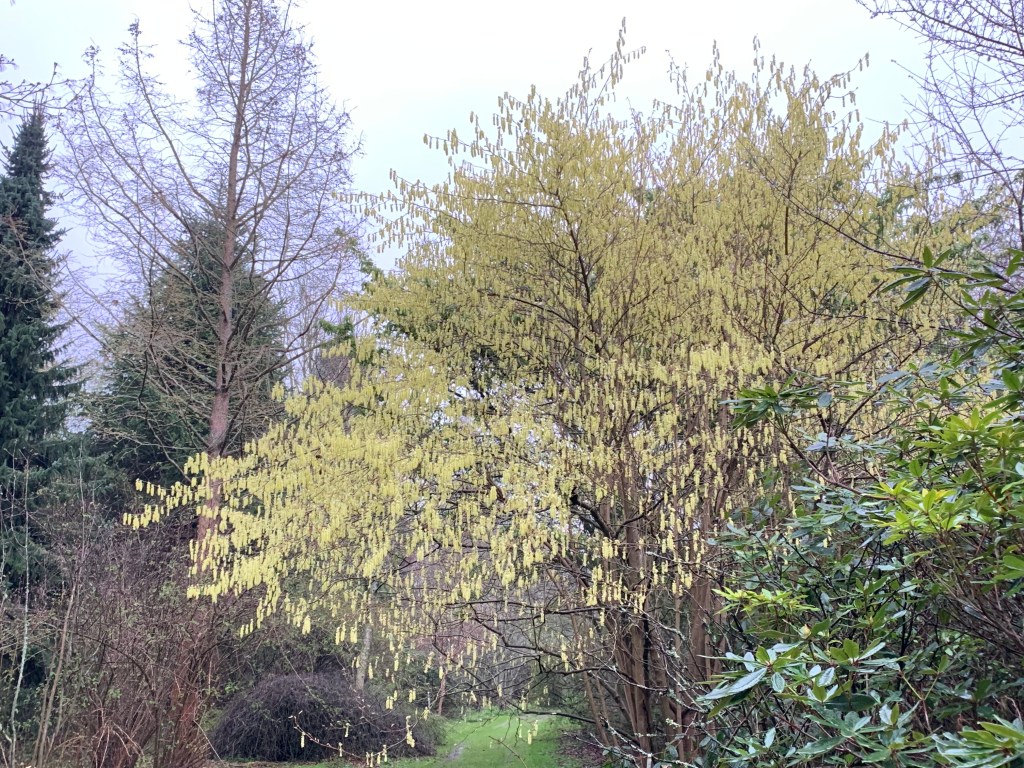
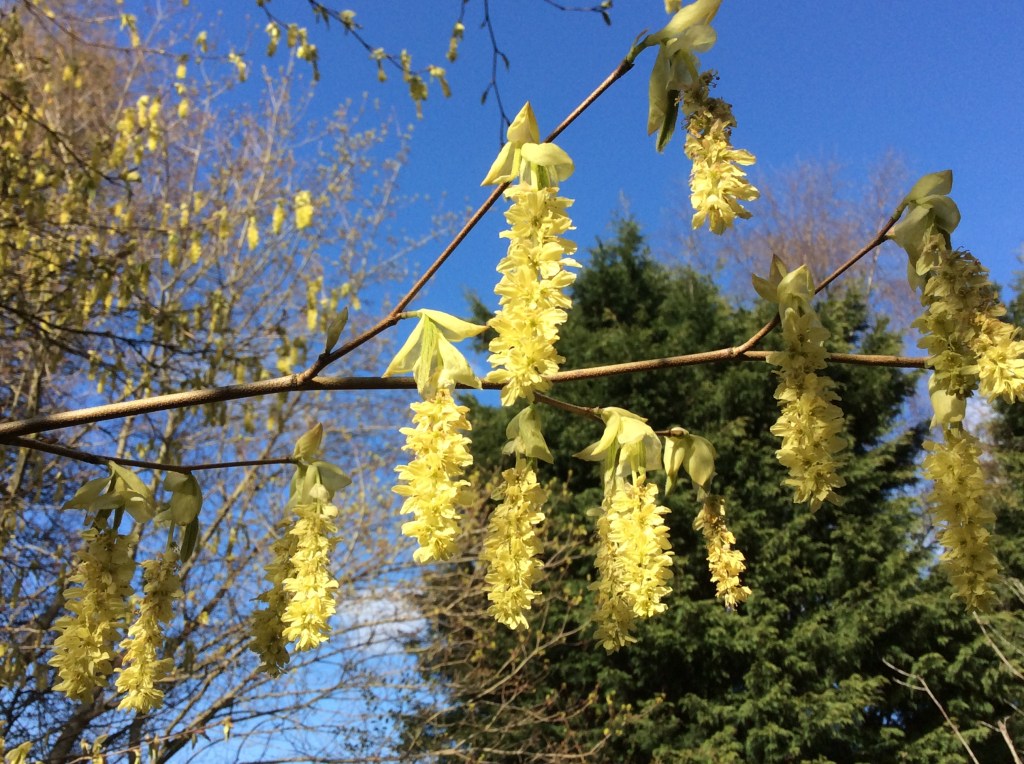
Another cultivated variety, with notably oblong leaves, glaucous below, is C. sinensis var veitchiana, distinguished by its protruding, conspicuous red anthers. ‘Sunk’ by some botanists into a variety of the type C. sinensis, but by others recognised as a distinct species, is C. sinensis var willmottiae. Although it might differ from C. sinensis with less pubescence and a variable leaf shape, it is equally showy in flower, and there is no noticeable difference in its impact in the garden, which is impressive. The young growth is often a reddish purple, to the point where a seedling at Hilliers was christened ‘Spring Purple’ with handsome plum purple young leaves.
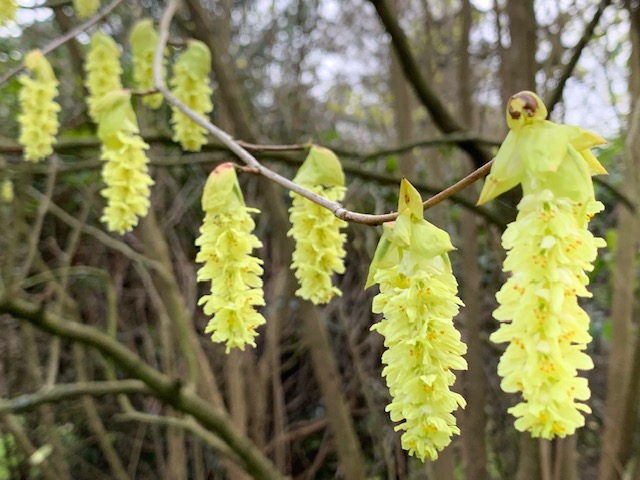
These variants of C. sinensis are all first class flowering shrubs, and I wonder whether, if many more diverse specimens were to be examined in the scattered wild populations, a wide variety of leaf shapes and intermediate forms of C. sinensis with varying characters might suggest they all fall within the natural variation of the type species. It all depends on where the line is drawn. Interestingly, an Arnold Arboretum study concluded ’ No significant differences in leaf shape were found in most of the cultivated taxa’.
Be that as it may, all these forms of C. sinensis have over the years been given RHS awards for vase exhibition for their flowers when shown to committees. In the garden they are all highly effective, both at close quarters and in the landscape. With the sun coming through them, they flood the early spring garden landscape with light.
Corylus glabrescens has been rather a disappointment with me. I only have the form ‘Chollippo’, a Ferris Miller collection in Korea. It makes a big spreading dense bush that wants to go sideways, and the ratio of flower to foliage is less generous, with the racemes shorter than those of C. sinensis and in comparison making less of a display. I have to admit, however, that my plant may be sited in too much shade to flower freely.
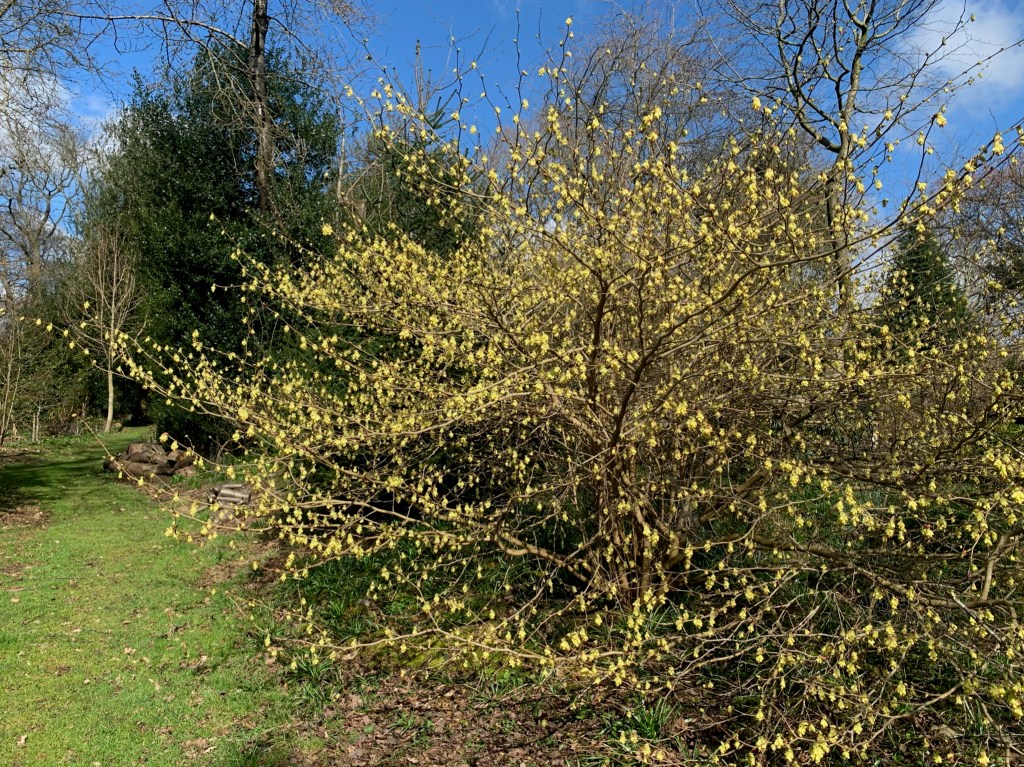
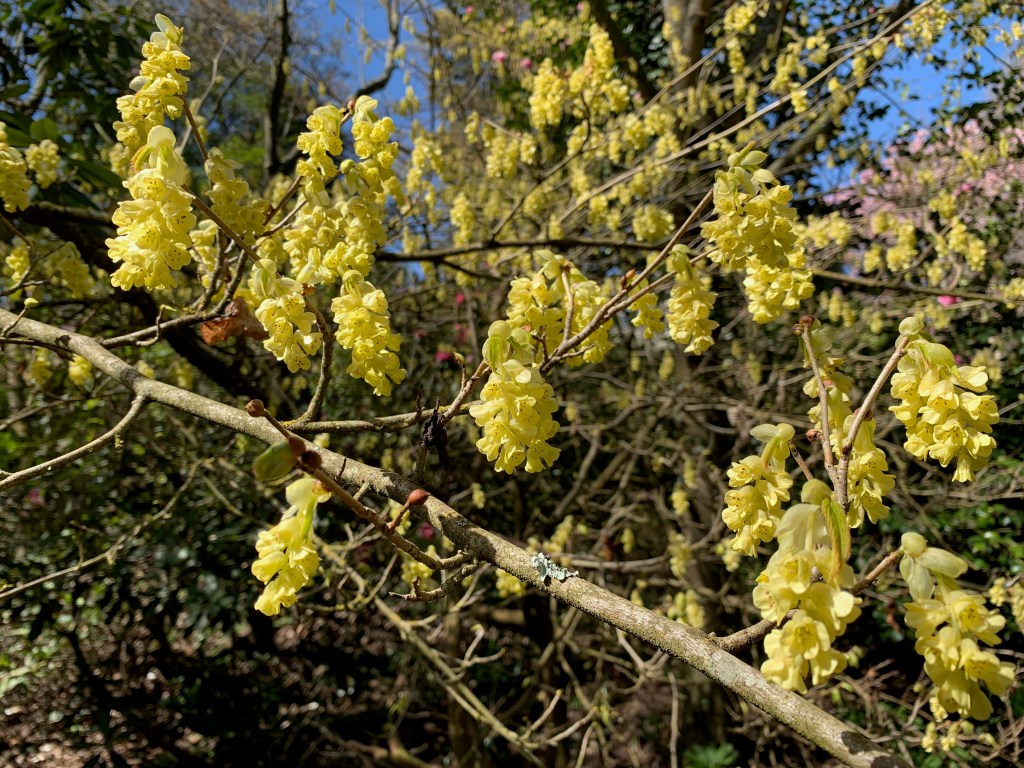
Corylopsis glabrescens has a variety, C. glabrescens var gotoana, a Japanese plant which again some taxonomists regard as a distinct species. This, too, with me is a spreading plant (a Howick collection), more open and presenting its lovely lemon flowers to perfection in 5-10 pendulous flowered spikes. It is not frequent in the wild, where it can make a 5m multi-stemmed tree. Again, I suspect this is a variable species, with a range of foliage, vestiture characters and growth habit.
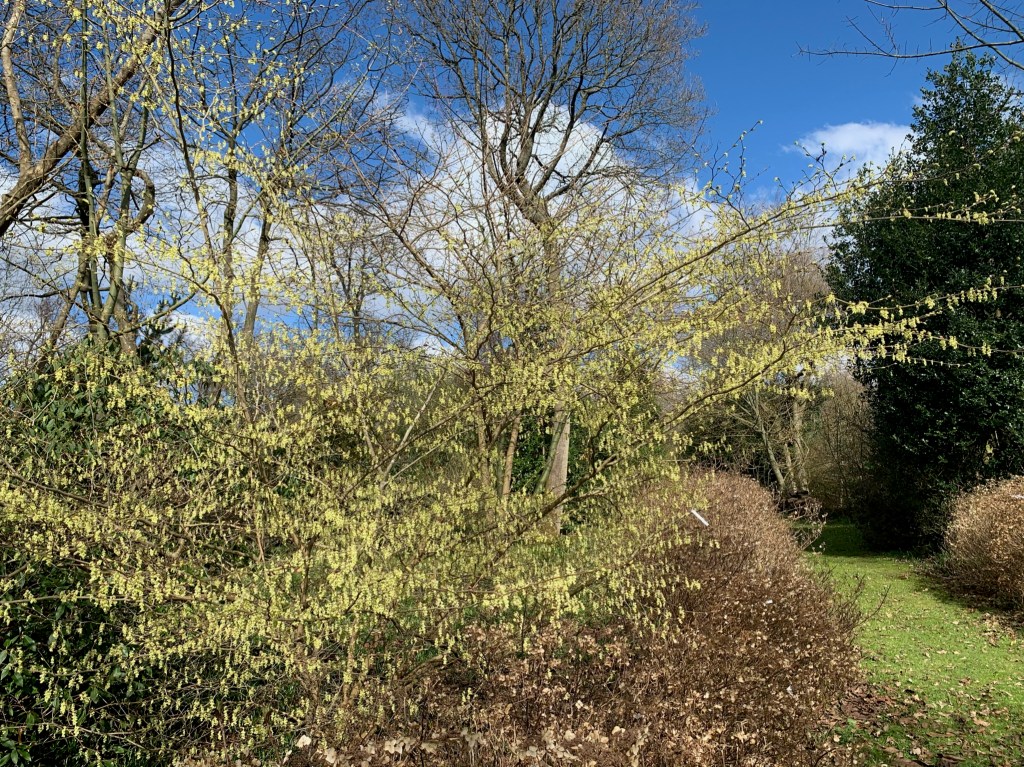
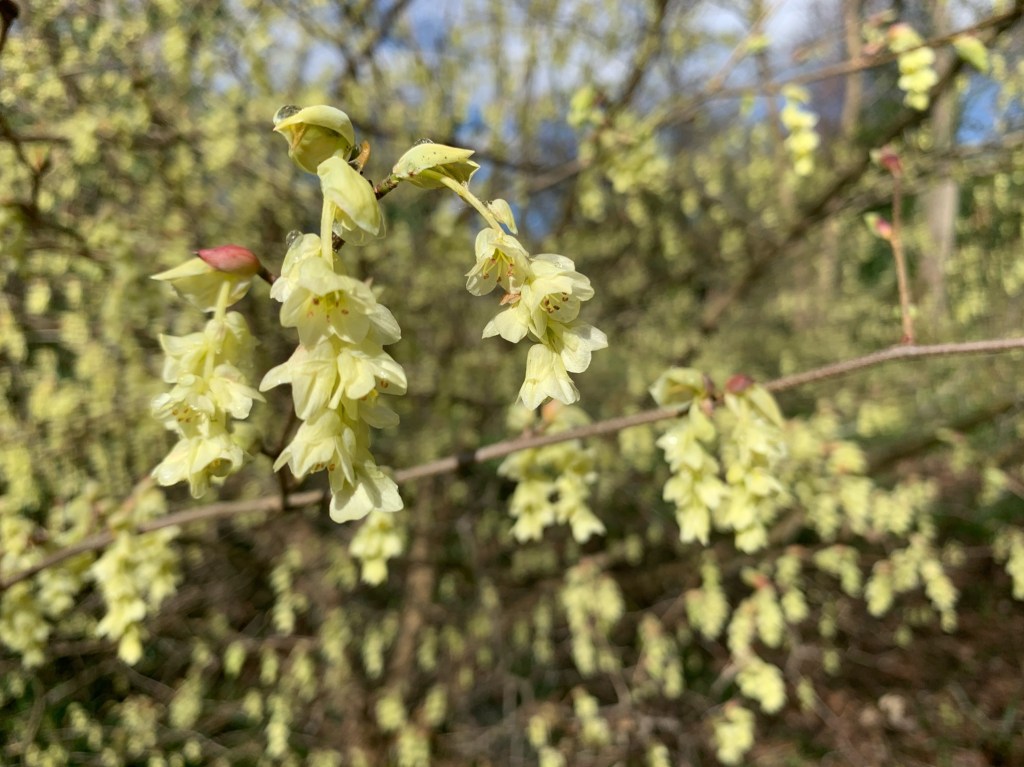
There are two other species worth noting: Corylopsis multiflora and Corylopsis himalayana. Both are of questionable hardiness and very rare in cultivation in the UK, probably confined to our west coast – but given our milder winters, both are being tried at WHF and so far growing well as small plants.
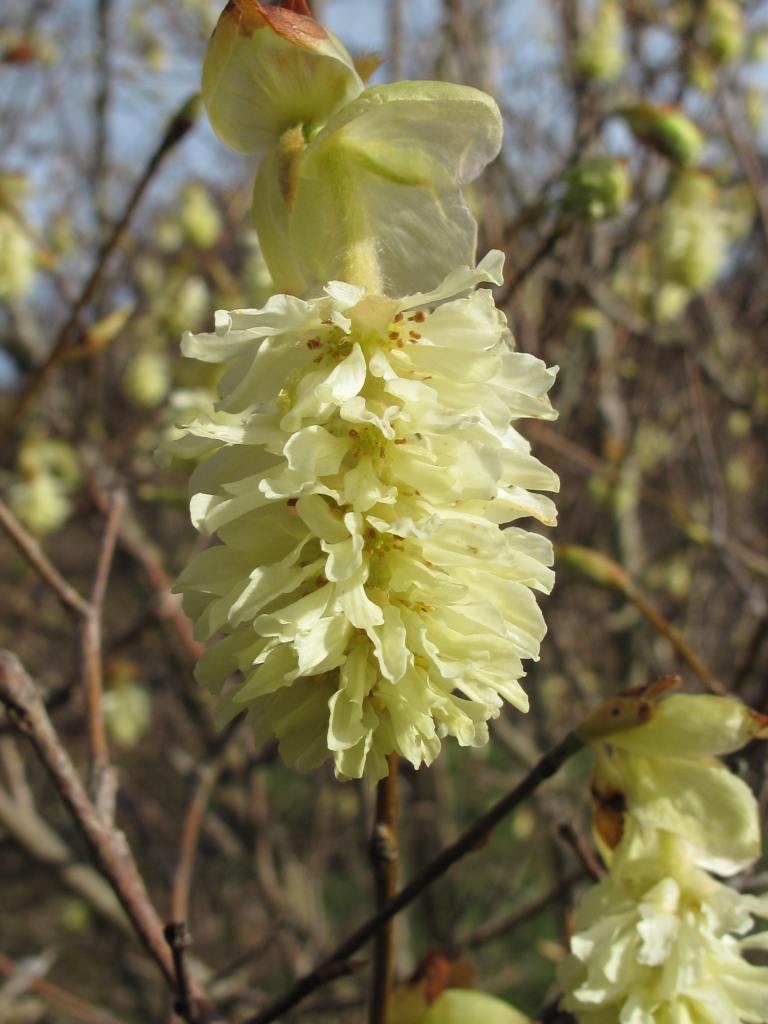
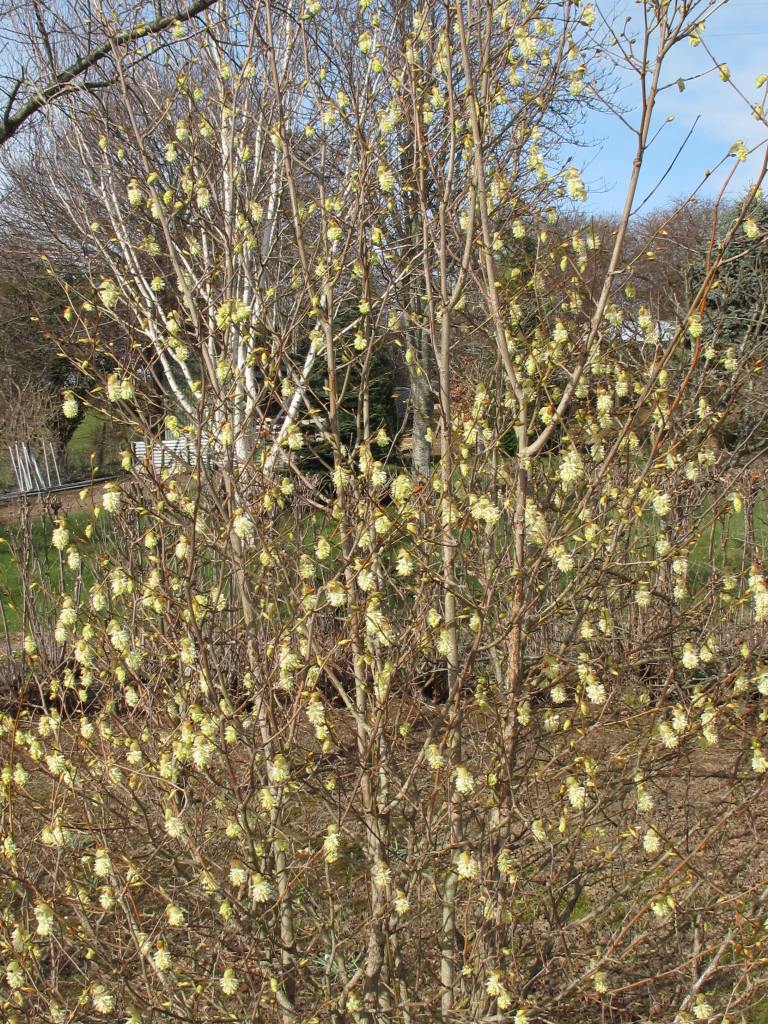
I have not seen a specimen of C. multiflora in flower, and it may well not be as ornamental as other species. I have it growing here, but for protection in deep shade, and as yet unflowered; it is being propagated to try it elsewhere in better light and test it further for hardiness. I grew C. himalayana for 5 years some 20 years ago. It never looked bursting with health, never flowered and eventually succumbed to frost. I am trying it again, courtesy of Jack Aldridge. I saw a large plant in the benign climate of the north island of New Zealand in full flower, and without question it was the finest specimen of any Corylopsis species I had ever seen, a large shrub perhaps 3x3m and awash with myriad lemon flowers.
To conclude, I have the temerity to disagree with the great Bean, who commented on the genus: ‘As garden shrubs the species of Corylopsis are not in the first rank…’ He does qualify this by adding ‘…at the same time the flowers have a soft beauty of their own and they are among the earliest to open in spring.’ But I think that, for example Corylopsis pauciflora and the various forms and varieties of C. sinensis are indeed in the front rank of flowering shrubs, with other species not far behind. They are plants I would not be without. I am more inclined to agree with US plantsman Prof. Michael Dirr – that they are ‘ as beautiful as any plant that could grace a garden.’
.
 White House Farm Garden and Arboretum