
The woodland at the top of the arboretum offers ideal conditions for testing the hardiness of new species and hybrids in South East England, from species rhododendrons (such as R. ellipticum, R. grande, R. sinogrande, R. falconeri, triflorums, and many others) and species camellias (such as C. trichocarpa, C. pitardii, C. bailenshanica, C. tunganica, and other species japonicas and small-leaved varieties) as well as Maurice Foster’s hydrangea walk, the result of his H. serrata breeding for the past three decades for compact form and intense colour, as shade-loving plants for ideal for underplanting.
A source of practical knowledge accumulated over 50 years about plants’ horticultural potential for all types and sizes of gardens
White House Farm is an example of what every gardener can achieve with woody plants over time. Maurice Foster has himself either planted, grown or propagated all the plants, including those given to White House Farm from other gardens, either from seed, grafts or cuttings.
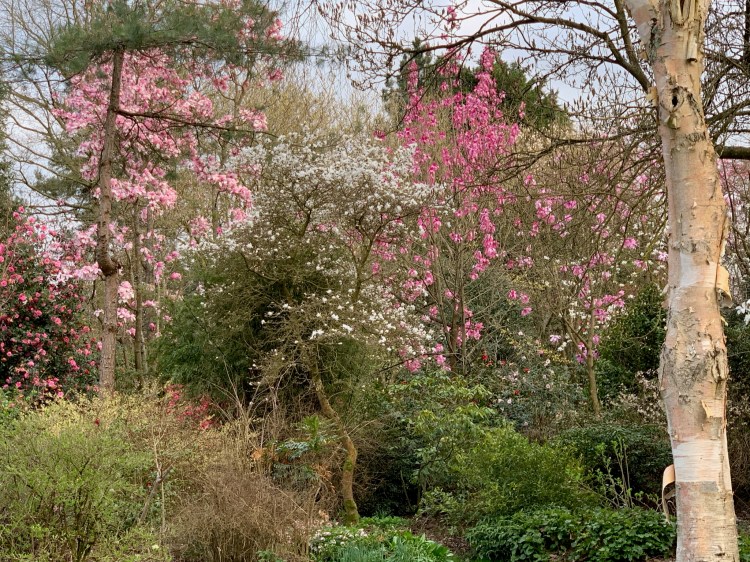
Garden beds are co-planted to be self-maintaining with minimal weeding and pruning, as woody plants and climbers grow into their own balance together. As hundreds of magnolias fade, climbing roses and clematis appear in their branches; in the summer, hydrangeas give sumptuous colour below.
On tours and at Friends volunteer sessions Maurice shares his personal knowledge of the thousands of plants’ individual histories, the history of the garden’s design for year-round colour, different approaches to propagation, the effects of pruning vs not-pruning on flowering habit and timing, and what he has learned about long-term pest, disease and weed control, principally via mulching.
Everything cut at White House Farm – grass, prunings, weeds, felled trees – is re-used.
 White House Farm Garden and Arboretum