Successive days in May 2026 with temperatures around 30C and an absence of rain caused concern about damage to many of our plants, but in general we found ill-effects were mitigated by the deep rains of late winter which left the soil at full field capacity, and our policy of heavily mulching all young plants with woodchip, bark and leaves (we were also lucky to have 27mm of rain over a series of showers the week before the heatwave). One noteworthy aspect of all this was that a number of evergreen late season magnolia hybrids planted over the last 5-10 years not only showed no adverse effects of the unremitting heat and dry conditions, but seemed to enjoy them, piling on fresh growth and freely flowering. They might be a good example of a group of plants to recommend for the future, able to cope well, if not prosper, through future anticipated periods of unseasonable heat.
Evergreen magnolias are already a useful addition to low lying gardens subject to spring frosts, since they flower in late May and June. They seem to be happy in either full sun or part shade; and in the past 15 years or so here have so far been undamaged by cold, reveling in our new norm of relatively mild winters. They probably prefer an acid soil, but being acid ourselves, we have no experience of their possible tolerance of a degree of alkalinity. Horticulturally, they are a very useful addition to the Oyama group of Magnolias, such as M. wilsonii or sieboldii, many of them modest neat growers, adding a useful evergreen element when out of flower. Some recently planted evergreen magnolias here are flowering well for the first time this year, and while they lack the ‘wow’ factor of the earlier spring magnolias, the flowers of some are quite freely borne and attractive at close quarters.
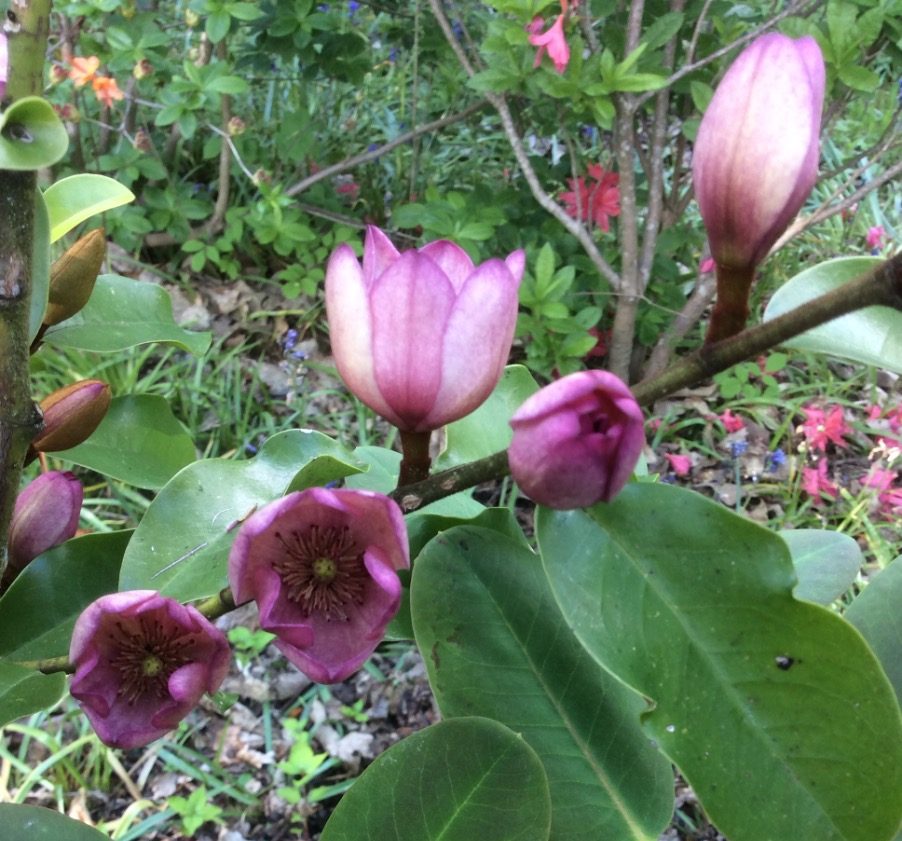
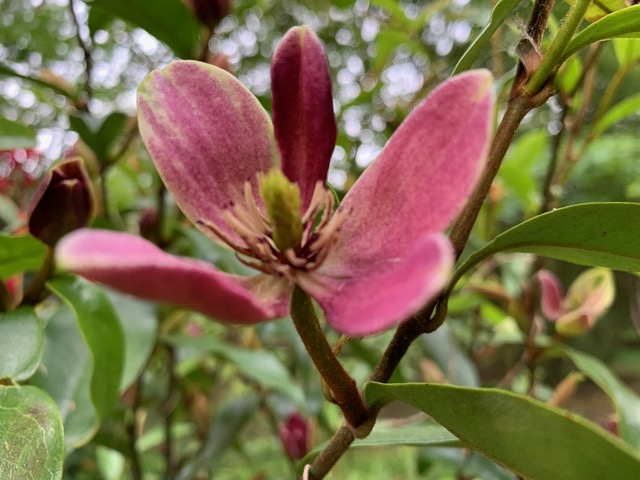
The parentage of most evergreen magnolias involves a variety of evergreen magnoliaceae, such as Mangleitia insignis, forms of M. figo , M. laevifolia and M. maudiae. Australian Bob Cherry made a number of crosses in the 1990s using M. laevifolia. He crossed it with the purple form of M. figo to produce a neat, upright small tree, now after some 12 years here about 4.5m tall. This has been flowering now for 6 years and at present, presumably reflecting last summer’s prolonged period of warmth, flowers profusely in all the leaf axils along the shoots. It makes no great show at a distance, but its pale purple cup-shaped flowers line the branches charmingly at close quarters. It has not been named.
A similar cross – this time using two forms of M. figo – M. figo var crassipes x M. figo var skinneriana – has flowers of a similar colour, but a shade darker, with separated petals and a definite fruity scent of bubblegum. The whole plant however is different, making a small, quite slow growing neat slender twigged bush, about twice as tall as wide, here 1.5m tall after 8 years. It has the curious moniker of ‘ Frosty Pale Purple’.
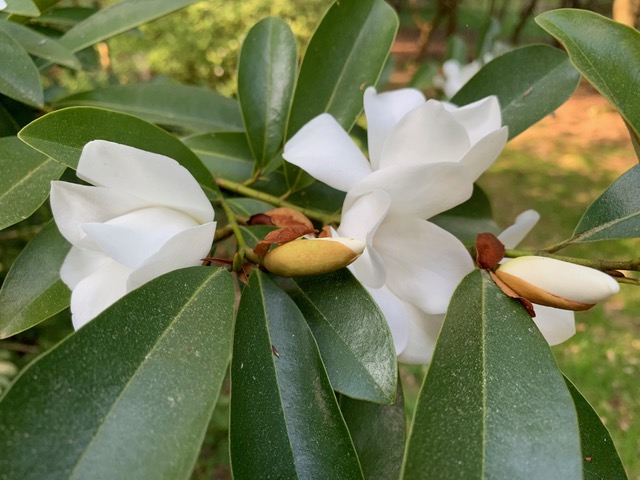
A second Bob Cherry cross was M. laevifolia x maudiae, which is halfway between its parents in most of its characteristics. It makes a rather spare tree with rather untidy white flowers. But I raised a F1 seedling open pollinated from it, and after 8 years this appears to be an attractive, balanced small tree, with lateral branches nicely spaced along a main trunk – which is still heading north, favouring the arboreal instincts of its M. maudiae parent. This year it flowered freely for the first time, over 4 weeks, making an effective picture in the landscape, with bunches of large informal flowers clustering towards the ends of the shoots. It is a very promising plant. Ultimate height to be determined but could be a small to medium-sized tree. Again unnamed.
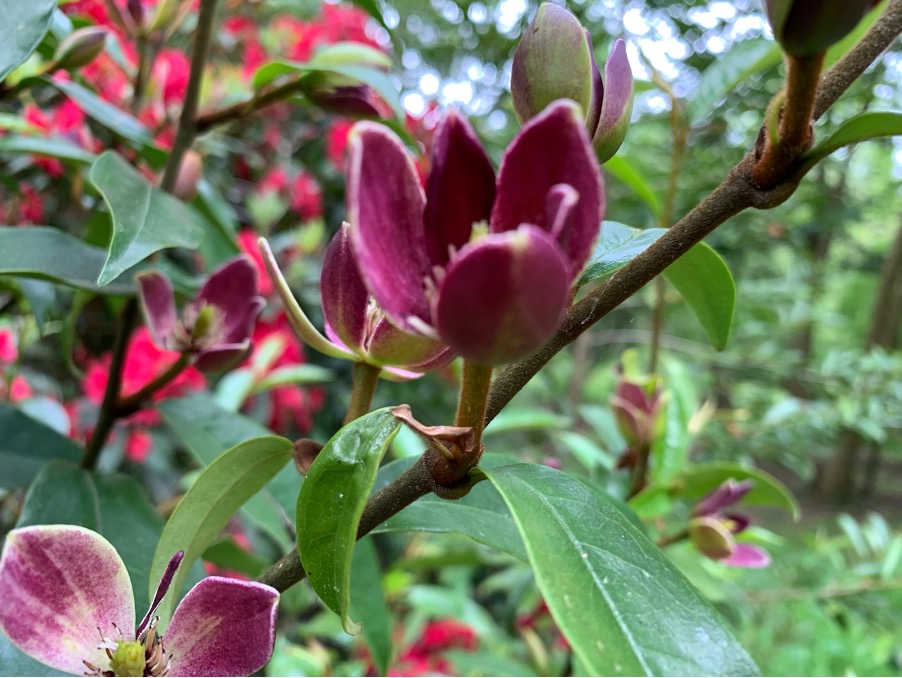
We have three ten-year-old seedlings of a M. sieboldii x M. (Mangletia) insignis cross made by Bill Smith in the US, and following last years warmth, these plants are now producing a serious number of flowers. Two are white, with flowers similar to those of M. sieboldii, with prominent stamens, but facing up or outwards, not semi-pendant.
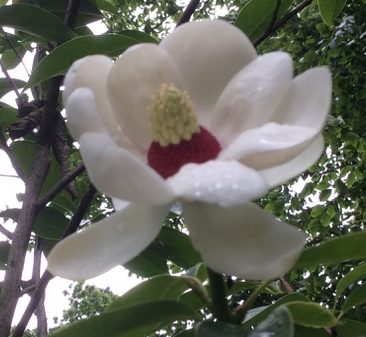
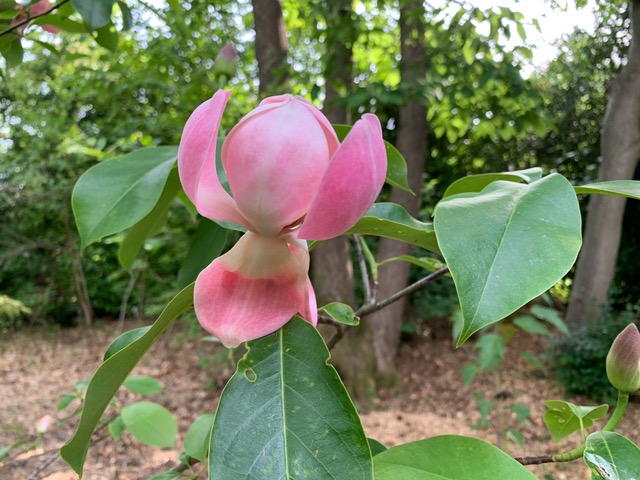
Upward facing flowers favouring M. sieboldii on unnamed Bill Smith M. sieboldii x Mangleitia insignis hybrid
But the third is an effective novelty, the outer sepals a clear pale pink, cream at the base, the outer tepals reflexing sharply to create a distinctive shaped bi-coloured semi-upright flower on a small spreading tree. This has been named ‘Pink Moon’ by Sven Bronckaers of the Bokrijk botanic garden in Belgium.
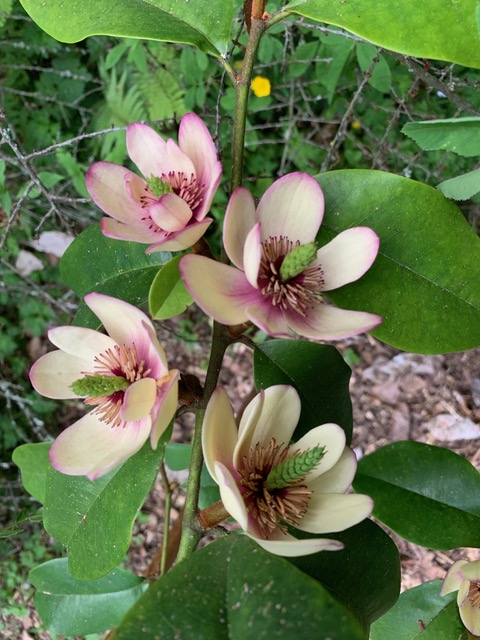
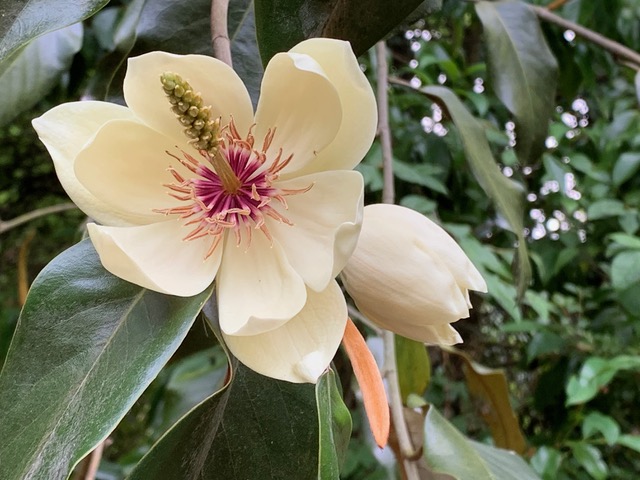
I have enjoyed the first flowering this year from a four year old evergreen Magnolia, named M. ‘Lennon’, growing freely in full sun here, but wind sheltered. This a cross between M. fulva var calcicola x M. figo var crassipes. M. fulva itself is rare in cultivation, from Yunnan and Vietnam, with cream cupped flowers.
Flowers on ‘Lennon’ are a half way house, medium size, nicely poised, yellowish/cream and freely diffused with purplish pink at the base and on the tepal edges. It has not been irrigated during this rain-free, heat punishing period, but is freely mulched and growing strongly.
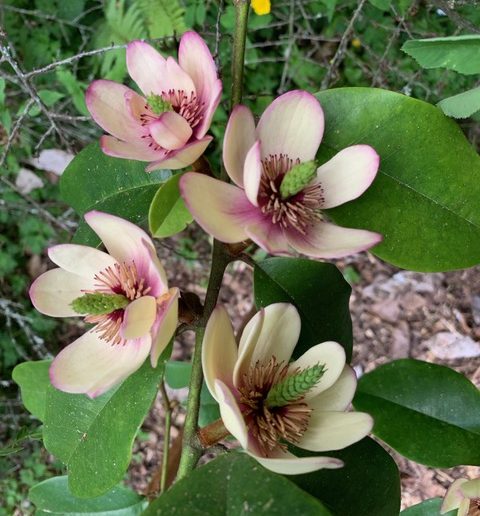
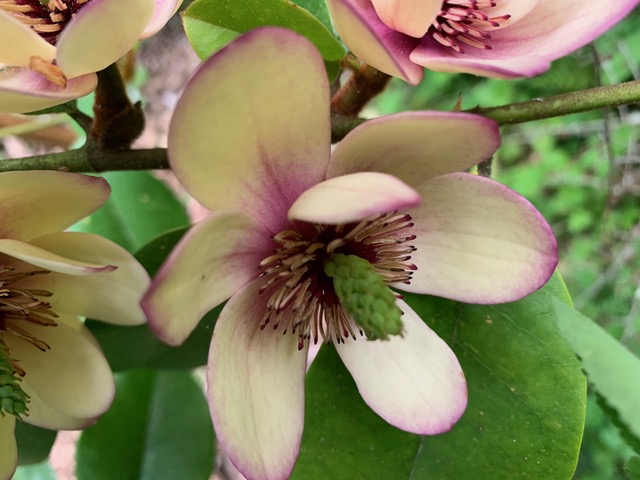
‘Lennon’ looks very promising as a good garden plant with attractive bright flowers which will be very effective if produced in profusion.
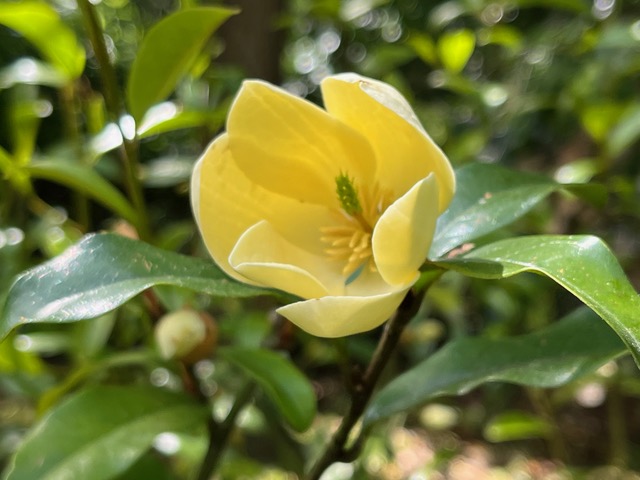
A delightful yellow magnolia here labelled M. laevifolia ‘Large leaf Kunming’ I think is worth a cultivar name. It flowers some 2-3 weeks later than M. laevifolia, has larger leaves, a more vigorous bushy habit and is free flowering. It opens a clear yellow and fades to cream, but the whole effect is an attractive pale yellow. I presume – and it’s a guess – it arose from M. laevifolia seed from the Kunming Botanic garden, where there is a wonderful collection of Magnolia species, and where hybridity in plants raised from seed will be rife. My guess would be that this is a cross with M. ernestii (formerly known as Michelia wilsonii) – a vigorous yellow arboreal magnolia, quite rare in cultivation. It looks very promising as a garden plant and with me is thriving in partial shade.
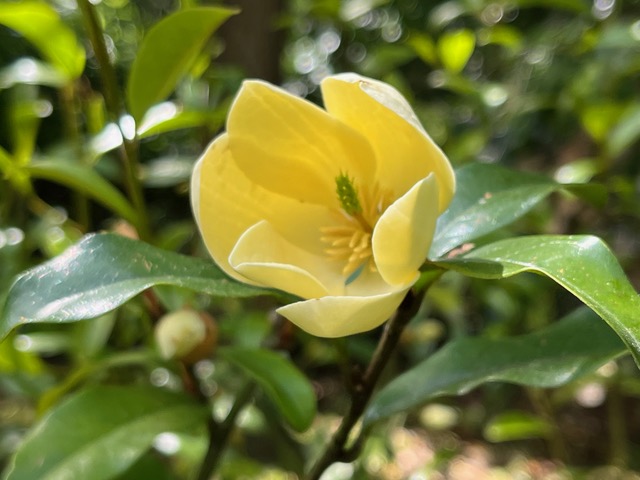
Finally, an outstanding form of a true species, M. foveolata, called ‘Kinba’. In the US I believe it is known as ‘Shibumichi’, named for a celebrated Japanese nurseryman. The copious foliage is quite unique, the large leaf reverse a shiny bronze, a light-reflecting gold satin. It grows vigorously in part shade, in spite of root competition from nearby trees. The flowers are large, cupped and a nice cream/yellow, with red staining at the base of the tepal.
None of these plants have suffered winter damage, though it has to be said the lowest temperature here in Kent has been only – 5C; nor have they been adversely affected by the two heat waves of 2022 and 2025 or various periods of drought. They are probably not going to produce the in-yer-face floral effect of the early precocious Yulanias, but it remains to be seen how effective they might be in the garden landscape as mature plants.
At close quarters evergreen Magnolias have great charm, most with a pleasant fragrance and with glossy green foliage able to contribute to the garden when out of flower. More of these ambitious hybrids are becoming available all the time, and we could be witnessing the birth of an attractive group of effective new ornamentals.
- Our next Open Days are Sunday June 14th, Wednesday July 1st, and Sunday August 16th 2026: 10-5pm guided tours of the Garden, Wood and Arboretum with Q & A and discussion. Email whitehousefarmarb@gmail.com to reserve a place.
- The IDS/TSO are holding a Study Day on Carpinus and Corylus here on Sat July 4th, with talks by Maurice Foster, Owen Johnson and Keith Rushforth: to attend, book through them at https://www.tickettailor.com/events/ids/2138496

