Yunnan in Western China is probably the epicentre of rose species – and many of them, such as members of the Synstylae group, have huge vigour, which they seem to pass on to their various hybrids.
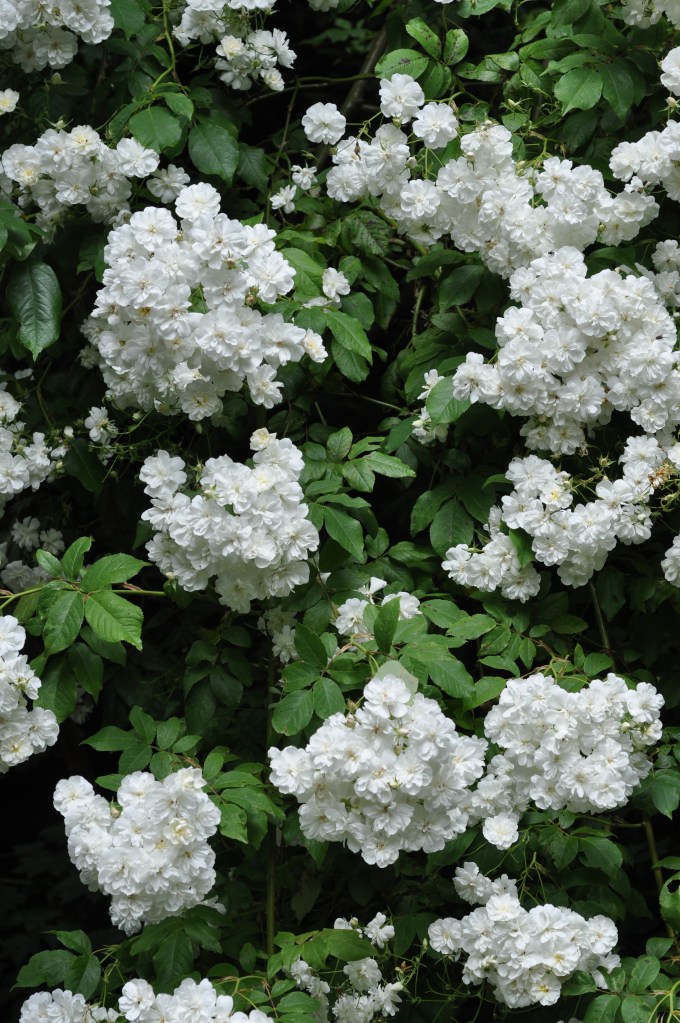
The best known is probably Rosafilipes, of which the remarkable ‘Kiftsgate’ is a form or hybrid. The type species of R. filipes is infrequent in the wild, but recognisable from its long, thread-like pedicels forming large corymbs of simple single white flowers.
R. filipes from the wild at WHF
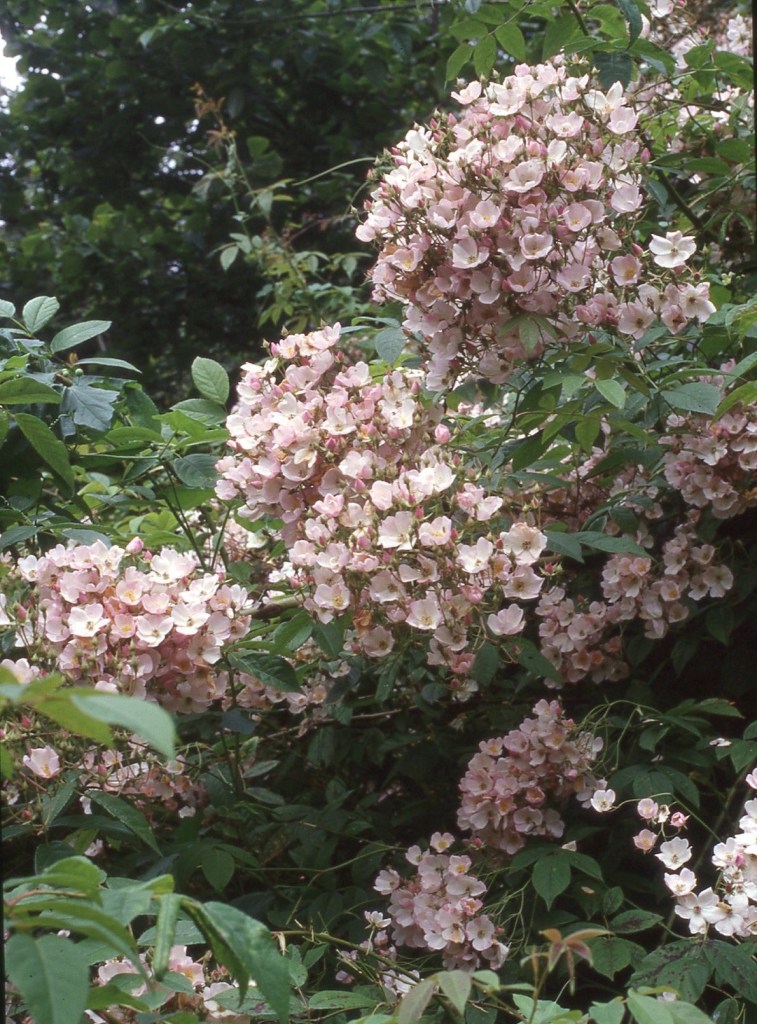
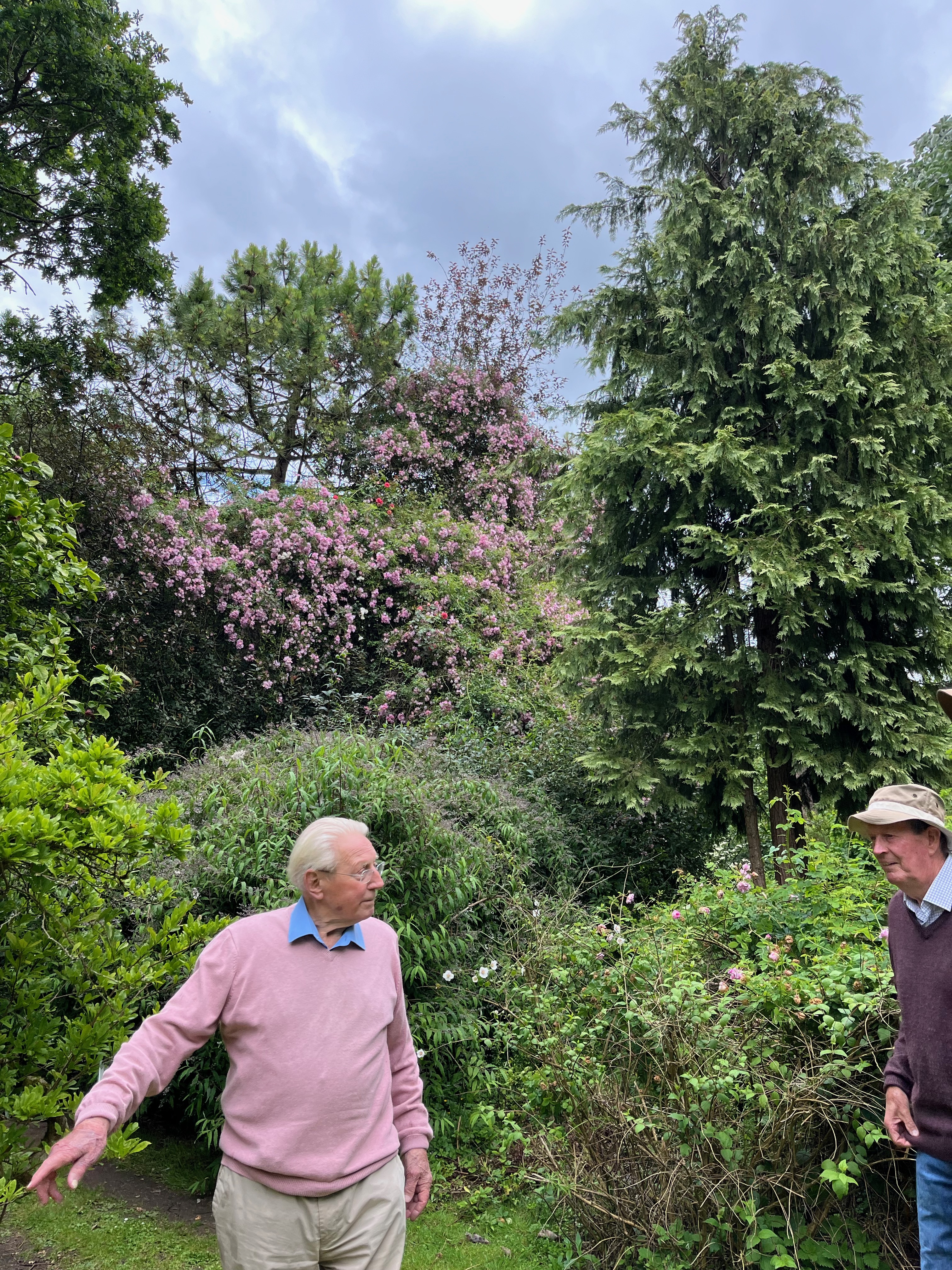
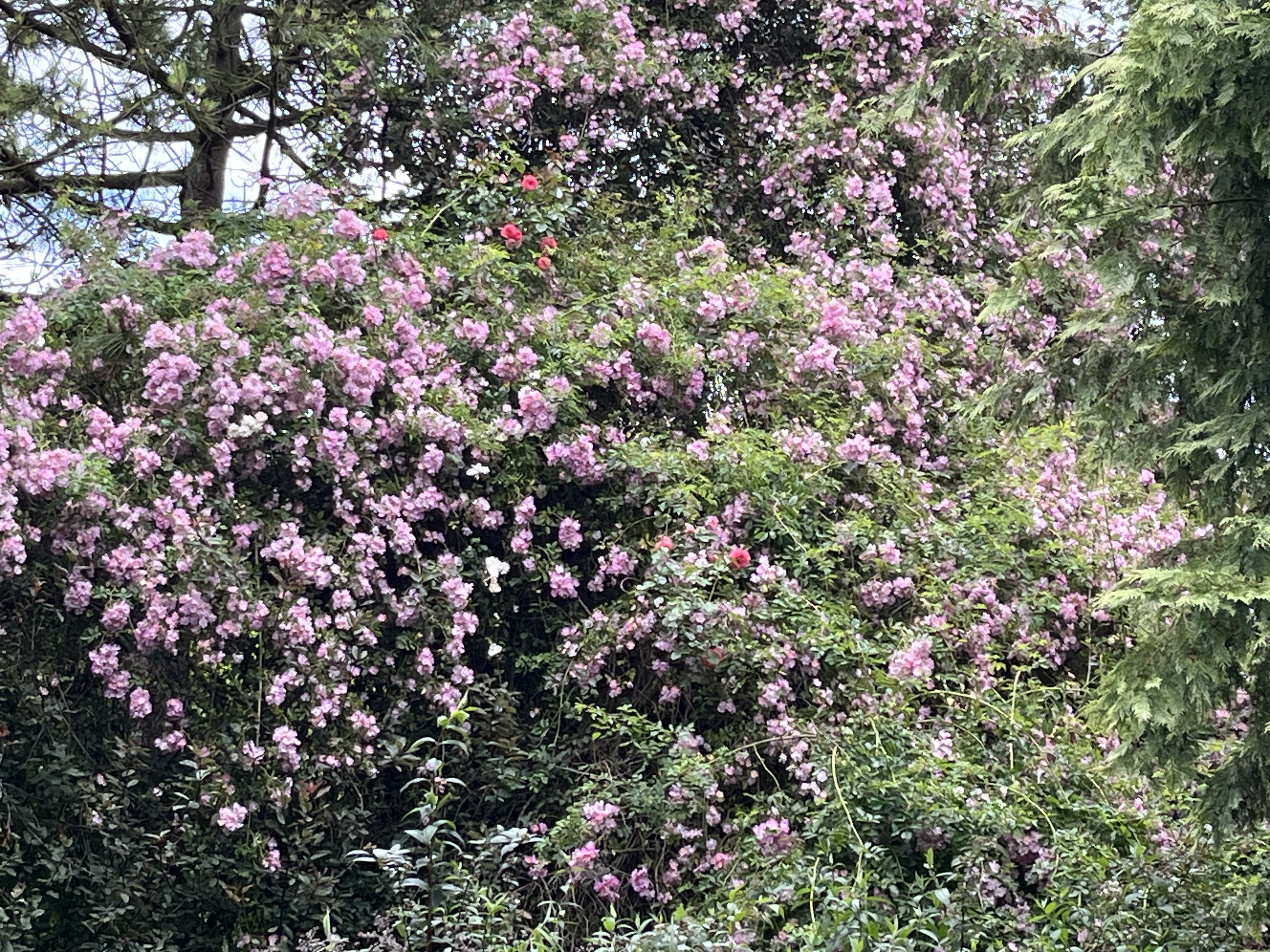
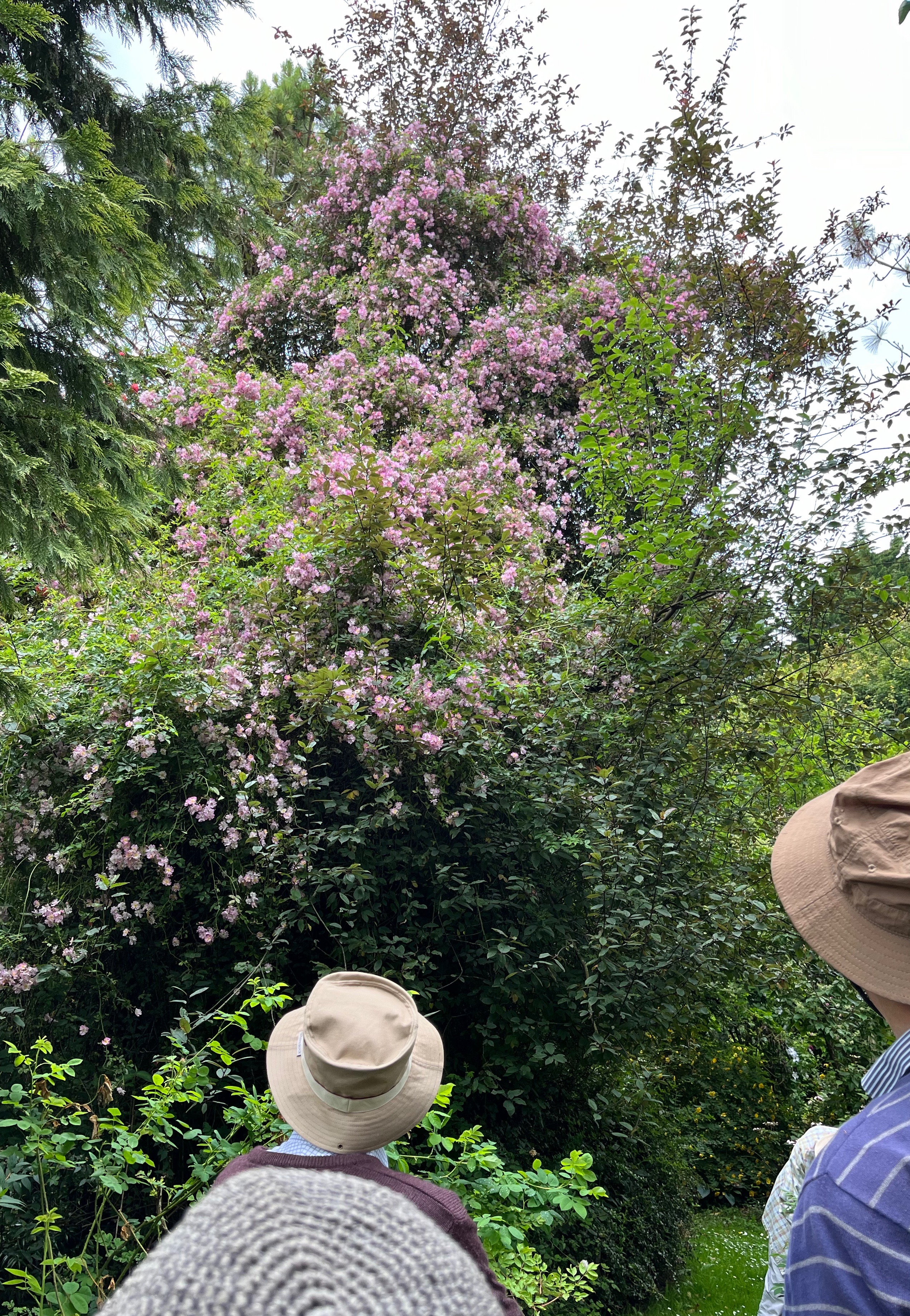
Below is an open-pollinated R. filipes seedling from White House Farm, ‘Rosemary Foster’, with pale pink colouring, which will climb up to fifty feet in a tree (here, sycamore and oak) and hang down long flowering shoots in arcs.
WHF’s R, filipes pink seedling, ‘Rosemary Foster’
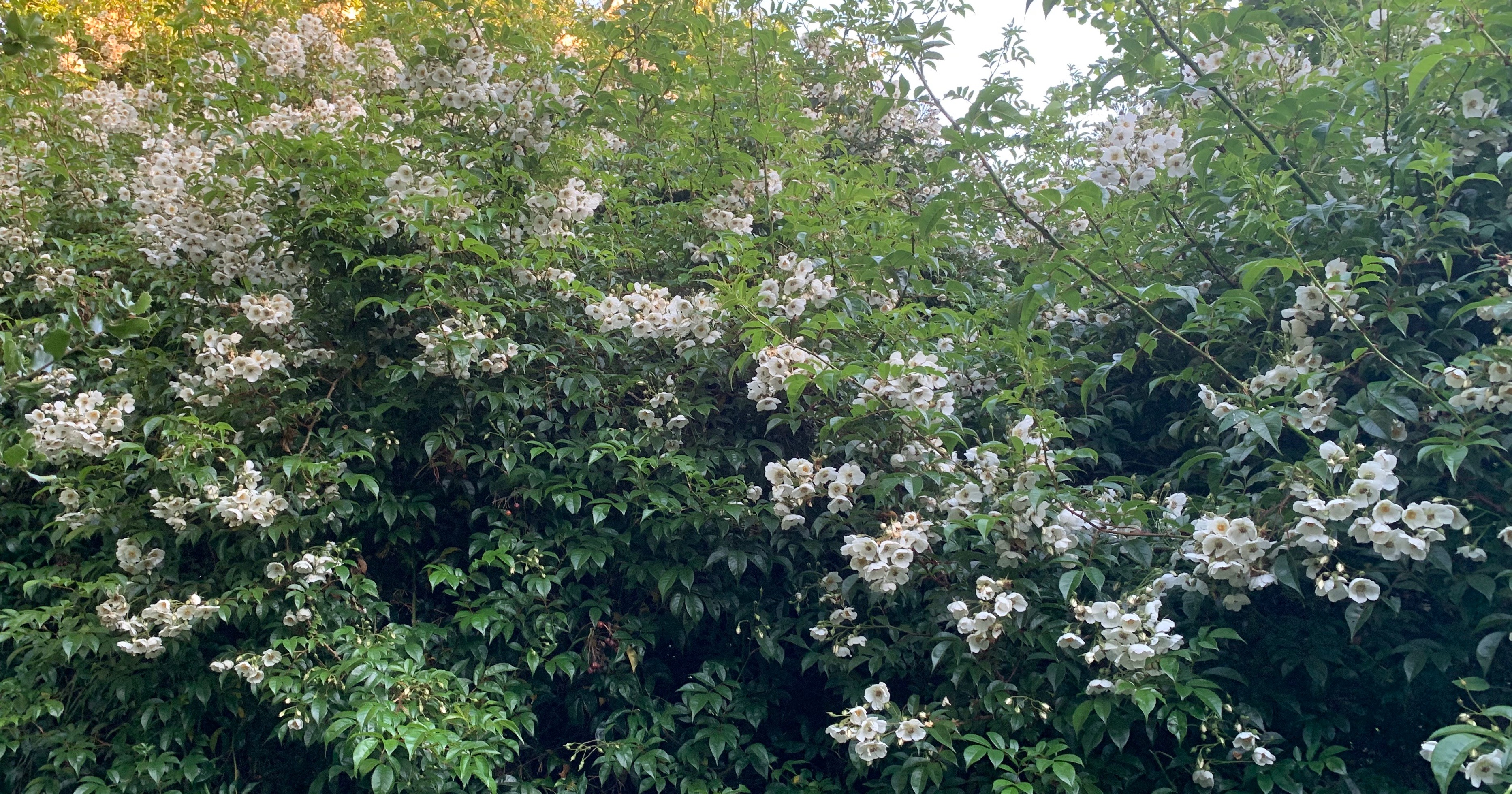
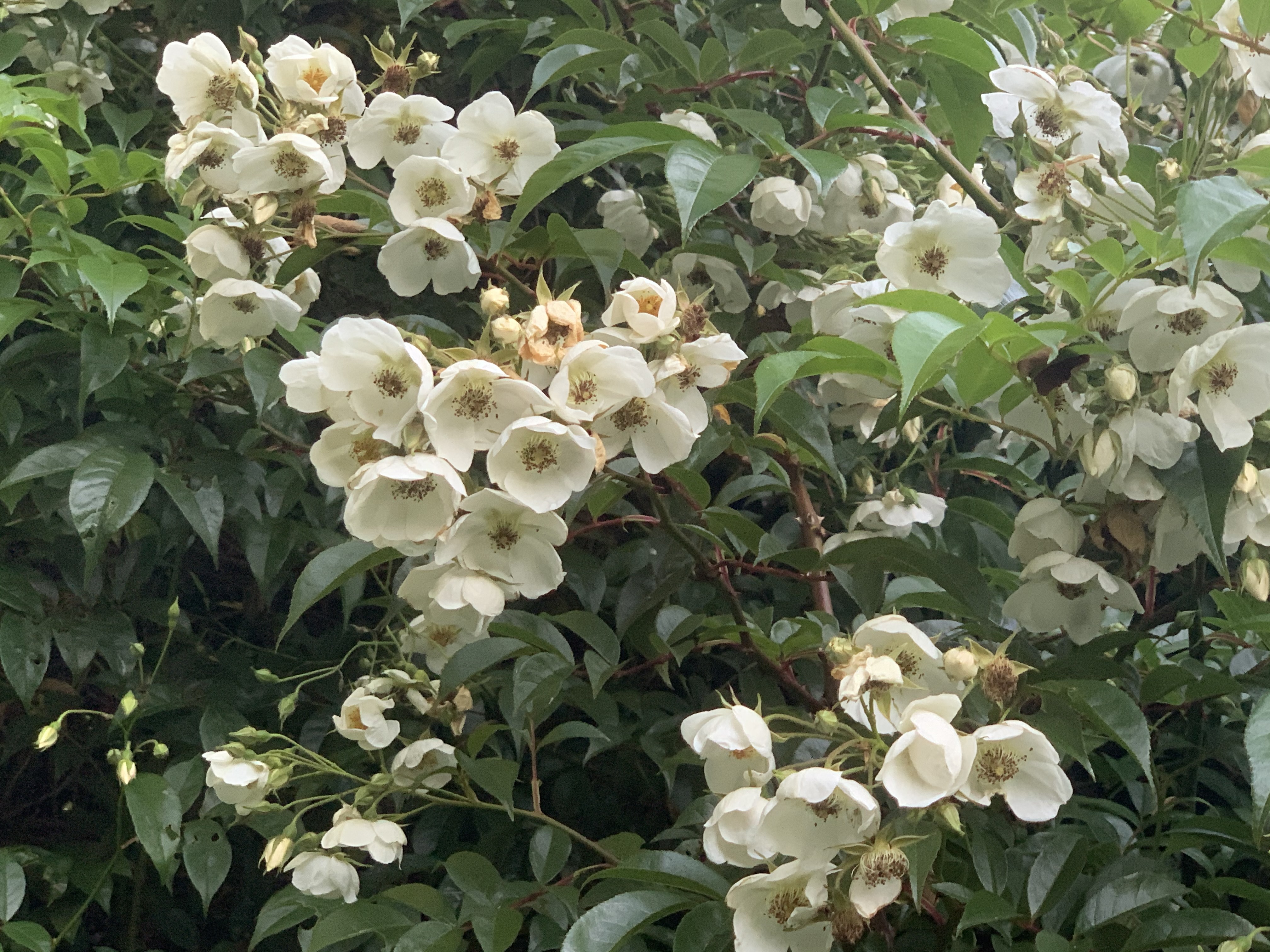
The other notable member at WHF of the synstylae group is Rosa longicuspis, which has virtually every attribute a desirable flowering plant might possess: it has polished dark green foliage, is fully evergreen (even in several degrees of frost), largish flowers in open corymbs which those with a decent nose say has a faint smell of bananas – and vigour. Our plant is 20 feet tall by as much as 40-50ft across, entirely smothering an old bramley apple tree. The young shoots are polished reddish brown.
The conventional commercial sources have said neither of these synstylae are marketable because they are too vigorous for the average garden. R. filipes is also ultra-promiscuous, producing copious seedlings, many of which are worthwhile (like ‘Rosemary Foster’). But we think they have significant potential for hybridising. We use them to enliven our screen trees, and they are often a feature in autumn for their clusters of hips.
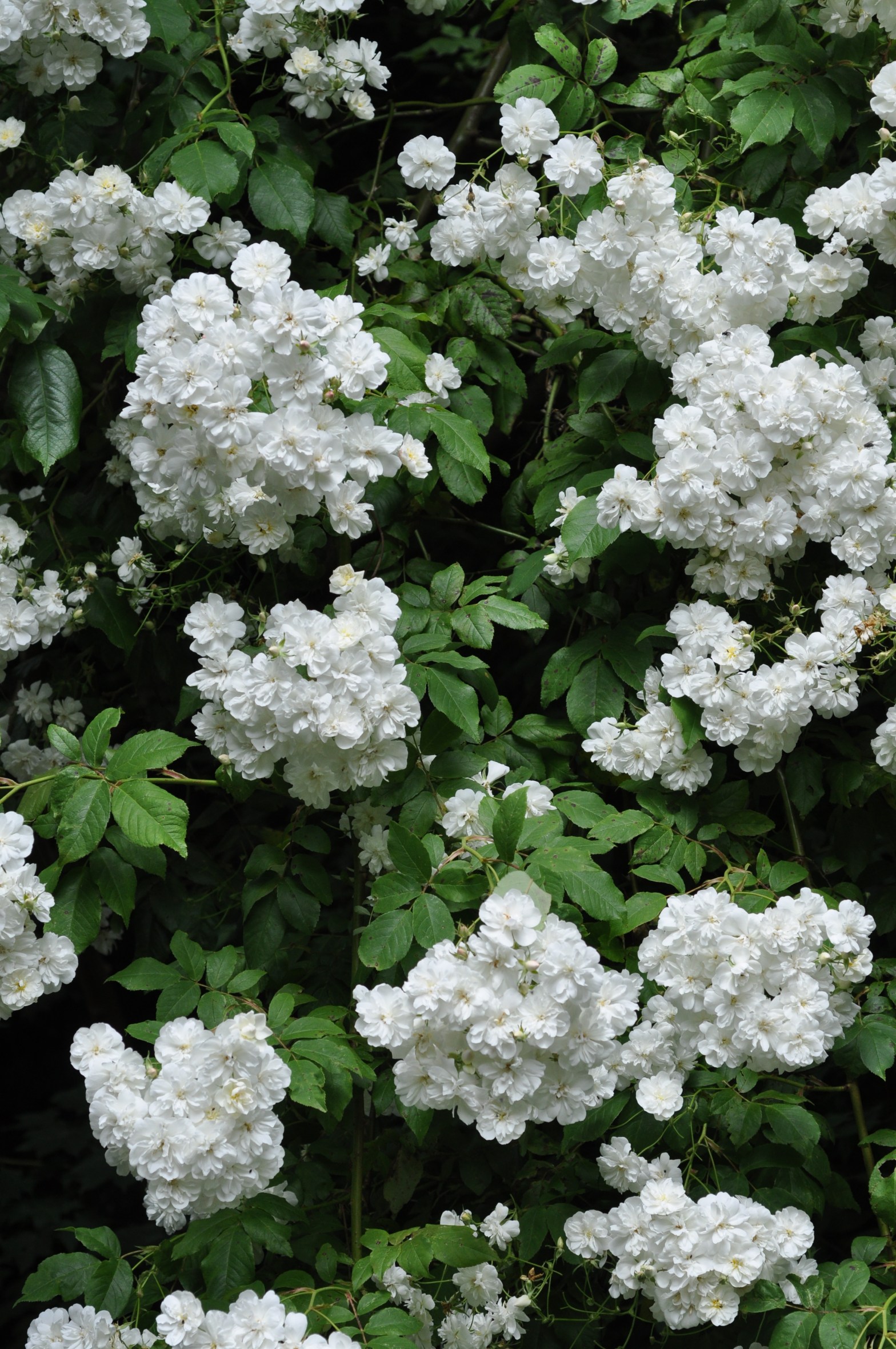
Another very promising synstylae bred here has large rosette-like white flowers hanging in festoons cascading down the side of an old gean. It leaves ‘Rambling Rector’ standing in the middle of his rural parish, so we’re looking for a suitable name for it from higher up the episcopal hierarchy.
A further climbing rose which has attracted much attention from visitors is a strong pink seedling of ‘Veilschenblau’ , now smothering a large Prunus colorata in the Rose Garden. This was brought in as a specimen to the RHS Woody Plant Committee by its then secretary Diana Miller many years ago as a seedling from her garden. I showed interest in it, took the specimen home and rooted it as cuttings. There seems to be little of Veilschenblau in it, in terms of either colour or vigour, but twenty odd years on it is now a remarkable spectacle.
We tend to leave self-sown rose seedlings here until they flower, particularly if a good rose is or was once planted nearby. One never knows one’s luck. After all, every plant we grow in our gardens originated from seed.
by Clare Foster, Chair of the Board of Trustees, WHFAF
On Wednesday July 10th we will hold an afternoon Garden Masterclass tour of White House Farm with Maurice Foster, Caroline Jackson, Jack Aldridge and Annie Guilefoyle, exploring White House Farm’s collection of Japanese serrata cultivars and Maurice’s own serrata hybrids. A few places are still available from Garden Masterclass here. For those of you new to us, Maurice and Clare’s Garden Masterclass Thursday Garden chat is here. It gives a brief overview of White House Farm’s 53-year history as a private garden and its current purpose as a charity.
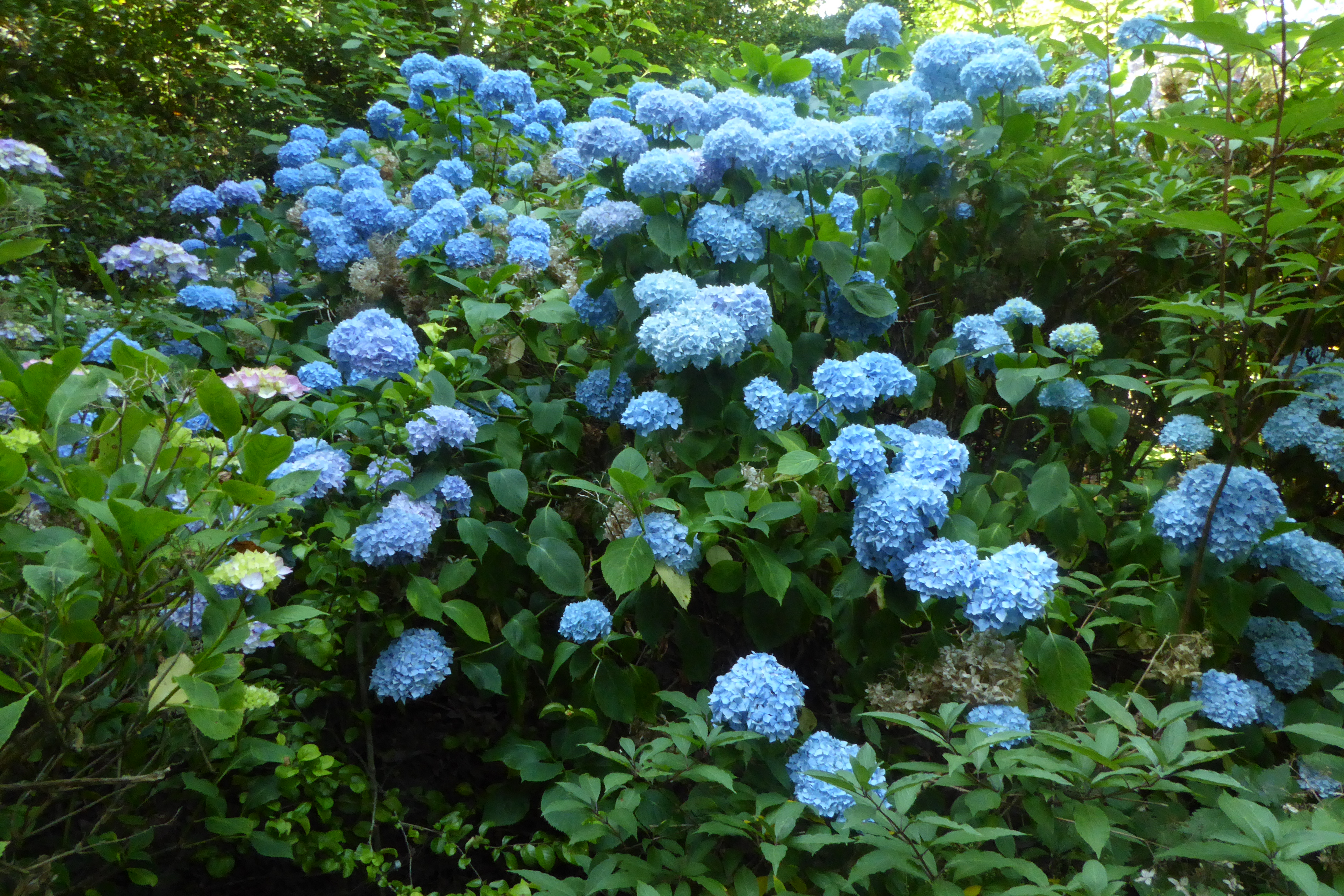
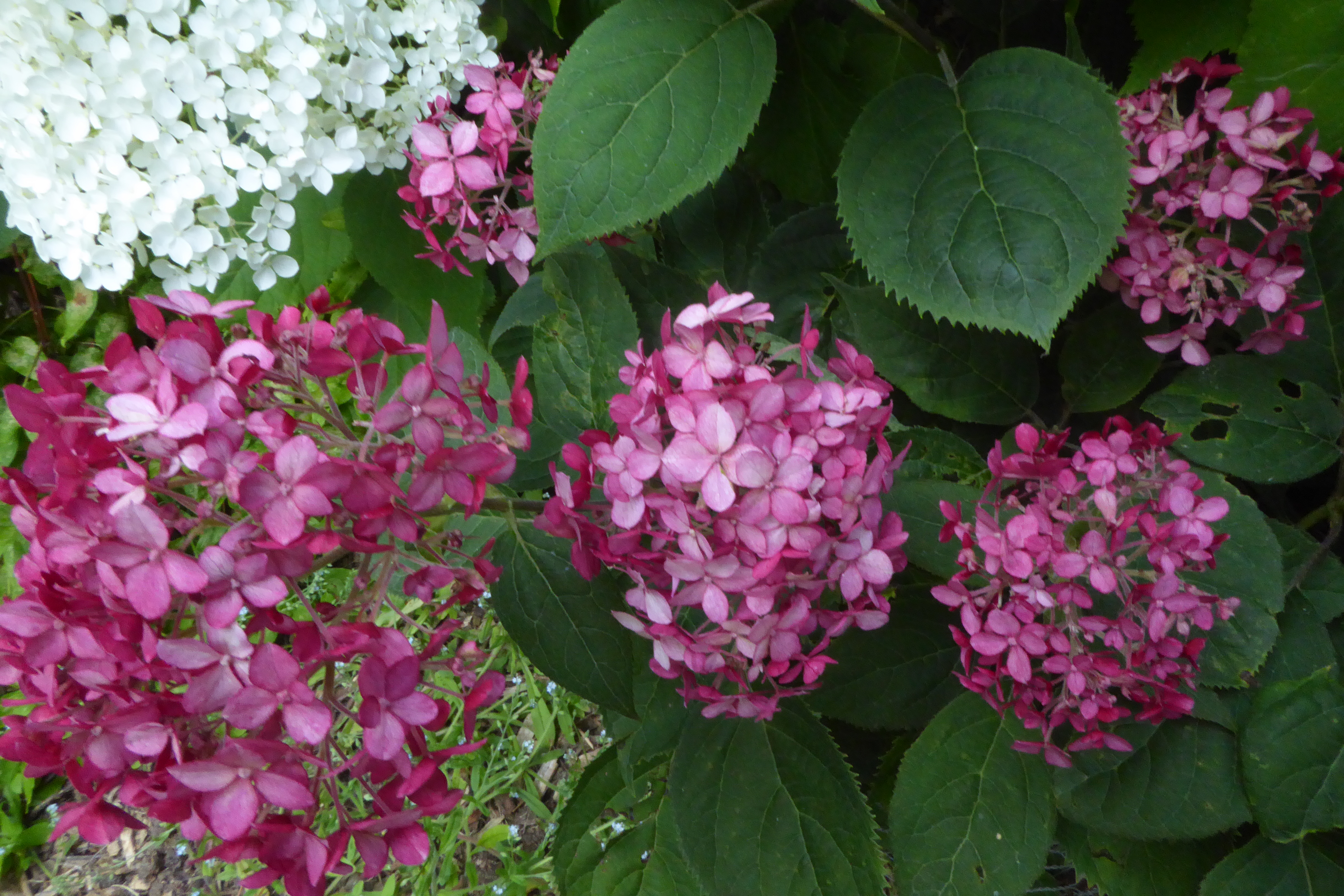
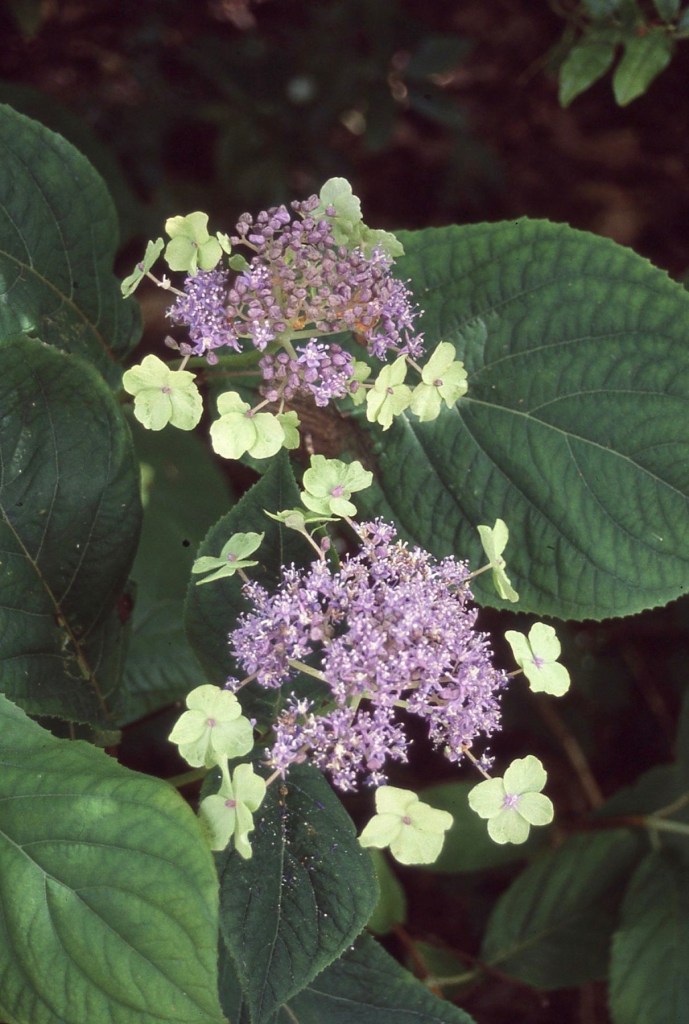
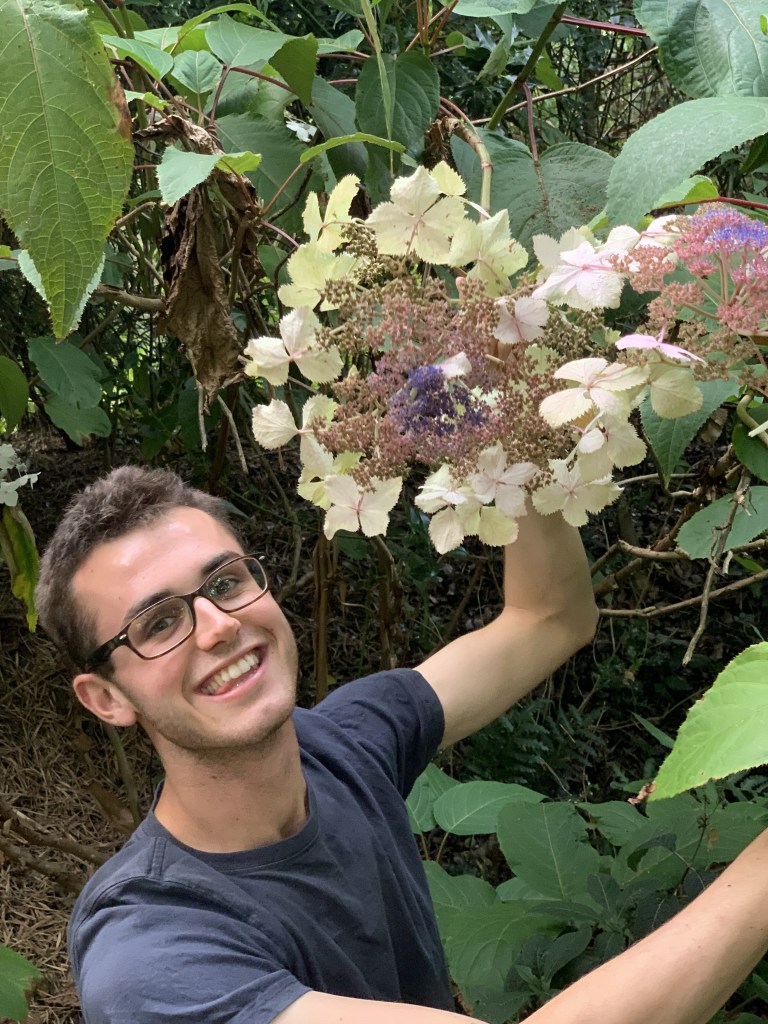
The recent rain and cool weather has brought our H. serrata walk to unusually spectacular free-flowering display and intense colours this week. Early Hydrangeamacrophylla – the Hortensias – are also coming into full character, such as the seminal ‘Veitchii’, ‘Rosea’, ‘Mme Emile Mouillere’, ‘Comtesse Generale de Vibraye’, along with several of the intensely-coloured Dutch Ladies and Teller series, among others. Together with Annabelle and its pink derivatives, and more recent introductions such as the black-leaved ‘Daredevil’ and scandent ‘Runaway Bride’, White House Farm offers a snapshot history of the genus Hydrangea in flower in a single afternoon. In the wood, species collections of H. angustipetala and chinensis – many with their yellow fertile flowers close to qualifying them as ‘yellow hydrangeas’ – are also at their peak.
Wild collections of H. stylosa – in the same section as H. macrophylla and H. serrata – are among our favourite plants.
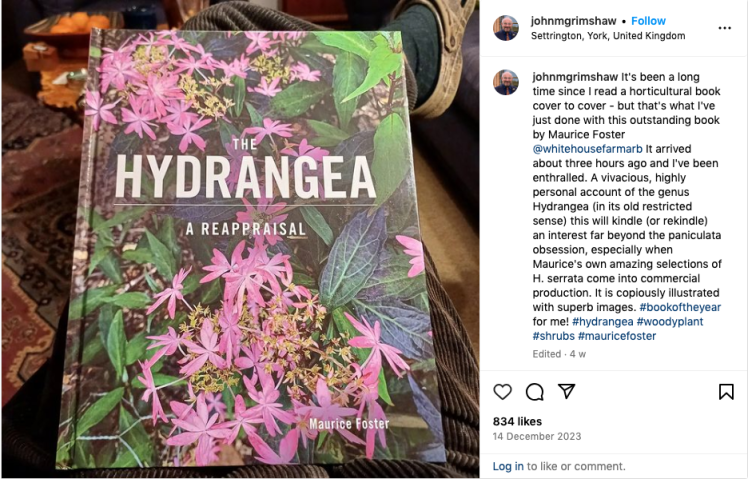
For those unable to make it in person, many of White House Farm’s hydrangeas are featured in Maurice’s recent book, ‘The Hydrangea: a Reappraisal.’
The book was written to capture the interest of both seasoned horticulturalists and beginning gardeners and garden designers: as John Grimshaw points out in his review for Hortus magazine, it shares a lifetime of practical knowledge of propagating, growing and observing these plants.* Everard Daniel in the RHS Rhododendron Camellia and Magnolia Newsletter has also reviewed the book and concluded …..’ this will certainly be the premier go-to Hydrangea reference book from now on’.
Our H. involucrata ‘Viridescens’, which is widely available, is demonstrating its astonishing freedom of flower in near 100% shade for something like its 30th year.
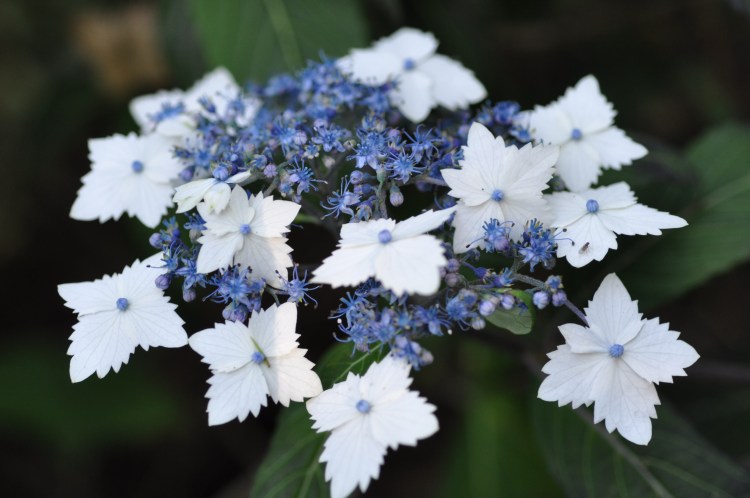
Come join us for a thorough discussion of hydrangea siting (crucial to their character), shade and sun tolerance, colour variation, and see the wonderful jewel-like variety of forms of rayflowers, especially among our some 57 Japanese and European serrata cultivars.
*If you order a copy at its RRP of £25 from us at whitehousefarmarb@gmail.com, £9 of the cost goes to the White House Farm Arboretum Foundation.
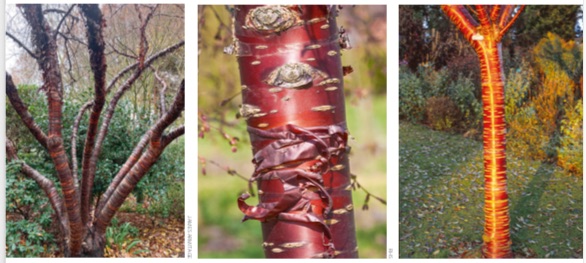
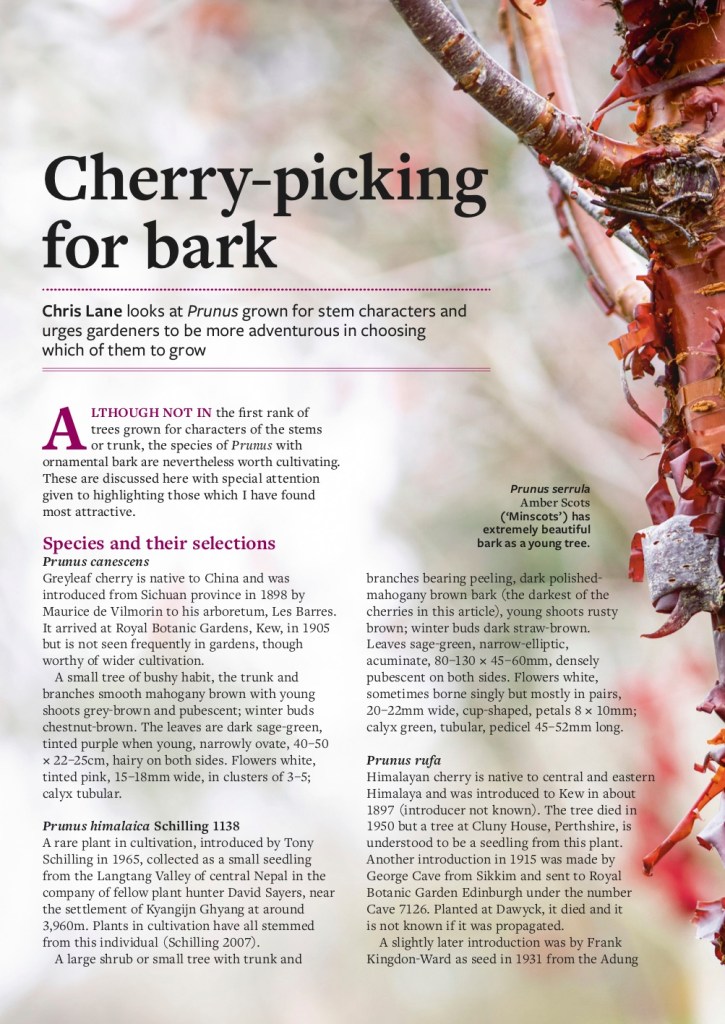
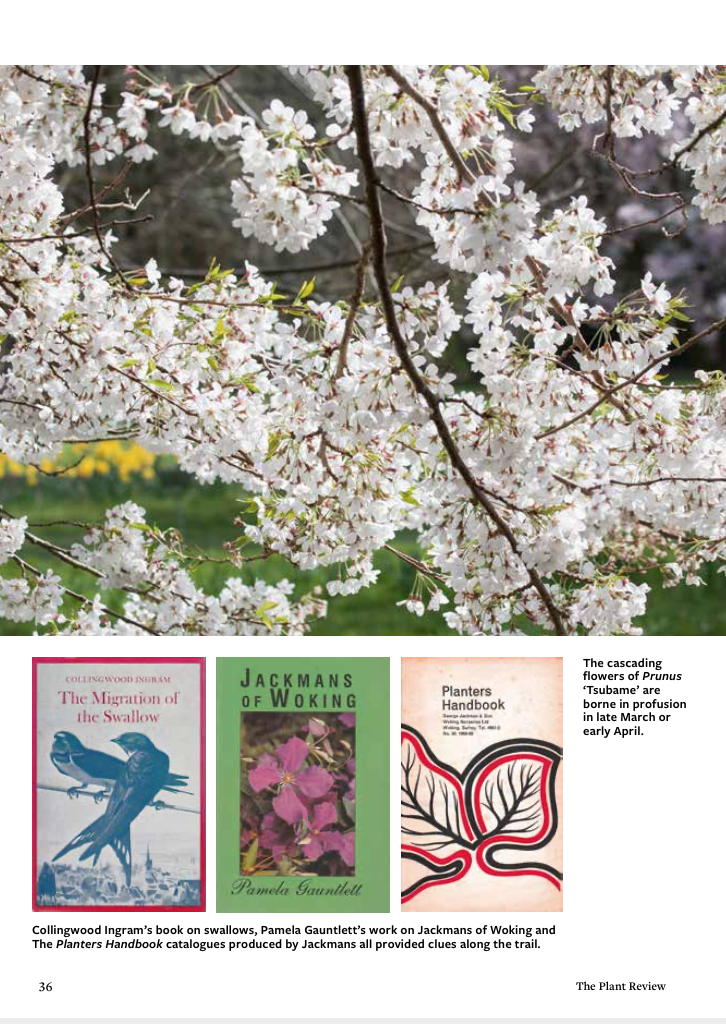
WHF Trustee Chris Lane, who holds the national collection of prunus at his Witch Hazel nursery suggests some Prunus worth growing for their beautiful trunks alone, with flowers the icing on the cake (or cherry on top….) Reproduced with the kind permission of the RHS Plant Review (March 2024).
Upcoming events at White House Farm in June, July and August:
-a WHF Hydrangea serrata Study Day on Saturday June 8th (9 places still available), email whitehousefarmarb@gmail.com for programme details and to reserve a spot;
-A Garden Masterclass ‘summer colour’ tour on Weds July 10th (book via Garden Masterclass website here)
-An IDS Study Day on the important ‘asperae’ subsection of Hydrangea (aspera and involucrata) on Weds August 21st (book via the IDS website here)
Jack Aldridge, WHF Trustee and Horticulturalist at RHS Wisley, gave a Thursday Garden Chat for Garden Masterclass about his work on Oakwood at Wisley; other recent talks range from ‘Woody Plants that Should be Better Known and Grown’ for Plant Heritage, and an overview of Camellia sasanqua for the International Camellia Society.
Jack has recently played a key role, along with Rod White, who has an unofficial national collection of Camellia reticulata, in identifying and labelling the camellia collection at White House Farm (some 100+ cultivars and 40+ species) which will be a feature of the April 4th guided tour and discussion; as will Magnolias (200+, some 50+ years old, including 12 national champions), which Maurice Foster is speaking about at a Wespelaar IDS Magnolia Study Day in Belgium next month.
WHF is known for its use of Magnolias as canopy trees for underplanted camellias, rhododendrons and hydrangeas, along with other small trees of interest for their flower or foliage, from cornus, styrax, and corylopsis, to carpinus and euonymus, with clematis, wisteria and climbing roses joining in, wherever siting offers each plant its best combination of light and shade, space and protection. This tiered woody co-growing approach offers sequential colour but is also low maintenance, enabling colourful year-long effects achieved without a team of gardeners. As well as looking at the best spring-flowering plants, and others that deserve not to be rarities, these methods and more will be showcased discussed as design strategies at the April Garden Masterclass event – an informal guided tour designed to be directed by participants’ specific interests and questions.
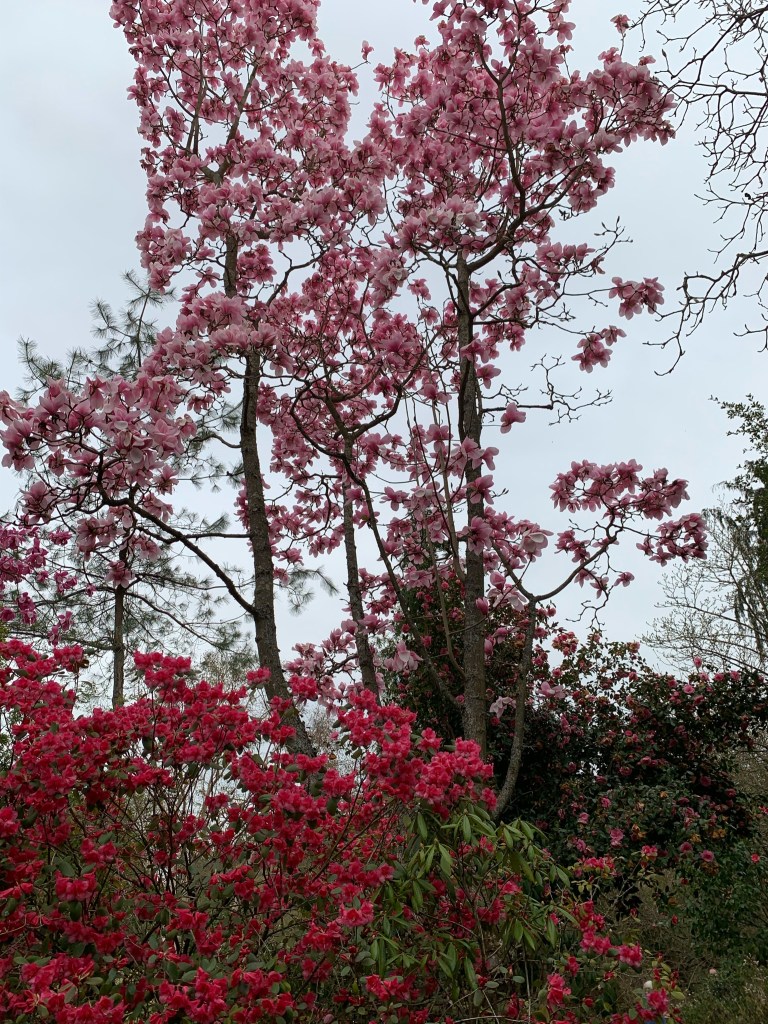
Spring at WHF is dominated by the spectacle of magnolias on all sides, set off by evergreen camellias and rhododendrons below, with conifers as high backdrops. But WHF is also known for the range of other often overlooked genera in spring gardens, such as Meliodendron, Staphylea and Berberis, as well as the colourful spring foliage of birches, maples, and hornbeams. A few places are still available for the April 4th event: for more information click here.
Jack is working on Cornus for Trees and Shrubs Online (TSO) and has an article in this month’s The RHS Plant Review about Cornus hybrids – an issue which also has contributions by two other WHF Trustees, Chris Sanders (on an overlooked clematis) and Chris Lane (on dark-stemmed flowering cherries).
Jack will join Maurice Foster and horticulturalist and gardening lecturer Caroline Jackson in leading the first of a series of Garden Masterclasses at White House Farm on Thursday April 4th, informal tours designed to be led by participants’ interests and questions – observing not just the best or some rare selections but also some growing and planning lessons learned over the past 50 years.
Maurice Foster shares some observations on some of the newer wild Camellia species growing at White House Farm.
The four seminal species behind the largely nineteenth-century development of literally thousands of cultivars are of course C. japonica, C. sasanqua, C. reticulata and C. saluenensis. Their relative merits as species are already well known, and their influence on the vast treasurehouse of garden camellia hybrids immense. C. cuspidata has also been quite widely grown for many years. But over the last 20 years several other camellia species have been brought into cultivation; some of the most promising of these for garden-worthiness are among the 48 Camellia species we grow here at White House Farm.
The total number of designated camellia species varies markedly depending on which taxonomist you favour. In 1958 Robert Sealy at Kew described some 82 species from the material then available; by 1981, with many more species newly discovered in China, H. T. Chang recognised no less than 280. T. Ming brought this back to a more sensible 119 in 2000 – but this back and forth itself shows there is a challenge here, and scope for more work, both in the field and the laboratory.
Whichever taxonomic classification you follow, about 80% of species are to be found in China, with some new species recently discovered in Vietnam and elsewhere in E. Asia. Most of these Chinese species are found in the warmer temperate zones of the south and south west, with inland populations often at relatively low altitude, meaning that cold hardiness has been seen as the principal limiting factor for successful cultivation in the UK. The vigour of WHF’s collection seems to disprove this concern. Of course we have had a good run of milder winters, and some botanists believe members of Theaceae, such as Camellia, and the closely related Ternstroemia and Polyspora, for example, have cold hardy genes in their makeup. But it may be, too, that as for so many other genera, siting is crucial.
C. pitardii – the best of our 4 seedlingsC. tunganica, introduced by White House Farm
Here, finding the right spot for planting is the first priority, and the key to success in creating optimum conditions for survival and good growth. Most of our species camellias are located in the wood, or as underplanting in the mature garden, with wind protection from the bitter North Sea winter winds to the north and the east to which we are exposed being on a hogsback of some 500ft. But the same slope protects against spring radiation frosts, because colder air, being heavier than warm air, sinks – this katabatic wind means sheltered slopes avoid frost pockets. Rainfall at WHF averages about 30” a year: drainage is another benefit of slopes, and there’s a balance to be struck between top cover, root competition, and good light, although I have found that once established, C. species cope especially well with this. Light woodland is ideal, with part shade, some humidity, and plenty of moisture during growth.
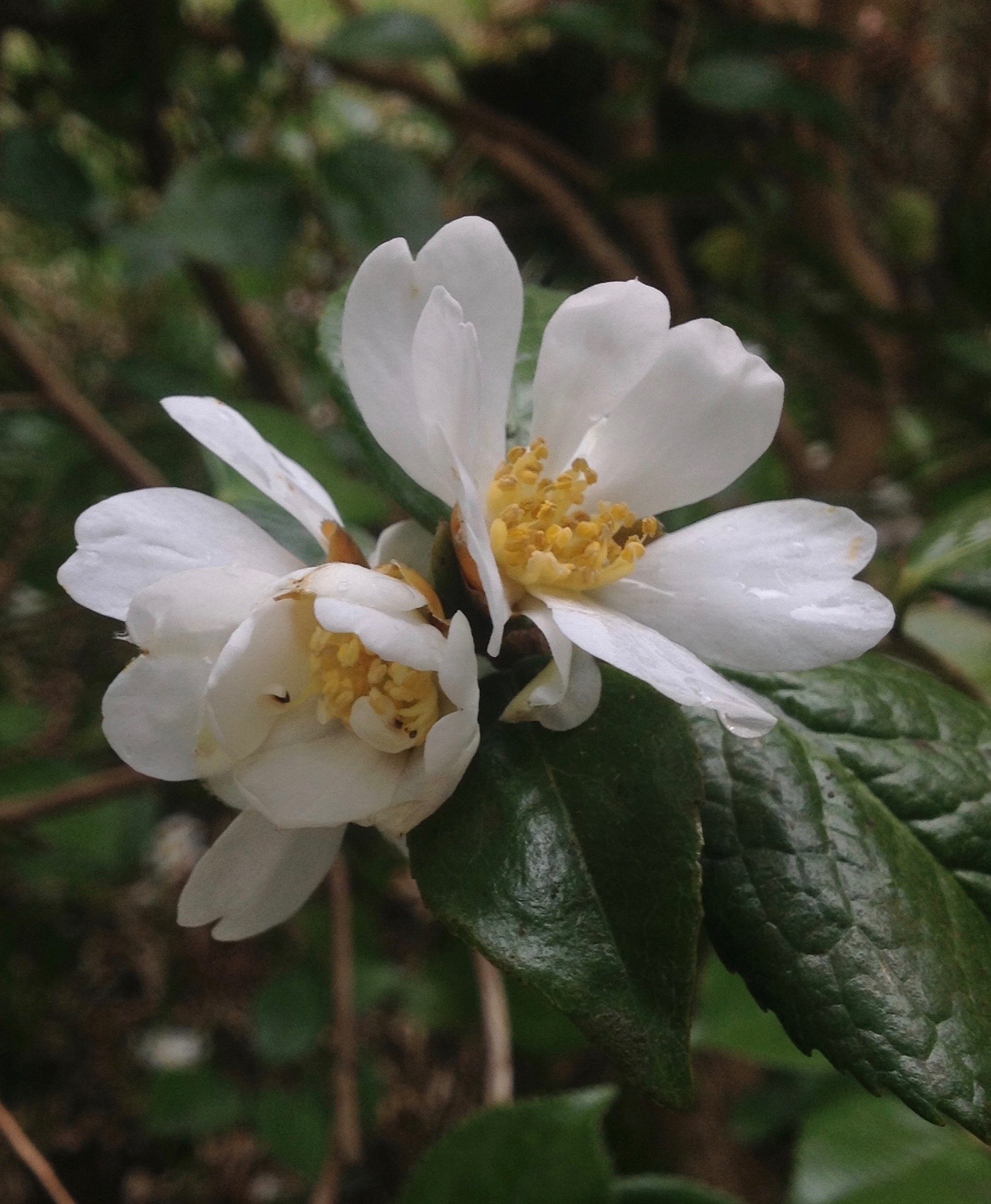
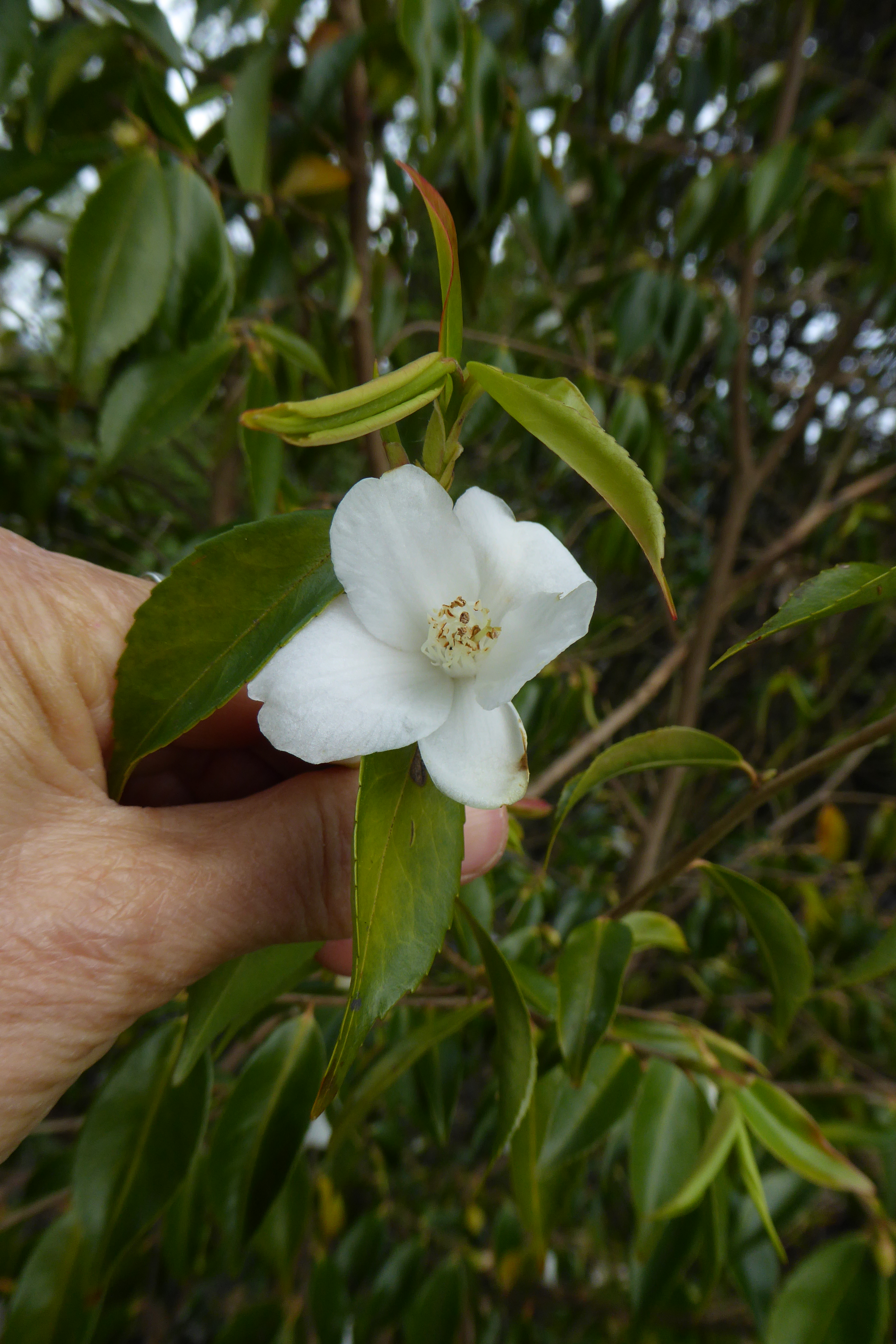
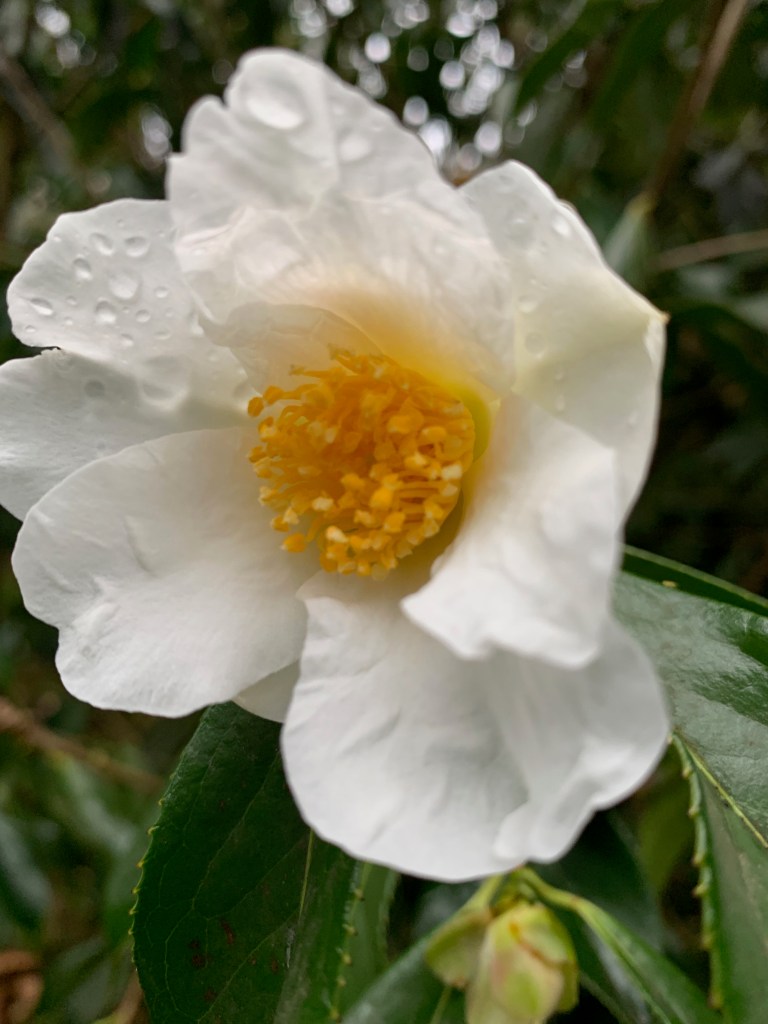
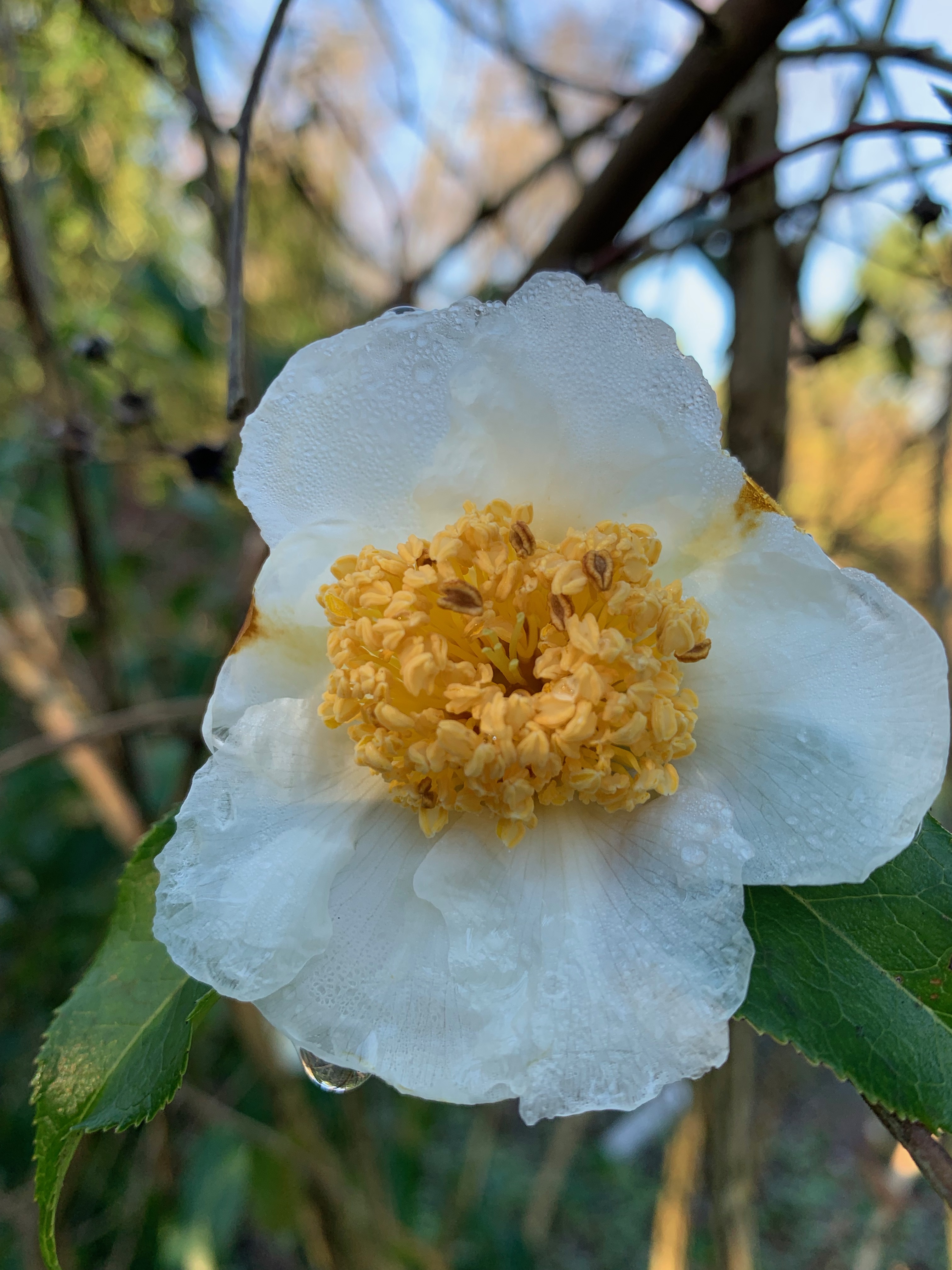
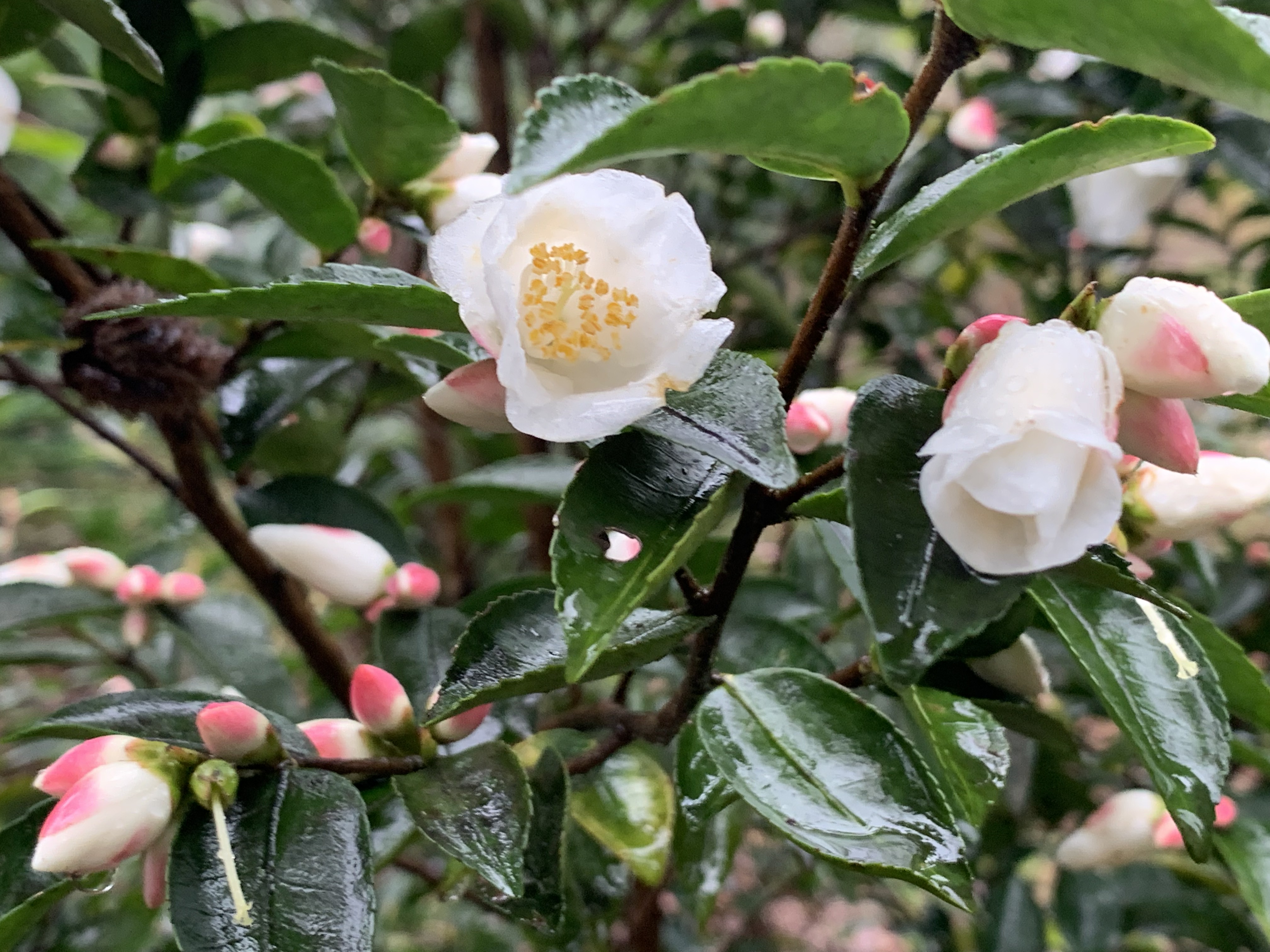
Certainly, winter hardiness appears to be less of a concern after 20 years growing experience here. Not only have these newer Camellia species not succumbed to frost, but last year C. tunganica, introduced by White House Farm some 15 years ago, maintained fresh white flowers in abundance after a series of -7C nights: freshness of flower already the standout quality of this species, which drops before browning, essential in a white.
C. tunganica
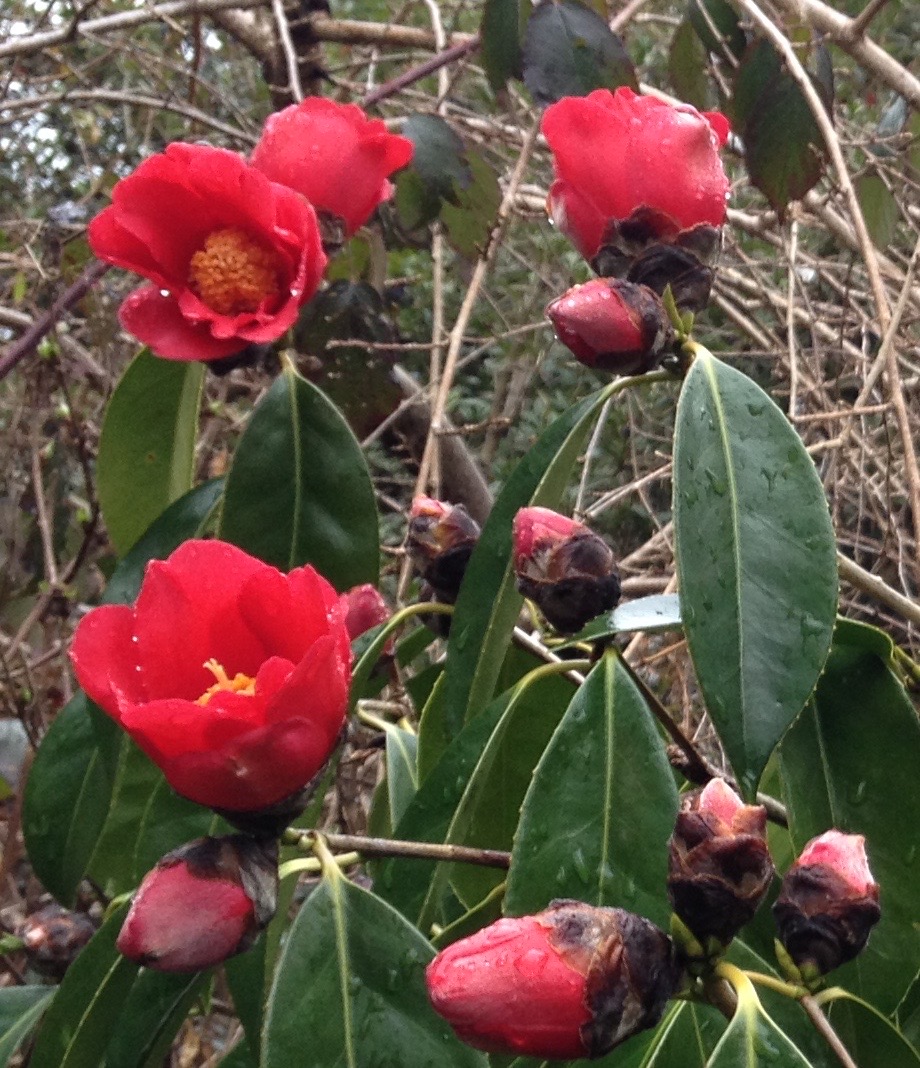
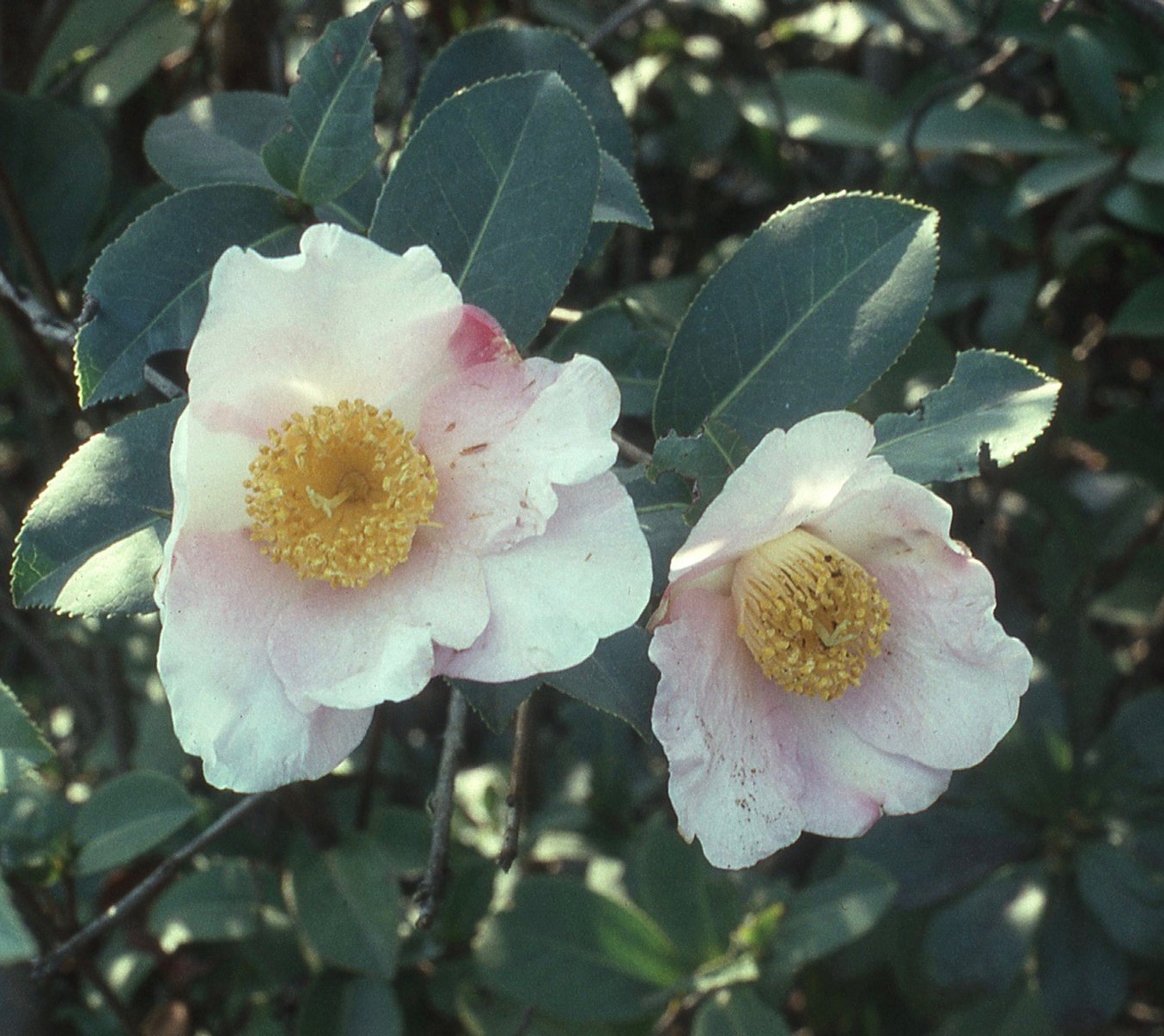
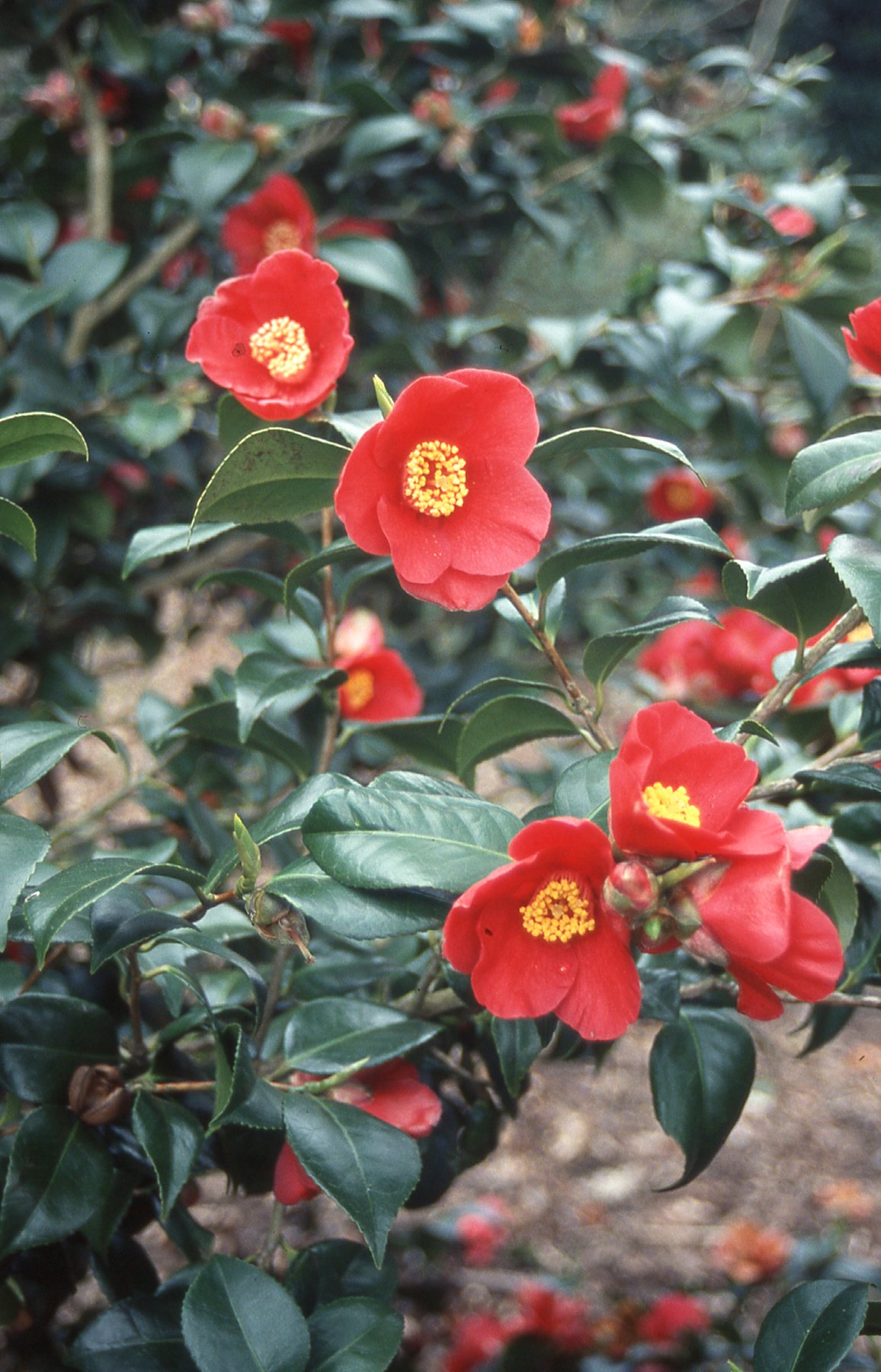
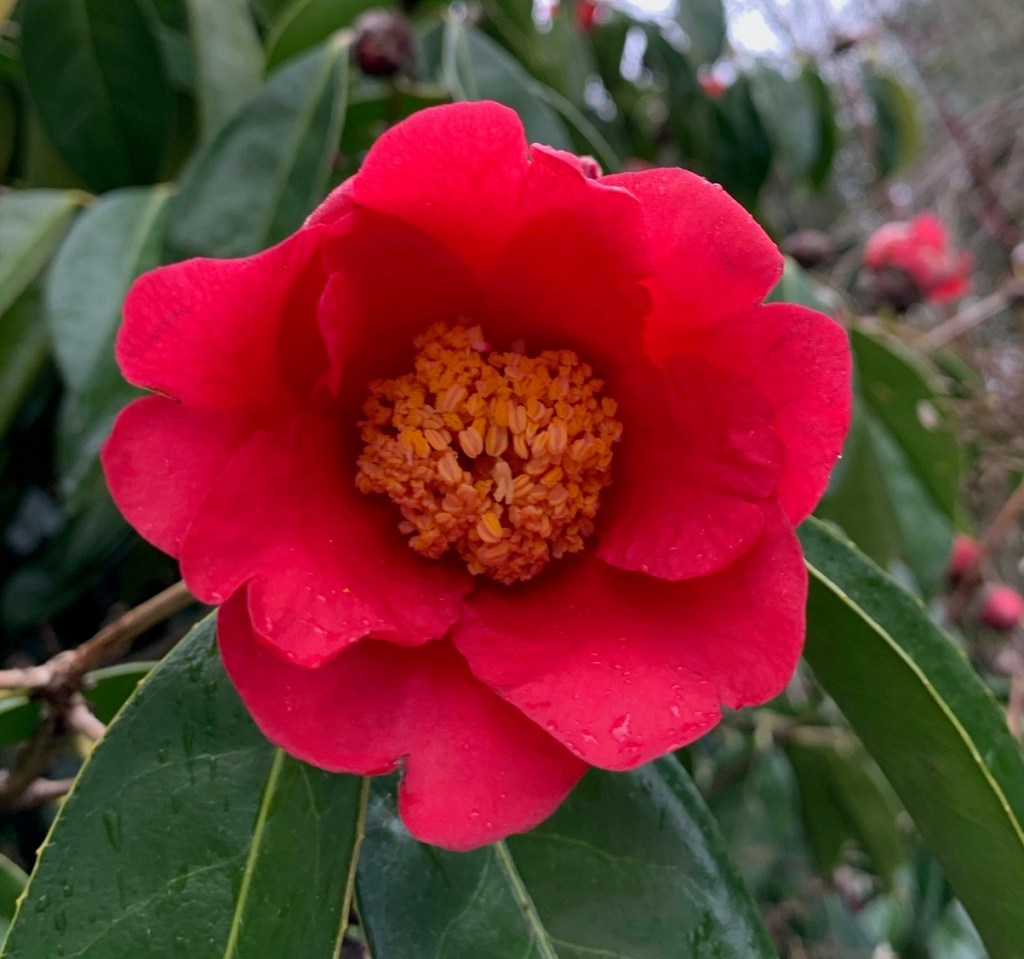
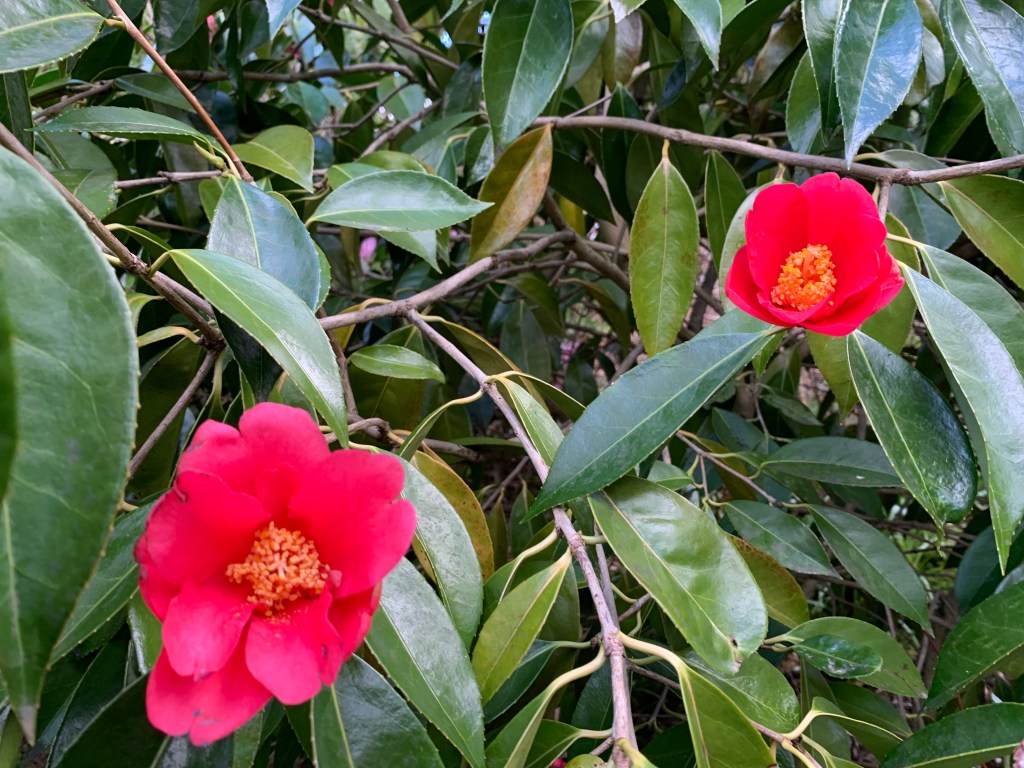
Bearing in mind that all species vary from seed, some of these species can clearly hold their own with the best of the garden hybrids in flower and foliage. Of three large flowered red species, the spectacular red flowers of C. chekiangoleosa warrant inclusion in any collection – and although I am now pretty sure that some of my open pollinated seedlings are contaminated with C. japonica and are natural hybrids, my plants still show what is distinctive about the species: a tough, vigorous pyramid of bold glossy large elliptic leaves ( typically 16x5cm) studded with large cupped flowers of a vivid clear blood red, significantly larger than those of typical C. japonica. It outperforms the reds C. polyodonta and C. semiserrata, which have also survived multiple cold winters here (-7C).
C. chekianoleosa – this form likely a wild hybrid with C. japonica
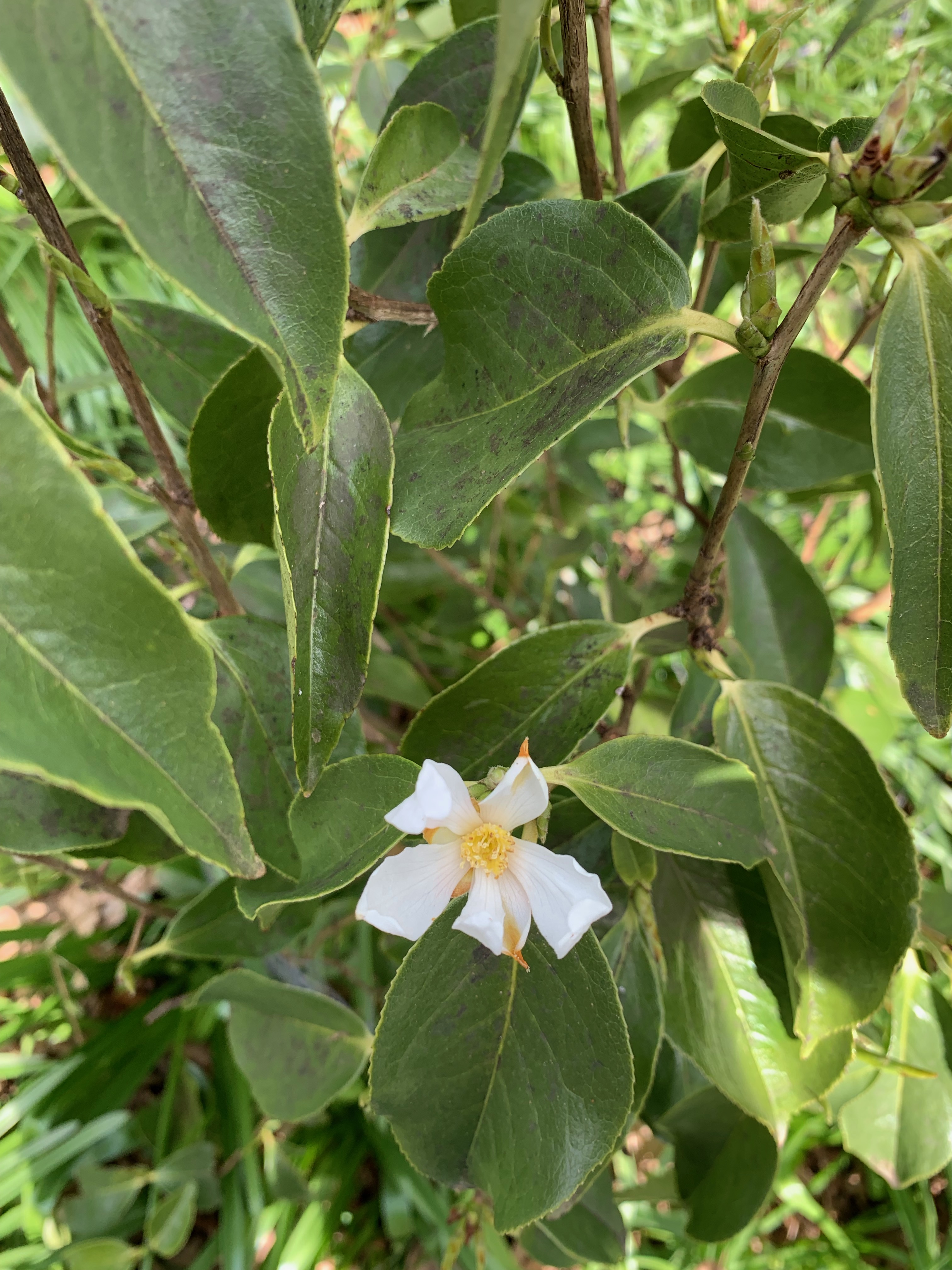
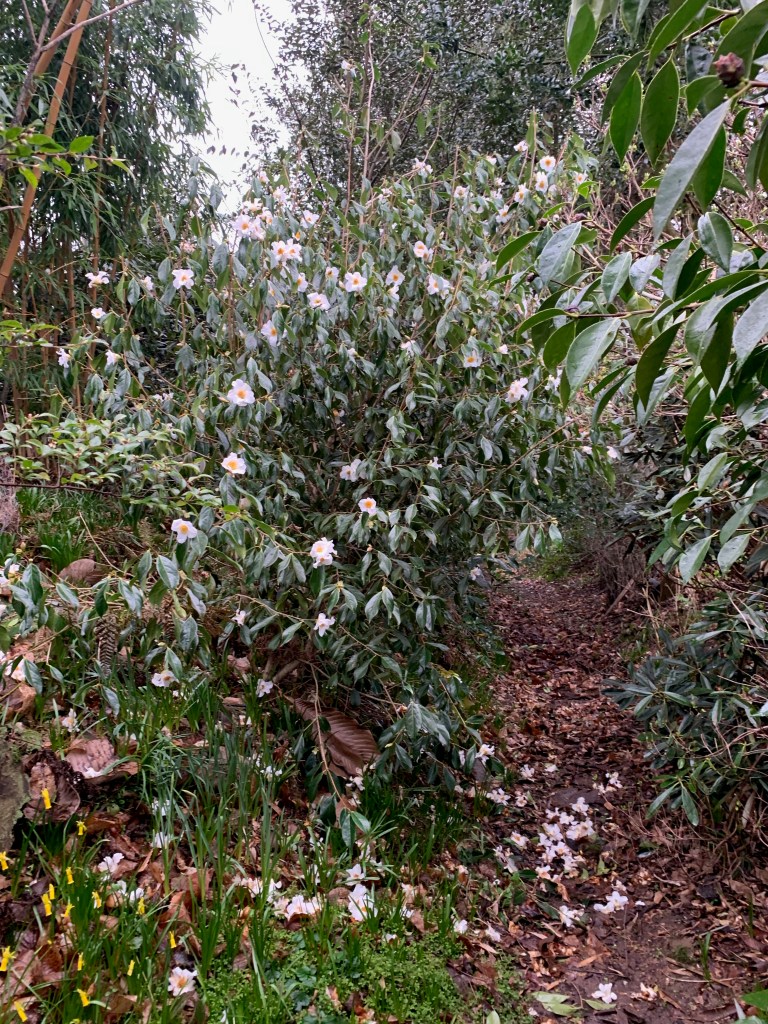
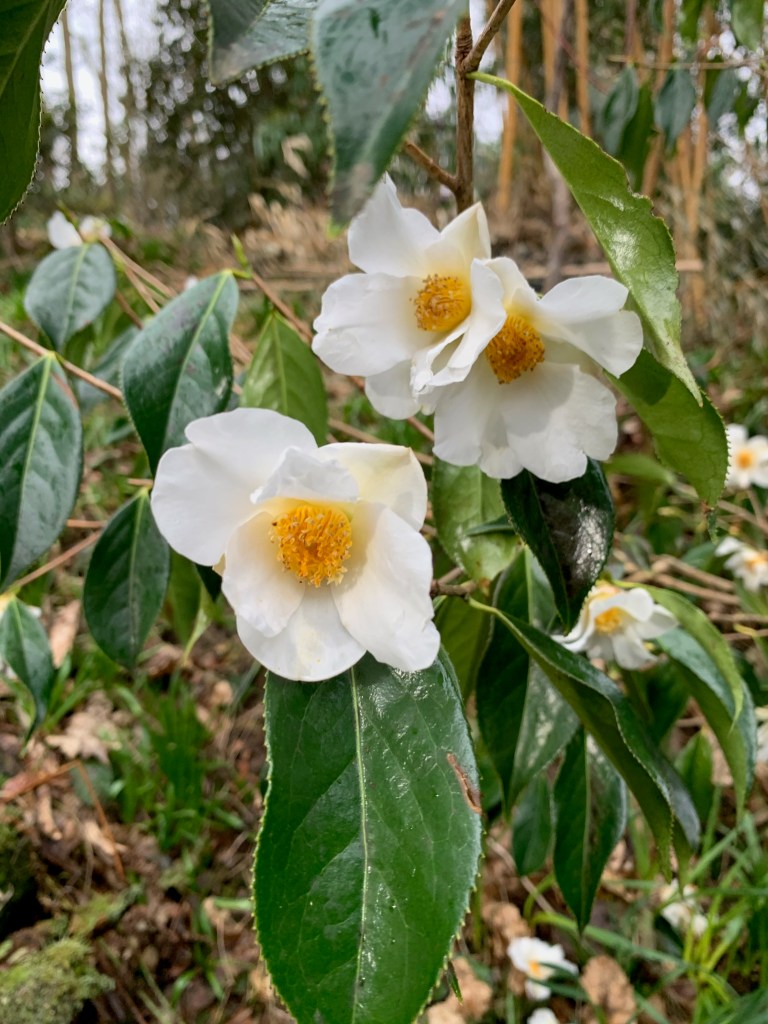
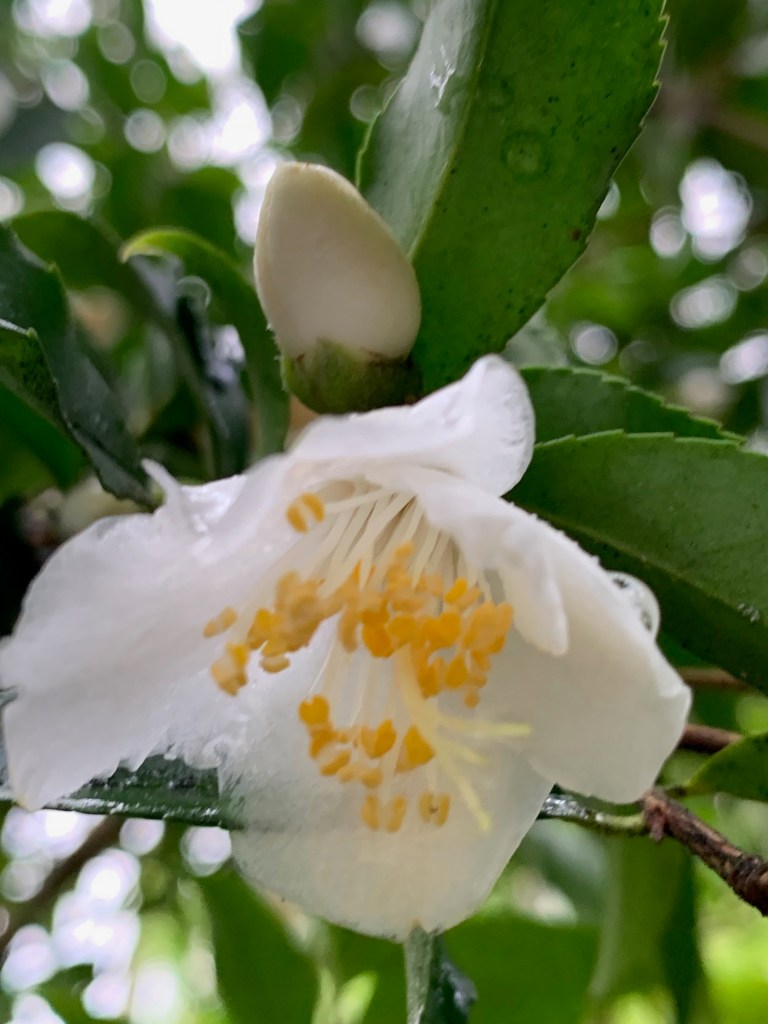
A species that should certainly be more widely grown is C. trichocarpa. From SE Yunnan and SW Guizhou at altitudes up to 2300m it is moderately hardy: here three plants have been growing strongly without problem for 17 years. The 5-6cm white flowers appear in early spring and have a large central boss of bright yellow spreading stamens, presenting themselves beautifully on an upright shrub (reaching about 3m) among green 11 x 5cm wavy edged leaves with deeply impressed veins, and attractive cinnamon bark.
See Maurice’s 2019 RCM Bulletin article on C. trichocarpahere:
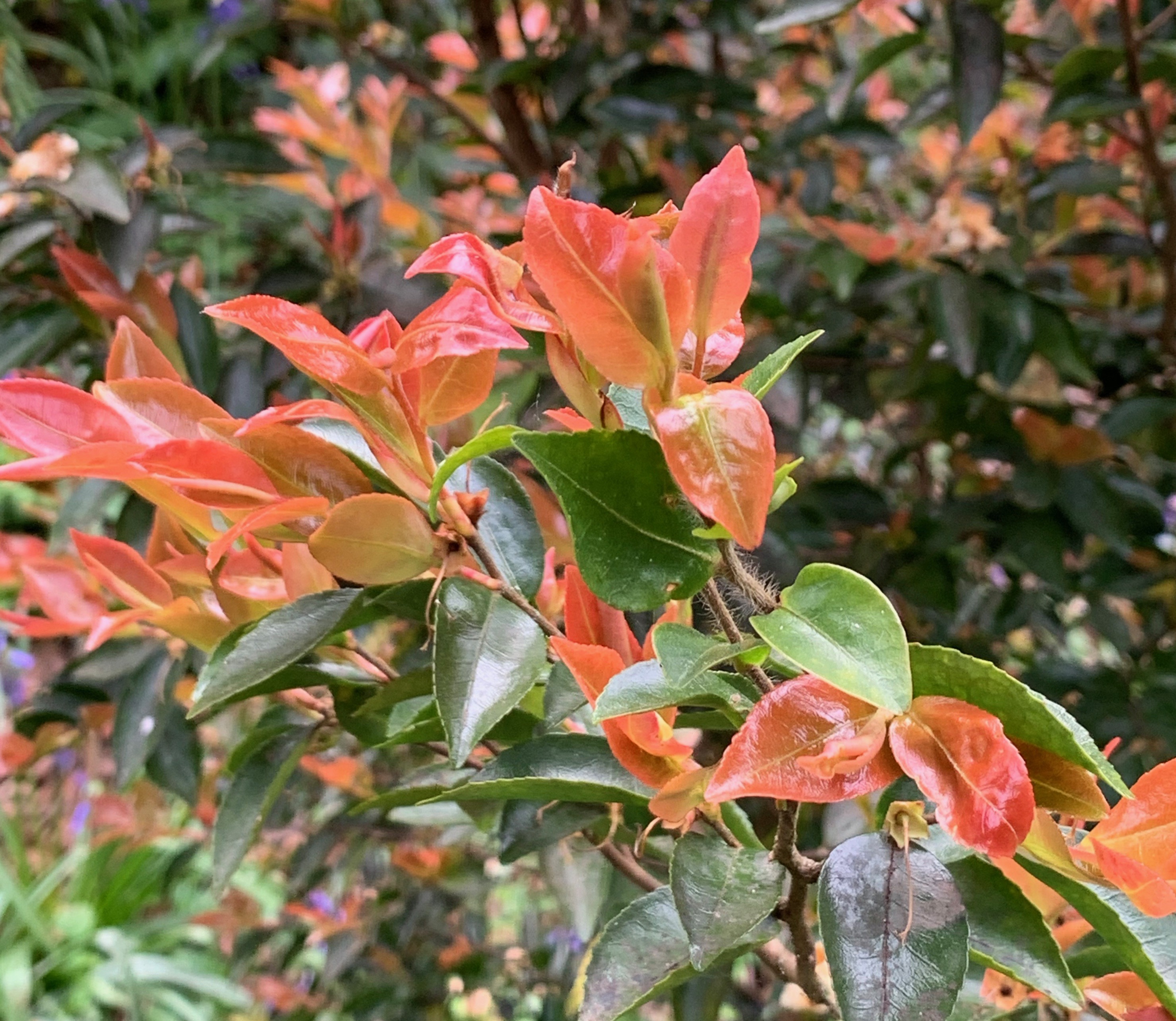
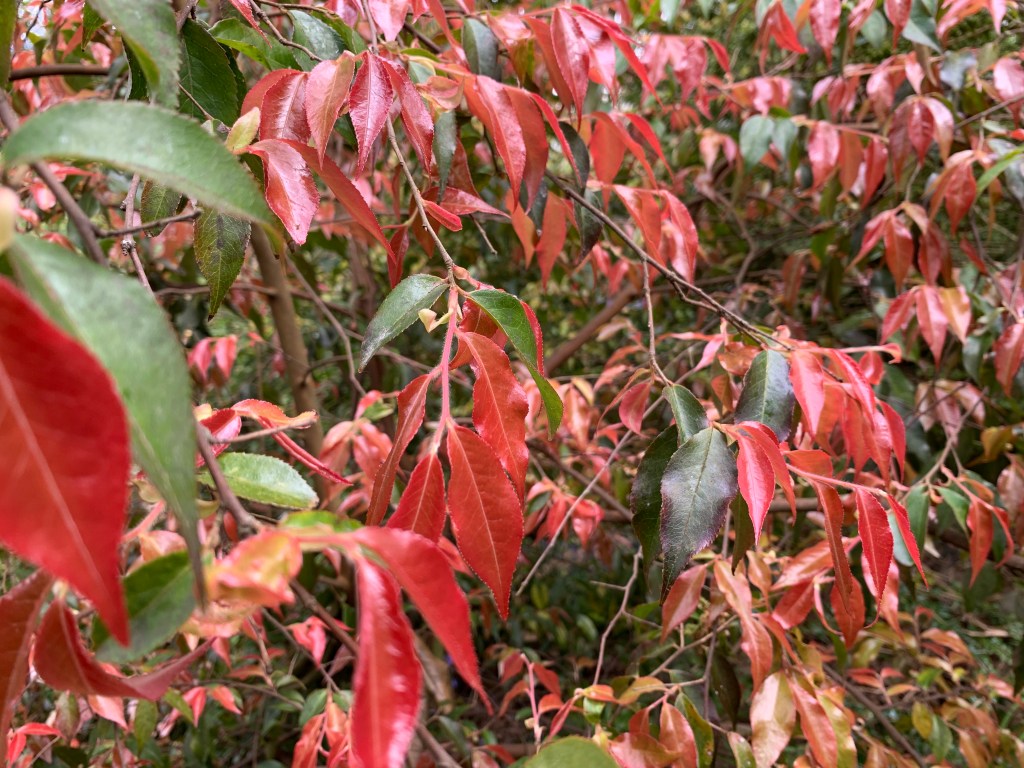
Ming reduced C. trichocarpa to a subspecies of C. henryana, but in cultivation the two are quite different. The flowers of the latter are much smaller, on a bush with a loose, spreading habit, and smaller, less impressively veined, acuminate 7x3cm lanceolate leaves more widely spaced on arching shoots. C. henryana is exceptional for its spring foliage: perhaps the best red young growth of all.
C. henryana – worth growing for its spring foliage display alone
Reddish coppery young growth is an attractive character of many species and is also a feature of C. yunnanensis, a species in turn often confused with C. henryana, as both flower from late October, and can continue over winter in milder weather into early spring. But C. yunnanensis flowers are relatively large, up to 8cm, produced both terminally and in the upper axils with the white petals reflexing to give still more prominence to the yolk-like shock of yellow stamens.
C. yunnanensis once mature (c. 10 years+) produces a good crop of conspicuous large fruits, like purple cheeked apples; as does C. tricocarpa, whose prominent apple-sized fruits, red where exposed to sun, are a valuable ornamental feature. I’ve found the seeds of this and most other camellia species also germinate, and the seedlings establish, very easily.
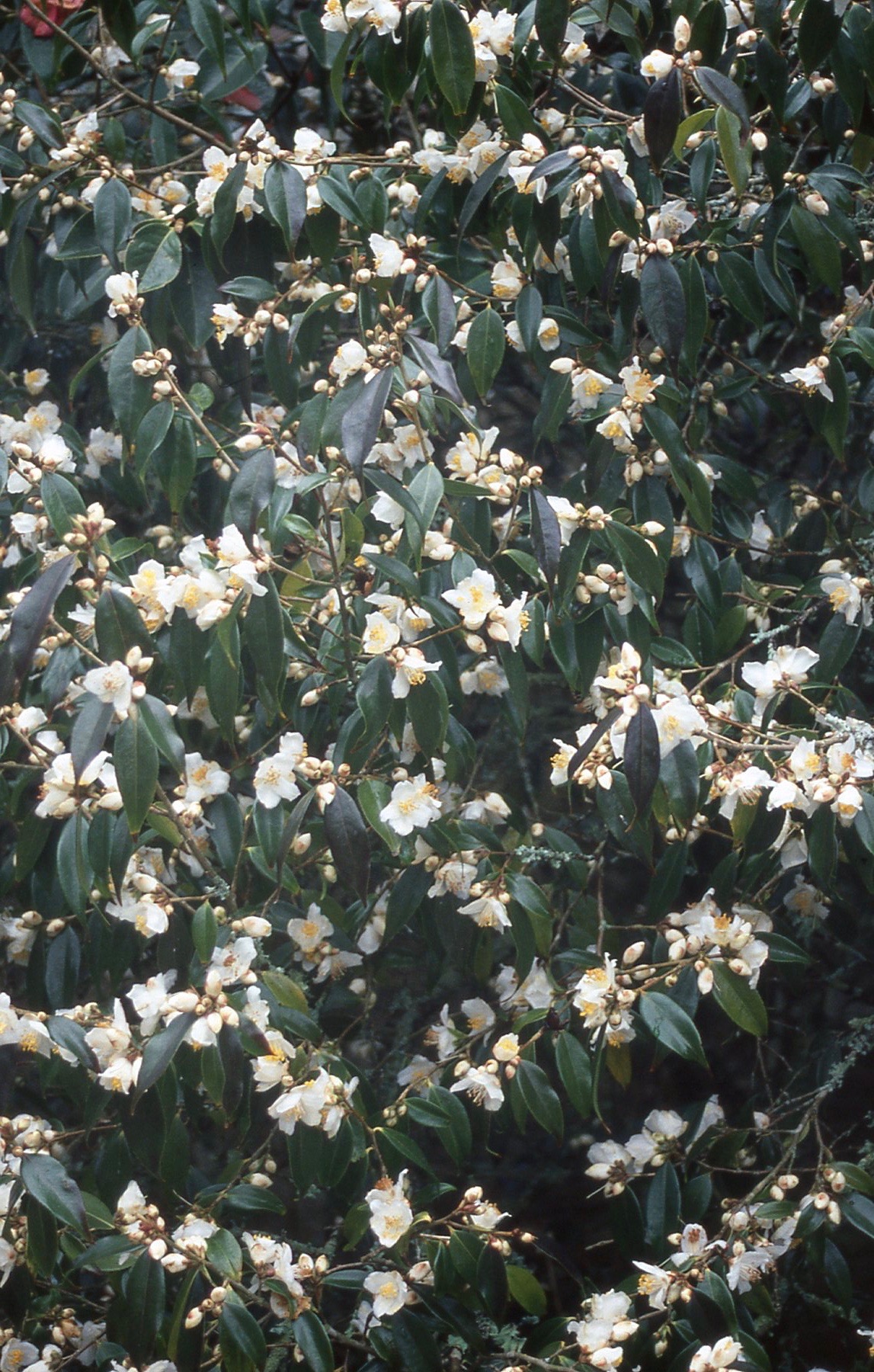
Also white-flowered but entirely different in character are C. forrestii, C. grijsii and C. brevistyla: all are small-flowered substantial shrubs, and all are proving to be hardy, achieving about 3m after 7-10 years. C. forrestii is particularly free flowering, terminally and in the leaf axils. The small flowers of some 3 – 4cms across are slightly cupped and slightly fragrant. Ovate petite leaves have a slight gloss on a bushy neat shrub. From Yunnan and found up to 2500m, it has been perfectly at home here and our two plants are fringed by dozens of self sown seedlings.
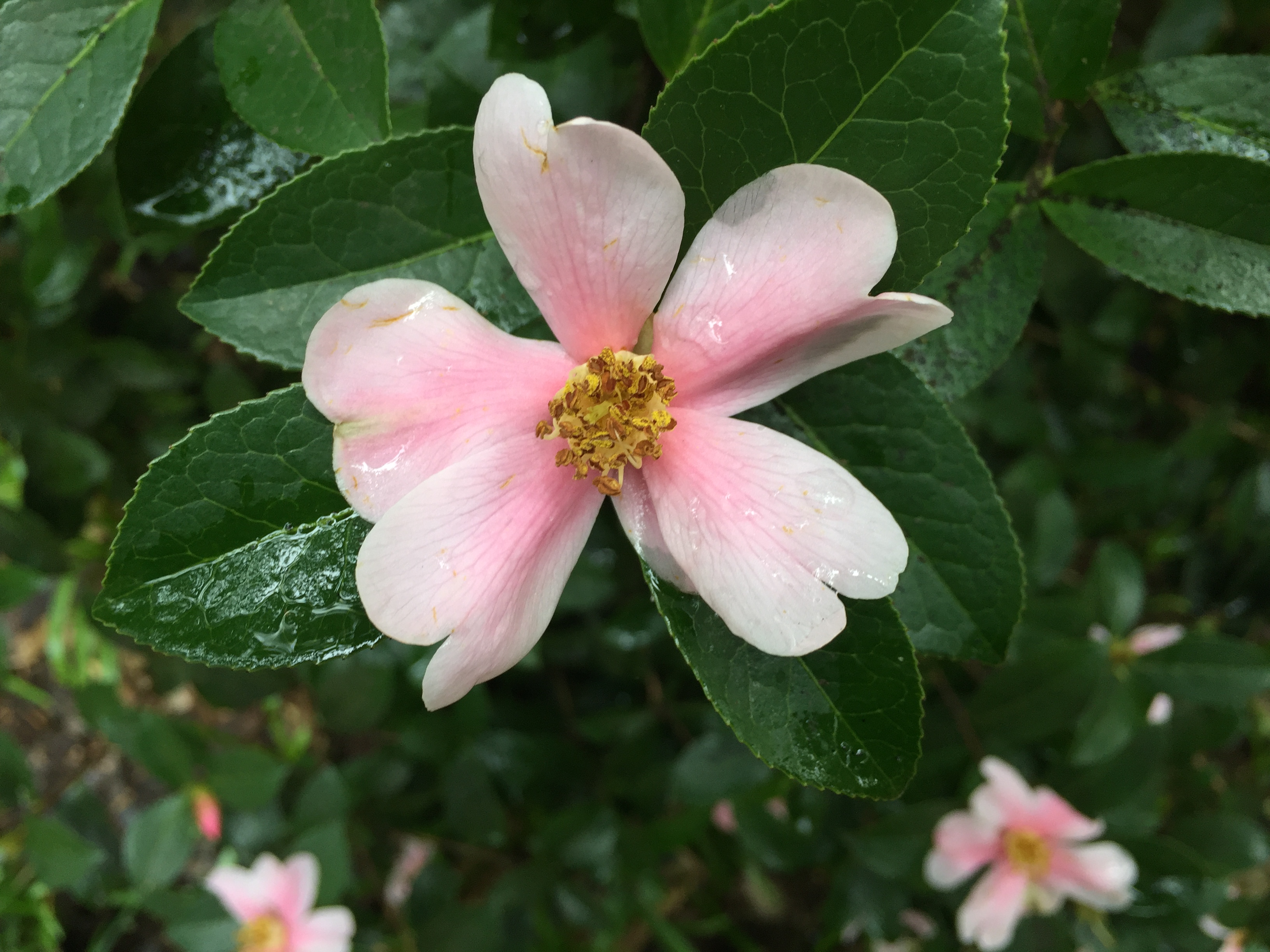
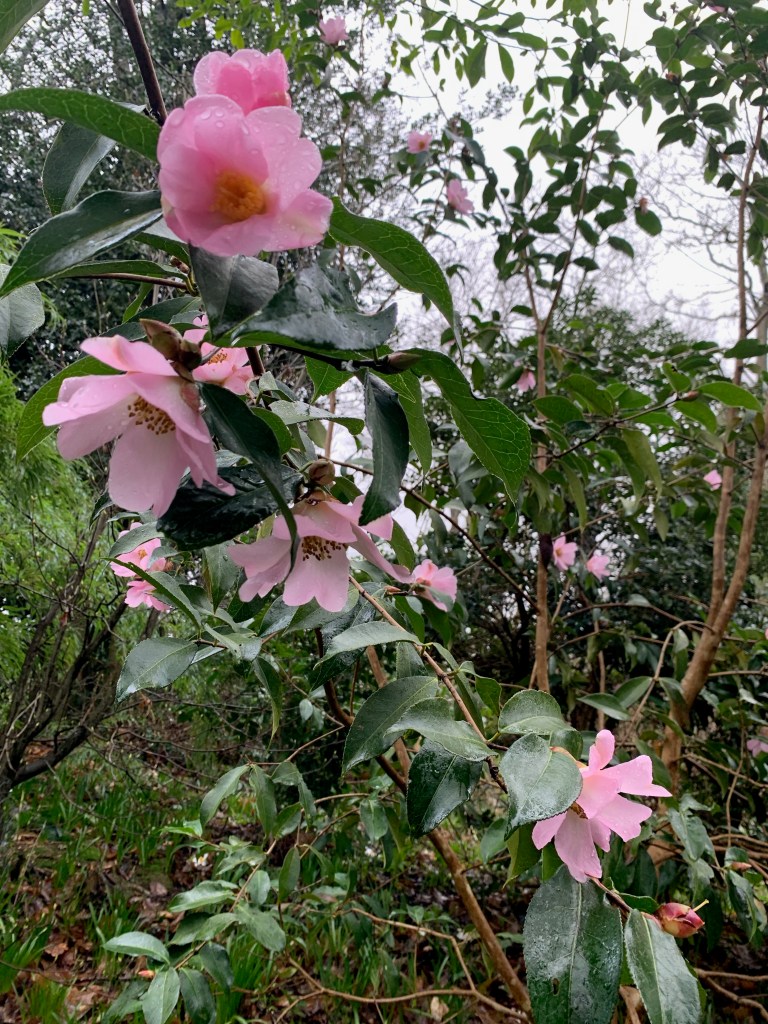
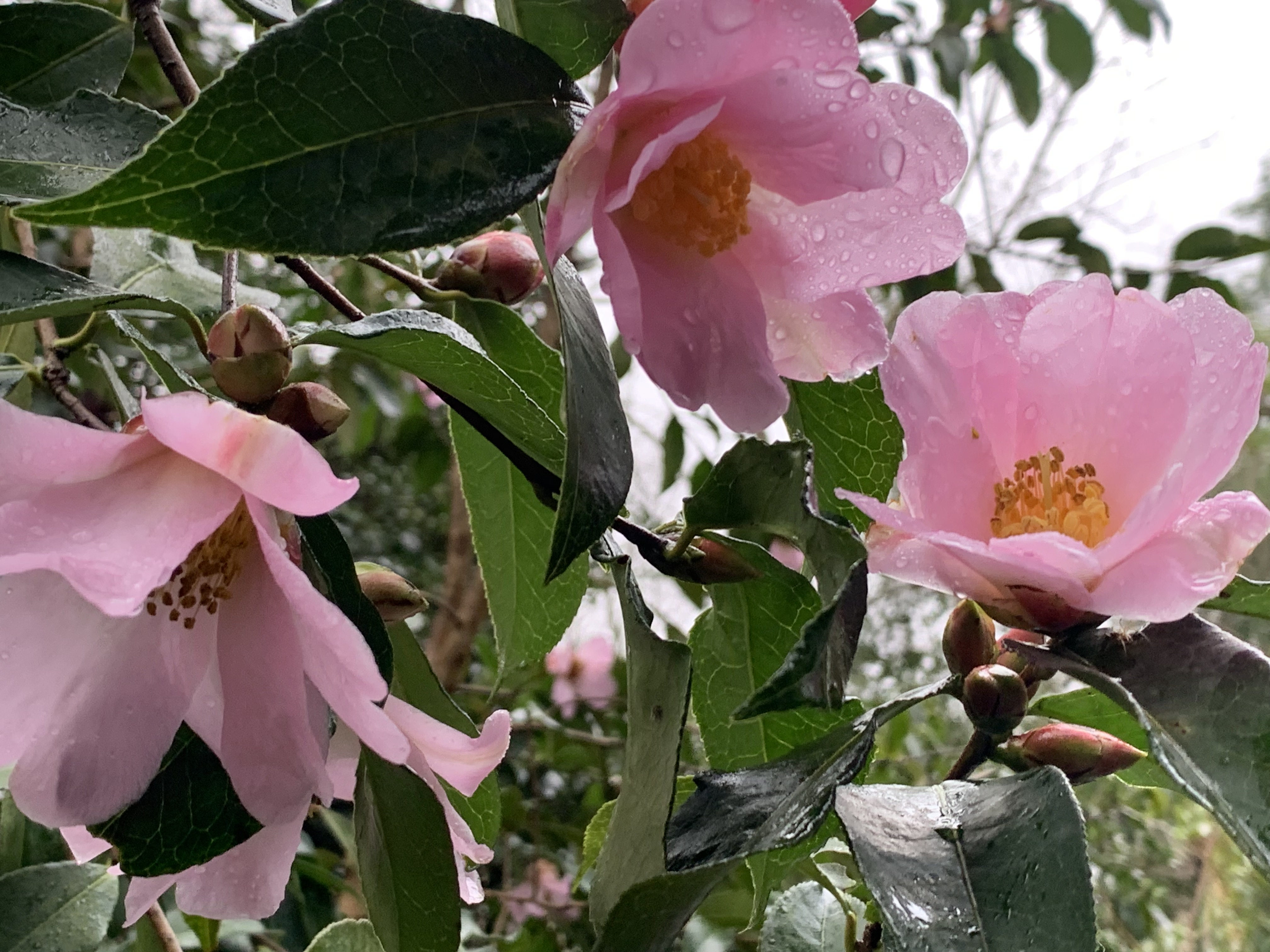
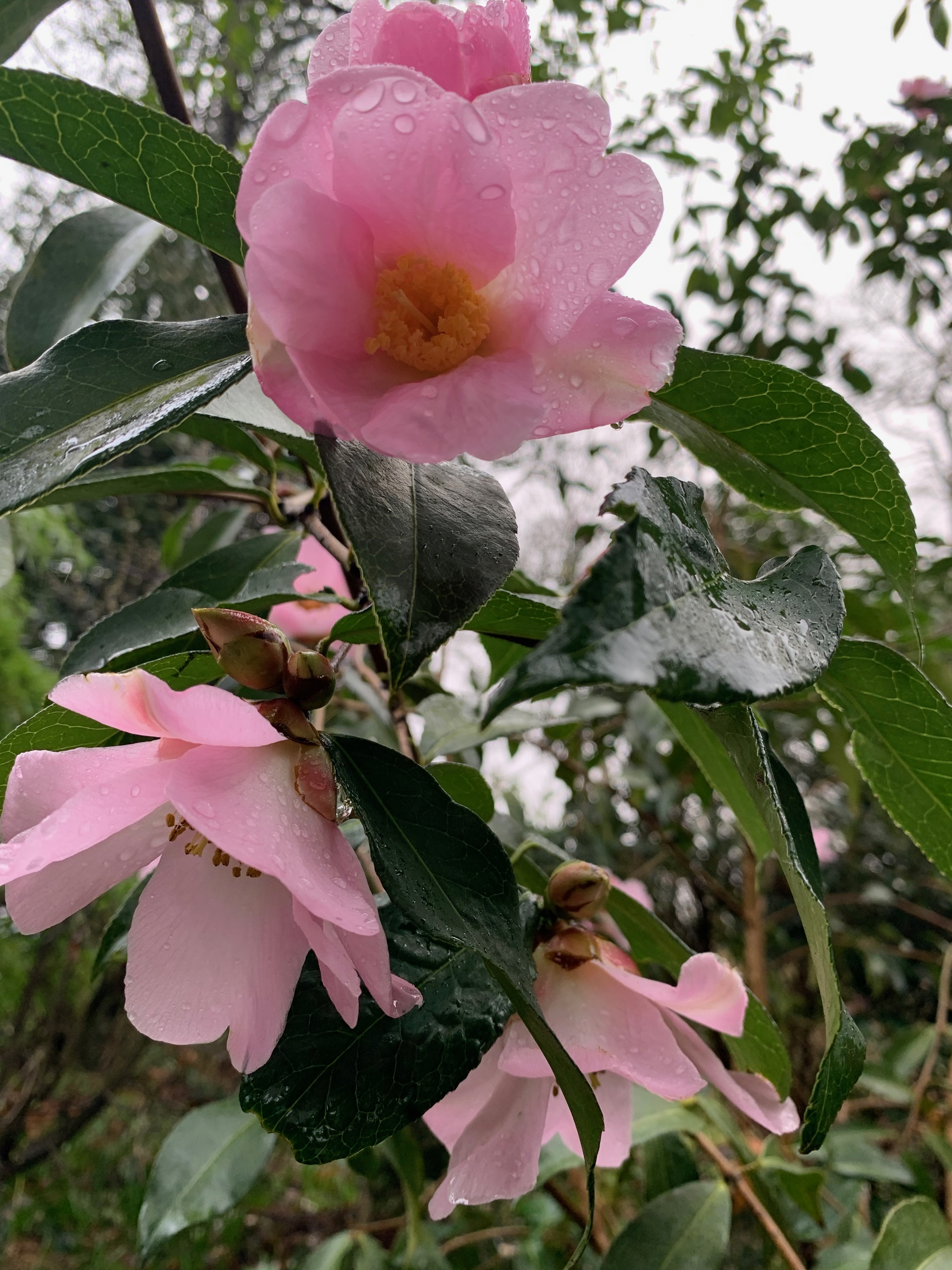
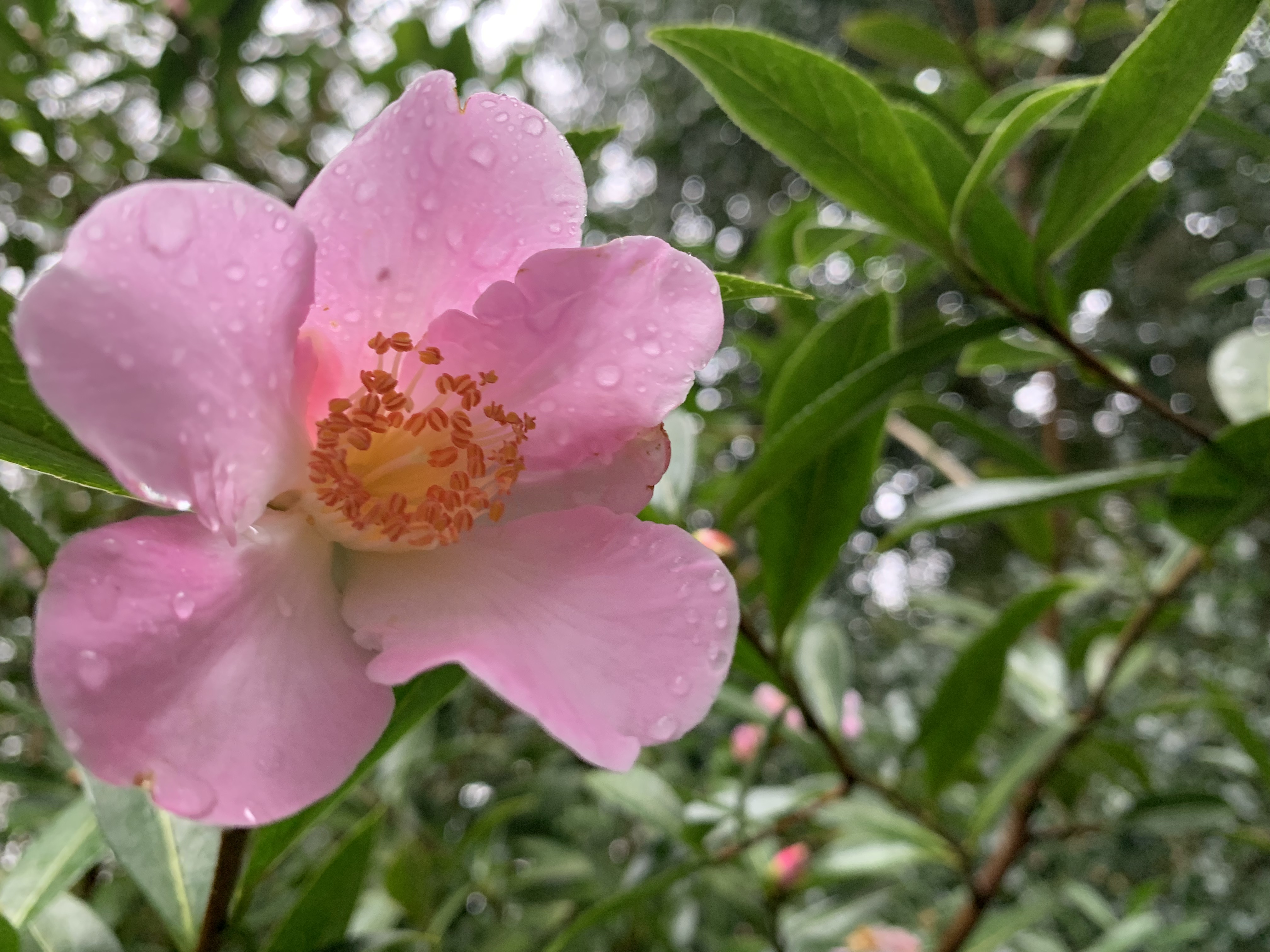
C. pitardii, with a wide distribution in China, is perhaps my favourite, variable in habit and in flower, with colour ranging from rich pink to white. In a good form flowers are of high quality, some specimens a clear shell pink, with little of the more typical vinous underlay. I have three different collections, all growing well after a decade; the best has an open habit and clustered flower buds, both terminal and axillary, with up to twelve buds on less than a foot of stem. The elegant open funnel shaped flowers are up to 8cm in diameter and open in succession over a long period from February onwards. It is an excellent plant often confused with C. saluenensis, parent of the great C. x williamsii race.
The Taiwanese species C. transnokoensis is now well known and frequently planted. It has turned out to be surprisingly hardy, and its dense bushy habit, small leaves and abundance of small flowers in spring make a great display. We grow 3 or 4 forms, the best with dark pink buds, the colour retained on the back of the outermost petals when open, particularly attractive. It is an excellent candidate for a small garden, or a specimen plant in a pot.
Many other new Camellia species are thriving in Cornwall – these notes offer a mere glimpse into a future full of exciting potential, and suggest what is already possible in Kent. This looks likely to be a continuously expanding new range of plants which are beginning to prove their value in gardens, and for hybridising, too. They certainly offer beauty and interest in a far more demanding range of garden conditions than their native origins might seem to allow.
References: Collected Species of the genus Camellia. An illustrated outline. By Gao Jiyin, Clifford R. Parks, Du Yueqiang.
See Maurice’s 2017 RCM Yearbook article on Camellia species here.
There will be an IDS Study Day on the genus Camellia on Saturday March 30th at White House Farm: for more information click here.
There will also be a Garden Masterclass guided tour of White House Farm Camellias and Magnolias on April 4th: for more information click here.
By WHFAF Trustee Christopher Sanders VMH. This article was originally published in December 2023 by the RHS Plant Review. Reproduced by kind permission of the RHS.
Erwan Le Bec, a French horticultural student at INH school (Agrocampus Ouest Angers) writes about his recent visit to us as an intern. He left us with extraordinary photographs and research notes about our collections.
Since I was a child I’ve had a particular interest in the world of plants.
It started with my grandfather’s vegetable garden, then moved to ornamental plants, and especially woody plants, whether trees or shrubs, because to me they seemed incredible living creatures, able to survive against all the difficulties of our world. This passion developed over the years and I decided to take advantage of my studies in landscape design to deepen my knowledge of botany. I began in 2019 with an internship at the Roscoff botanical garden, then continued with an internship at the Aoba nursery, run by Cédric Basset and Manon Rivière, and, last year, had a unique experience at Wespelaar arboretum with Christophe Crock and Koen Camelbeke. This world of trees and shrubs is now for me both a refuge and an idyllic setting for a future professional life.
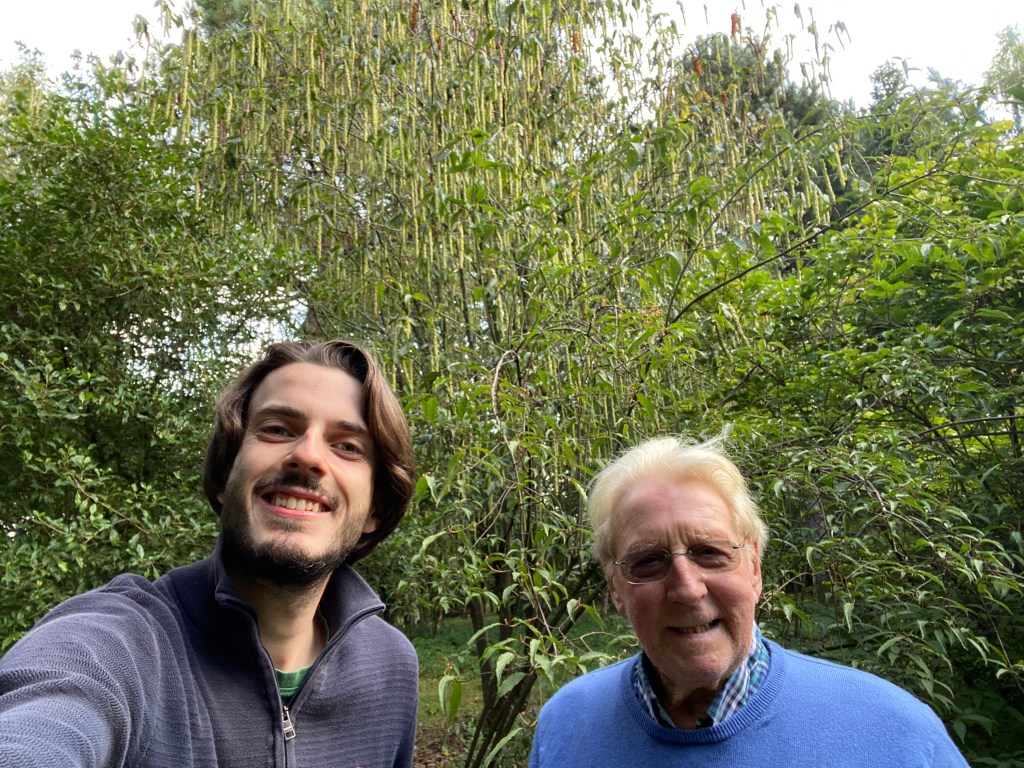
A selfie with Carpinus fangiana
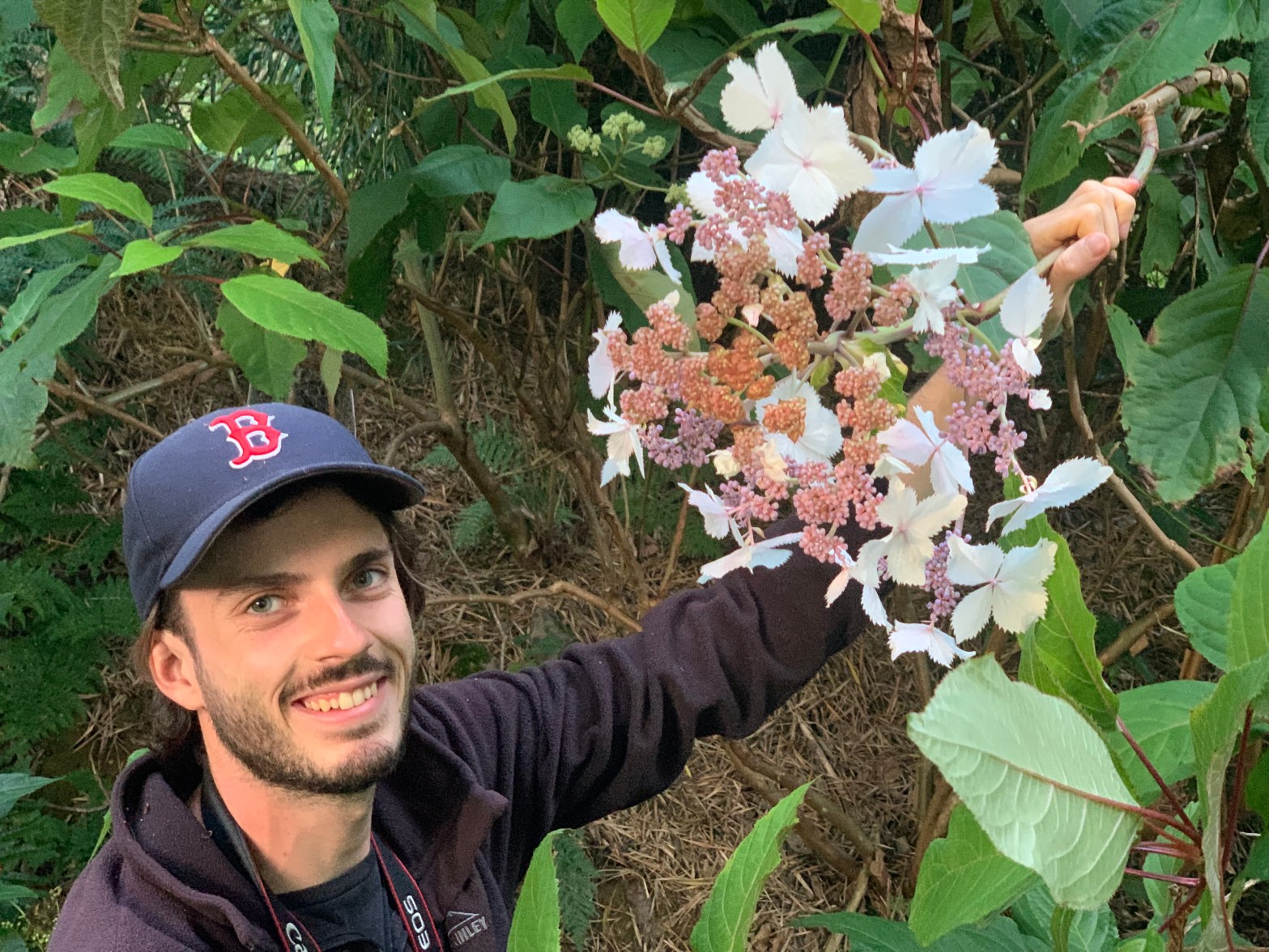
For several years I’d been hoping to be able to have some experience in gardens in England, to improve my English and my knowledge of plants at the same time. Last summer, during a talk in Herkenrode with Philippe de Spoelberch, we spoke about the garden at White House Farm and its wonderful Hydrangea collection. Having worked on the Hydrangea collection at Wespelaar arboretum, WHF seemed a good choice for my next internship destination. After few emails, I agreed with Maurice Foster on a 3-week internship in August 2023. As soon as I arrived, I felt right at home at White House Farm, with a nice welcome from Clare, her children and Maurice. The atmosphere was incredible: a house in the middle of a treasure trove of plants from so many different horizons. The Hydrangea aspera had just begun to bloom and were shining in all their splendor, like images I’d seen in books about the flora of China.
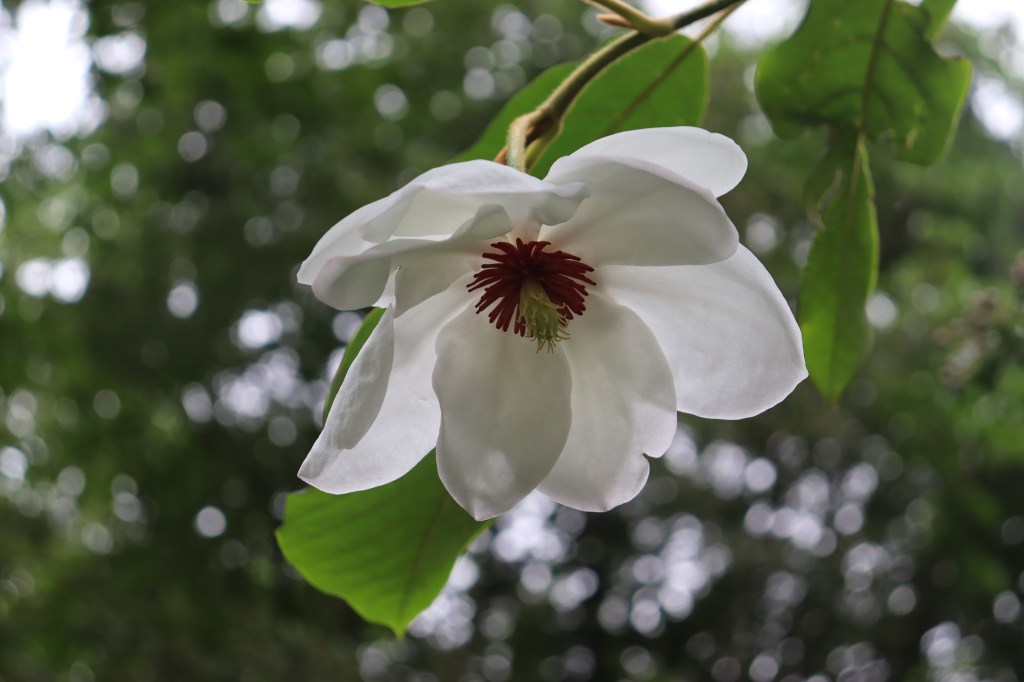
From the very first evening, Maurice welcomed me with open arms into his world, giving me access to his knowledge and some interesting books: it was the beginning of an incredible experience, three weeks of pure happiness. During these weeks I inventoried with Maurice some zones in the garden, and some genera like Carpinus, Sorbus, Corylus and Euonymus. Thanks to this work, I discovered my favourite plant of the garden: the Magnolia wilsonii x Magnolia globosa seedling from one of his collections that he has nicknamed ‘Parachute’ because of its very big white flower.
White House Farm Magnolia seedling ‘Parachute’, 17cm across
Any activity with Maurice at White House Farm is interesting and instructive, because at WHF each plant has its own story, so every day he took me with him to the different regions of his travels. For example, he discovered Carpinus fangiana in Yunnan in 1998 with some American botanists – the tree had no fruits, and they thought that the foliage looked fagaceous, and was probably an oak. But Maurice kept on searching, and finally spotted a the very characteristic single fruit of Carpinus fangiana in some taller branches. I also helped the arboretum team for one day a week, pruning, tree-felling, and weeding, which was a great way to learn about plant collections in a different way, as something constantly changing. And every week Maurice took me to different famous gardens like Wisley, Nymans and Hilliers to meet different plant specialists, such as Chris Sanders, Chris Lane, Rod White and Jack Aldridge. It was a great pleasure to talk to them, each one a specialist in his own areas.
Rod White’s private garden
This unique and comprehensive experience was very encouraging; it helped me feel I belong in this world of enthusiasts. So I’m finishing my last year of study in landscape design by specialising in urban green spaces, with a 6-month work experience in February 2024 to conclude my course, which I hope to do in a garden or arboretum. My sincere thanks to Maurice and Clare for their welcome, and to Philippe de Spoelberch for this recommendation.
_______________________________________________________________________________________________For more about White House Farm, join WHF Friends to receive our latest newsletter.
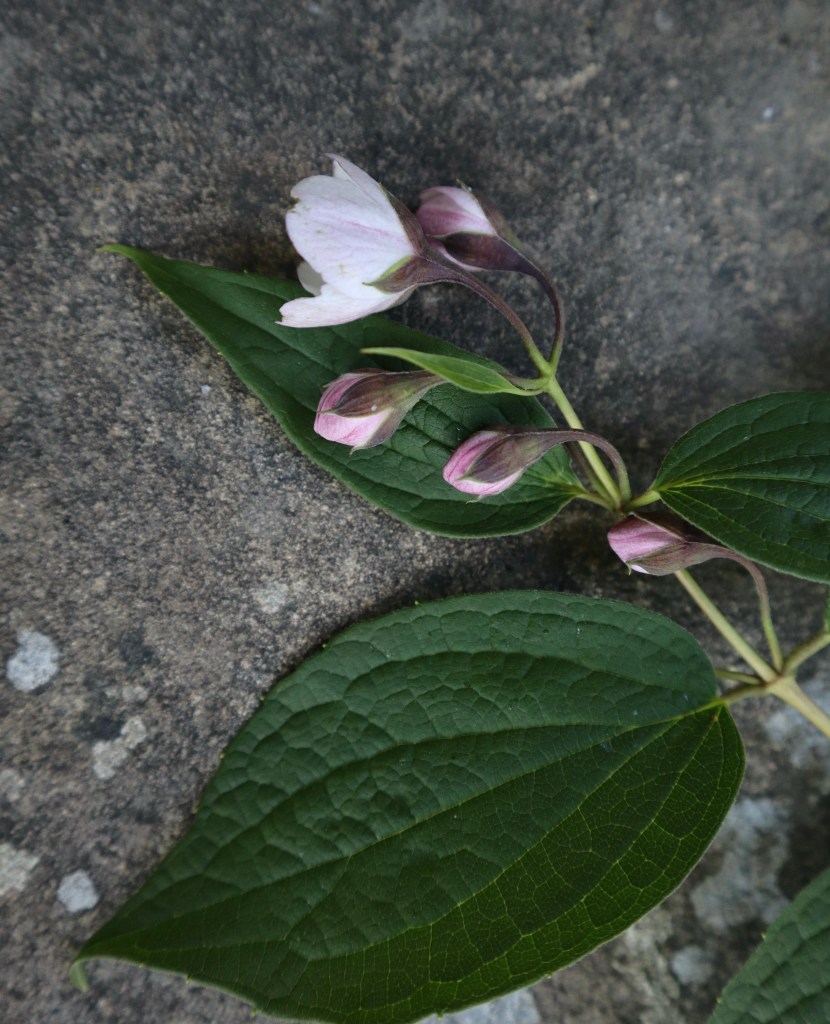
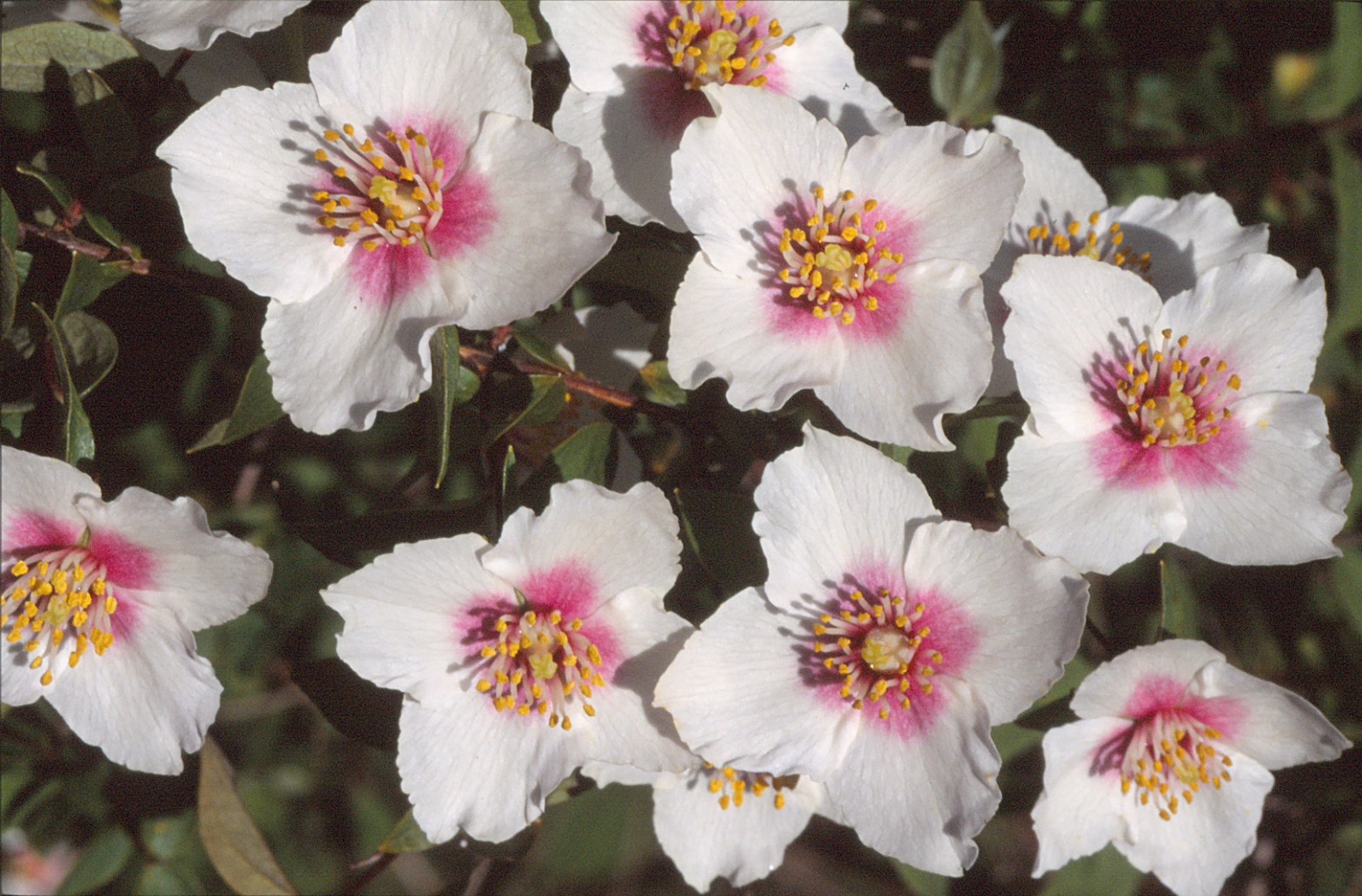
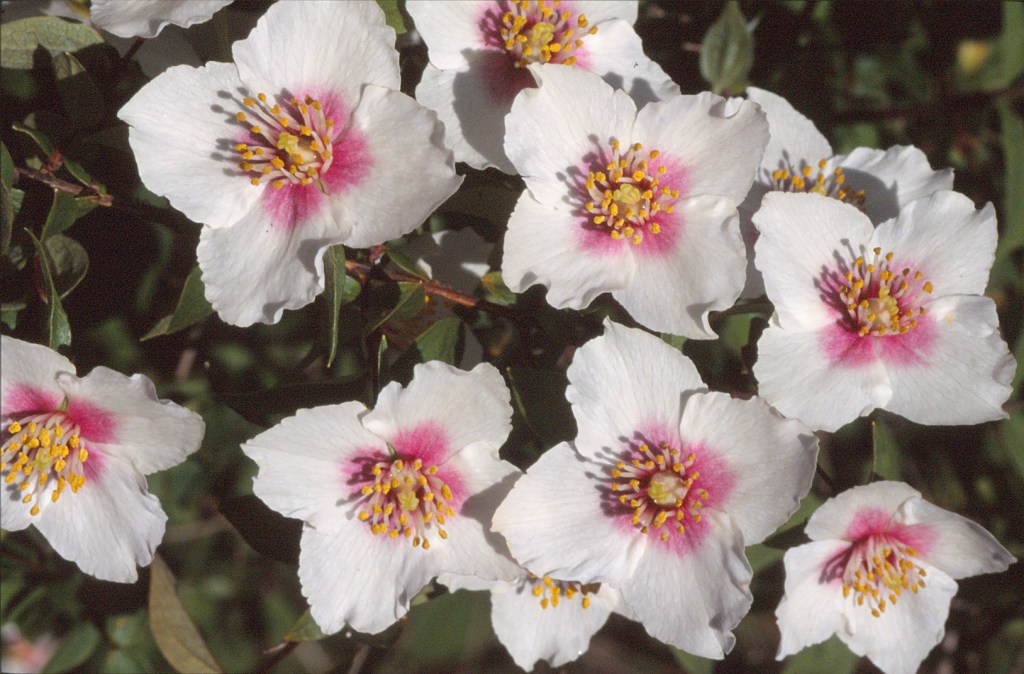
It’s well known that some Mexican species and their hybrids such as P. maculatus, P. mexicanus and P. ‘Belle Etoile’ possess a gene for the colour pink, but this is manifested as a more or less basal blotch on the inner surface of the petals, resulting in a central ring of pink or purplish-pink in the heart of the flower. However, those present at the recent Philadelphus Study Day at White House Farm were intrigued when shown a young shrub recently planted out in the Wood, which was clearly exhibiting pink-flushed flower buds and whose petals had faint pink streaks on their exterior.
Maurice told us that he had been given this as a cutting under the name of Philadelphus aff. delavayi “pink form” during an RHS Woody Plant Committee visit to Bodnant in North Wales a few years ago. The name seems somewhat doubtful, given that P. delavayi is an early-flowering species; other examples of P. delavayi in the collection (a fine melanocalyx B & L collection and the Nymans form, for example) had mostly finished flowering by the study day (17th June), although a longer-lasting P. delavayi flavescens was still going strong into July. It reminded me that I had once seen something similar many years ago on a visit to Highdown, the famous chalk garden near Worthing, Sussex, created by Sir Frederick and Lady Stern. It bore no label, but at the time I attributed it to P. tomentosus.
Philadelphus tomentosus? A pink form of Philadelphus photographed by the author at Highdown
Fortunately, I took photographs of it because on a more recent visit I found that the border where I last saw it had become a dense, overgrown thicket and there was no sign of the pink philadelphus. Hopefully it is still there, but the whole border is in desperate need of drastic pruning in order to give it a chance to recover. In the meantime, fellow trustee Jack Aldridge found in the Wisley library the following brief reference in EXTRACTS from the Proceedings of The Royal Horticultural Society, Vol. LXXXI, 1956, Part Two:
Referred to Scientific Committee and to be seen at a future meeting:
Philadelphus L. & S. 17408 (pink form) exhibited by Sir Frederick Stern O.B.E., M.C., Highdown, Goring-by-Sea, Sussex.
This must be the same thing I saw at Highdown. Further research revealed that L. & S. 17408 was collected by Frank Ludlow in Gyasa Dzong, NW Bhutan, on Oct 3rd 1949. Frank Ludlow and George Sherriff (L. & S.) collected mainly in Bhutan and SE Tibet, and P. tomentosus is native to the Himalaya. More details have been requested on the precise origins of both this and the Bodnant plant, and I’ll report back here as more information comes in.
Another picture (by Jack Aldridge) of White House Farm’s Bodnant ‘pink form’: encouragingly pink in bud.
Might there be a connection between the Highdown and Bodnant plants? Back in the 1950s at the regular RHS fortnightly shows at Vincent Square, there would have been much keen but friendly competition involving many of the great gardeners of the time, including Sir Frederick Stern from Highdown and Lord Aberconway from Bodnant. Plants and/or cuttings were likely freely exchanged afterwards, so the Highdown philadelphus could well have found its way to Bodnant.
It is, then, not inconceivable that the pink genes of the Mexican plants could be married to species like these from the Himalaya, and maybe after a couple of generations we might see a really pink philadelphus.
As a result of the successful Philadelphus study day held at WHF on Saturday 17th June, two rare Lemoine Philadelphus cultivars believed to have been lost to cultivation have come to light.
Philadelphus ‘Oeil de Pourpre’ (Purpureomaculatus Group)
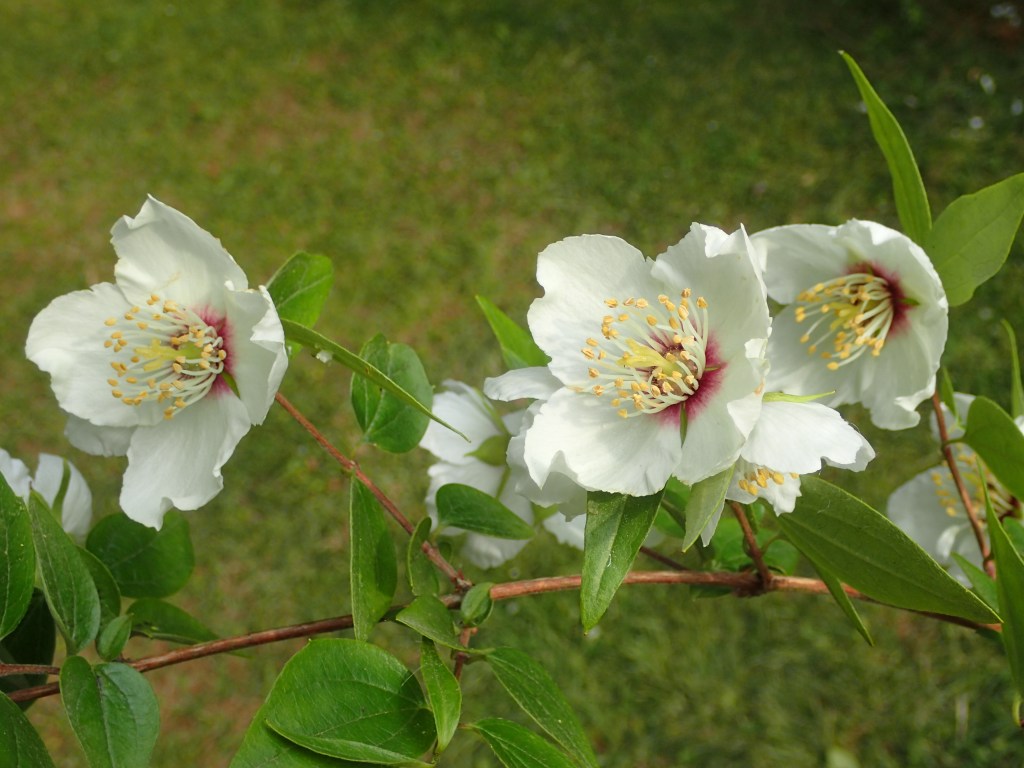
Trustee Jack Aldridge, who is based at Wisley, brought a handsome specimen from that garden labeled ‘Oeil de Pourpre’. At first, both Maurice and myself, who had both grown and lost this cultivar in the past, and remembered it as a rather weak plant of poor constitution, were rather doubtful about its identity. However, on returning home, I dug out some images taken many years ago when I grew a specimen obtained from the National Collection of Philadelphus at Leeds, and I’m now convinced that the Wisley plant is indeed correctly named. In the attached image its chief characteristics of a deep purplish basal blotch (the deepest colour of any Philadelphus) and the distinctive cup-shaped blooms can clearly be seen.
‘Oeil de Pourpre’ was raised by the famous French Nursery of Victor Lemoine et Fils and introduced in 1910.
Philadelphus ‘Oeil de Pourpre’ Photo: Chris Sanders
At the study day, there was some discussion about two other Lemoine cultivars, namely ‘Bicolore’ and ‘Purureomaculatus’, neither of which had been seen in cultivation for some time. I later recalled that a plant from Leeds which had been distributed as ‘Bicolore’ had been misidentified and was really ‘Purpureomaculatus’, but, like ‘Oeil de Pourpre’ seemed to have become very rare and no longer offered for sale. Arguably, this is the most attractive of the group with widely expanded medium-sized flowers having a good purple blotch at the base of each petal.
Philadelphus ‘Purpureomaculatus’ (Crathes)
A couple of days after the event, the indefatigable Jack alerted me to a small Shropshire nursery (Harley Nursery, near Much Wenlock) who were offering ‘Bicolore’ for sale via their website. Photographs accompanying the text left no doubt in my opinion that this was clearly ‘Purpureomaculatus’. A visit to the nursery on the following day resulted in the purchase of five lusty plants for distribution to interested parties. Also, interestingly, the nursery owner confirmed that he had obtained his original stock from the (now defunct) National Collection at Pershore College in Worcestershire. As a former student at this college who was very familiar with the collection in its heyday, I was aware that much of the Pershore collection had been obtained from guess where – Leeds!
‘Purpureomaculatus’ was raised by Lemoine and introduced in 1902.
The above two cultivars are really important discoveries and the intention is to propagate them as soon as possible for wider distribution. Now it just remains to try and track down the real ‘Bicolore’.