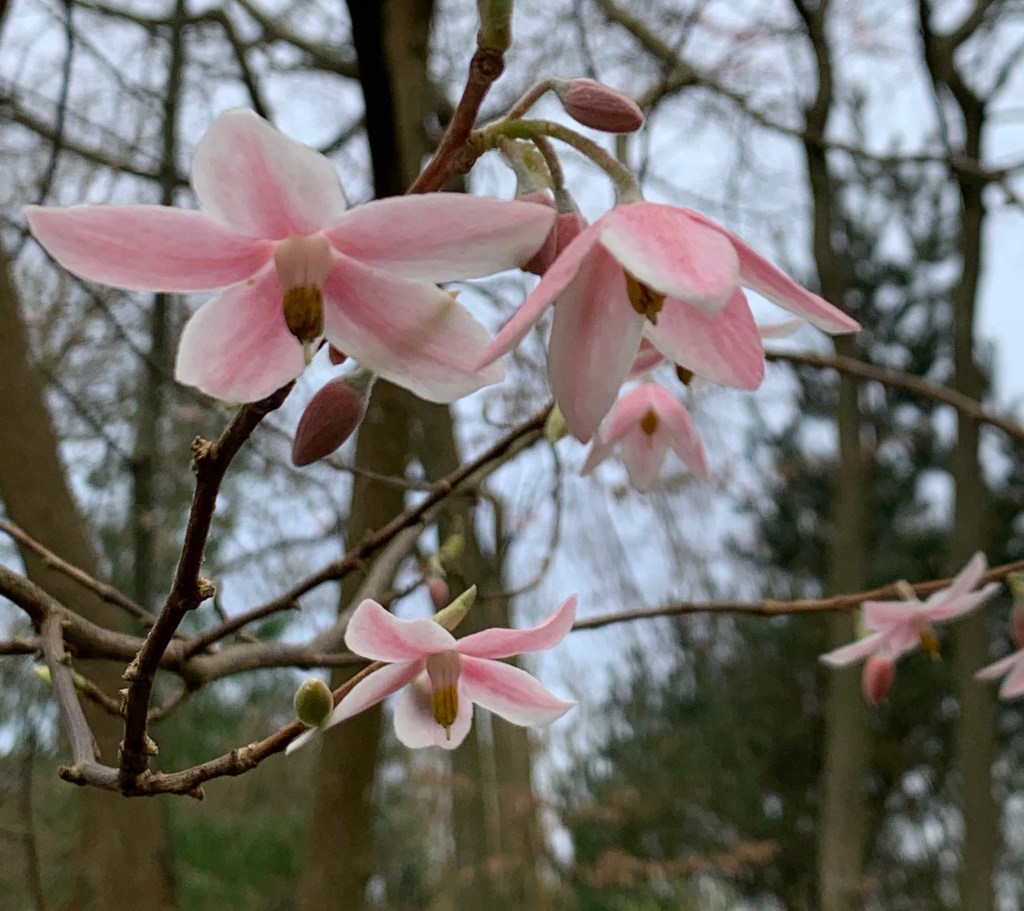
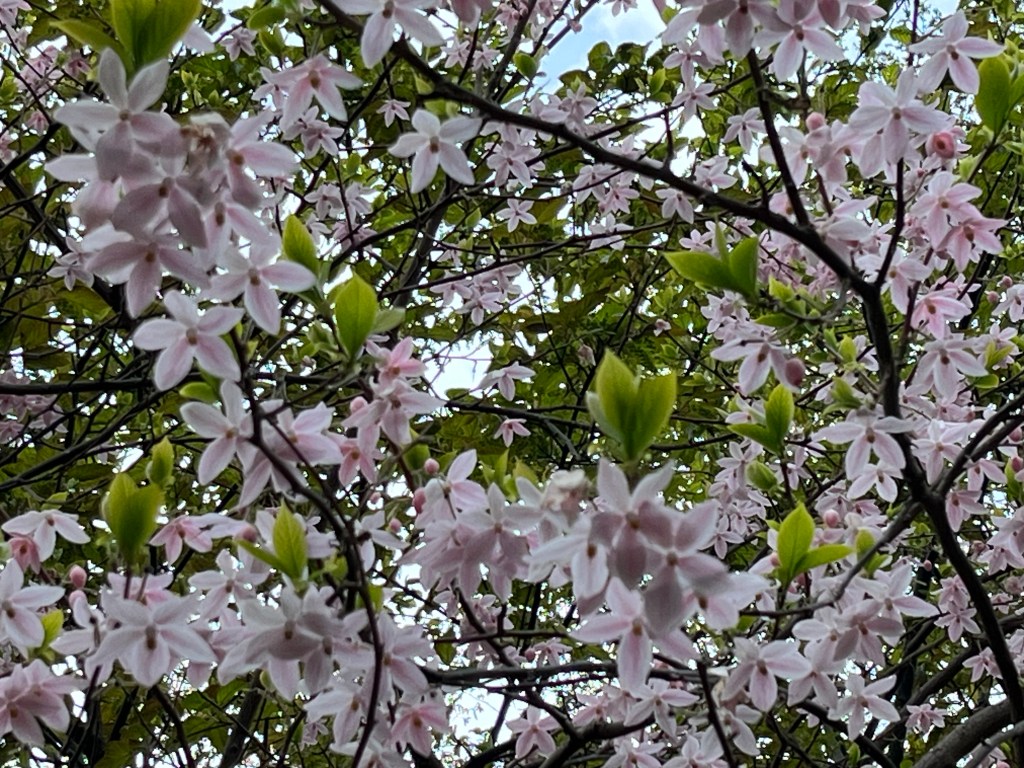
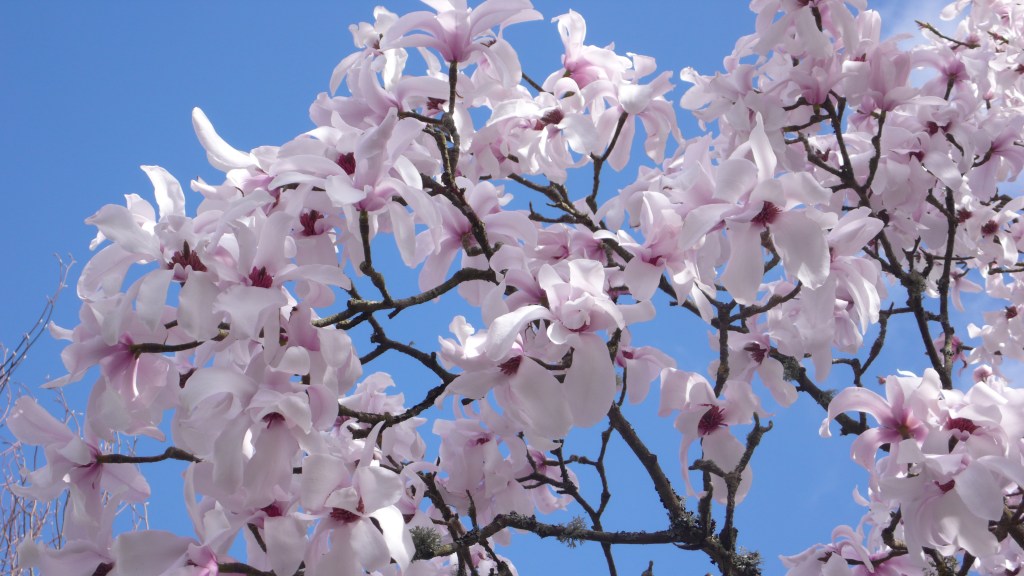
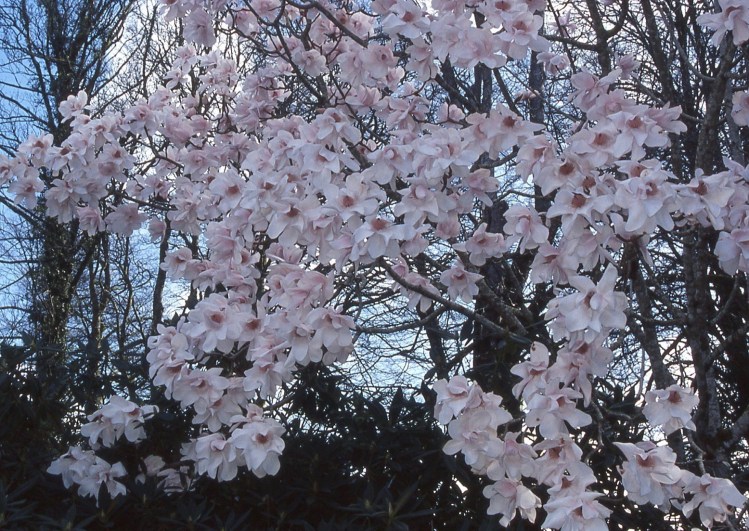
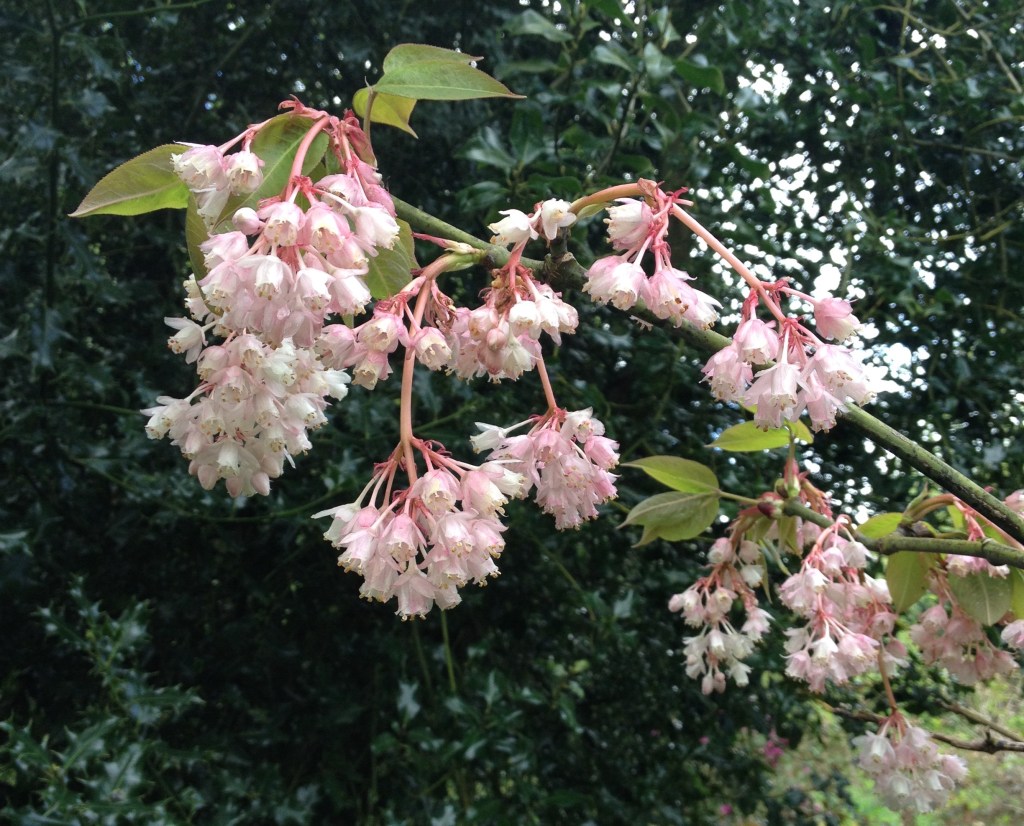
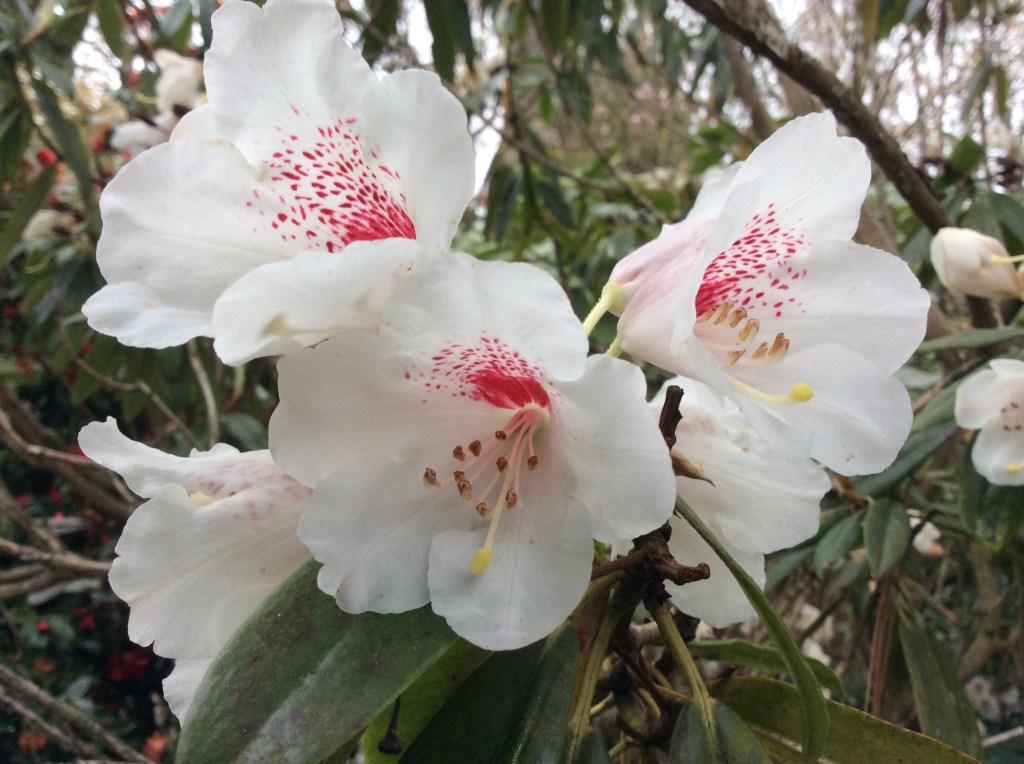
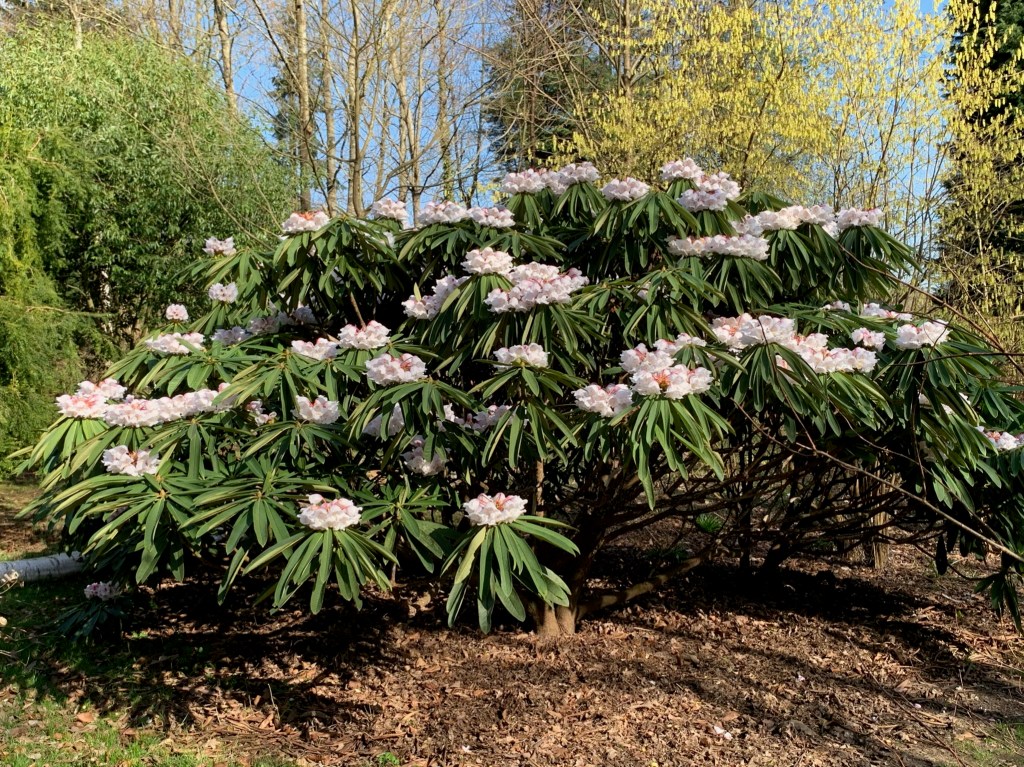
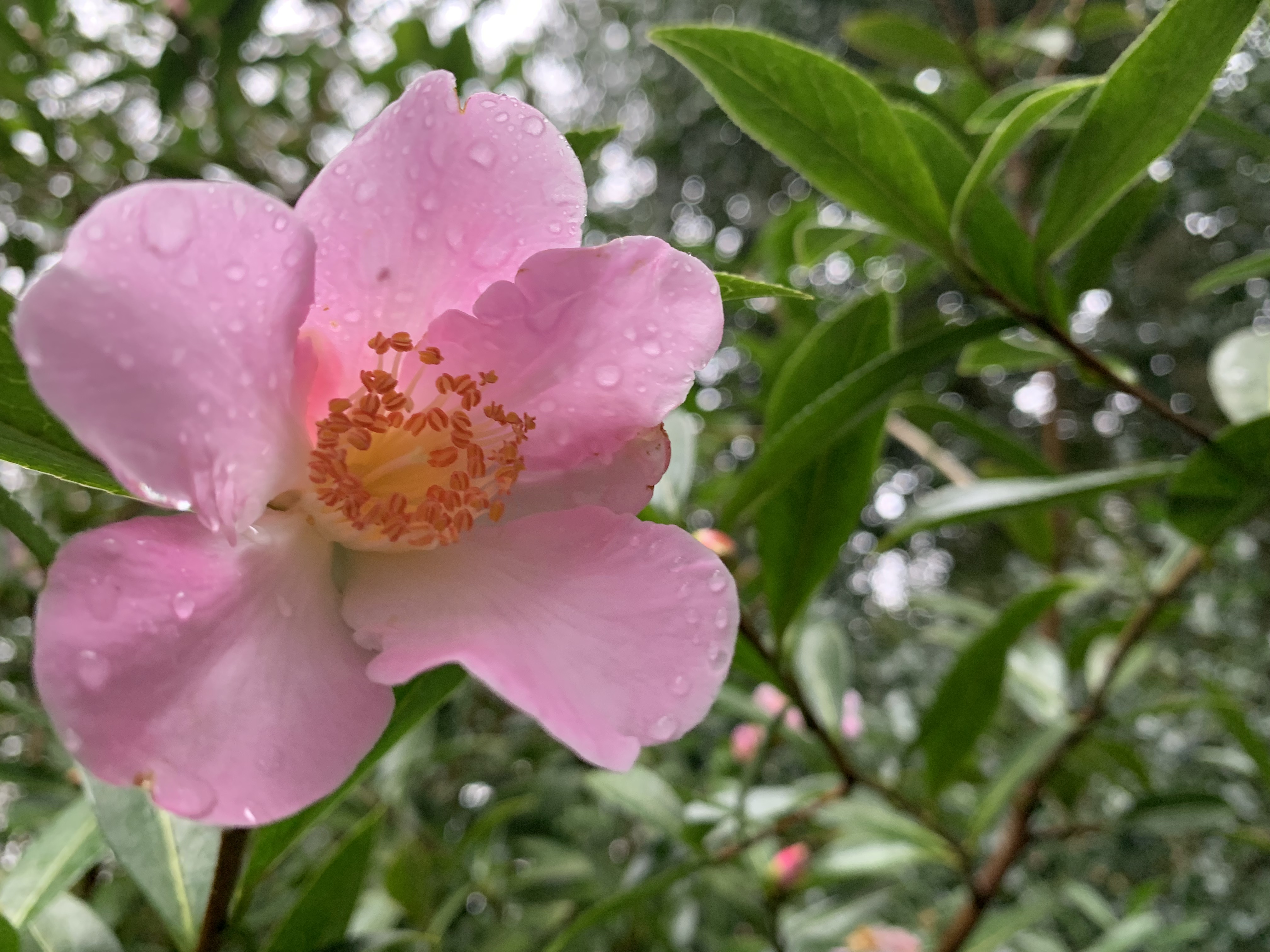
It has been a very good year at White House Farm for Melliodendron xylocarpum, which has lived up to its reputation as an outstandingly attractive newly introduced small tree. A quiet, warm, sunlit spring, and cool at night has meant the flowers have lasted well, and the trees have been effective for two months.
The much larger UBC form reaching free-flowering maturity this year
We have six accessions here of which four are now regularly flowering freely – the Hillier form, one from the University of British Columbia and two seedlings from a collection in Hunan.
L to R: The UBC form, Hillier, and one of our Hunan collections
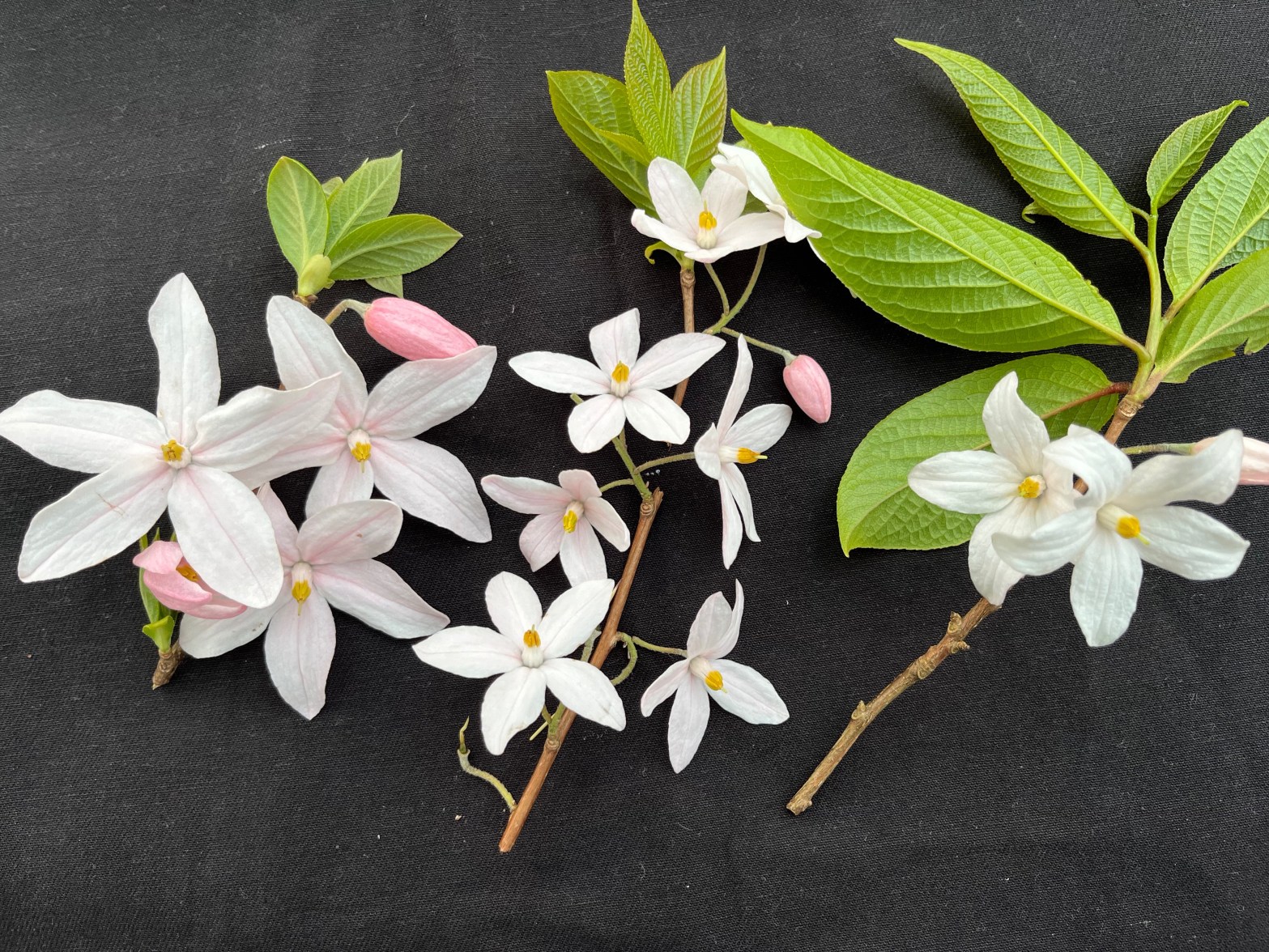
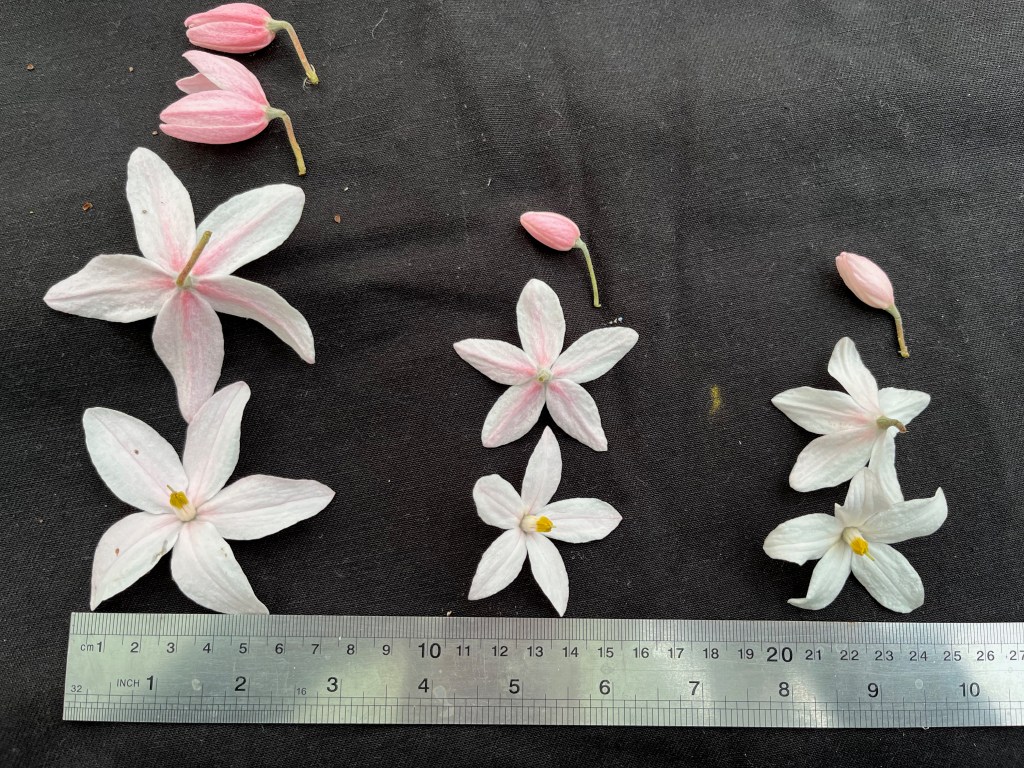
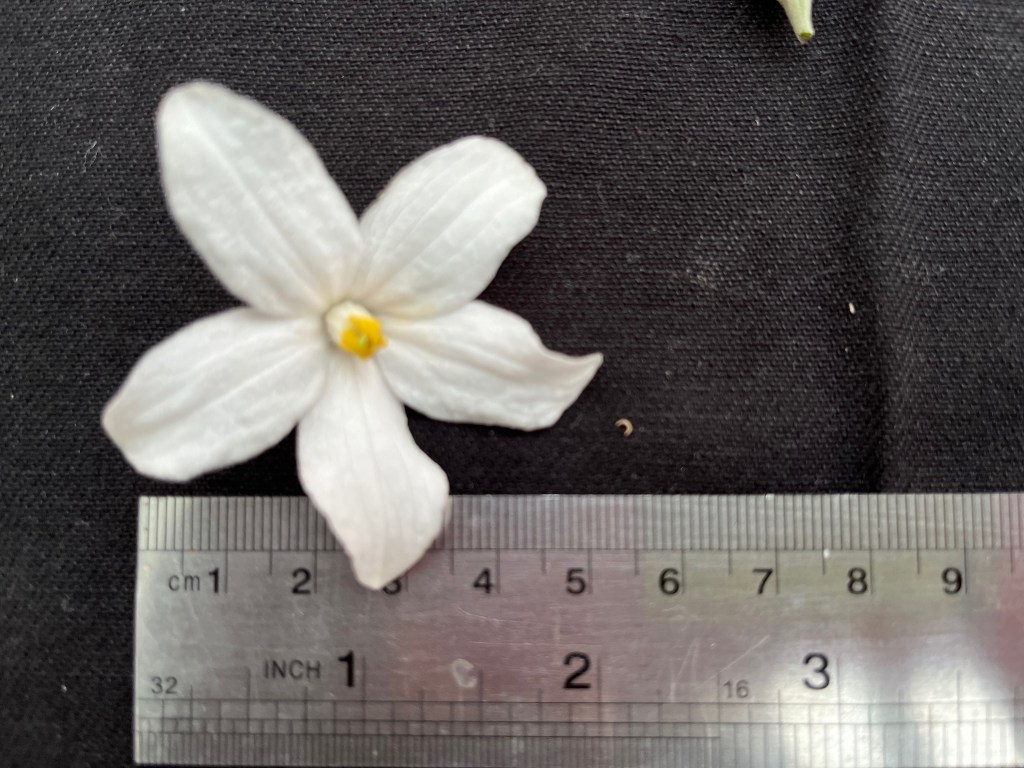
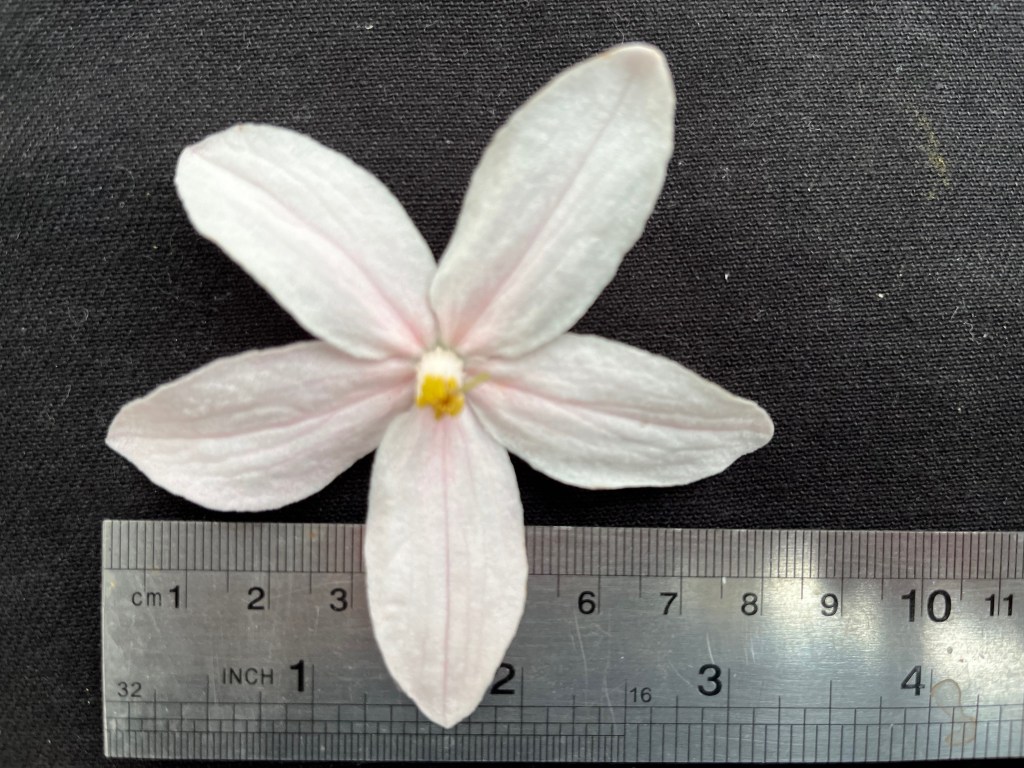
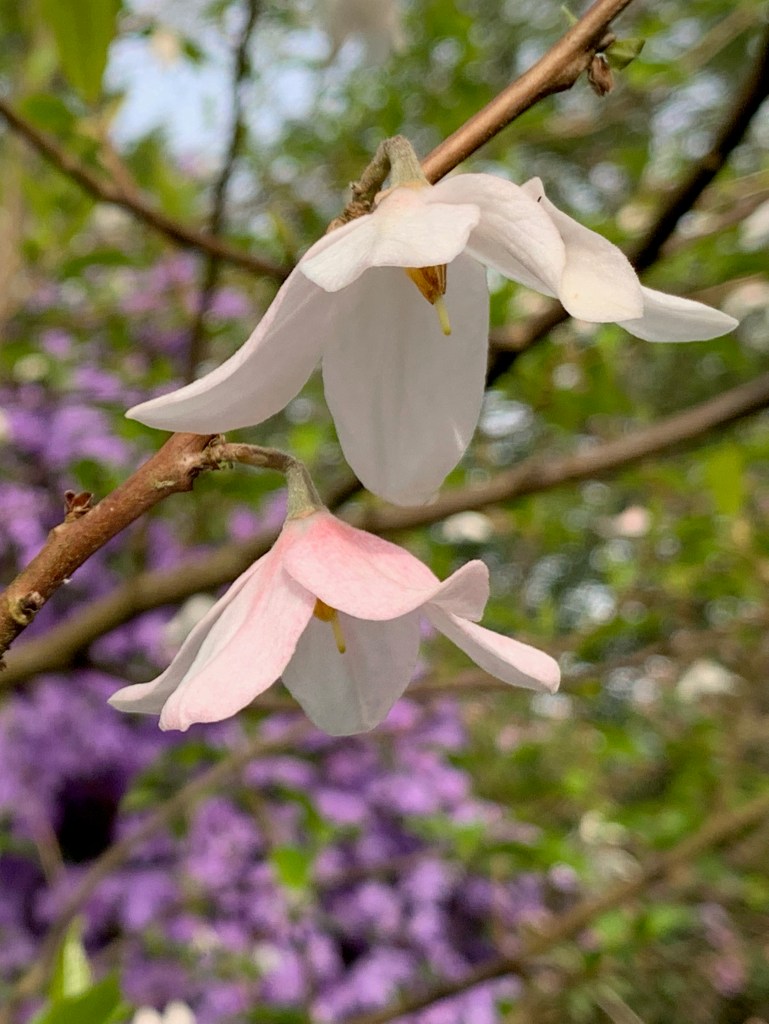
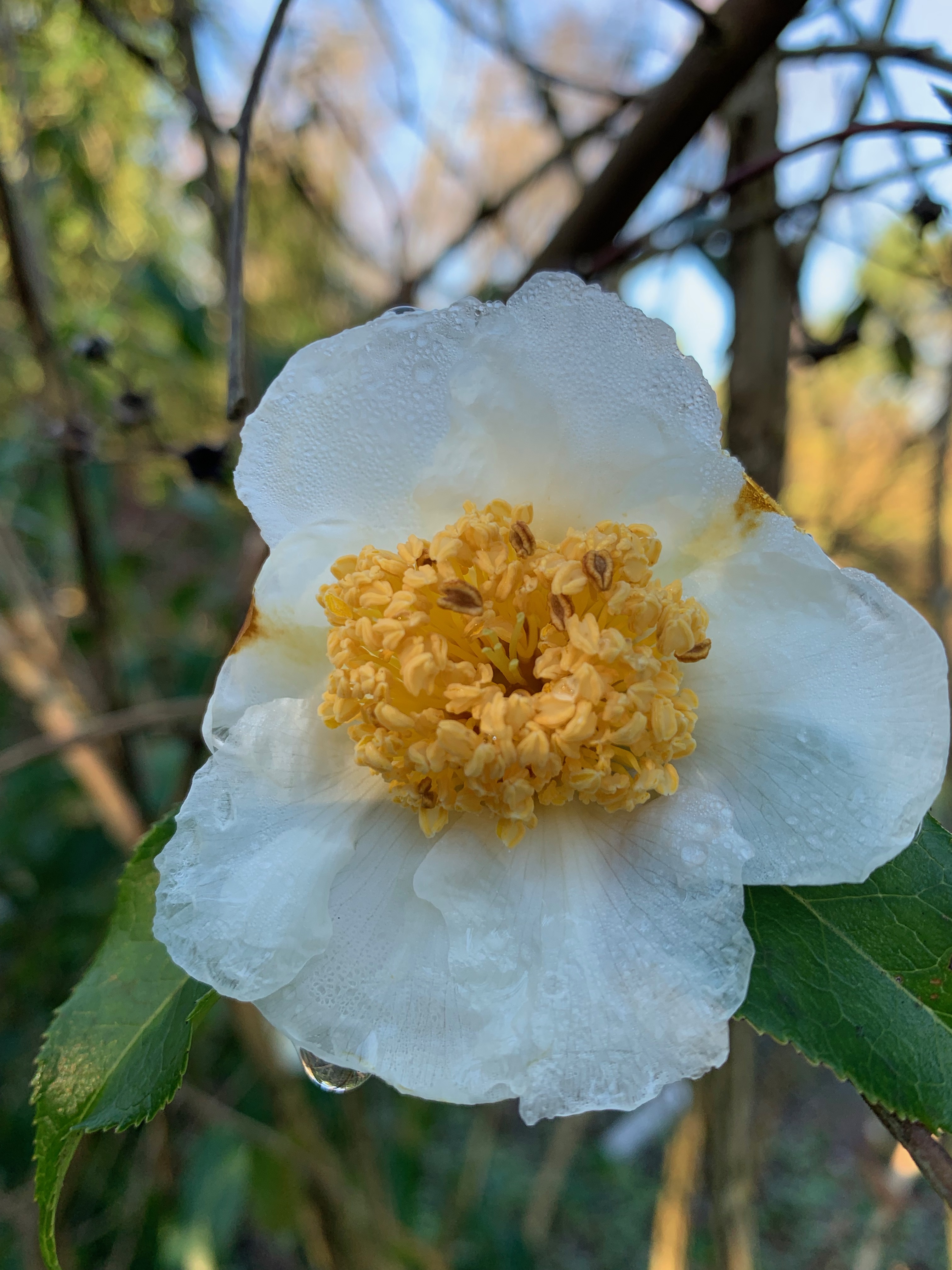
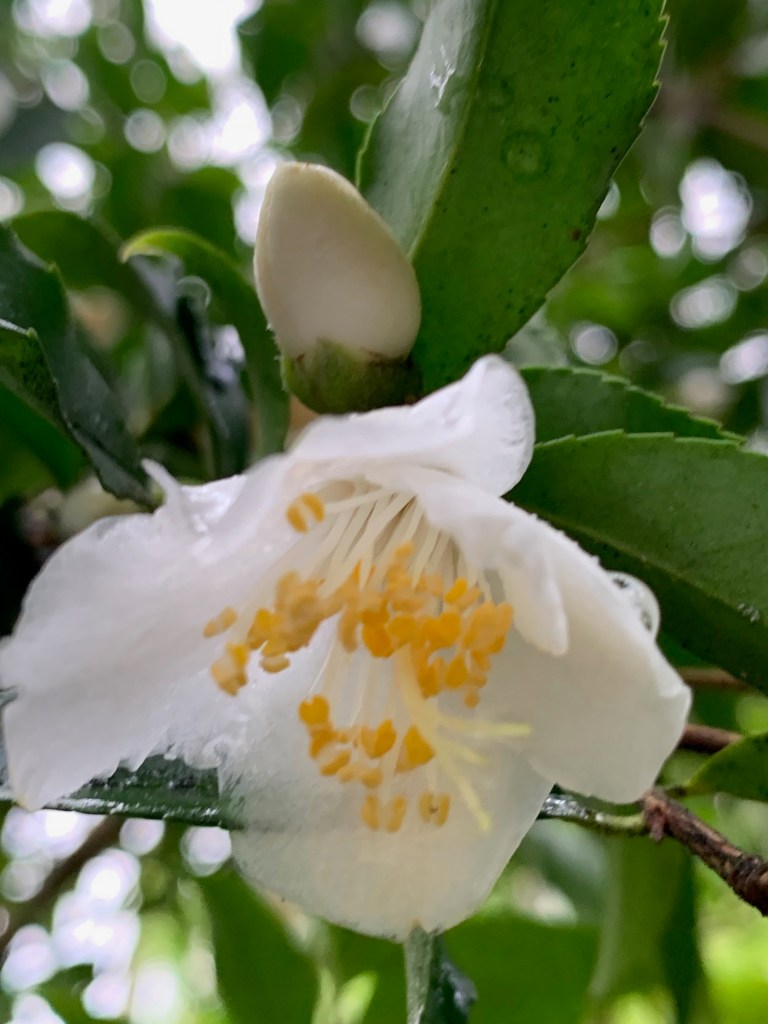
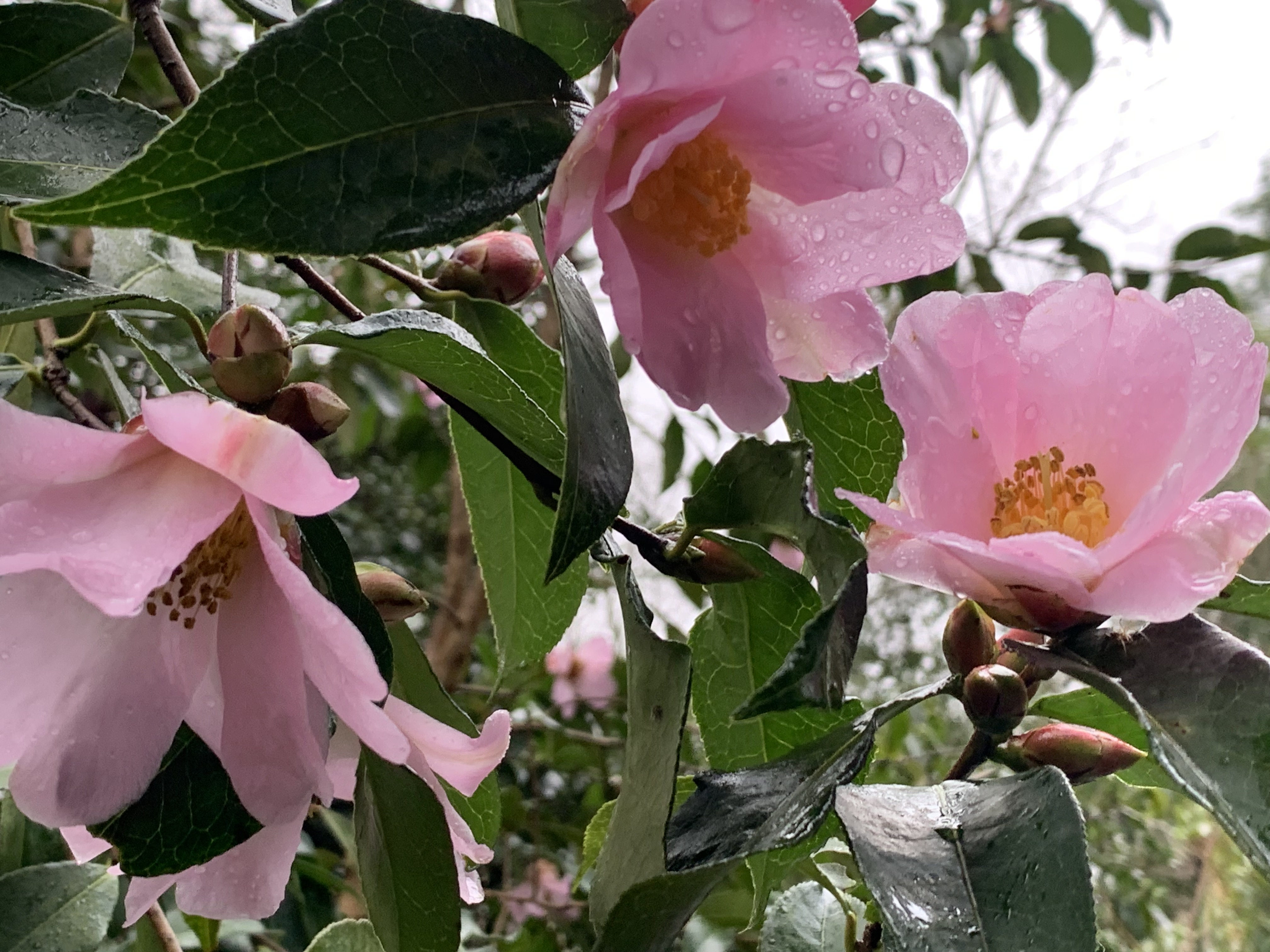
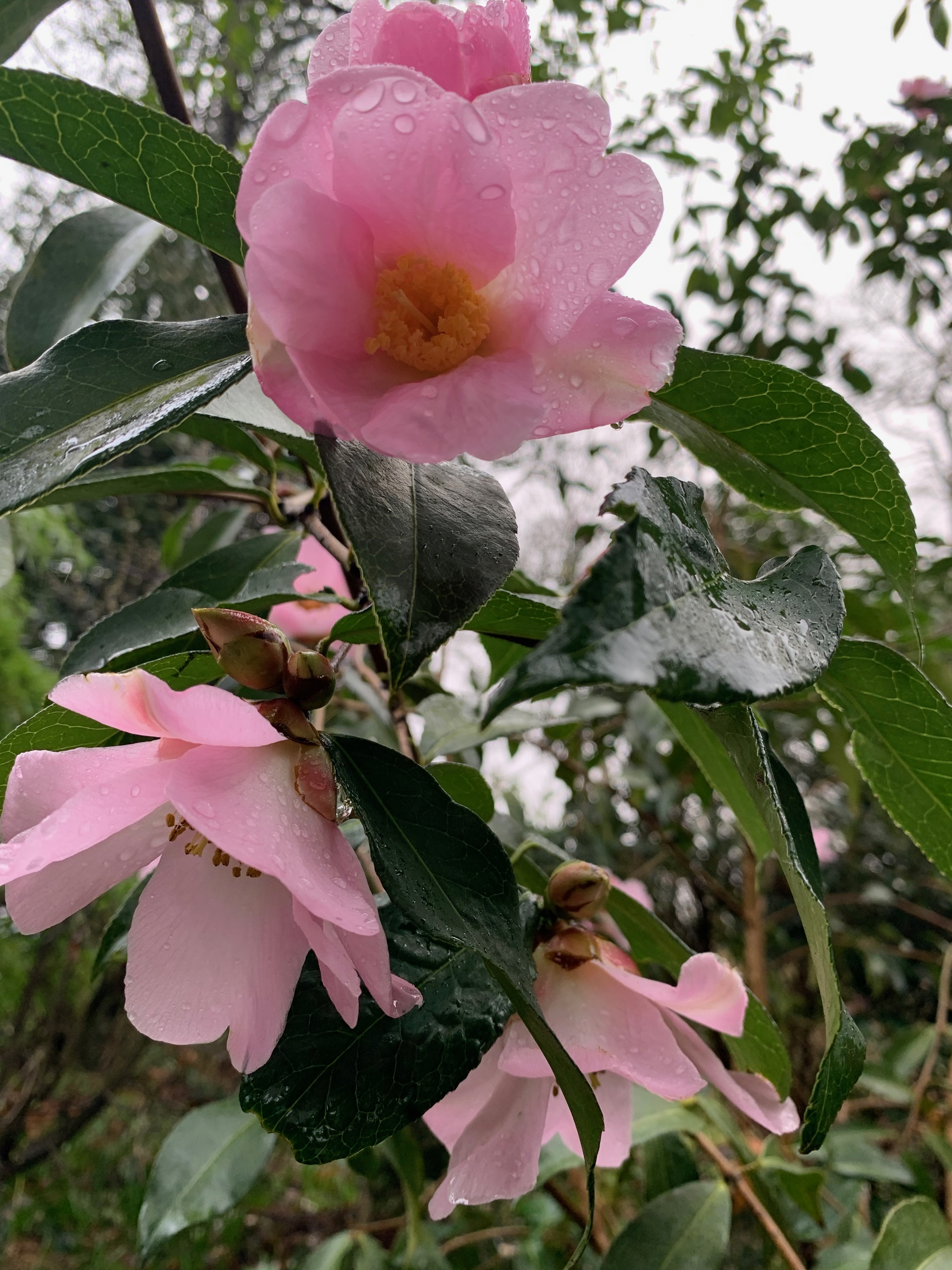
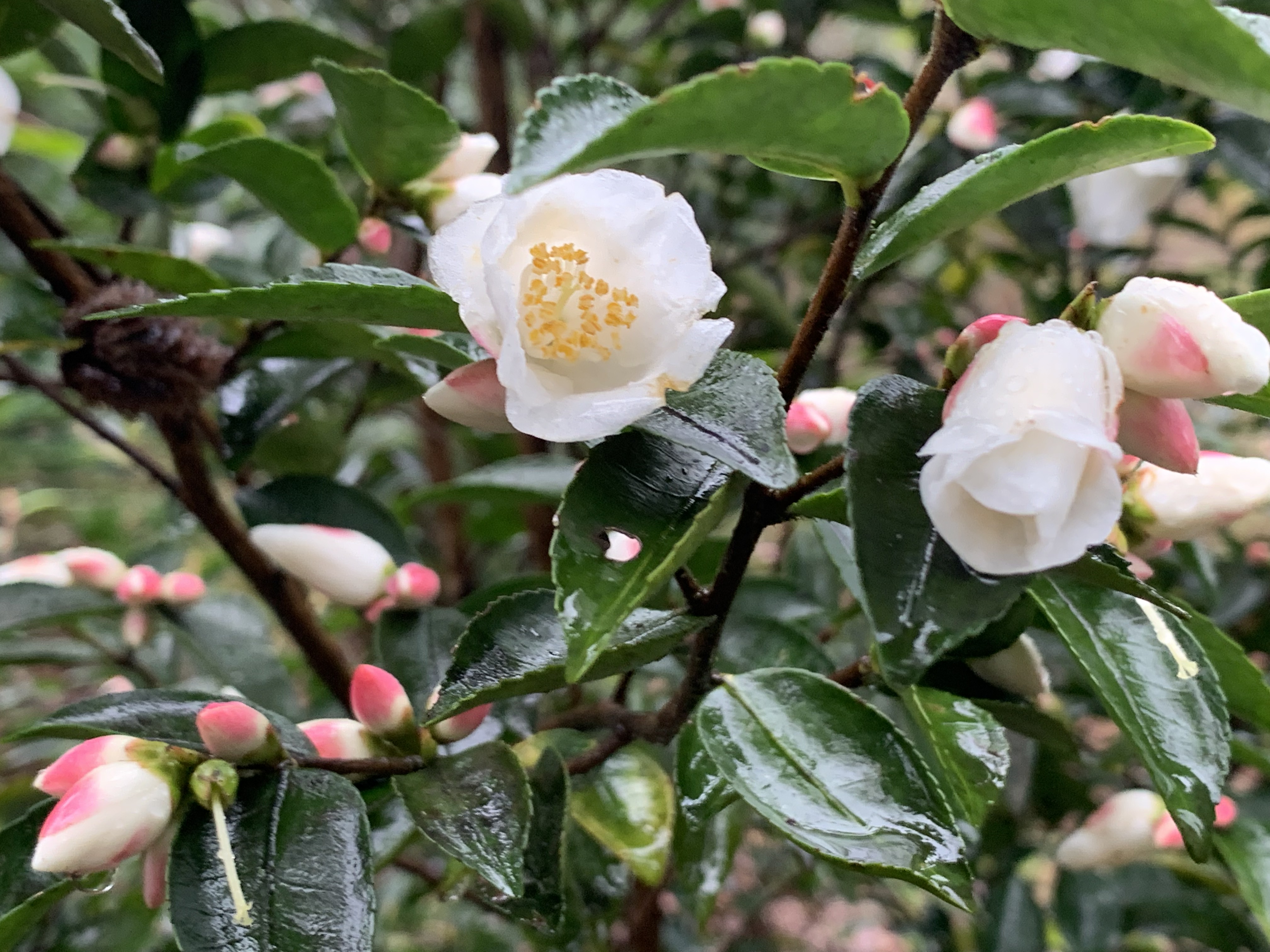
We have noted that no two are quite the same and there are variations in flower size and colour as well as flowering time. Seedling forms are thus likely to vary, and forms of a richer pink may well emerge and be worth naming – so it will be interesting to keep an eye open for seedling variations in the next decade. There was a good seed set last year (pace squirrels) and trees take around 10 years to flower from seed, so it may be a while before potentially richer pink forms emerge. Clare has been photographing the accessions for four years and has observed variation in degrees of pink from year to year, presumably due to varying conditions. In all our accessions pink is most intense in bud then pales significantly as flowers age, in some cases to an almost pure white – the comparison photographs below were taken with the smaller earlier-flowering specimens in their later colour.
L to R: The UBC much larger flower, then Hillier, then one of ours with curled petals from Hunan (the last two in their latest colour, faded to almost white)
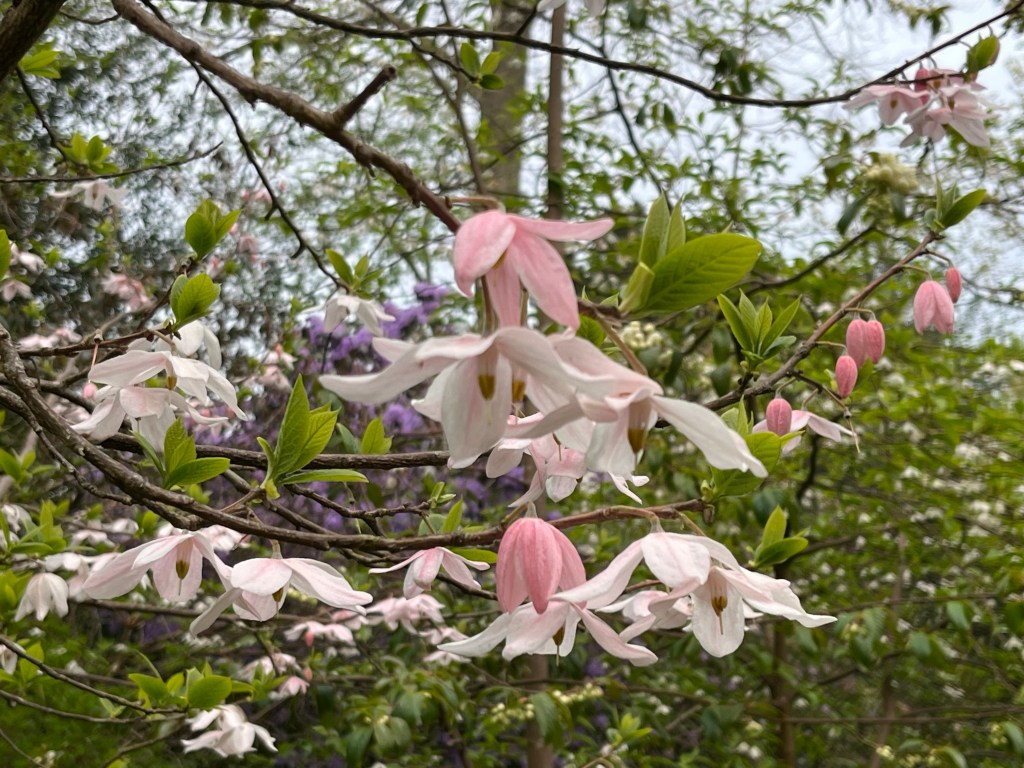
Flowering times vary slightly. The Hillier form is first to flower and is truly precocious, its solidly pink (rather than pink-streaked) flowers opening before the leaves. It is the deepest pink of those we grow but fades slowly in warm sunshine. The Hunan seedlings flower as green leaf growth is just emerging, with pink buds and white open flowers appearing with the first leaves in a three-colour display; but the flowers hang well clear of the foliage, so it does not spoil the effect.
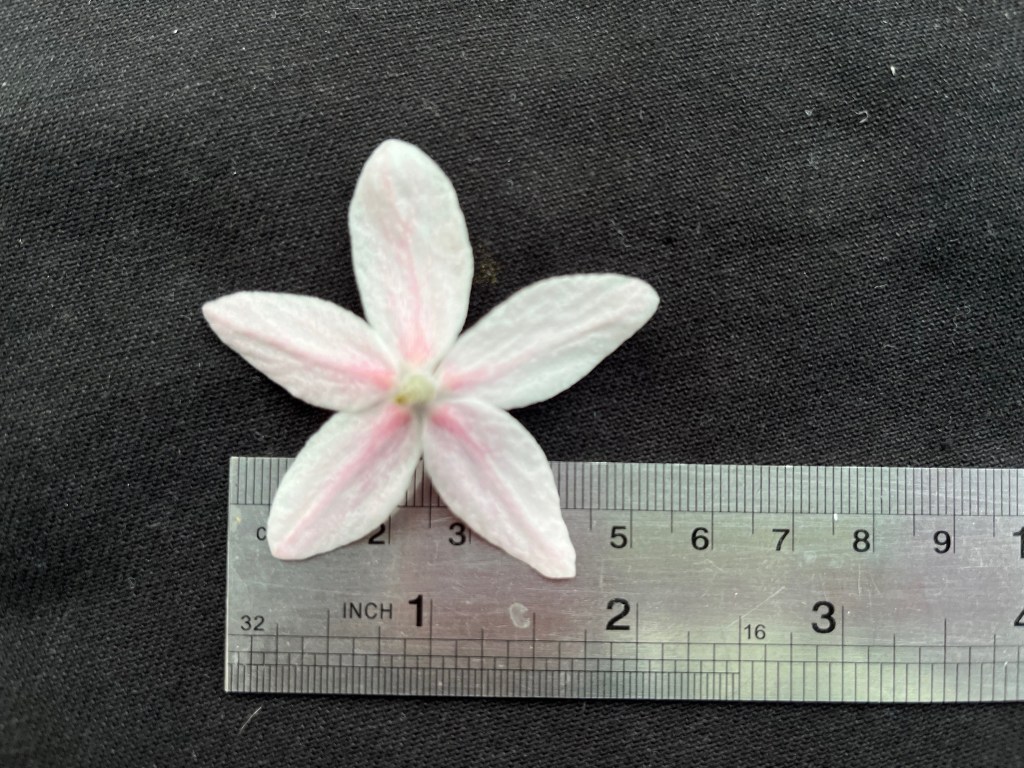
The UBC form is late, at least two weeks after the Hillier form, and this year, as our specimen reaches maturity, the UBC flowers have been a full three inches across – significantly larger than all the others – appearing both before and with the foliage.
Hillier formHunan collThe UBC form
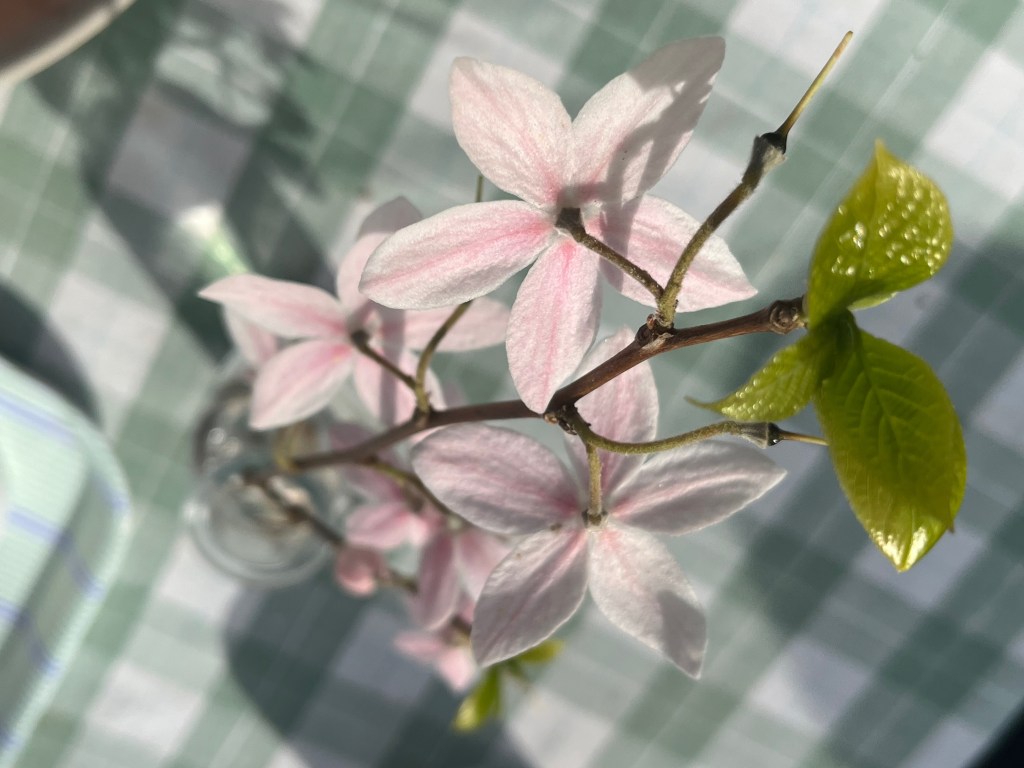
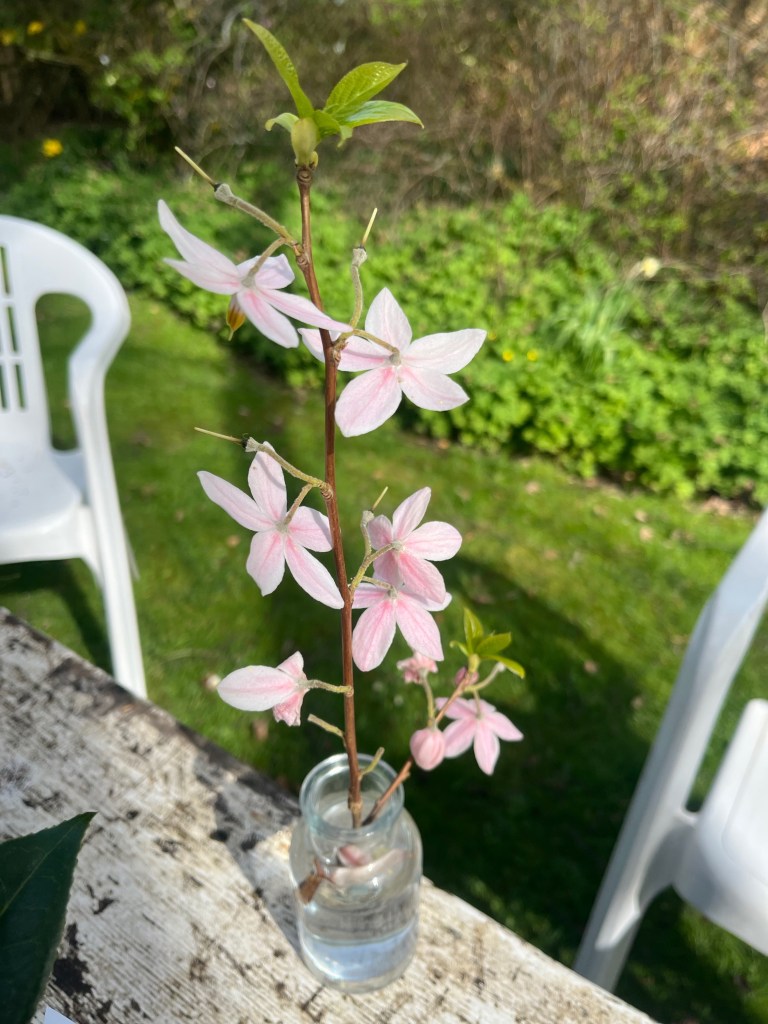
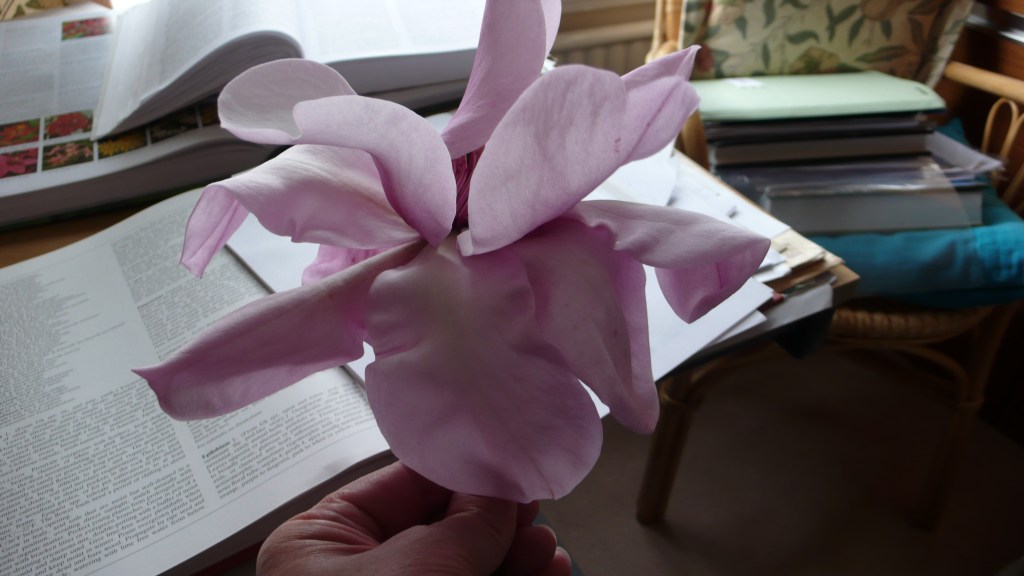
We also discovered by chance that Melliodendron has remarkable longevity as a cut flower. A specimen of the Hillier form picked on March 30th for our Open Day and left on the table outside in rain, wind and full sun looked like this on April 9th.
The Hillier form earlier in the season on the tree:
For more on Melliodendron, see the introduction to the plant I wrote in the 2020 IDS Yearbook: ‘Meliodendron xylocarpum: a new star’ . Please get in touch if you have thoughts on this exciting recently-introduced genus to share.
Maurice is on last week’s ‘Gardening WithThe RHS’ podcast, talking about hydrangeas: listen here.
In Asiatic Magnolias in Cultivation (1955) G. H. Johnstone OBE VMH wrote:
“ This magnolia [sargentiana var robusta] is certainly one of the most spectacular of all those introduced into our gardens and in the running maybe for inclusion in a list of the most beautiful plants to be seen in the gardens of the British Isles.”
M. sargentiana var robusta: dinner- plate sized flowers, typically with a dark centreOur M. sargentiana var robusta ‘Caerhayes dark form’ at 20, and heading North, when M. sargentiana, the type, might not yet have bloomedOffers a massed effect, like other Asiatic magnolias that bloom all at once: this at Lanhydrock
George Johnstone grew all the big Asiatic magnolias in his garden at Trewithen in Cornwall, and studied them as living specimens closely and comprehensively over many years at first hand. He was also a frequent visitor to the other great Cornish collections, notably to that at Caerhays, where J. C. Williams had planted all the big Asiatic species available at that time, including the type species of M. sargentiana. This appeared more closely allied to M. dawsoniana than to var robusta, and there is a remarkable similarity in flower between the two, the relatively narrow tepals hanging loosely ‘like the fringe of a tassel’.
M. dawsoniana ‘Chyverton” flower form, at Lanhydrock: longer, narrower tepals than var robustaOne of four M. dawsoniana seedlings at White House FarmA M. dawsoniana at Borde Hill – photo courtesy Jim gardiner
By contrast, the bigger nodding flowers with large broad tepals of var robusta are just one character that singles it out as a distinctive plant, very different to the type species.
A pale form of M. sargentiana robusta at Lanydrock
M. sargentiana var robusta was found and introduced as a single plant by Ernest Wilson (W 923a) on the Washan in W Sichuan. He collected it blind in a population of the type without seeing it in flower., which may have influenced his naming.
Both Johnstone and subsequently Treseder (Magnolias) were both firmly of the view that M. sargentiana var robusta merited full species status. In his book Treseder lists the detailed differences between M. sargentiana and M. sargentianavar robusta. Without reproducing all his comparative detail here, suffice it to say that Treseder clearly differentiates habit, young shoots, leaves, flower buds, flowers, fruit cones, and seedling flowering times (25 years for the type, and only 11-15 for var robusta).
M. sargentiana var sargentiana W914 taken at Wisley in 2010: the first flower of a scion given by Charles Williams grafted and planted on Battleston Hill in 2006/7. Many thanks to Jim Gardiner for photo and info.
Johnstone makes the point that of the many seedlings of var robusta raised over the years in Cornwall, none reverted to the type, all maintaining the character of the original. My own experience is limited, but I have been growing what is known as the ‘Caerhays Dark Form’ for 50 years from an original Treseder graft, which today as I write is pushing 50ft with perhaps 2000 flowers. It is a spectacular tree (see below).
I sent seed to the late Peter Chappell who returned a seedling that had beetroot red young growth, which needless to say it lost as it matured. It flowered in 11 years from seed and is identical to the parent in every particular, so that cut flowers from the two, in different vases were indistinguishable by visitors who could not tell which from t’other. I like to think that the ability to reproduce morphologically identical offspring is a strong indicator of a true species.
The change to full species status was not accepted by the botanical authorities at the British Museum and the RHS Council at the recommendation of the then acknowledged authority on Magnolias, J E Dandy, who wrote ‘ I….cannot accept that this single plant (from which all the cultivated plants are derived) represents a botanical taxon.’ In other words a single plant growing within the range of typical M sargentiana is not enough to establish a new species.
This naming of a less common and less horticulturally significant variety as the type species is an example of a problem that is by no means unique, especially when opinions are based, for example, on herbarium specimens only (Callaway, in The World of Magnolias points out that Dandy named at least 6 magnolia species based on single herbarium specimens.)
None of the authors above followed through, deferring to the botanists. They reluctantly concluded that more should be known about the plants involved with more specimens studied in and from the wild. Treseder sums it up ‘ The unfortunate difference of opinion between plantsmen and botanists remains and is likely to continue until botanical research becomes possible once more in China’.
Unfortunately since China opened up again to western botanists in 1980, as far as I am aware no new introductions or further studies of M. sargentiana or M. sargentianavar robusta have been made, so at present the status quo for var robusta prevails.
A further option is from Spongberg ( Magnolias and their allies) who writes ‘…..it may be best to accord this plant cultivar status in the future’ – ie Magnolia sargentiana ‘Robusta’.
Whatever its name, it remains in my experience the best choice of the big flowered Asiatics for general cultivation: with vigorous growth, excessive freedom of flower, and weather resistant 8-10 inch nodding flowers in extraordinary profusion. A majestic tree.
‘Mr Magnolia’ Jim Gardiner looks less than dismayed at being surrounded by M. sargentiana var robusta.
I’ve sown seed from a M. sargentiana var robusta cultivar called ‘Blood Moon’ and produced two promising seedlings: M. ‘Premiere Cru’ and ‘Grand Cru’.
M. ‘Blood Moon’ – a M. sargentiana var robusta cultivar, always our earliest magnolia to open, even before species M. biondii.Like other sargentiana var robusta cultivars, ‘Blood Moon’ offers excellent massed effect. M. ‘Premiere Cru’ yesterday: raised from M. sargentiana var robusta ‘Blood Moon’
M. ‘Premiere Cru’, bred here at WHF, is striking for its intensely dark colour compared to its parent ( it may be pollinated by the deep pink Aberconway cultivar M. sprengeri ‘Claret Cup’ ). It is reliably hardy -and is certainly reliably free-flowering. Like an earlier seedling of var robusta, it flowered after 11 years from seed, and I like to think its robustness since then at White House Farm – very rarely damaged by frost in Kent – reflects its M. sargentiana var robusta tough constitution, which in my experience is by far the most ‘robust’ of all the early Asiatics. It’s high time to revise perceptions of the gardenworthiness of this first rank flowering tree.
Maurice Foster
Featured image at top: our M. sargentiana robusta ‘Caerhayes dark form’ in 2023.
Join us for our spring Open Days to see our 200+ magnolias, 140 camellias and other spring-blooming genera on Mother’s Day, Sunday March 30th and Wednesday April 9th. (£15). To reserve a space, email whitehousefarmarb@gmail.com
Join us for our spring Open Days to see our 200+ magnolias, 140 camellias and other spring-blooming genera on Mother’s Day, Sunday March 30th and Wednesday April 9th. (£15). To reserve a space, email whitehousefarmarb@gmail.com
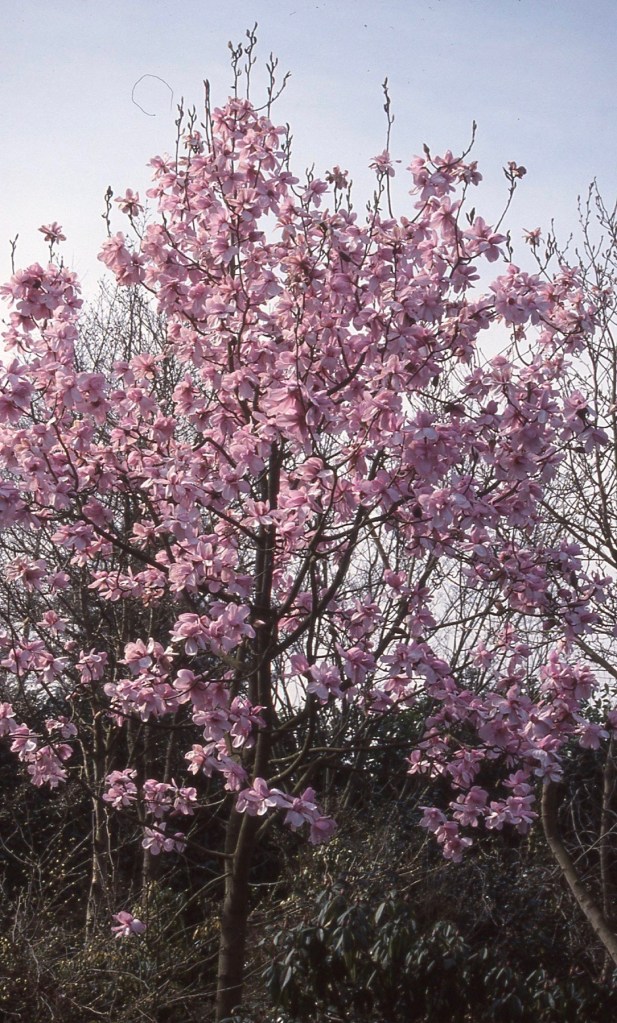
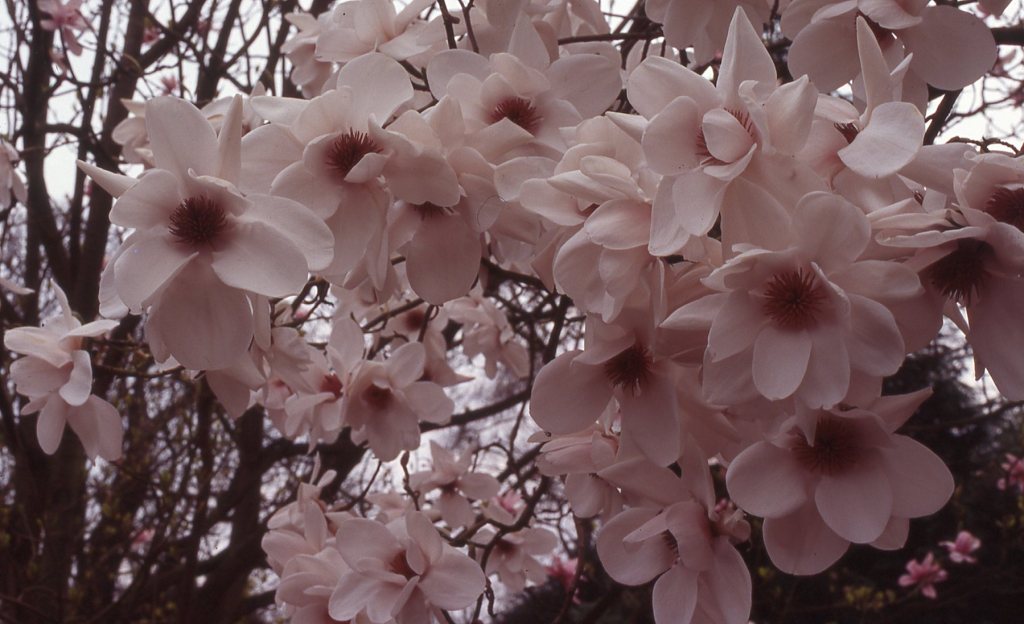
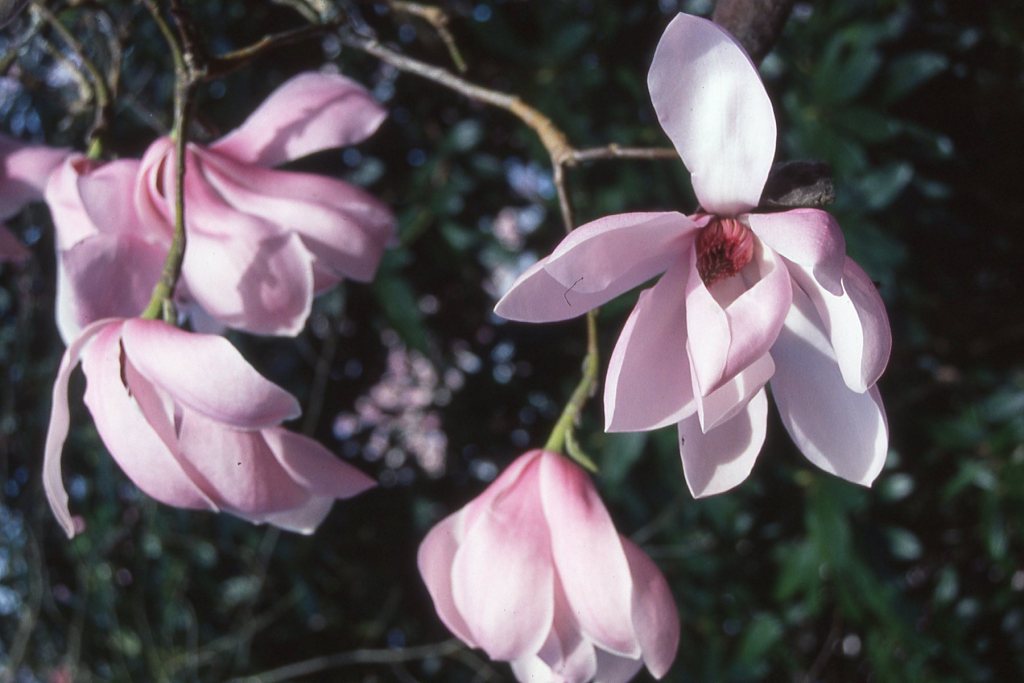
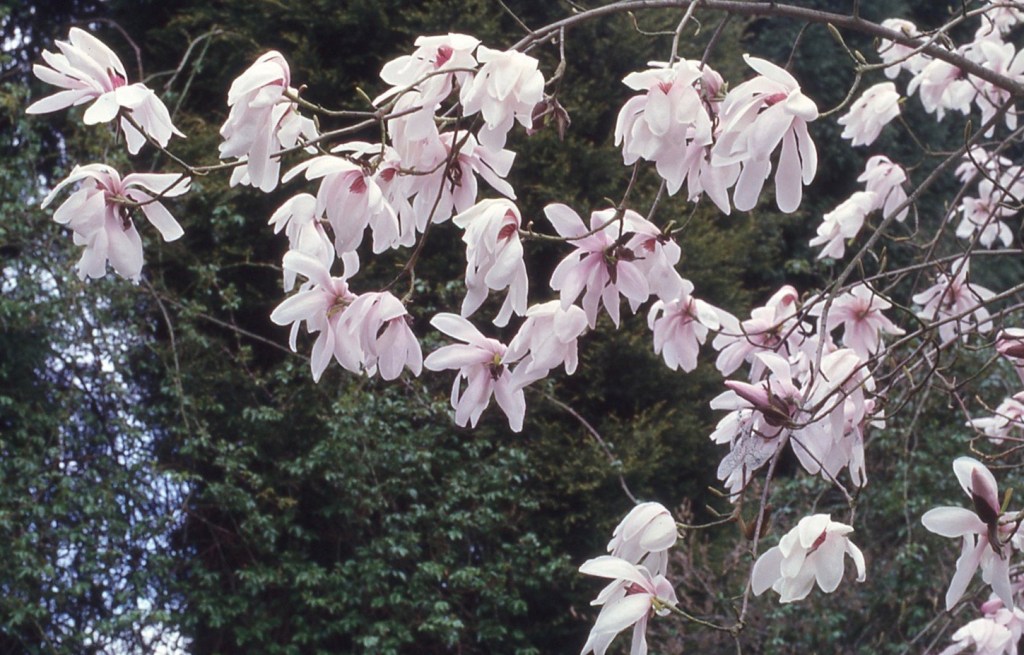
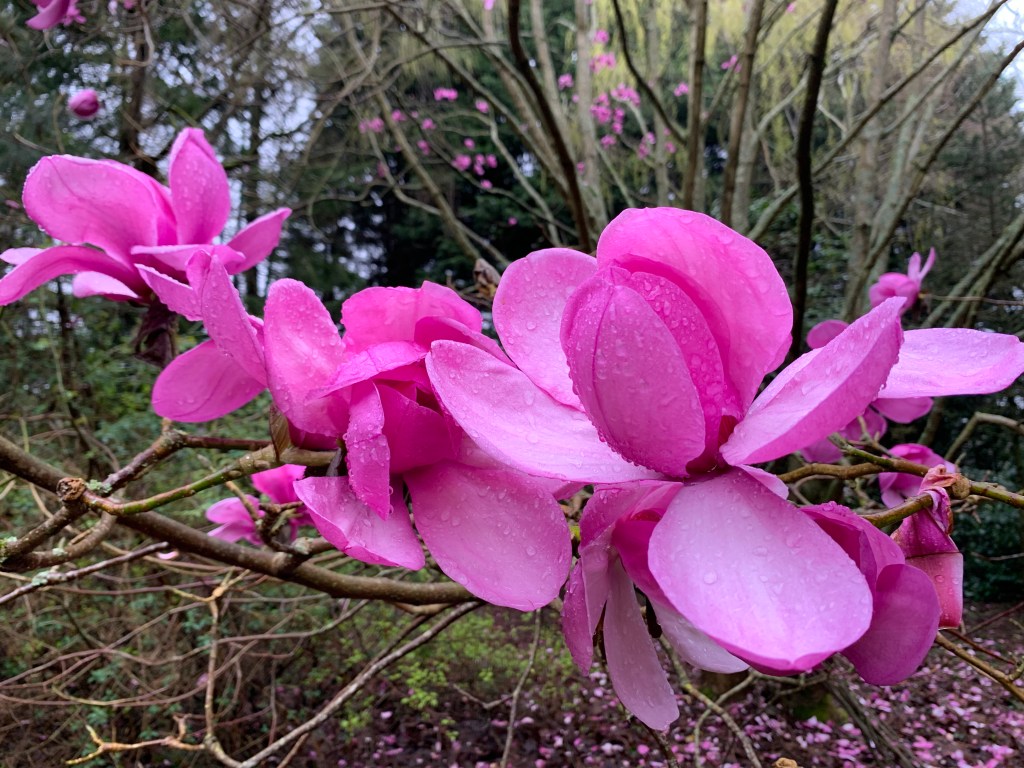
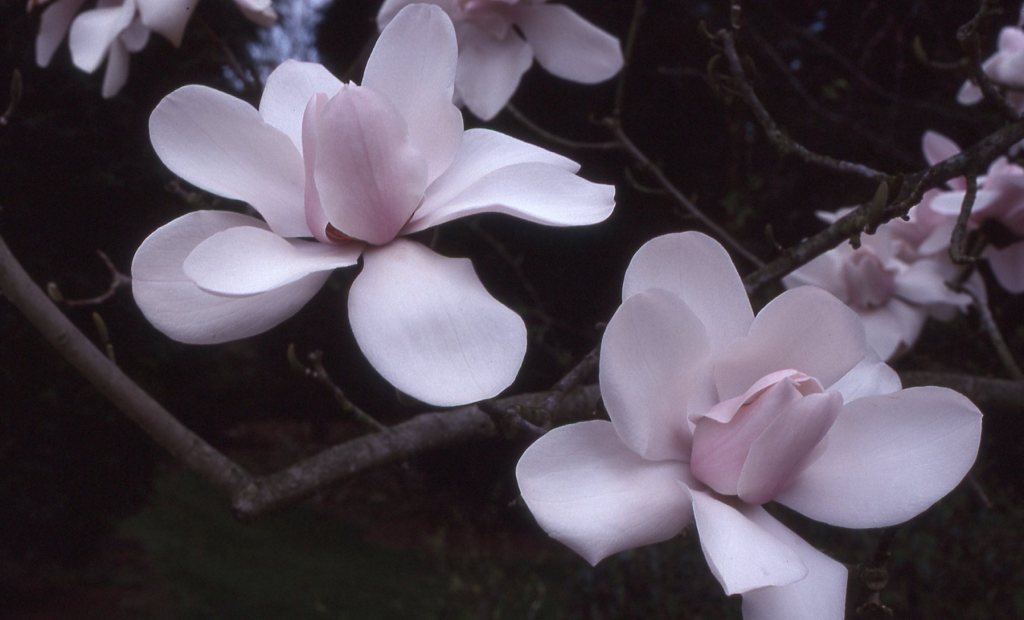
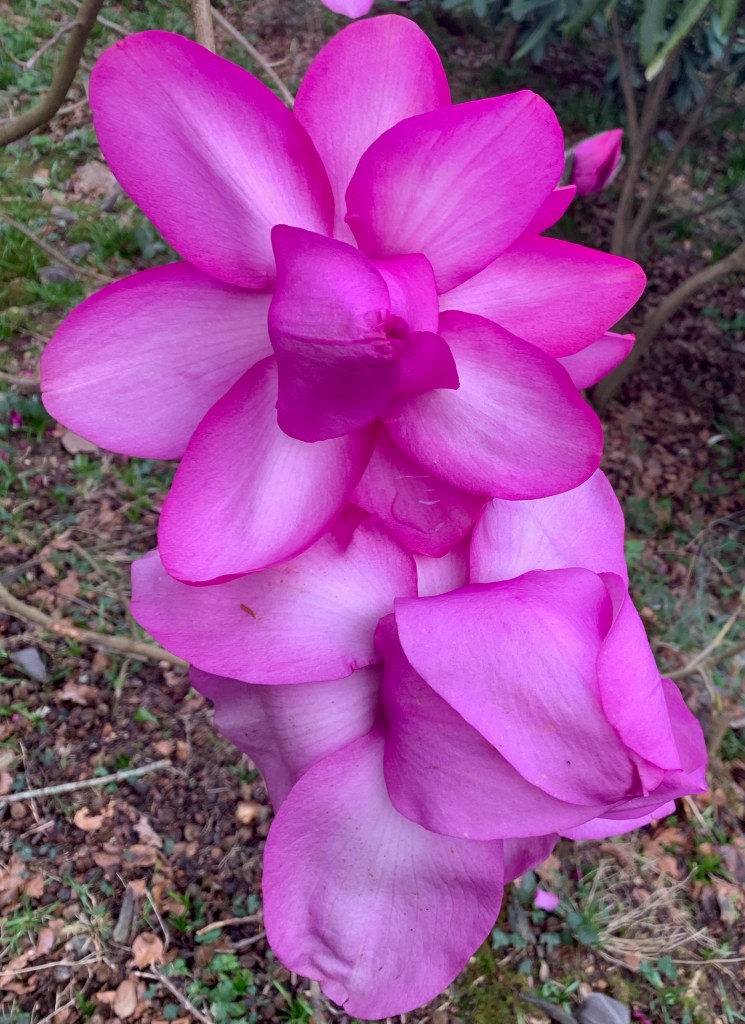
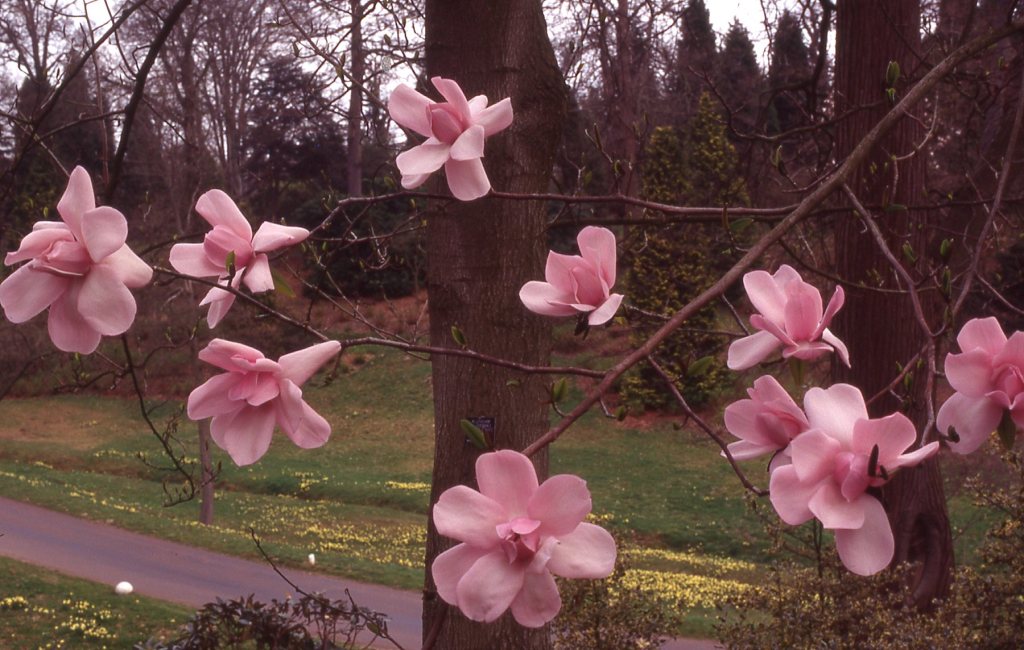
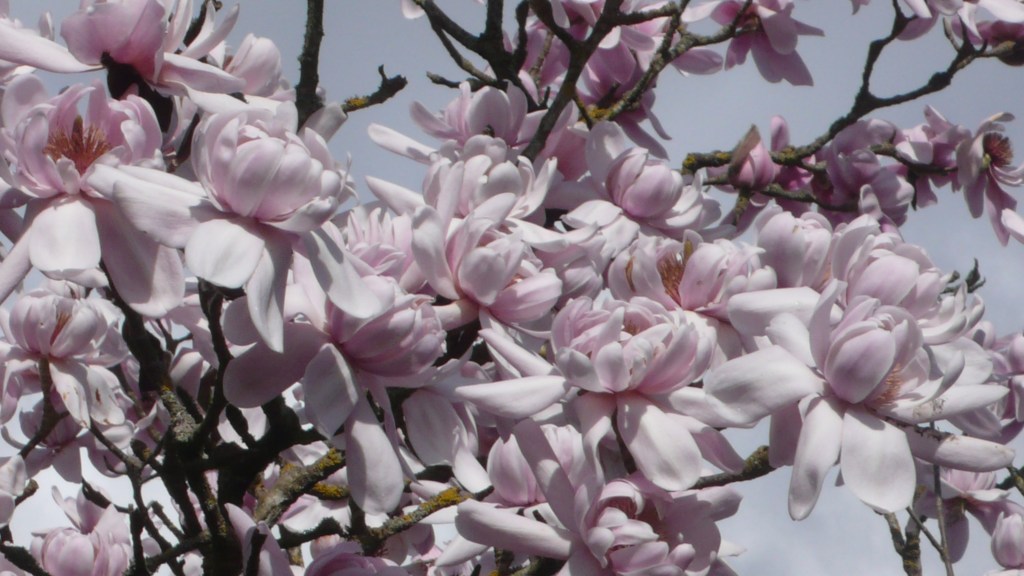
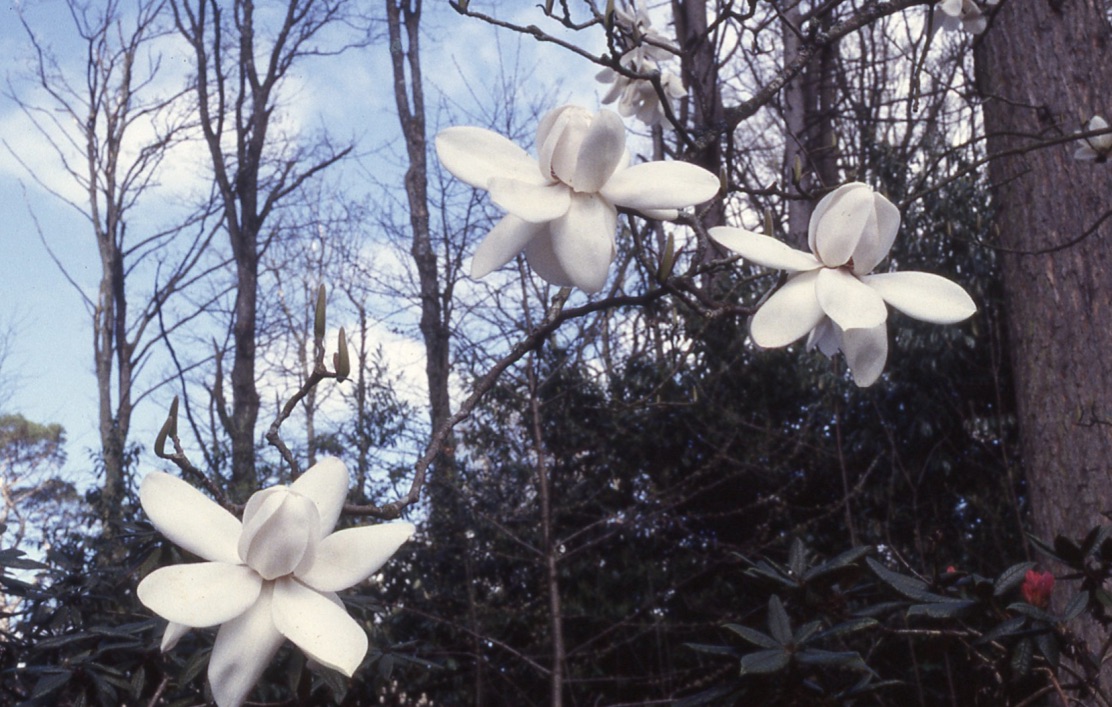
Magnolia campbellii occurs right along the Himalaya, from Nepal to SE Tibet. Moving further east, into W. China, in the spring of 1904, George Forrest discovered, on the western side of the Mekong valley in Yunnan at 10,000 ft in snow drifts, a magnolia with an affinity to, but distinct from, M. campbelli. This was named as M. campbellii ssp mollicomata.
A George Forrest introduction ofa pale form of M. mollicomata at Caerhayes
Botanists now vary as to the status of mollicomata. TSO treats it as a horticultural ‘group’ within campbellii, holding that it forms a meaningful entity only within gardens. Others still maintain it as a variety, or a subspecies. Botanically, it may not differ sufficiently to separate it from campbellii, but horticulturally the differences are real:
The pedicels and perules are notably hairy (hence mollicomata – the ‘downy magnolia’)
The buds are bullet-shaped, with a little pinched waist, as against ovoid for M. campbellii
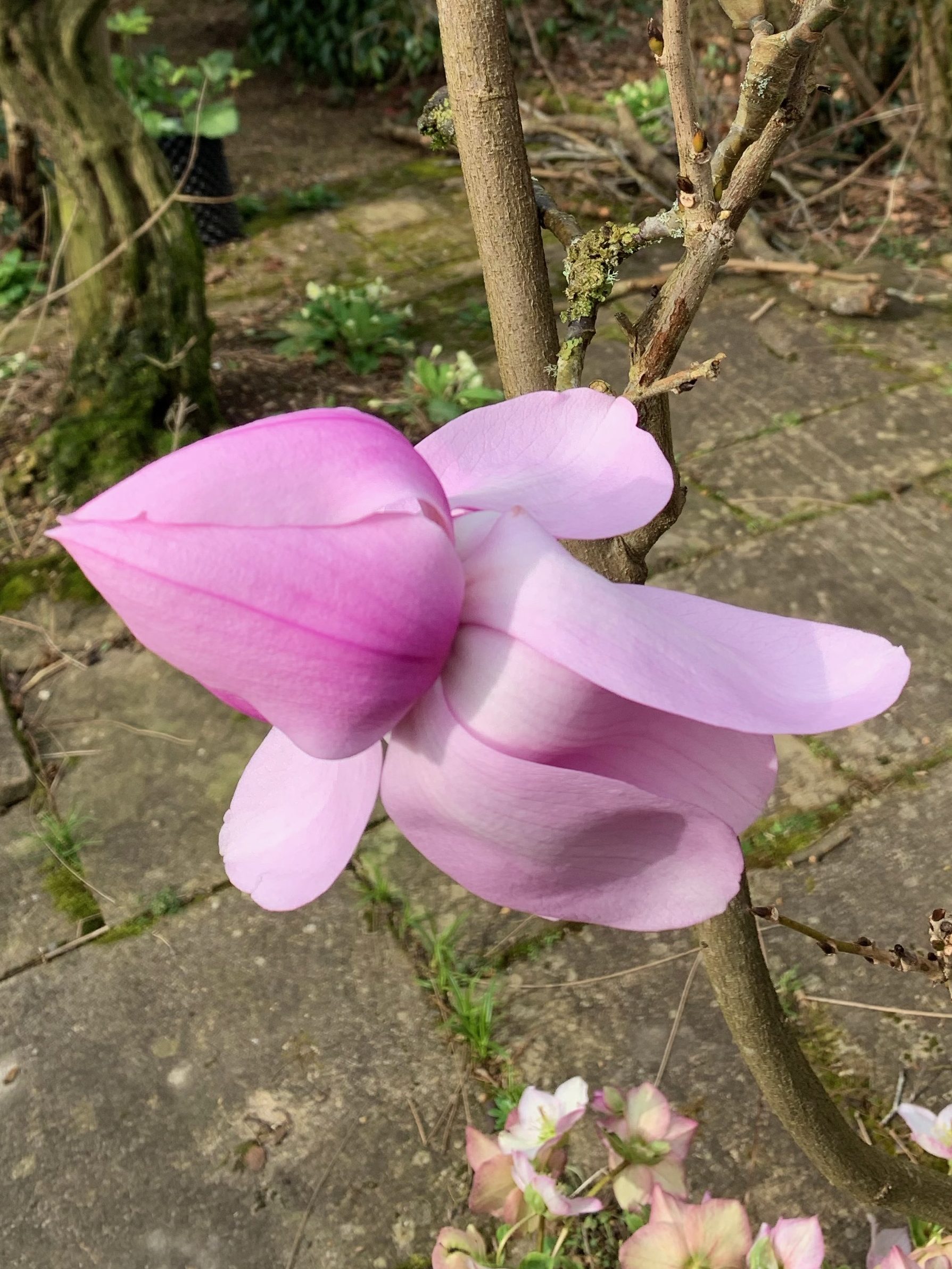
The shape of the open flower is different: M. mollicomata is invariably some form of cup and saucer but, while M. campbelli is quite often in this style, it can vary, sometimes with looser cup-shaped flowers.
The flower is a different and for some a less pleasing colour; jt has a more fuchsia tone, with a bluish colour base. Gardeners expecting the clean clear pink of the campbelli type might be disappointed.
It flowers from seed in half the usual time of M. campbellii – after 10 or 12 years. It took 12 years to flower from seed at both Bodnant and Windsor.
White flowers are rare.
It flowers two weeks or more later than typical M. campbellii and is thus more likely to avoid frost damage in the garden.
Classic mollicomata form, from the Upper Salween, Yunnan
This is a typical flower from the Salween drainage of the Salween/Mekong divide in far N.Yunnan, where it is locally frequent in silver fir forest. Forrest thought it favoured the western aspect, exposed to the wetter conditions of the monsoon. Note the sharp reflexing of the outer tepals.
Incidentally, in the wild, a white form of M. mollicomata is as rare as the (wild) pink form of M. campbellii. I don’t know of a true white mollicomata in cultivation – but readers may have seen one?
It is rare now to find a plant in flower in the wild because the buds appear to be taken for medicinal purposes, along with young bark and young shoots. Even in very remote areas huge trees are still found climbed high, with not one bud left. It seems as much in demand for this purpose as M. officinalis, especially in Yunnan. So it is rare to see a large tree smothered in flower.
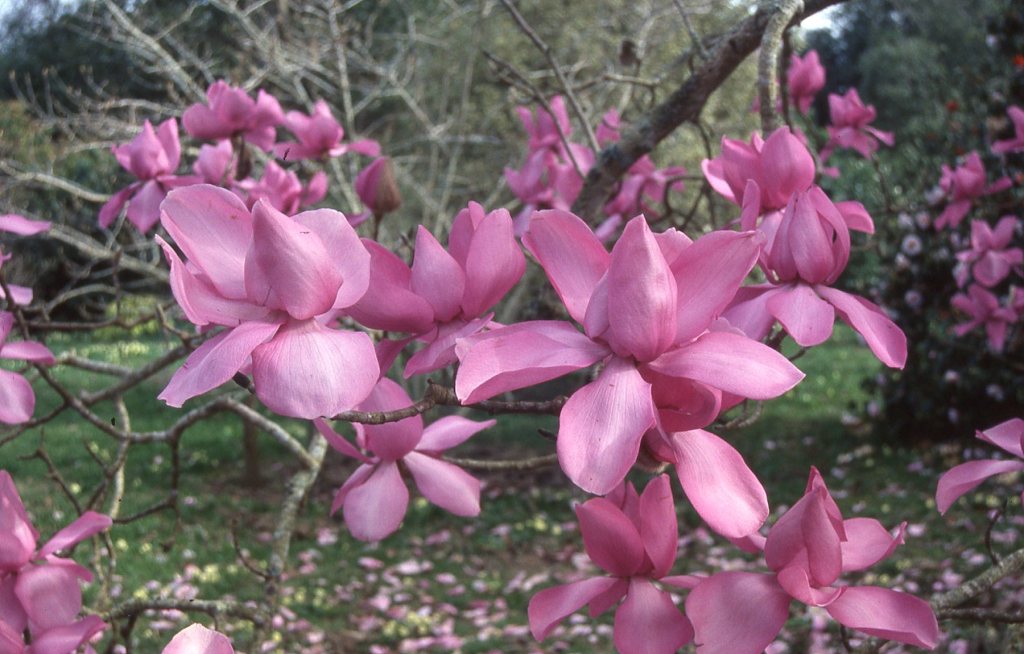
Its relative lateness is a virtue in the garden; and there are forms that are even later than the type. Some of these offer wonderful colour, and for the garden are a massive improvement on the type. For those uneasy about the early flowering and frost susceptibility of typical M. campbellii, these later forms are not only superb for their colour, but generally April flowering, and thus escaping the occasional cold snap of late winter and early spring.
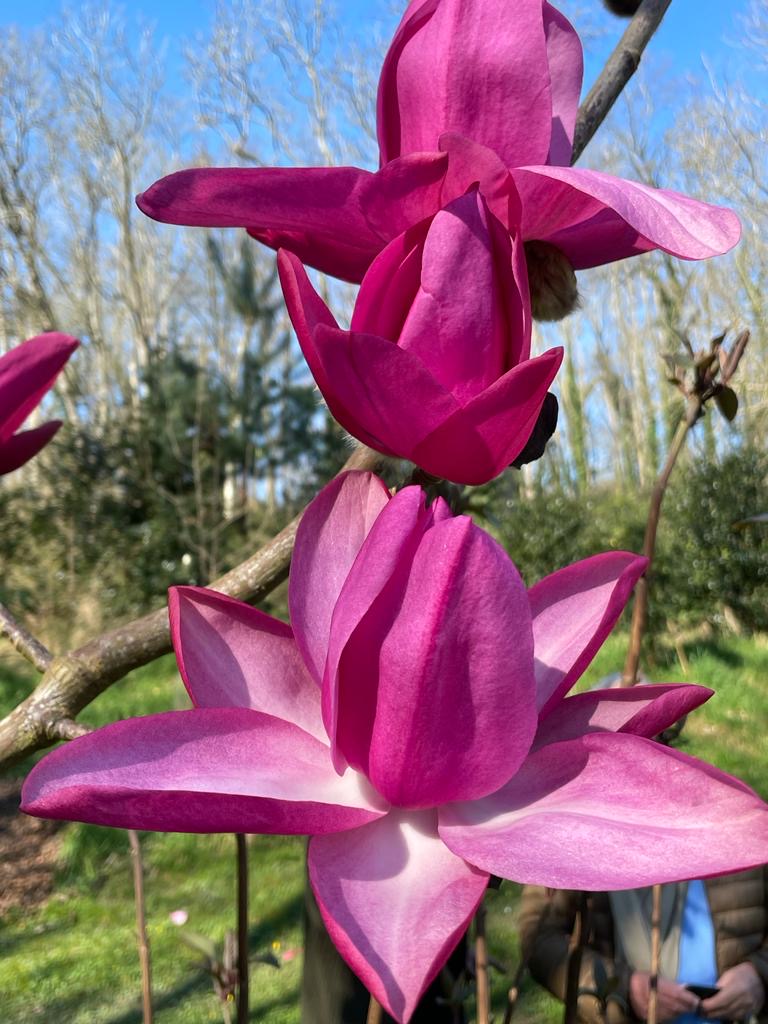
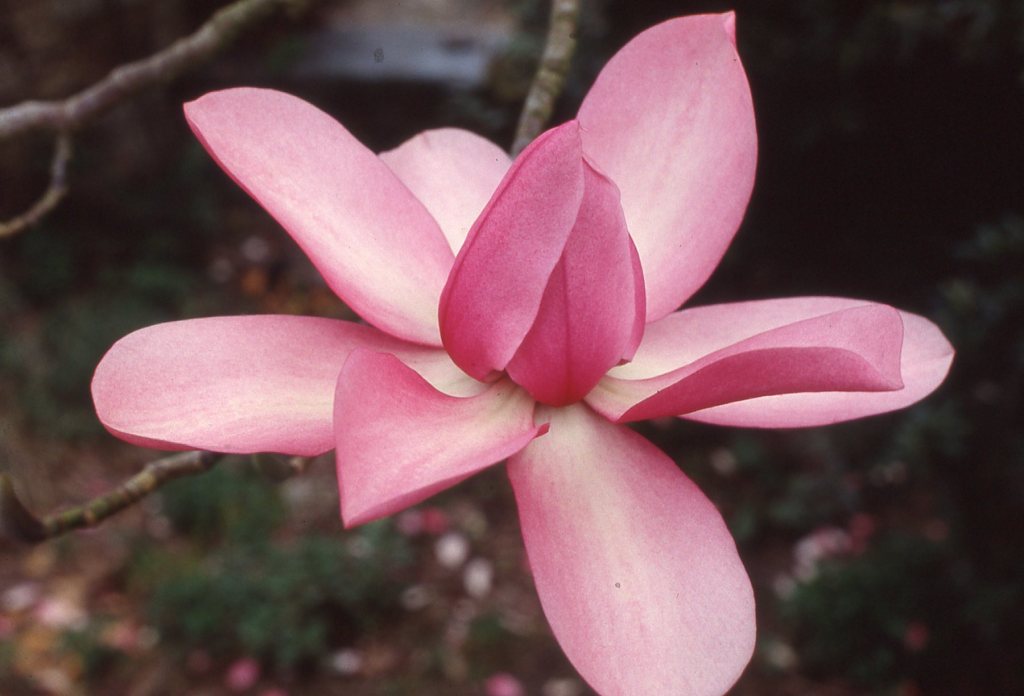
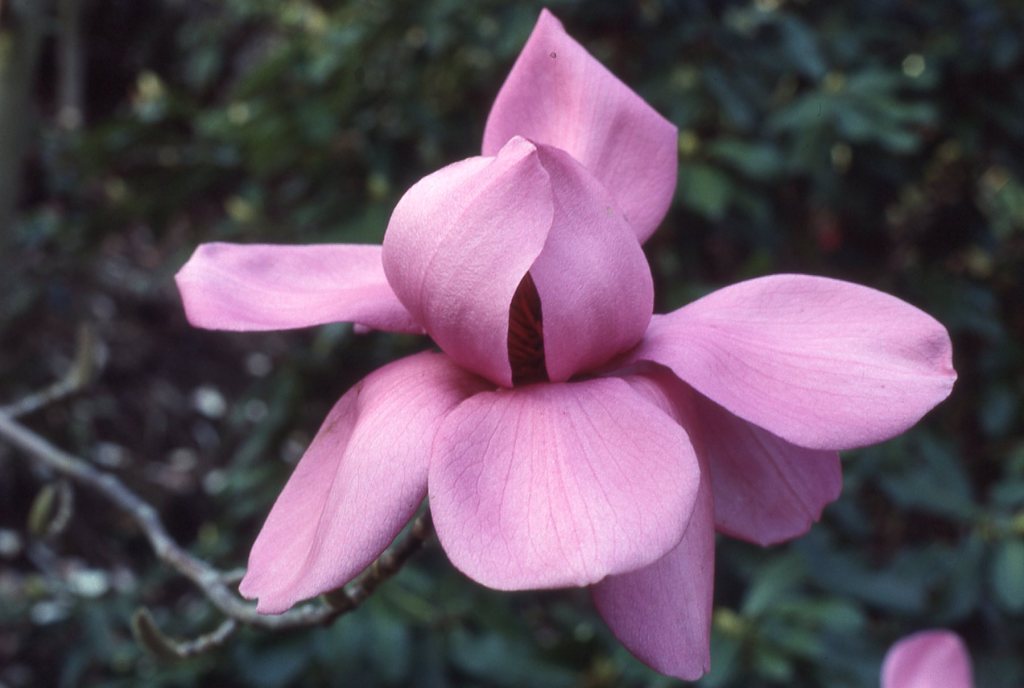
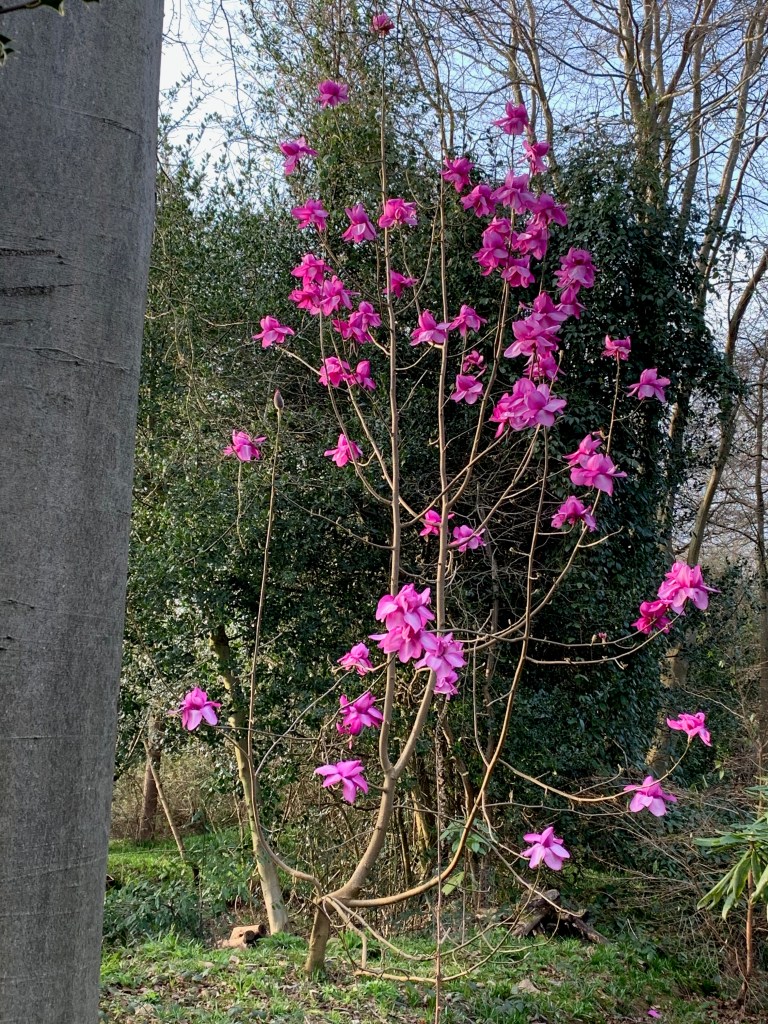
Darjeeling is one such, and high on my list of top 10 magnolias. The exceptionally rich red/purple colour with the outer whorl of tepals reflexed to show a paler inside, together make an unforgettable picture. This is an even richer colour in the warmer climate of New Zealand, as appears to be the case with other ‘red’ magnolias. The colour seems to be fugitive to cold. It was named by Hilliers as long ago as 1987 and grafted from a tree growing in the Lloyds Botanic Garden, Darjeeling. A fabulous flowering tree.
‘Darjeeling’ at White House Farm, at c. 10 years‘Darjeeling’ in Varangeville, Normandy
And Betty Jessel is a seedling raised by Sir Charles Jessel in Kent from M. mollicomata ‘Darjeeling’, and is also a remarkably rich colour, almost crimson in effect, during open weather. It does not appear to graft as easily as other cultivars and this is maybe why it is less often seen.
M. mollicomata ‘Betty Jessel’
Latest of all to flower is Peter Borlase, a little-known seedling from Lanhydrock. This is an unusual colour, a warm rose with a paler bar down the centre of the tepal. It was named for the head gardener at Lanhydrock and selected from a row of open-pollinated seedlings planted as a shelter belt. It flowers in April and as late as into May, on a sturdy upright medium-sized tree. It leafs out late; so late, it can appear to have died, like Acer pentaphyllum or Sorbus keenanii.
M. mollicomata ‘Peter Borlase’, flowering in late April
And of course there is the ‘Lanarth’ group, collected by Forrest in 1924, which tend to flower later than typical M. campbellii and from an earlier age. All have the remarkable and unique episcopal purple colour, fading to magenta/violet. It comes more or less true to colour from seed.
Forest never saw ‘Lanarth’ in flower, his note just said ‘only M. mollicomata, I think. GF’. When it was first introduced it was known as the ‘telephone number Magnolia’, because its collection number was F25655, typical of the then five digit phone number. Three seedlings were raised. One went to Lanarth, one to Werrington, the other to Borde Hill.
The ‘Lanarth’ at WerringtonA ‘Lanarth’ at Caerhayes
The original raising took 20 years or so to florescence, but seedlings from it have flowered sooner, such as ‘Trewidden Belle’, almost certainly a hybrid, below:
‘Trewidden Belle’, flowering at 15 years‘Trewidden Belle’, a ‘Lanarth’ seedling
At White House Farm this took some 15 years to flower from grafting, but it was moved as a small tree of about 2.5m which set it back. The colour has something of the magenta/purple tone of‘Lanarth’ but with more red and and brighter.
Another group that brings in the 3 elements of later flowering, a cup and saucer shape, and improved cold hardiness is the hybrid between the type campbellii and mollicomata, the Raffillii Group. Charles Raffill at Kew made this cross in 1946 and distributed up to 100 plants to gardens across the country. It flowered first at Windsor and this plant was named ‘Charles Raffill’. A subsequent cultivar flowered at Caerhays and was named ‘Kew’s Surprise’.
M. campbellii x mollicomata ‘Charles Raffil’ at Windsor
The quality of the flower may be just short of the class act of M. campbellii, but it is a first rate plant for those who fear the species may be susceptible to frost damage.
M. mollicomata ‘Jim Gardiner’ – the only double of the Group (photo courtesy Jim Gardiner)
Lastly, the M. campbelli mollicomata Group includes a wonderful double form – as far as Jim Gardiner knows, the only one – aptly named M. mollicomata ‘Jim Gardiner’, pictured above at Borde Hill in 2014 another variety well worth watching….
Maurice Foster
Featured image at top: M. mollicomata ‘Werrington’ at Tregrehan.
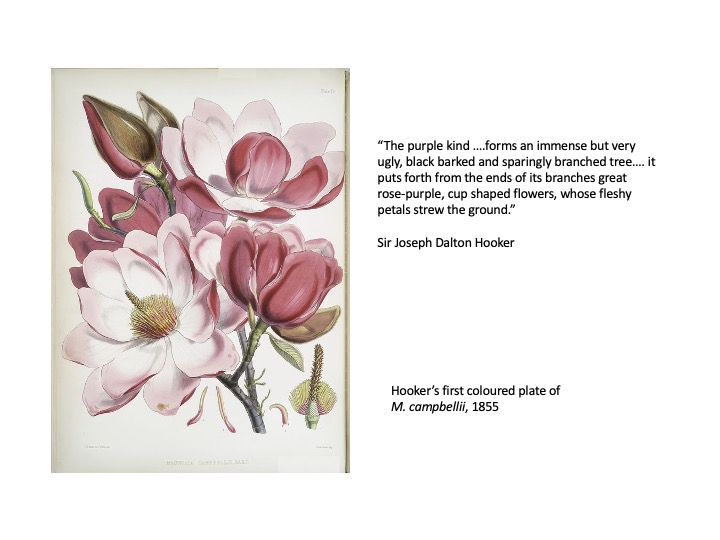
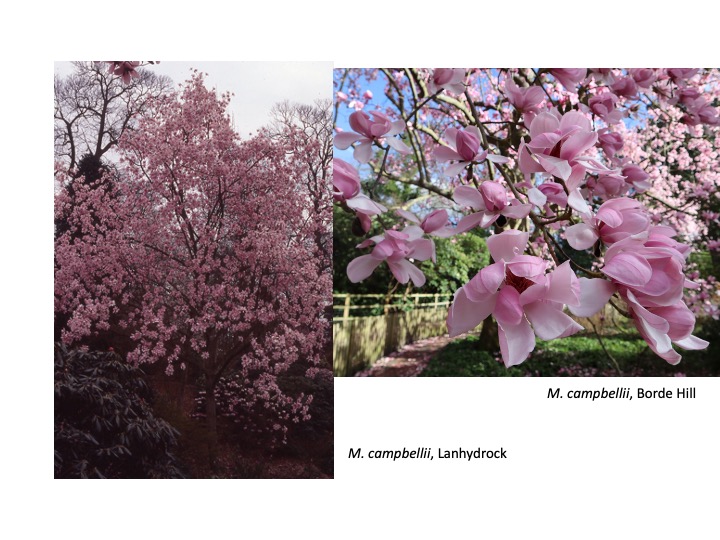
Archibald Campbell was a political officer at Darjeeling in N. India at the time of Joseph Hooker’s celebrated 1849 visit to the Himalaya, which he helped to expedite. He was perhaps fortunate to have the most spectacular flowering tree yet discovered – the pink type species of Magnolia campbellii – named for him by Hooker. For Hooker’s early experience of the species was restricted to Darjeeling and Sikkim, where the superb pink form is local, and of very limited distribution, possibly even ex situ as planted specimens: as Polunin and Stainton say in their 1984 Flowers of the Himalaya ‘A pink-flowered form is cultivated around Darjeeling’. By contrast, the white form (now M. campbelli alba) is ubiquitous across wide swathes of the Himalaya, from Nepal to Tibet. For the pink form to have been recognised as the type of the species is arguably an accident of history.
Kingdon Ward’s well known description of M. campbellii in Sikkim refers to ‘a fleet of pink waterlilies riding at anchor in a green surf’. But he also described the trees in Sikkim as white-flowered and rarely pink, writing ‘[we] gaze down in wonder on the dark forest, lit by thousands of milk-white glowing cups, hung like beacons in the bare trees, and be silent.’
Borde Hill photo courtesy Jack Aldridge
Hooker himself mentioned the scarcity of the pink form in 1855, only six years after first seeing it and naming it – due to the demand, he suggested at the time, for its high quality timber from huge specimens, up to 150ft tall.
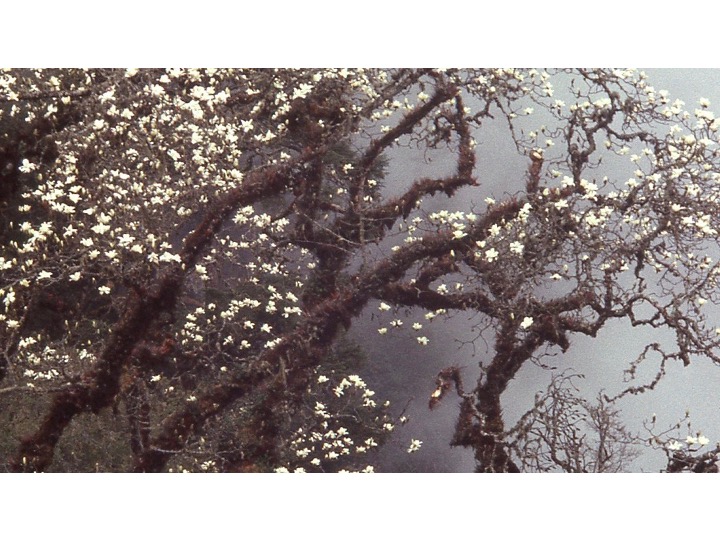
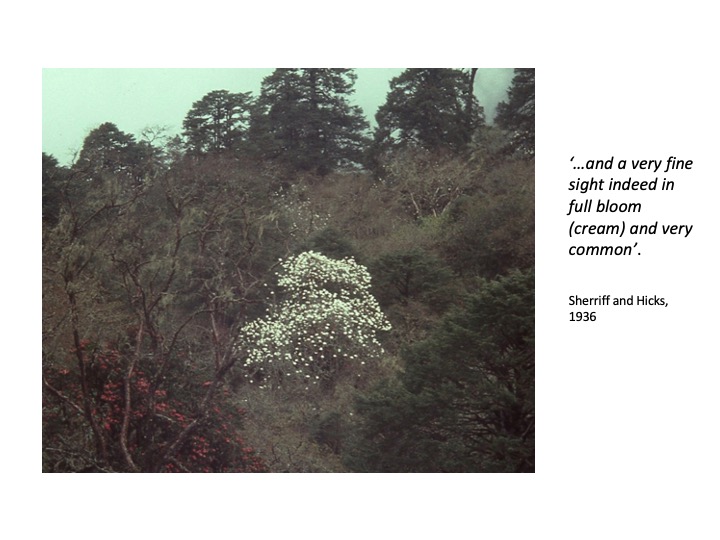
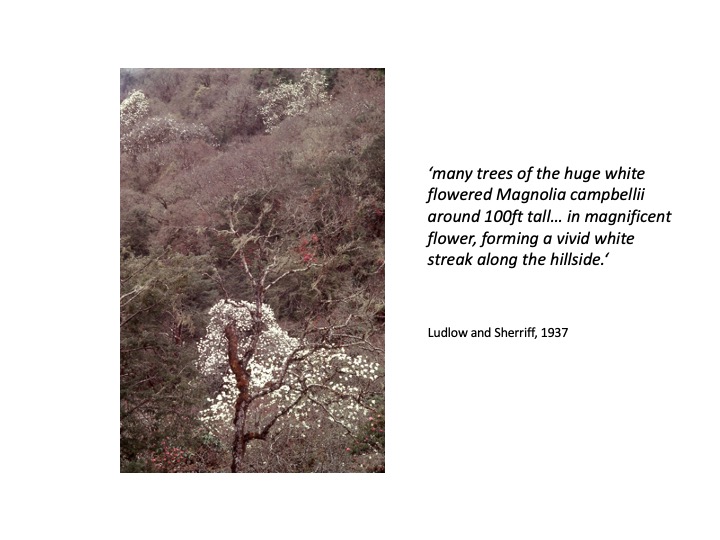
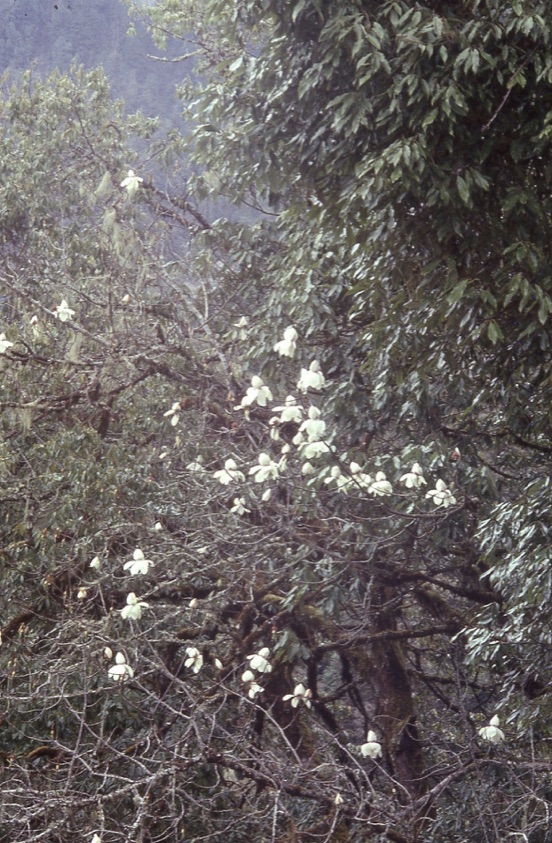
But all other published descriptions I have read of M. campbellii in the wild are of a white, not pink, form of the species. Polunin and Stainton state that there are no pink forms in Nepal. In 1936 Sherriff and Hicks described the species as up to 80ft in central Bhutan: ‘and a very fine sight indeed in full bloom (cream) and very common’. And a year later in 1937, Ludlow and Sherriff in N. Bhutan saw M. campbellii‘in magnificent flower, forming a vivid white streak along the hillside’.
Heading west they encountered ‘many trees of the huge white-flowered Magnolia campbellii around 100ft tall’.
In 1989, travelling for almost 3 weeks in West and Central Bhutan, when M. campbellii was in its full pomp, with scores of trees in full flower, I never saw a single pink form.
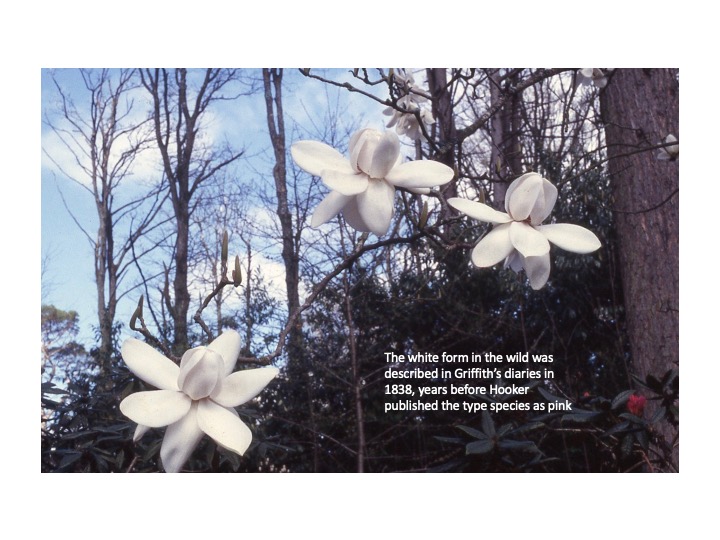
Long before Hooker described the pink form, William Griffith, an assistant surgeon working in Madras for the East india Company, had travelled extensively in Assam, Burma, Bhutan and neighbouring countries, and made significant collections. He discovered the white form in 1838, eleven years before Hooker saw the pink form. Griffith described the white form in his diaries, but alas, died at the untimely age of 35, and his records were published posthumously, well after Hooker had already published his description of the pink form and designated it the type species.
But for this accident of history, the white form would certainly have been described as the type species, and the pink form a local forma rosea.
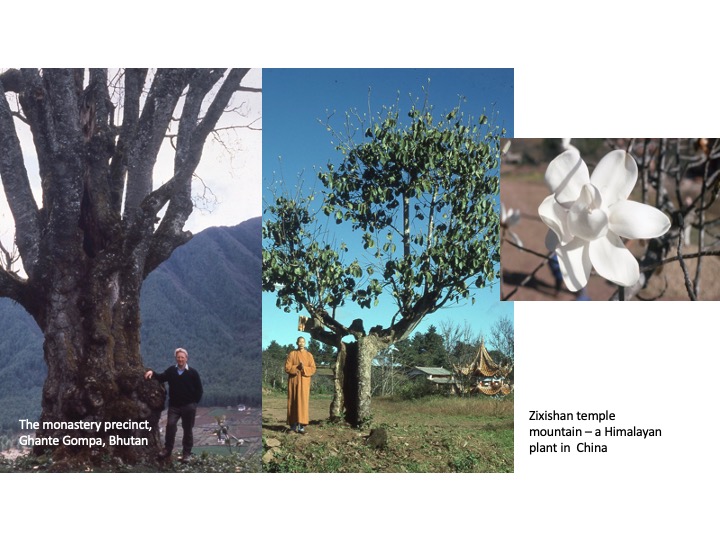
The white form in the wild is long lived, and can grow to a great size with specimens up to 150 ft reported, and once established, is seemingly indestructible.
The tree on the left is at the head of a village called Gante Gompa in Bhutan, growing in the precinct of a temple. Completely exposed and coppiced by storm and hollow, it is still 70ft tall and 8ft in diameter, full of vigour and reportedly flowering to capacity. The middle picture is a very old specimen, a true plant of M. campbellii alba from the Himalaya, planted on Zixishan, a temple mountain between Kunming and Dali in Yunnan, apparently presented to celebrate the historic visit of a significant religious figure. This makes sense, as these pure white flowers were regarded as a symbol of purity among Buddhists. It is protected by a monk, who as someone pointed out, has not done a good job as it has been burned, hollowed out and hacked, but in spite of it all still manages to grow with vigour, and flower freely. On a subsequent visit the guardian allowed me to climb it to photograph the flowers close up (right) which confirmed it as classical M. campbellii alba.
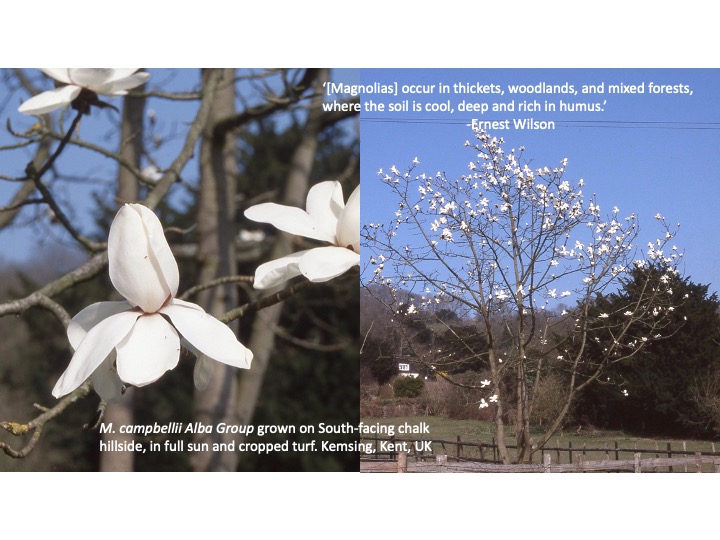
Further improbably tough hostile conditions are evidenced in a M. campbellii alba not far from us at White House Farm in Kent. “Plant a tree in seventy three” was a slogan to encourage schoolchildren in the UK to plant trees. The late Brian Doe, then Head Gardener at Borde Hill in Sussex took a seedling of M. campbellii alba to the field of a friend who lived on the North Downs on chalk, next to a chalk quarry, and it flowered with a classic cup-and-saucer pure white campbellii bloom. It survives, if not prospers.
I’ve no idea why to Brian it seemed a suitable place for a magnolia, which in the wild enjoys an acid forest soil with plentiful moisture in the benign shelter of open woodland. Maybe it was a deliberate experiment. It rather echoes the work and experience of Colin Mugridge, who grows healthy rhododendrons in a limestone quarry in N Wales with a pH of 7-4. Here it was planted in turf, short cropped by grazing sheep, on a south facing slope, in full sun, in the precinct of a cottage called Chalk Pit Cottage. The soil is grey, full of shards of crushed chalk, and with little humus. At one stage the tree had a pony tethered to it. There could be nowhere more hostile, but although growth was not optimal, it evidently showed no signs of chlorosis.
Who claimed that these Magnolias required an acid or neutral soil, or were impossible to grow in alkaline conditions? Has any formal research been done into soil pH? Does this single example open this whole question? If any reader of this blog has further experience of alkalinity tolerance in magnolias, please comment below, or email us at whitehousefarmarb@gmail.com. All the books say don’t plant these trees in alkaline conditions, so this is an important issue. Would there were more Brian Does who dared to defy received wisdom.
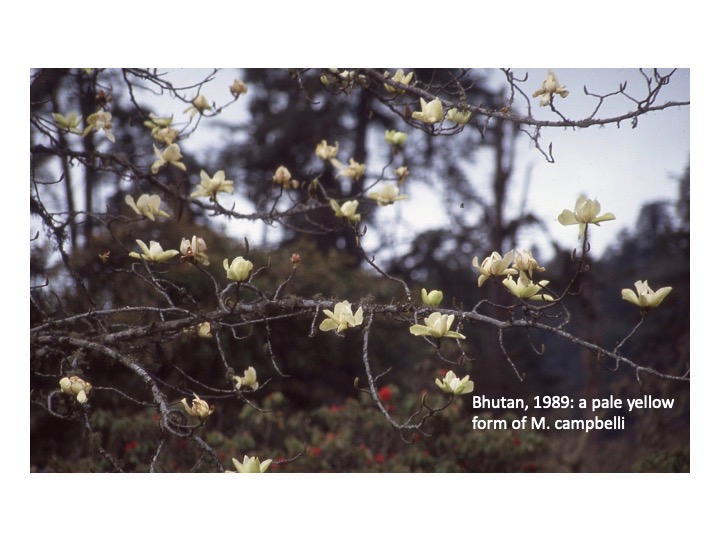
In the wild, the pink form may be local, the white form ubiquitous: but what is also curious about this brilliant species is that yellow forms reportedly exist quite widely in Bhutan, and must have been encountered, but for some reason not reported, by earlier explorers.
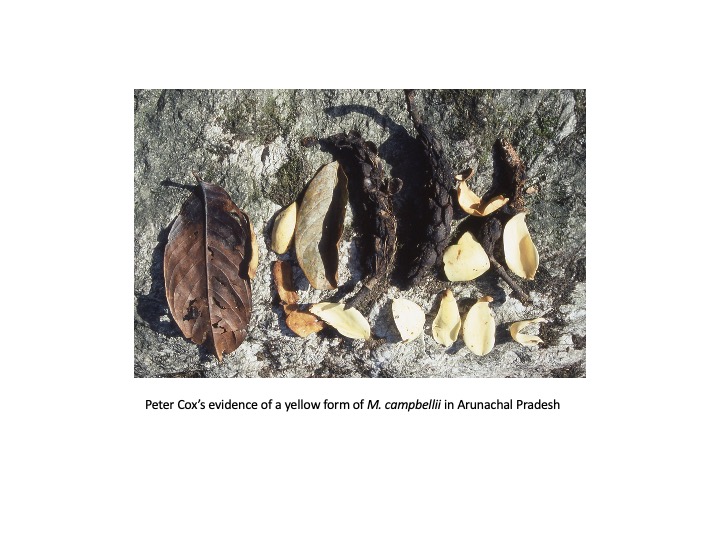
I saw this inaccessible specimen deep in the forest, but even with a zoom camera was unable to do it full justice. A student from Bhutan at Wisley told me that yellow-flowered specimens are quite frequent off the beaten track, and not at all unusual. Peter Cox sent me a photo of fallen tepals from a yellow form he saw in NE India.
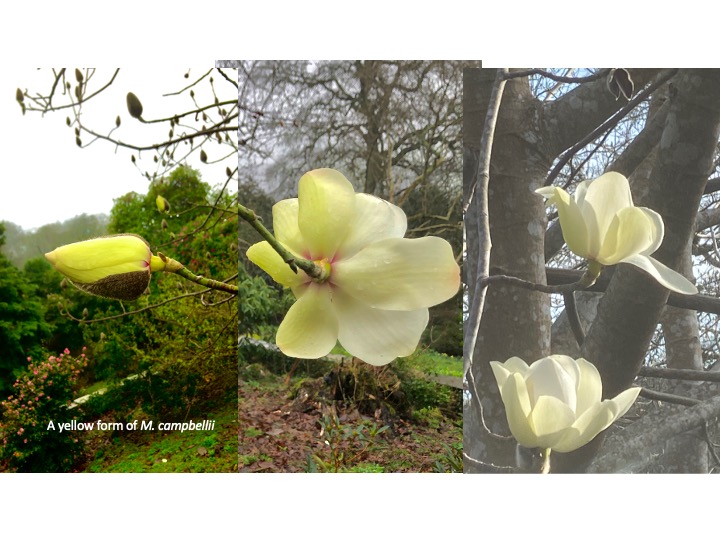
Taken at Mount Congreve, showing how the colour fades from bud, to mature, to the fading flower. Photos courtesy of Raf Lenaerts.
At Mt Congreve in Ireland this fine specimen shows that this is not a flight of wishful thinking, but a reality. The yellow is quite intense in the bud, gradually fading with maturity to cream. It is surprising that this opportunity for hybridisers has not been exploited. A cross with M. acuminata or one of its hybrids seems obvious.
It is easy to conclude that these are straightforward, forgiving plants, and once established, indestructible, combining this cultural toughness with a generosity of flower of a beauty unsurpassed by any other flowering tree. But hang on a minute, comes the cry – in the UK they flower in March, and thus the flowers are always susceptible to frost damage.
But this is ‘up to a point, Lord Copper’ – siting with tree top cover, or against a wall, with tree top cover, or on a slope to guarantee cold air drainage, can each contribute to mitigate this. At White House Farm on our katabatically favourable hill in Kent, we have suffered frost damage to our campbelliis only once in the last 15 years. Perhaps climate change brings such hidden advantages.
M. campbellii is also said to take 20-30 years to flower from seed. This may be true in the benign west country, where rainfall and shaded warmth stimulate impressive growth, perhaps at the expense of flower, but I have found they will flower from a strong graft at 10-12 years with good light and good siting. Perhaps it is time for us all – even those in their wrinkly sixties – to give this wonderful tree a try, and experience the skin tingling majesty of its flowers.
By Maurice Foster
Some of these ideas and images were shared at an IDS Study Day on Magnolias held at Arboretum Wespelaar, on April 14th 2024.
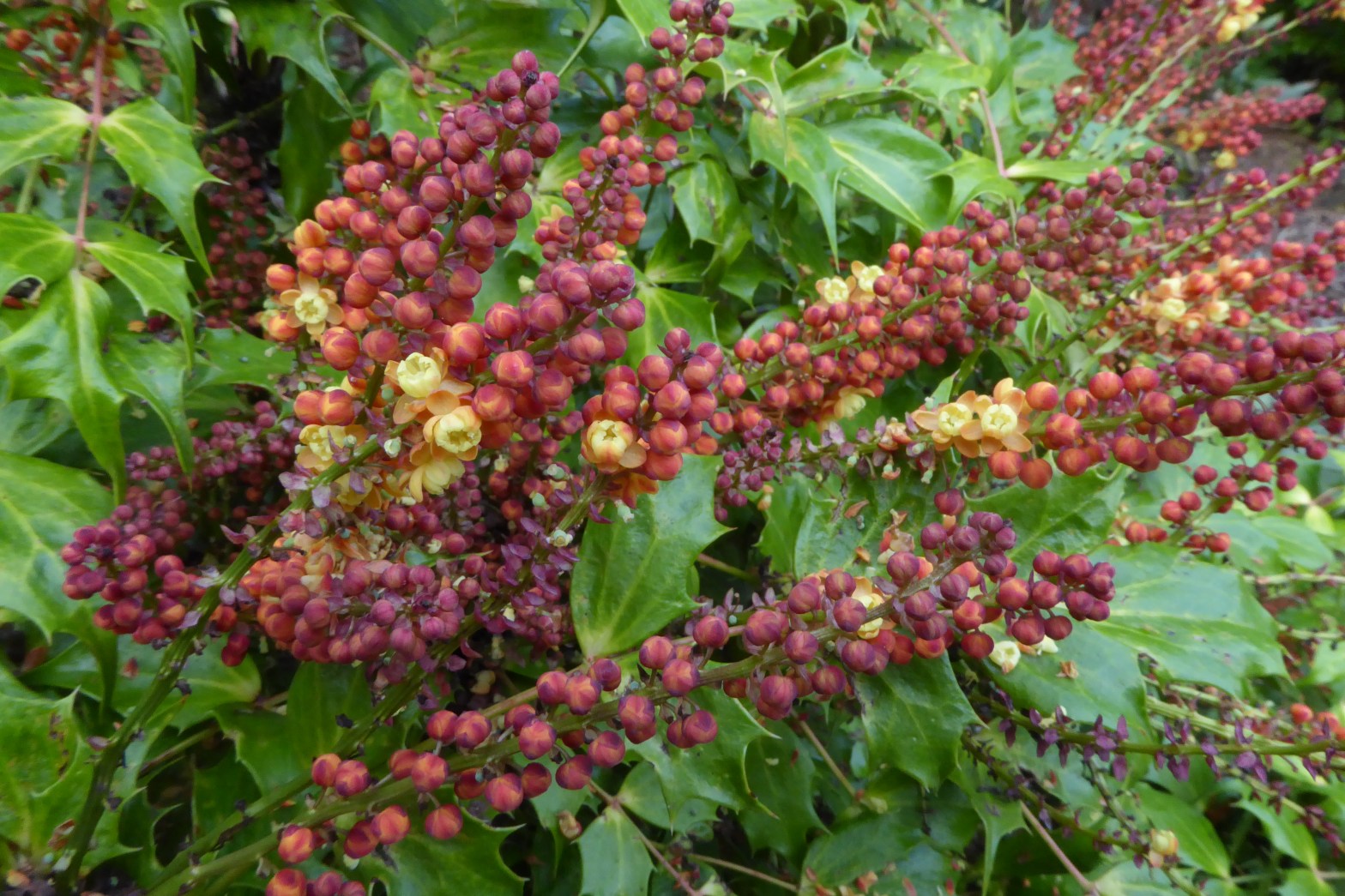
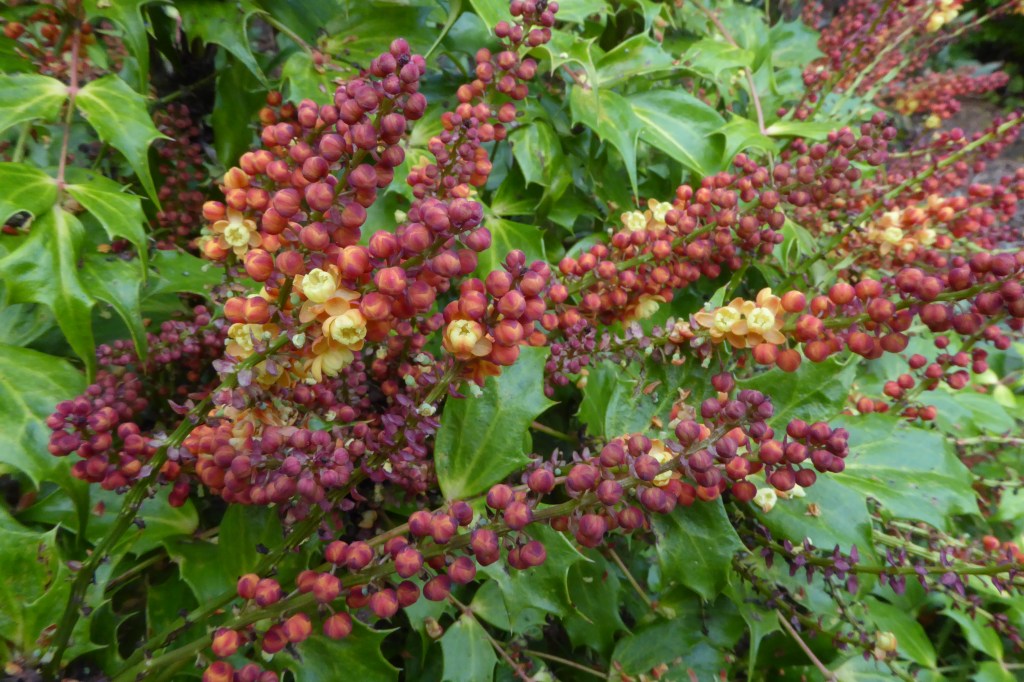
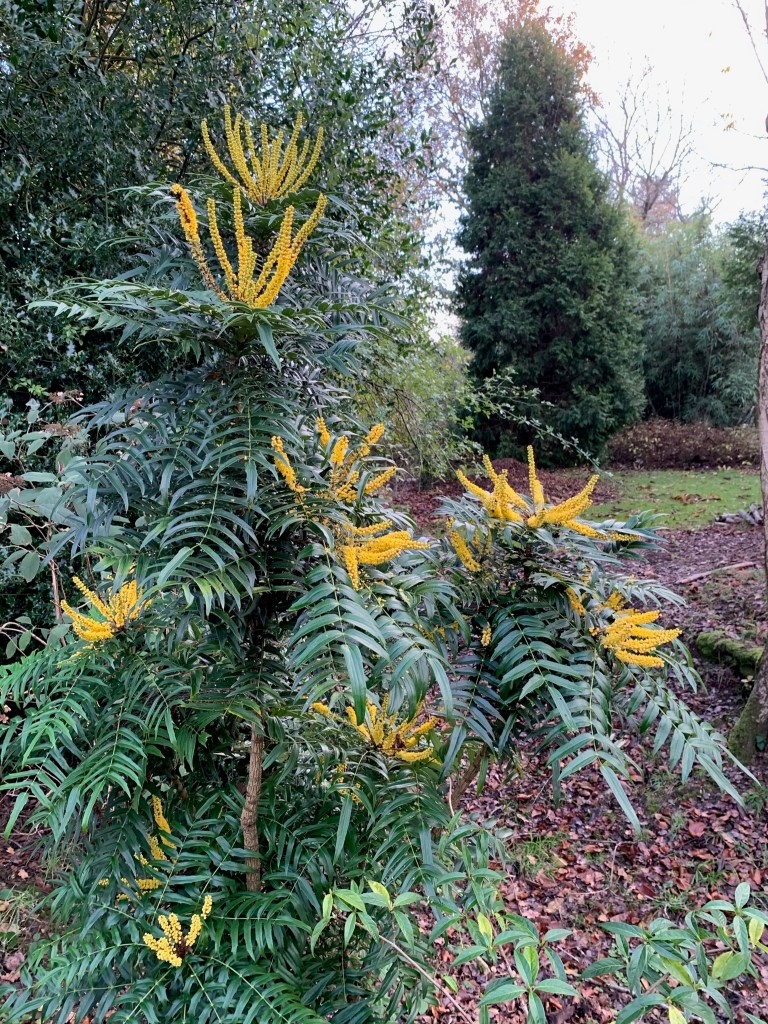
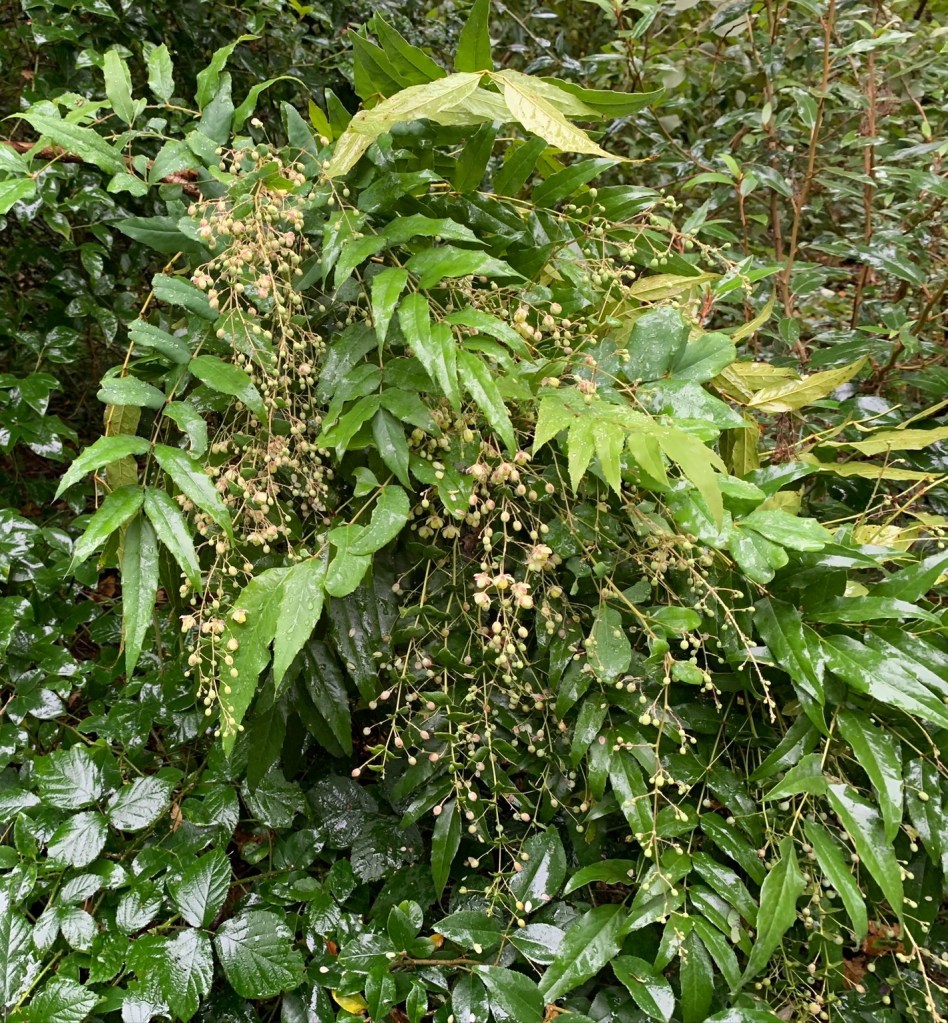
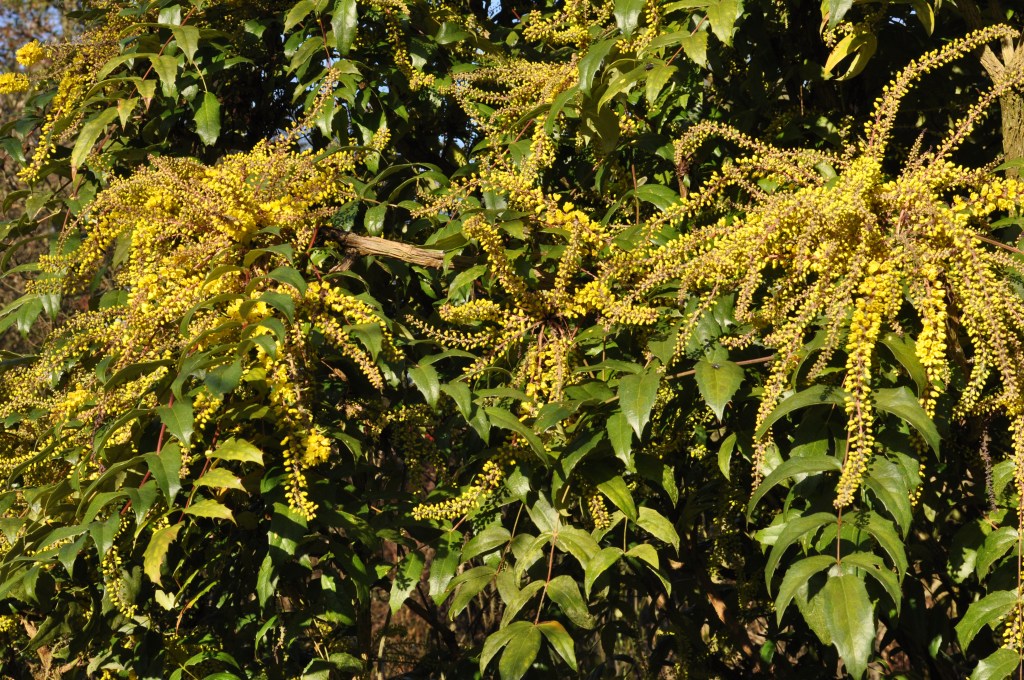
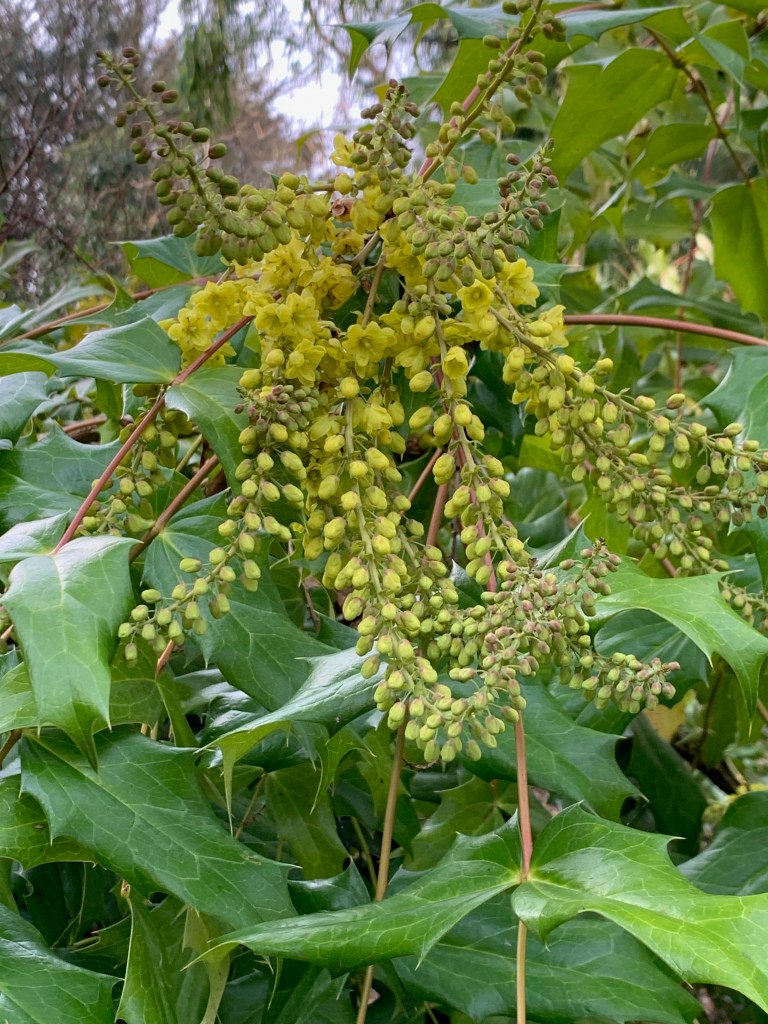
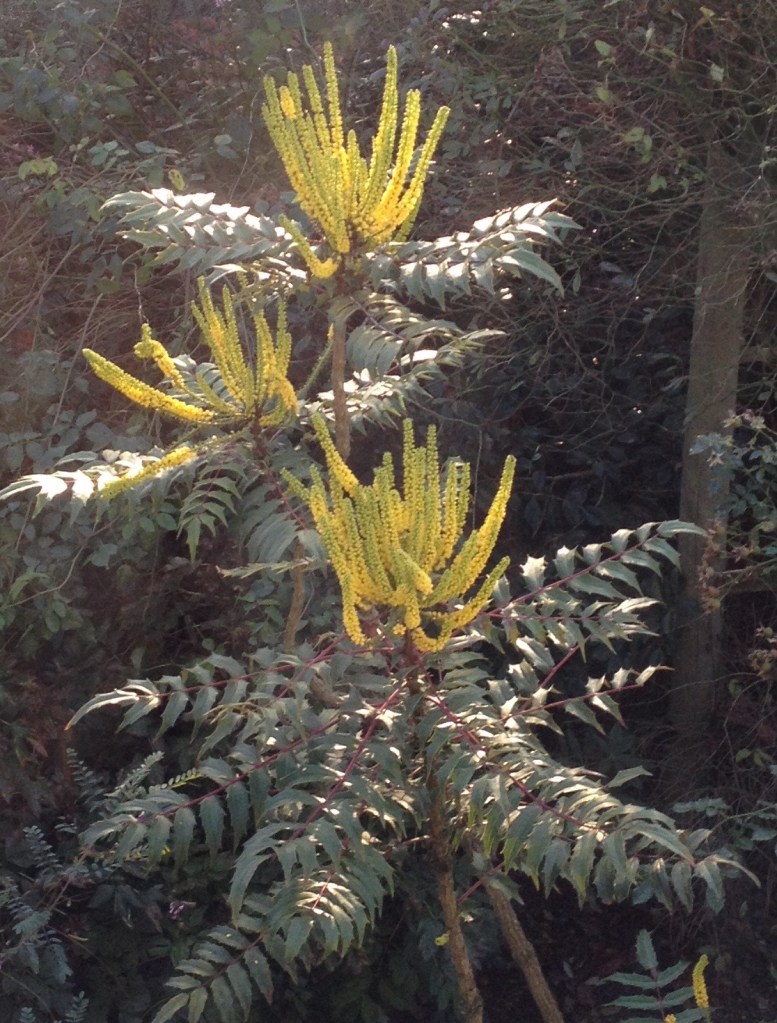
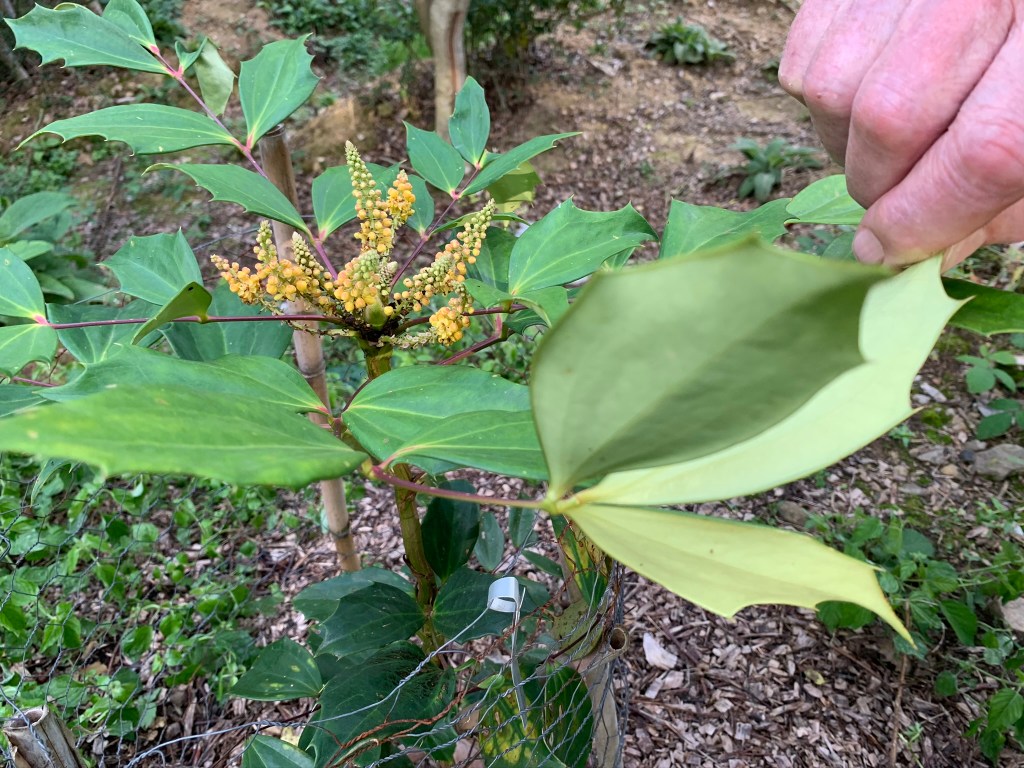
One of our main occupations at present is to review all genera in the collection here at White House Farm, with a view to completing an accurate database, and creating permanent labels. Trustees Chris Sanders, Jack Aldridge and Rod White have all recently been trawling through the Mahonia collection in a valiant attempt to sort out the nomenclature and taxonomy of a genus where hybridity is rife and newly wild-collected species the subject of much discussion. French expert Olivier Colin was also here recently for the day with advice and comment, so the horticultural brainpower applied in the field is formidable. And comment on the current RHS mahonia trial at the Hillier arboretum is also a useful source of information.
I have been collecting Mahonias for some years as I rate very highly the role they play in the winter garden from September to March. This year, when for days it seemed hardly to get light, and a depressingly dark cloudbase hung over the world like a giant saucepan lid, Mahonias lifted the spirit with their irrepressible shiny evergreen foliage and their longlasting succession of bright yellow flowers, with a constant flutter of bluetits feasting on nectar and blackbirds later relishing the juicy blue fruits.
When we completed our initial survey I was amazed to discover that I had amassed as many as over 70 species, forms and hybrids, including a significant number raised from wild collected seeds from both Asia and the Americas. Here are just one or two to provide a flavour of the pleasure they give in passing them daily during the short dog days of dormancy.
Mahonia nitens
Mahonia nitens
This is M. nitens (Ogisu 94010) photographed in September, and one of the earliest to flower. It was given to the De Belders at Kalmthout, who generously distributed it. Great for small gardens: compact, excellent foliage with purple young growth and flower able to compete with the best.
Mahonia oywakensis
Mahonia oywakensis
An Edward Needham collection, this is the type species of M. oywakensis. Its narrow leaflets and golden flowers are special and it looks a relatively compact grower. It flowers from October into November.
Mahonia russellii
Mahonia russellii
A quite recent introduction, this is the Mexican M. russellii, named for James Russell of Castle Howard fame. Suspecting a lack of hardiness, I tucked it in under an old holly in a quite dry situation, stony and well drained – poor soil to keep it honest – and it has thrived, flowering freely each year in December. There are some first rank Mexican mahonias turning out to be hardy here at White House Farm, and which should be better known for their significant impact on the winter garden.
Mahonia ‘Esme’
Mahonia ‘Esme’
I have named a plant for each of my 7 grandchildren and this is called Mahonia ‘Esme’, who is currently in her third year at Glasgow university and rapidly becoming Scottish. It appeared from nowhere as a volunteer in a pot in the greenhouse and I planted it as any old background seedling evergreen in the rose garden. It turned out to be a first class plant some 4x4m with long pendulous racemes of small flowers in January and February. I measured one raceme at 16 inches. The young growth is plum purple. The parentage is anyone’s guess but M. duclouxiana – whatever that is – influence gets most votes.
Mahonia ‘Cantab’
Mahonia lindsayae ‘Cantab’
Also with pendulous flowers is the hybrid M x lindsayae ‘Cantab’, which sprawls untidily over a vast area. Don’t plant it if you are a strict disciplinarian. The individual florets are perhaps the largest in the genus, delightful and highly effective – and like the plant, sprawl gently everywhere in a generous mass. A plant of distinction, in both senses; I enjoy its flowers and its individuality.
Mahonia huiliensis? MF 941068
From south Sichuan, the identity of this Mahonia is a subject of some discussion. It was identified as M. huiliensis MF 941068 (Chinese advice) but there are thoughts it may be something new. In any event, from October on it is magnificent. The dark red rachis are distinctive.
A recent discovery, not yet certainly identified
There is a variety of opinion among cognoscenti on this plant. It was collected in Yunnan by Charles Boulanger, and this plant was kindly given to me by Alexander Anagnostides who is building a fine garden in Varengeville sur mer, in Normandy. It flowers very early in late August/early September and one thought is that it may be a hybrid between M. shenii and M. nitens. However, I have raised it from seed, kept three and distributed the rest and so far all seedlings have turned out to be identical to the parent, with no suggestion of hybrid parentage. The foliage is highly distinctive, unmistakeably thick and hard like a stiff plastic. Any thoughts welcome.
Mahonia in a temple garden in the far west of Yunnan, China
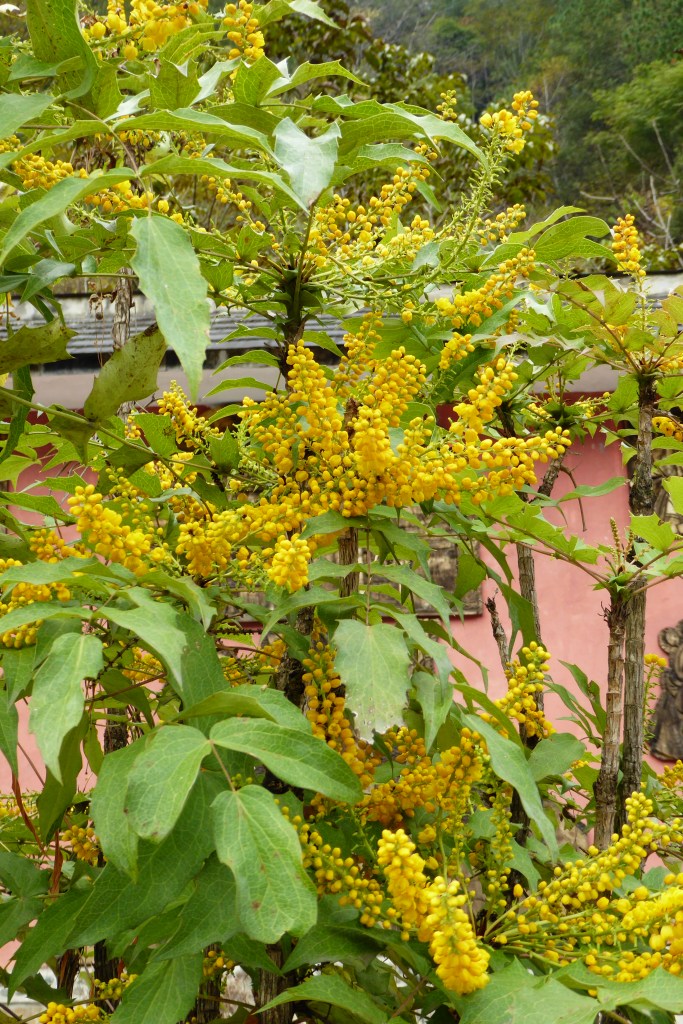
Finally, there must be many more fine mahonias still to be discovered in China and not yet in cultivation in the West. For example, this is a highly distinctive free flowering plant with unusually pale green foliage I photographed in a temple garden in the far west of Yunnan. We can only hope that the wonders and wealth of the Chinese woody flora, the finest in the world, may still be available for our future enlightenment and enjoyment.
Yunnan in Western China is probably the epicentre of rose species – and many of them, such as members of the Synstylae group, have huge vigour, which they seem to pass on to their various hybrids.
The best known is probably Rosafilipes, of which the remarkable ‘Kiftsgate’ is a form or hybrid. The type species of R. filipes is infrequent in the wild, but recognisable from its long, thread-like pedicels forming large corymbs of simple single white flowers.
R. filipes from the wild at WHF
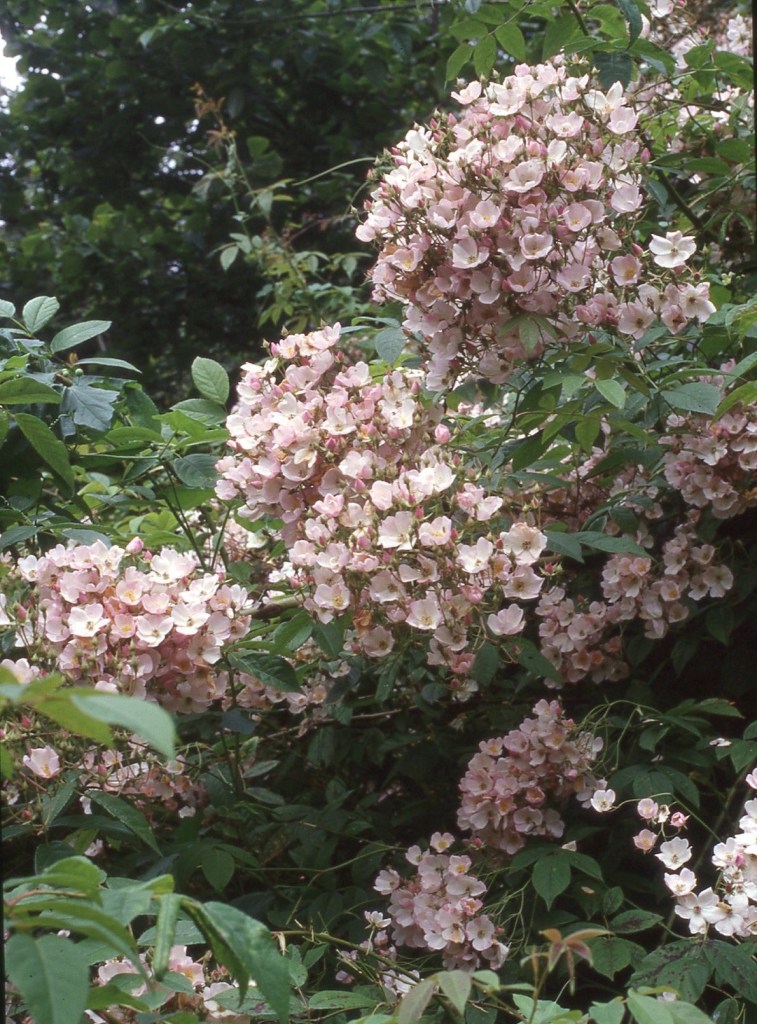
Below is an open-pollinated R. filipes seedling from White House Farm, ‘Rosemary Foster’, with pale pink colouring, which will climb up to fifty feet in a tree (here, sycamore and oak) and hang down long flowering shoots in arcs.
WHF’s R, filipes pink seedling, ‘Rosemary Foster’
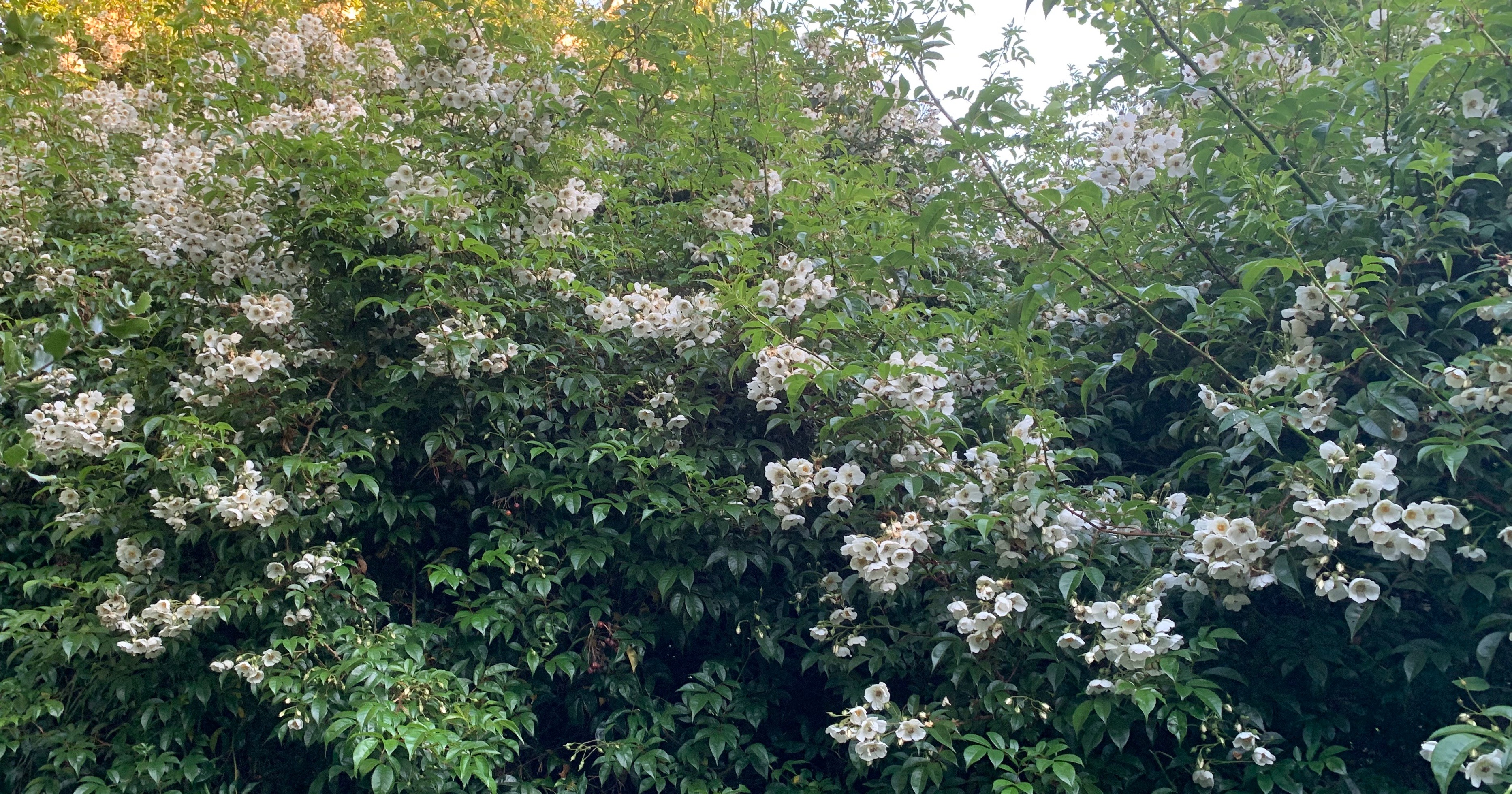
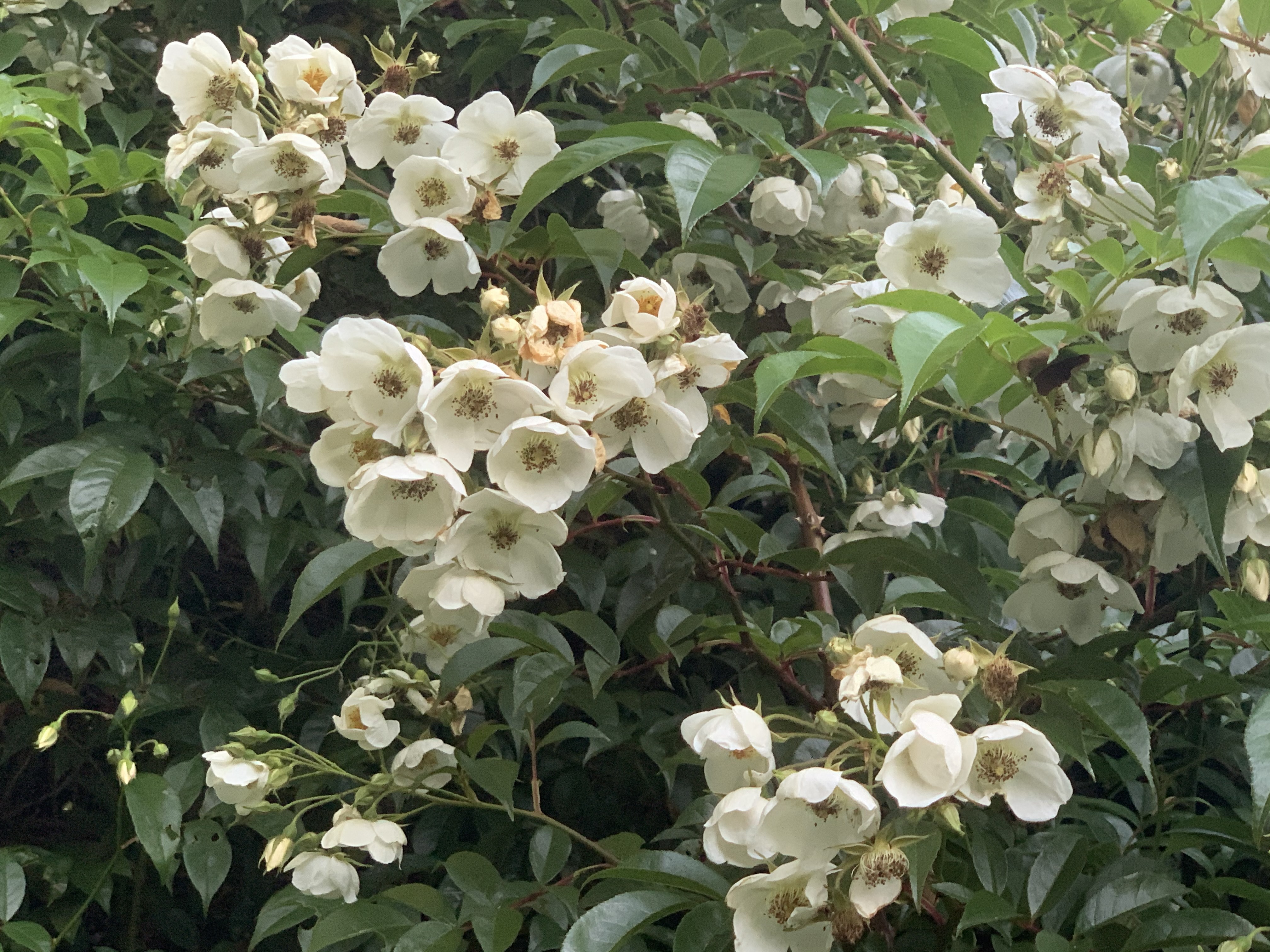
The other notable member at WHF of the synstylae group is Rosa longicuspis, which has virtually every attribute a desirable flowering plant might possess: it has polished dark green foliage, is fully evergreen (even in several degrees of frost), largish flowers in open corymbs which those with a decent nose say has a faint smell of bananas – and vigour. Our plant is 20 feet tall by as much as 40-50ft across, entirely smothering an old bramley apple tree. The young shoots are polished reddish brown.
The conventional commercial sources have said neither of these synstylae are marketable because they are too vigorous for the average garden. R. filipes is also ultra-promiscuous, producing copious seedlings, many of which are worthwhile (like ‘Rosemary Foster’). But we think they have significant potential for hybridising. We use them to enliven our screen trees, and they are often a feature in autumn for their clusters of hips.
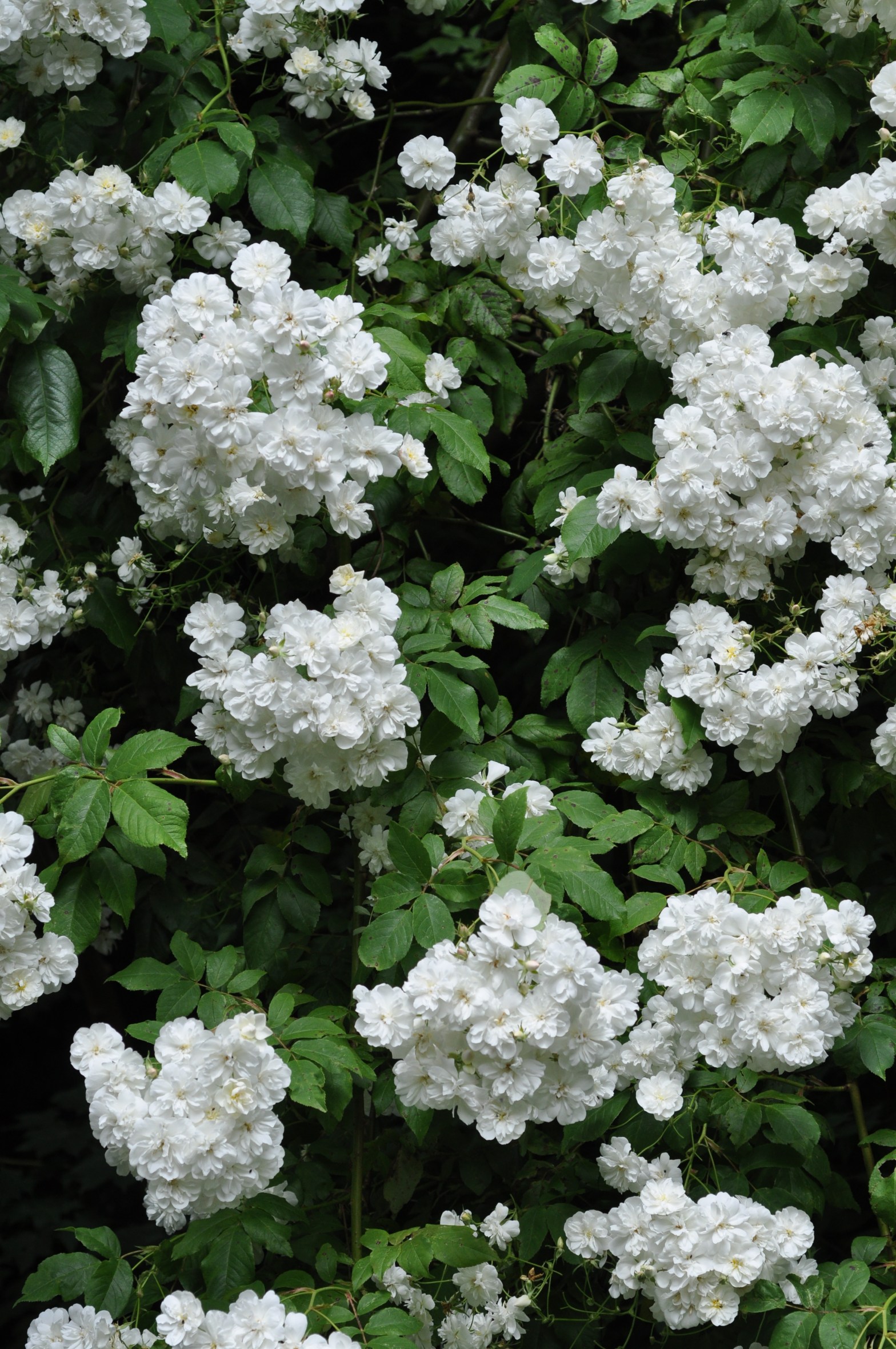
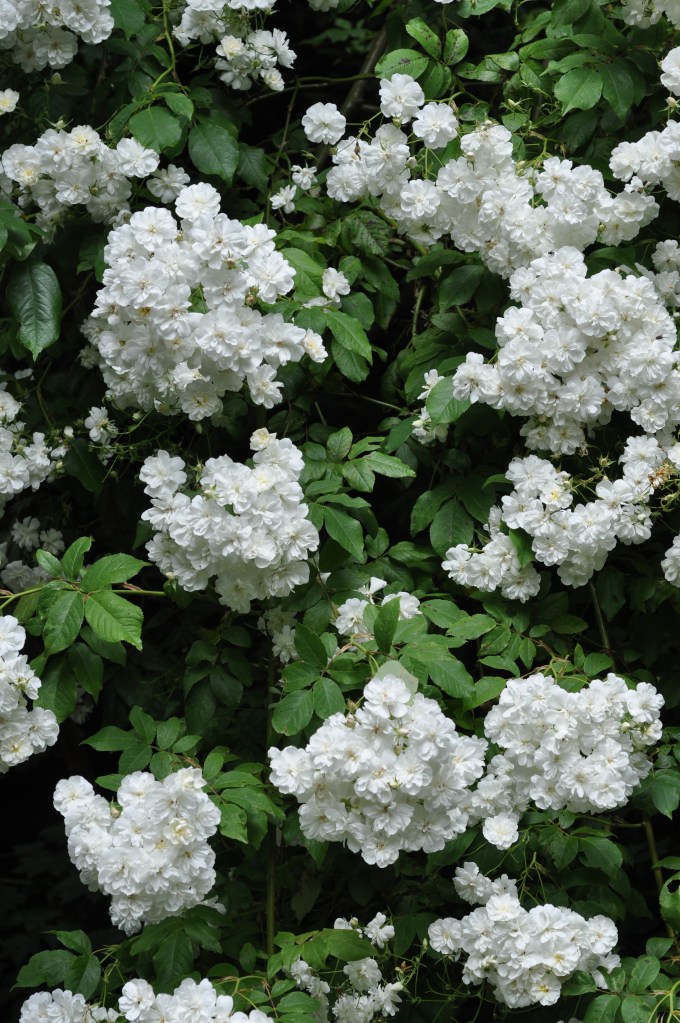
Another very promising synstylae bred here has large rosette-like white flowers hanging in festoons cascading down the side of an old gean. It leaves ‘Rambling Rector’ standing in the middle of his rural parish, so we’re looking for a suitable name for it from higher up the episcopal hierarchy.
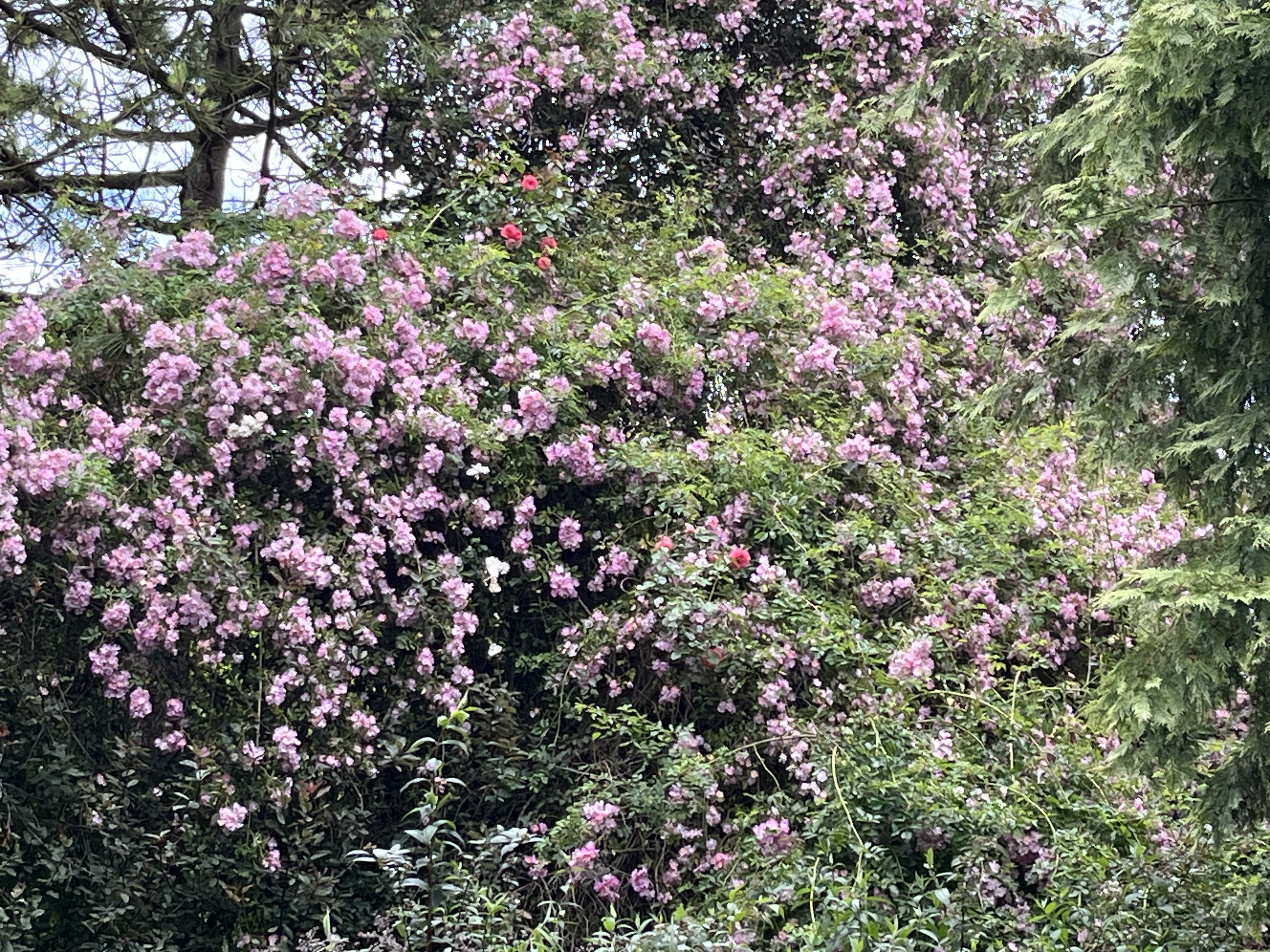
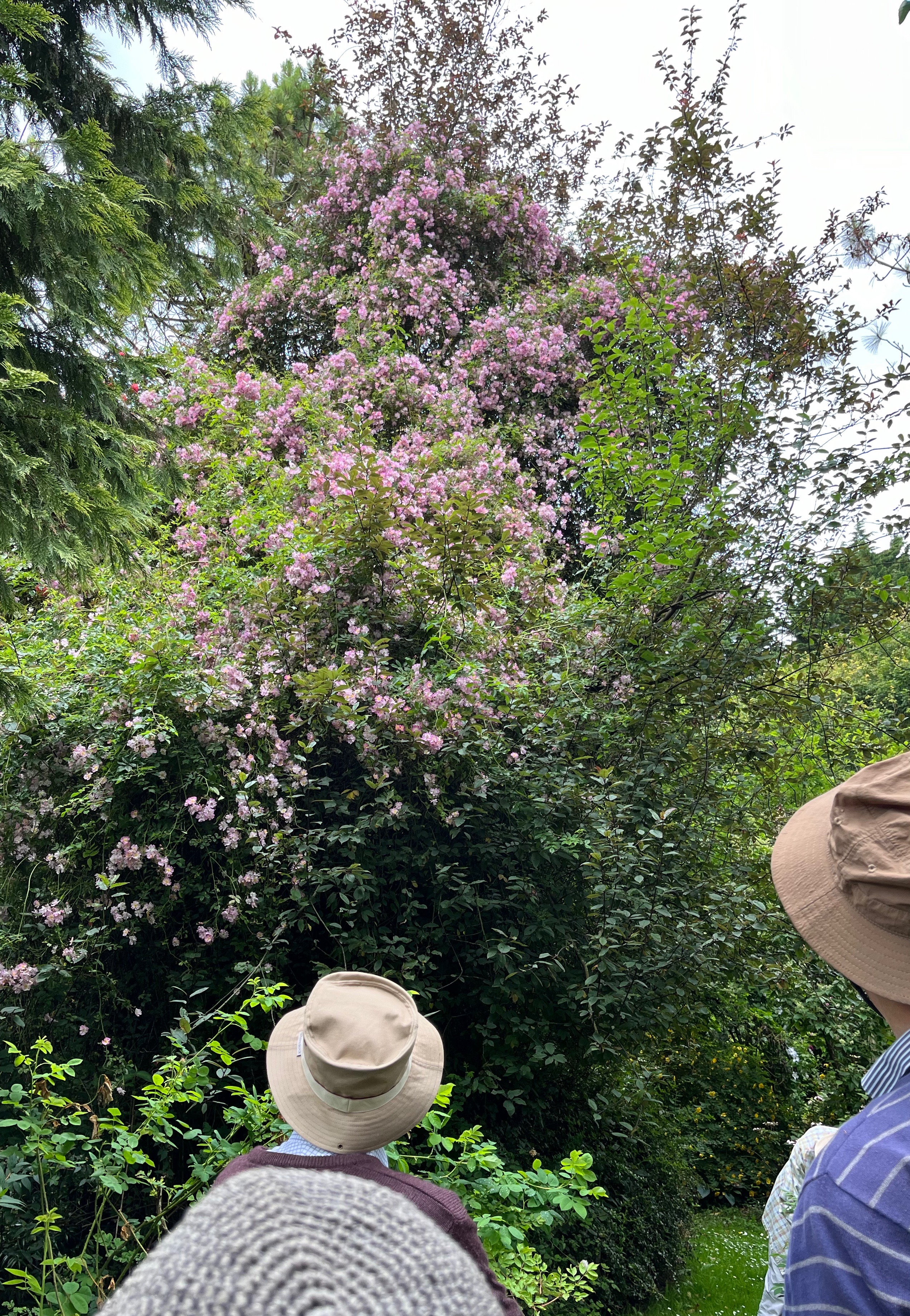
A further climbing rose which has attracted much attention from visitors is a strong pink seedling of ‘Veilschenblau’ , now smothering a large Prunus colorata in the Rose Garden. This was brought in as a specimen to the RHS Woody Plant Committee by its then secretary Diana Miller many years ago as a seedling from her garden. I showed interest in it, took the specimen home and rooted it as cuttings. There seems to be little of Veilschenblau in it, in terms of either colour or vigour, but twenty odd years on it is now a remarkable spectacle.
We tend to leave self-sown rose seedlings here until they flower, particularly if a good rose is or was once planted nearby. One never knows one’s luck. After all, every plant we grow in our gardens originated from seed.
by Clare Foster, Chair of the Board of Trustees, WHFAF
On Wednesday July 10th we will hold an afternoon Garden Masterclass tour of White House Farm with Maurice Foster, Caroline Jackson, Jack Aldridge and Annie Guilefoyle, exploring White House Farm’s collection of Japanese serrata cultivars and Maurice’s own serrata hybrids. A few places are still available from Garden Masterclass here. For those of you new to us, Maurice and Clare’s Garden Masterclass Thursday Garden chat is here. It gives a brief overview of White House Farm’s 53-year history as a private garden and its current purpose as a charity.
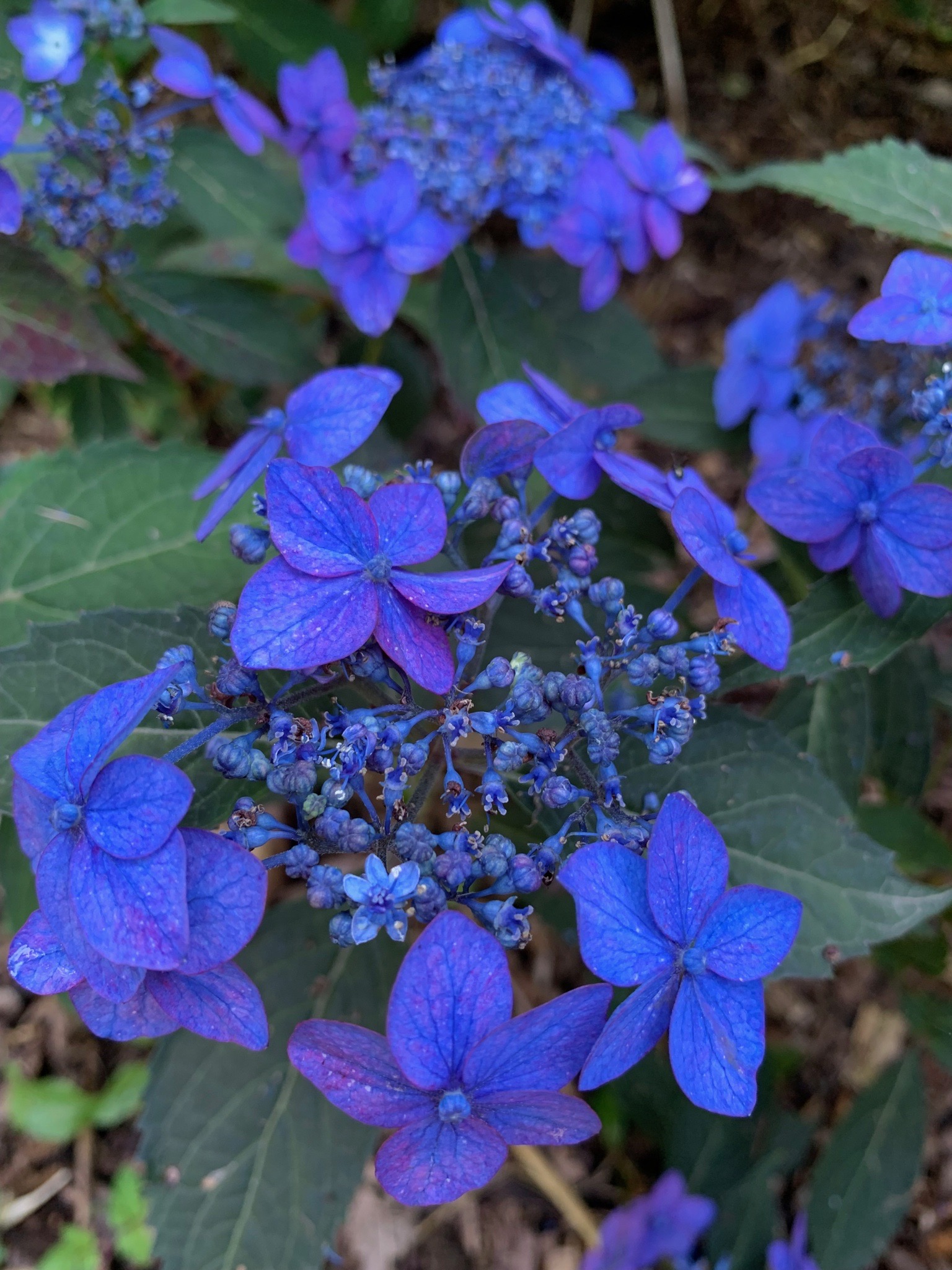
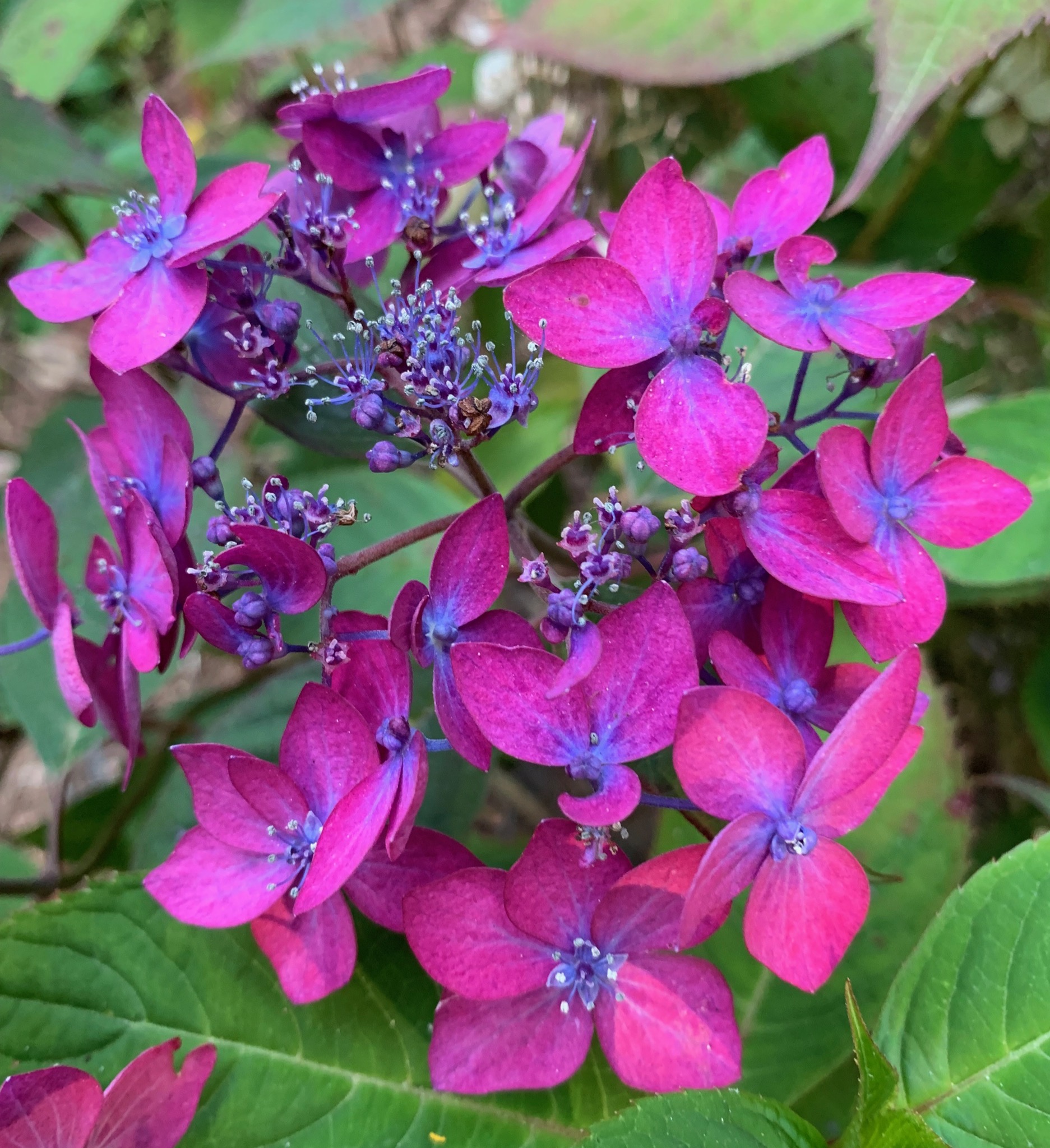
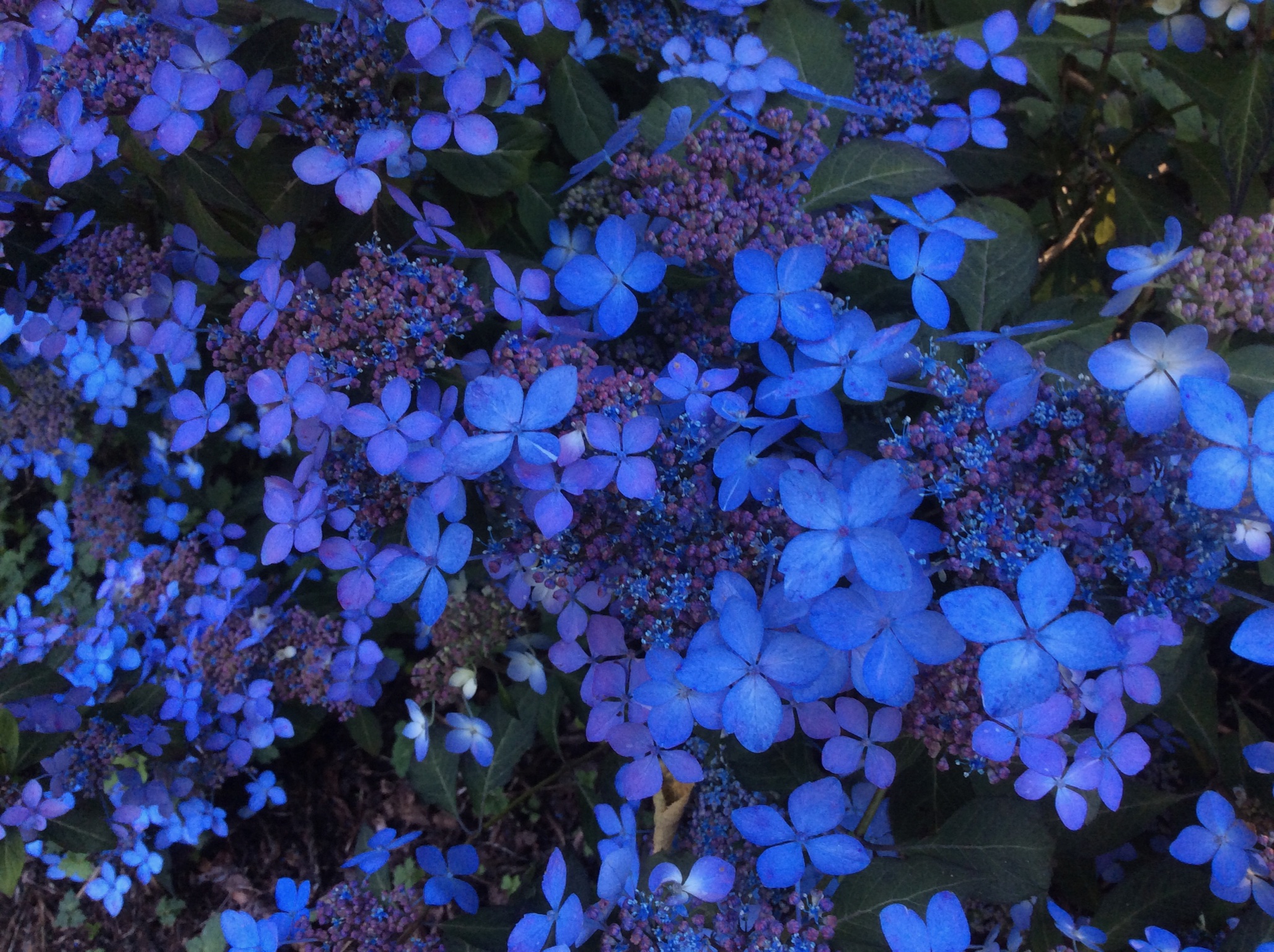
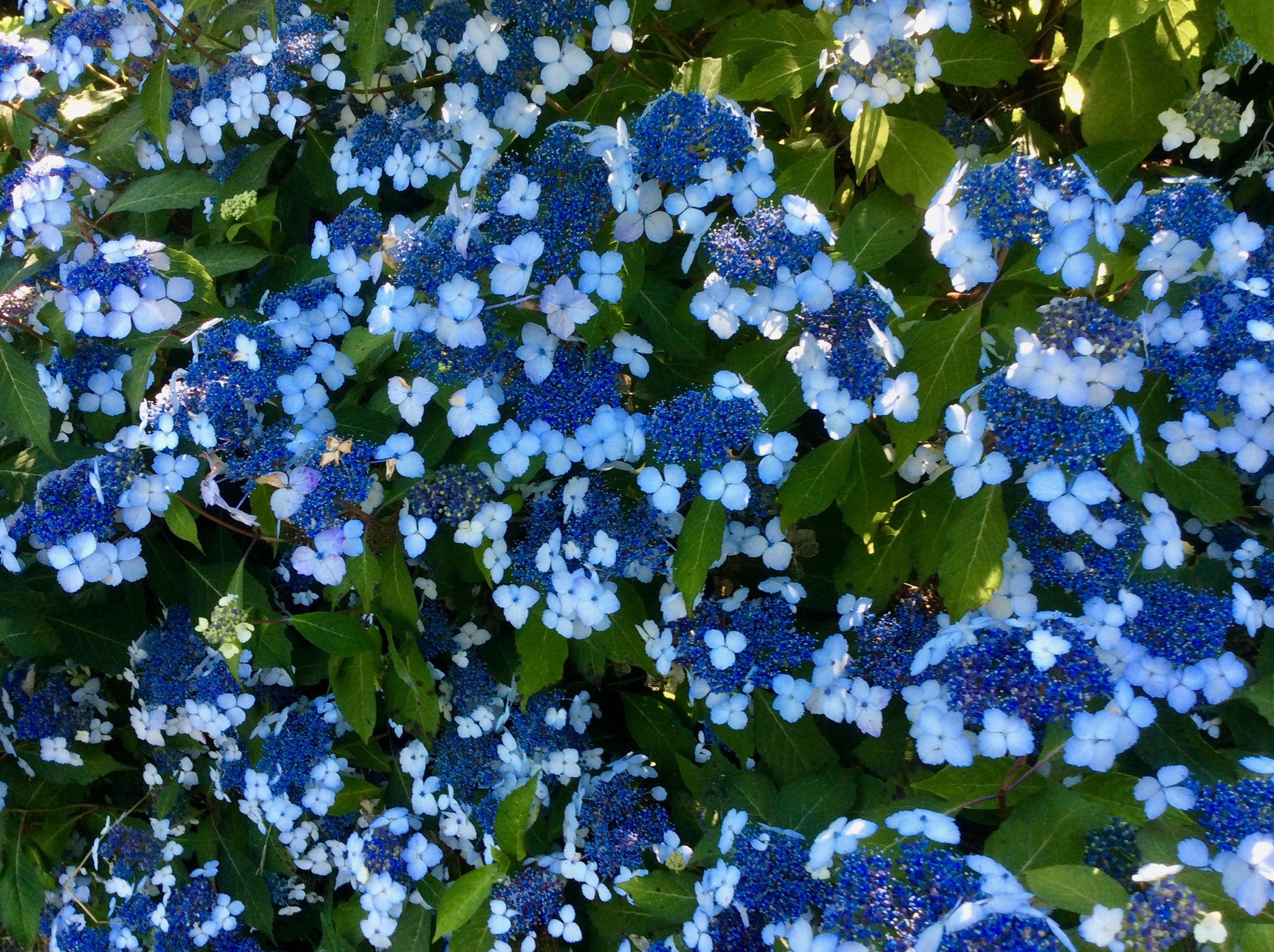
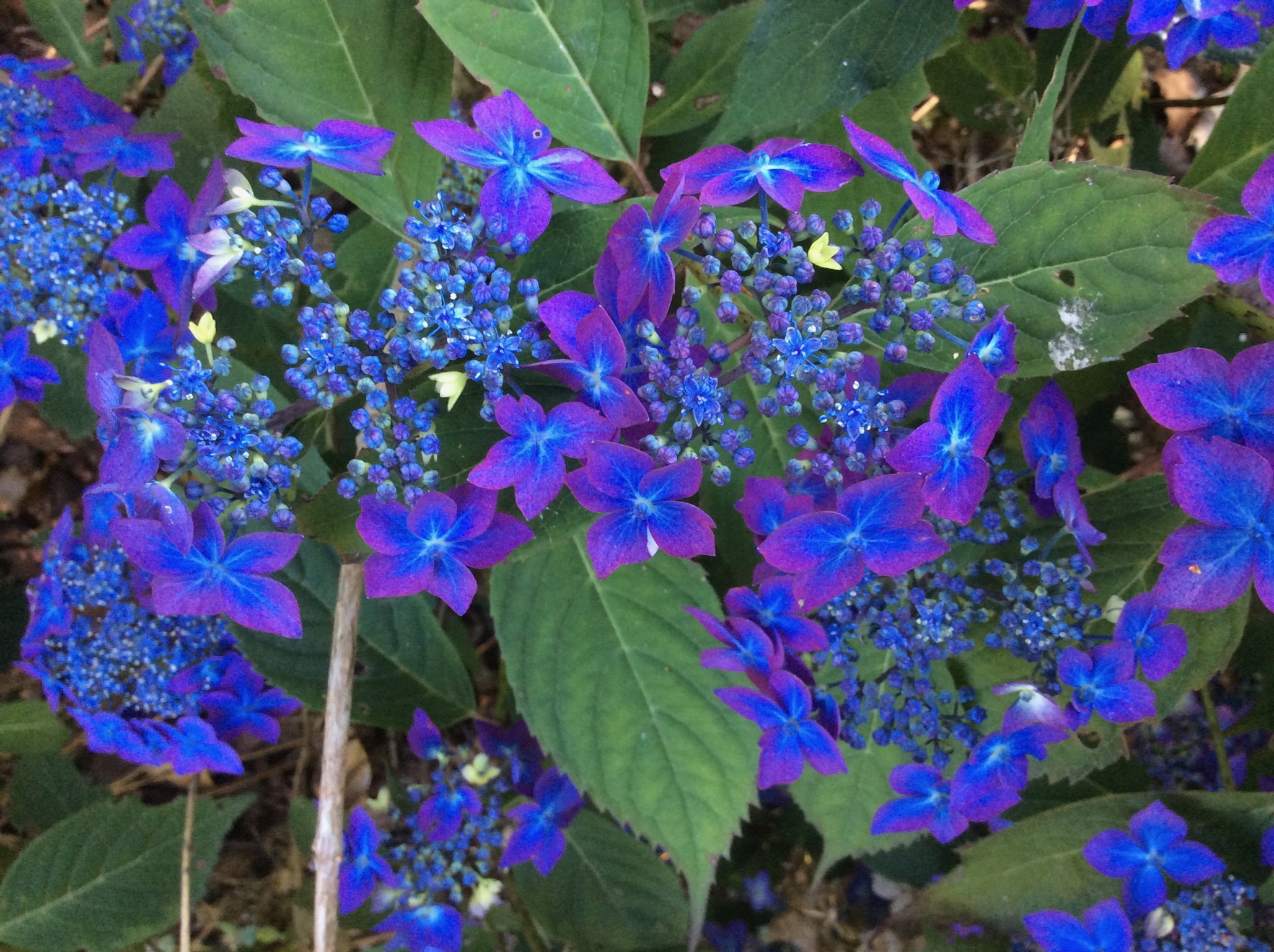
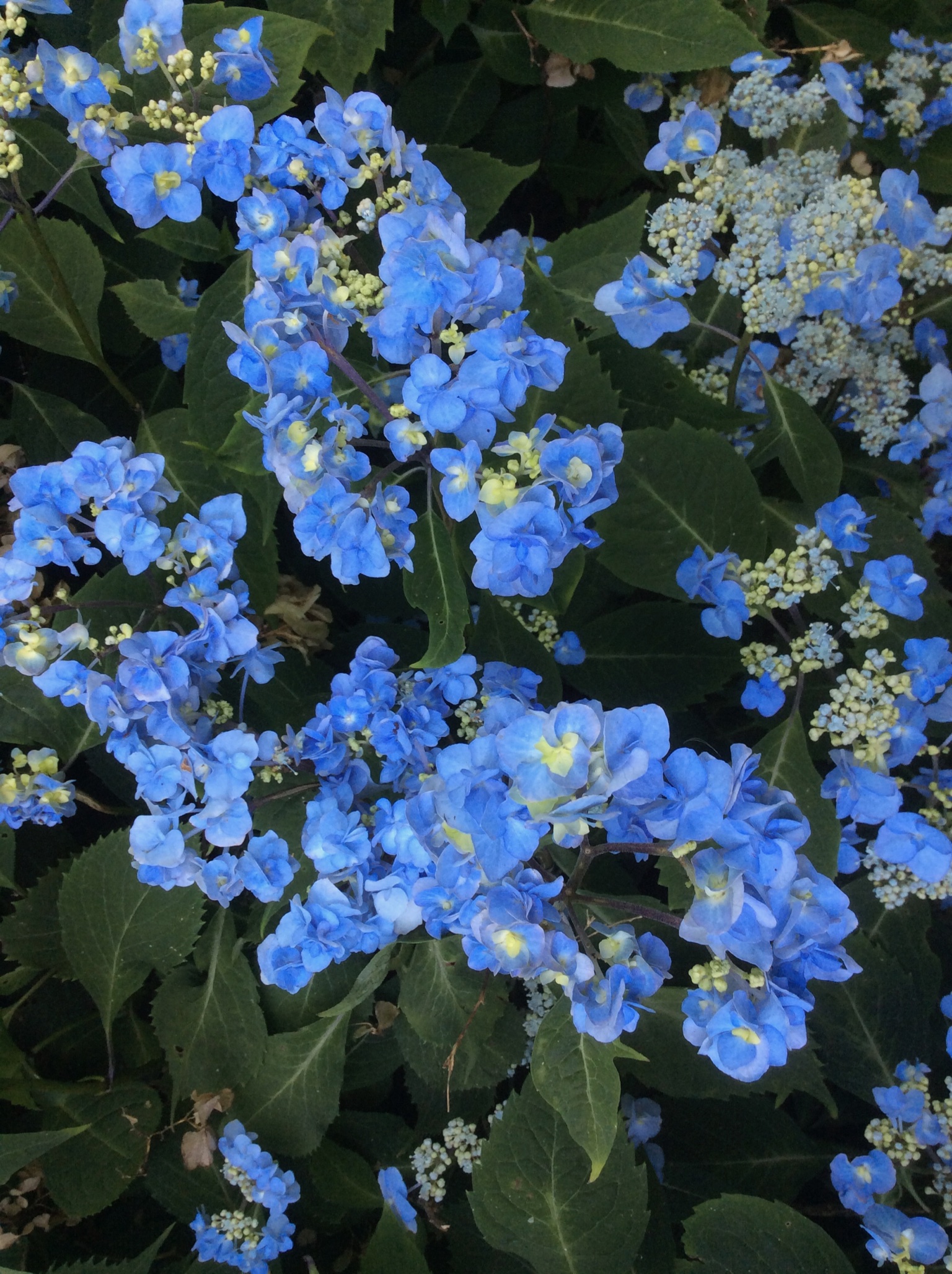
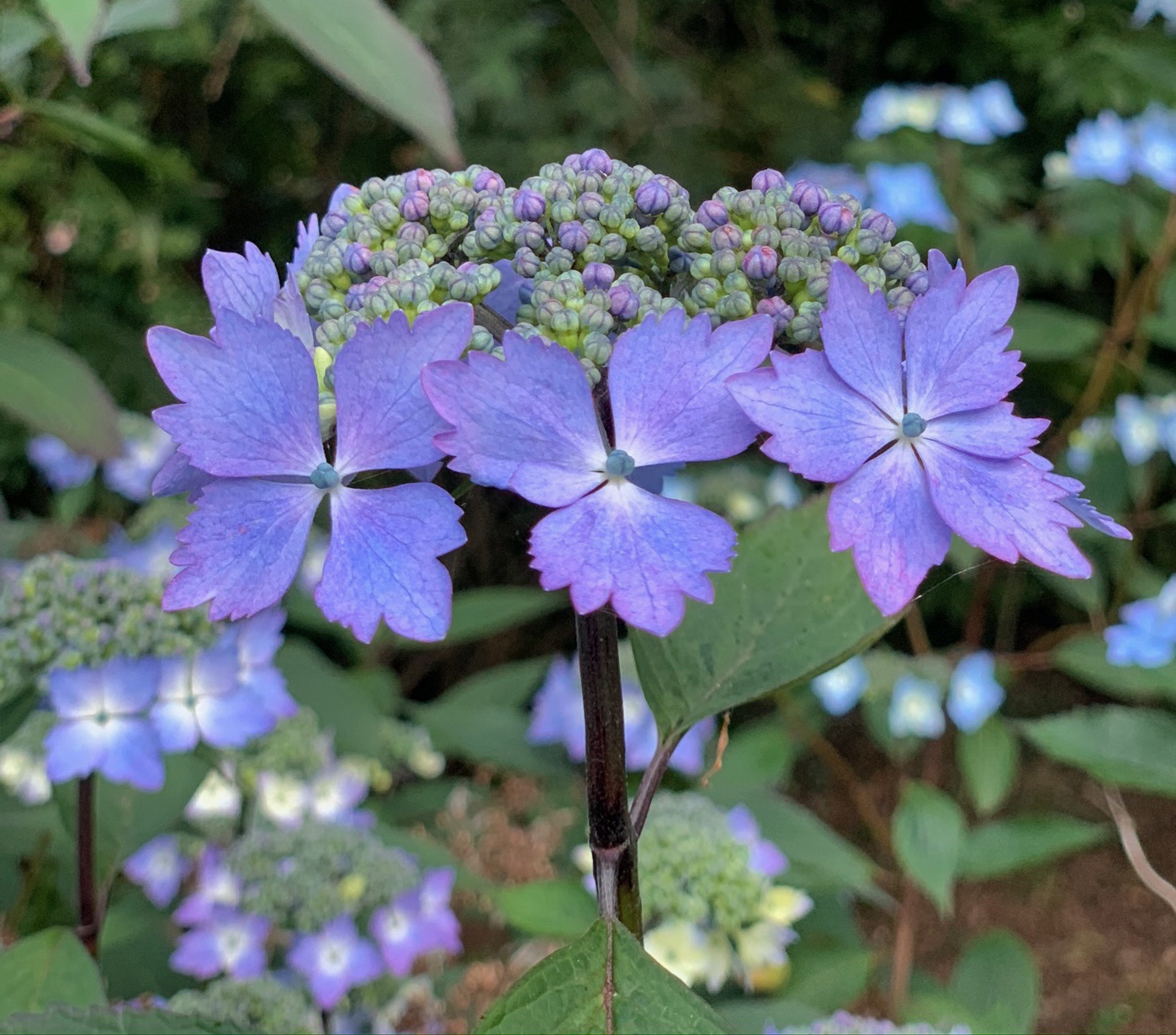
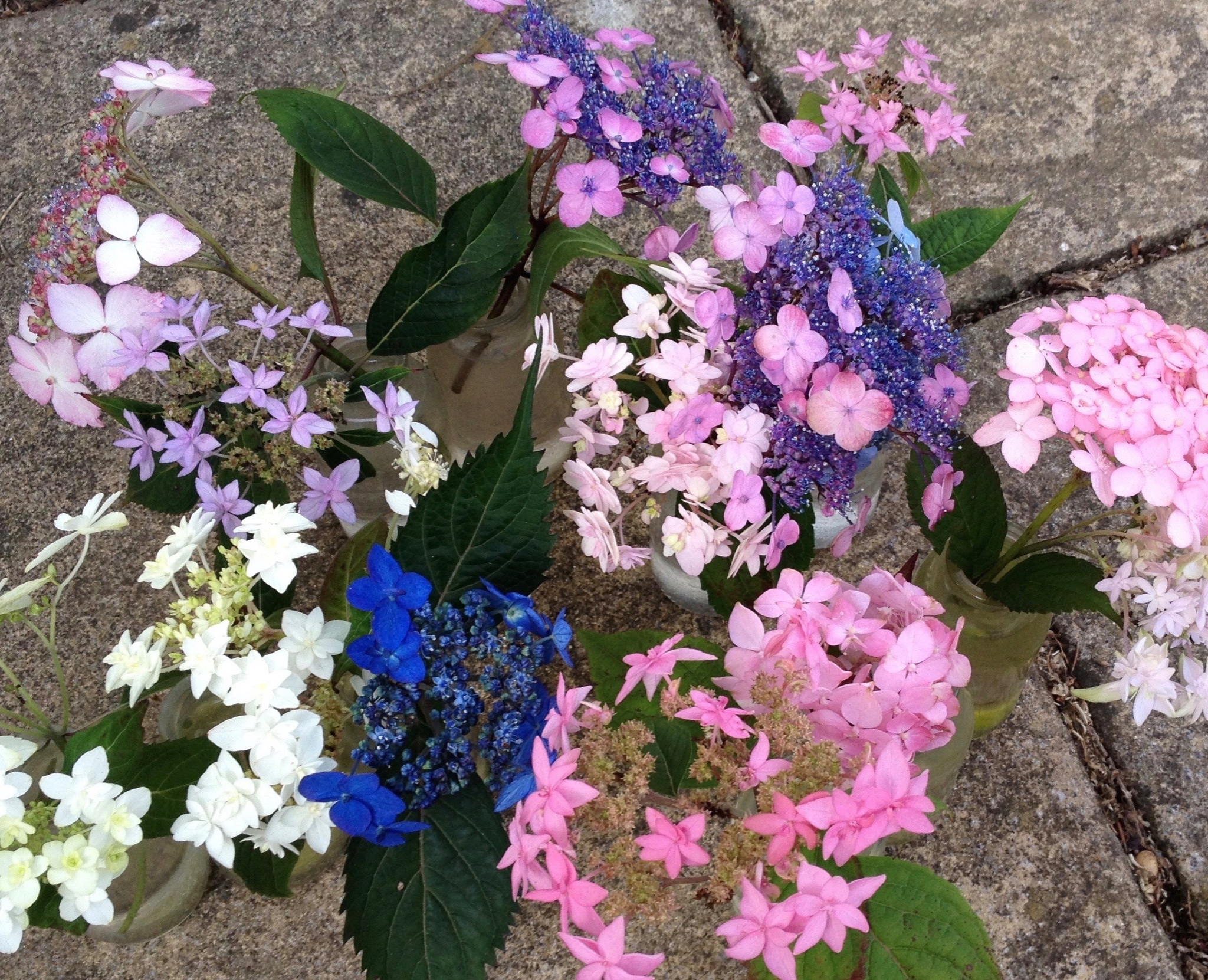
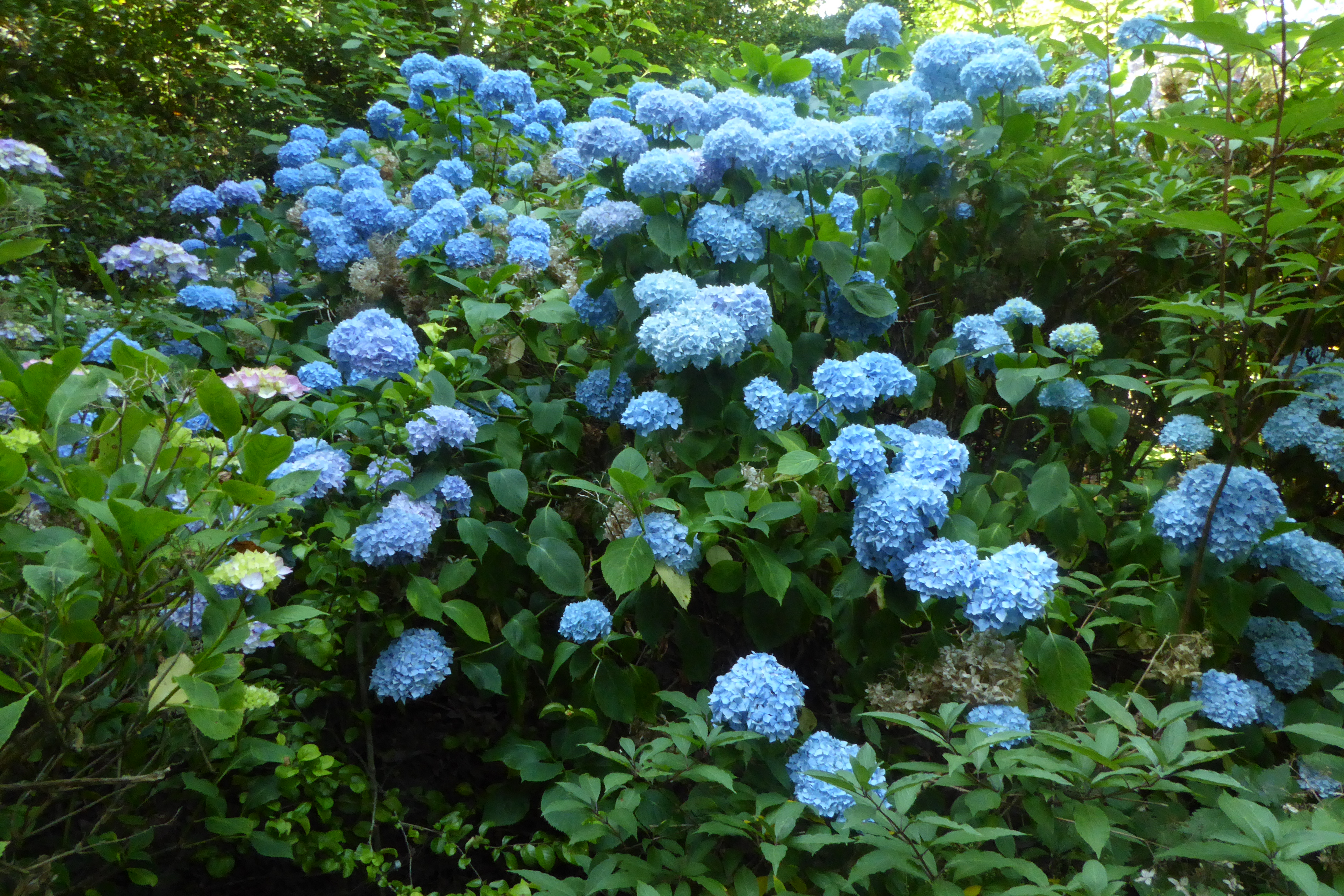
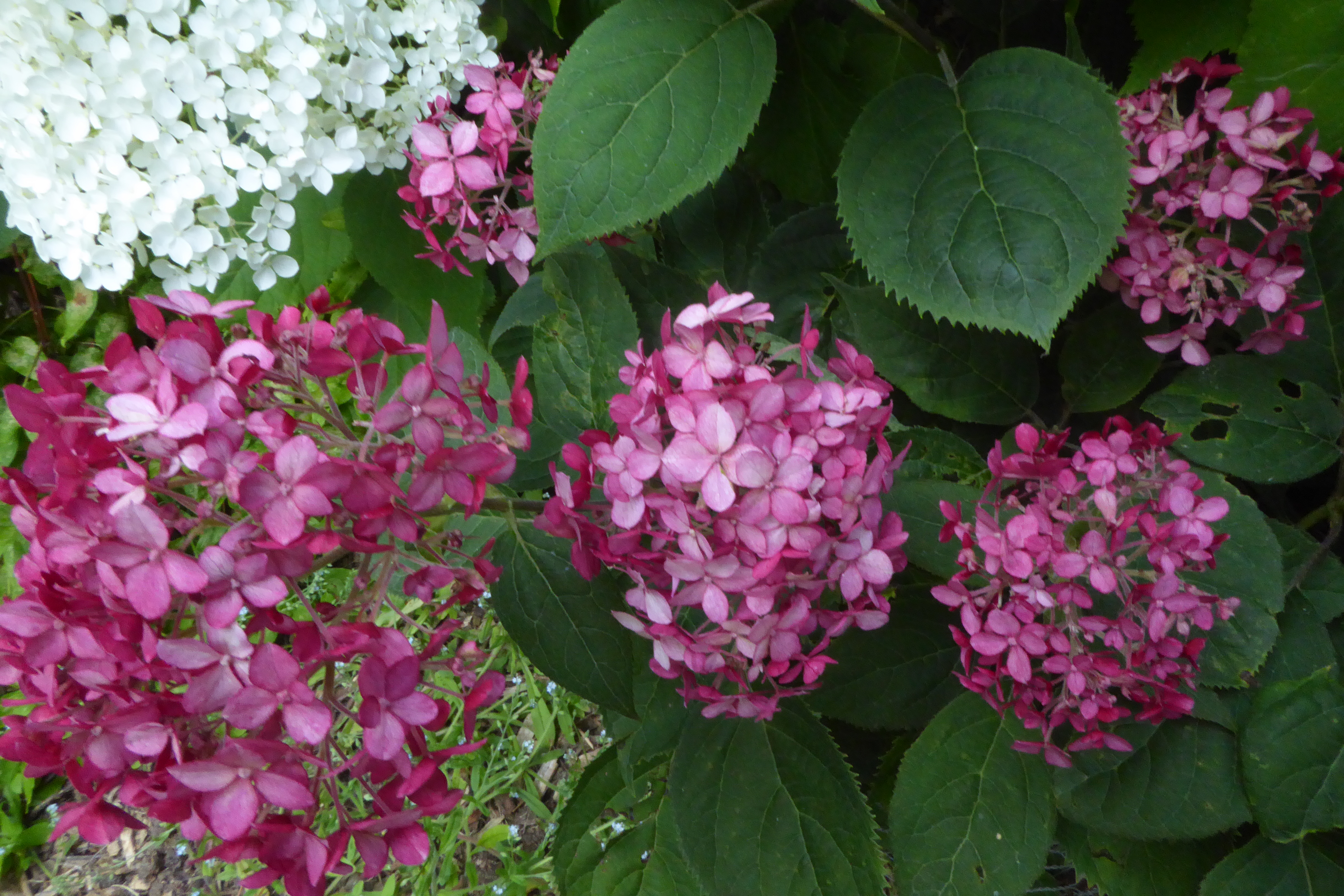
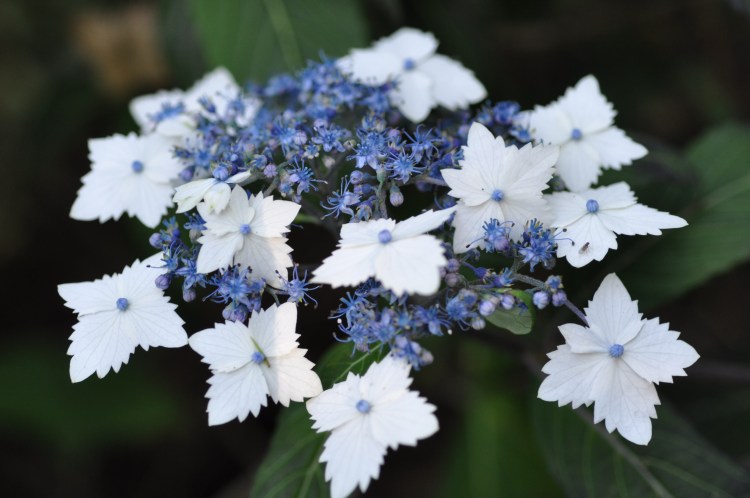
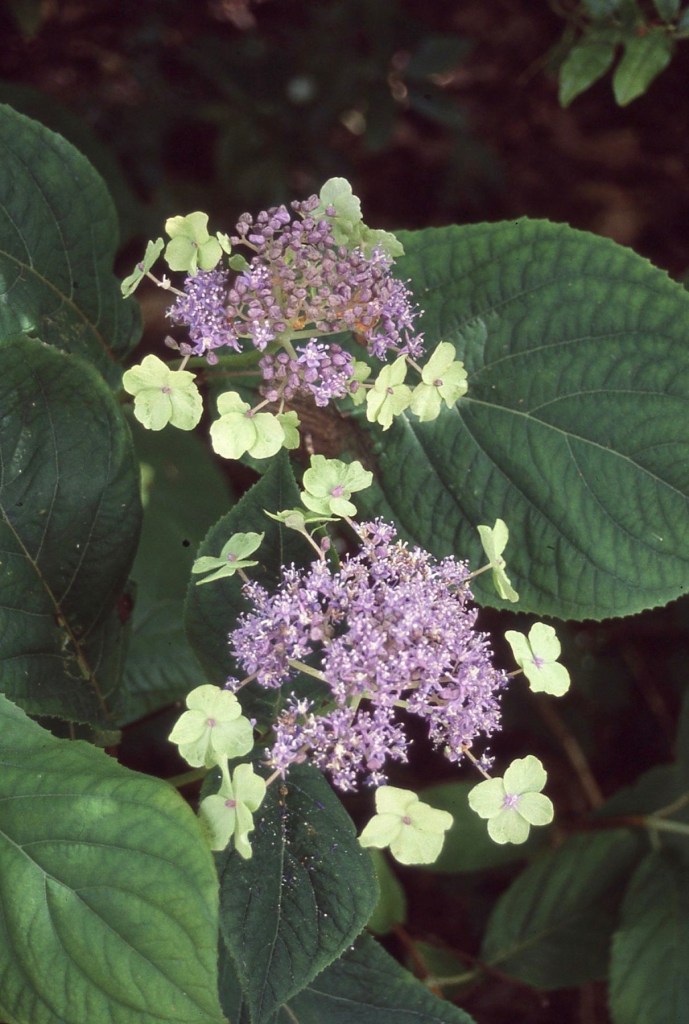
The recent rain and cool weather has brought our H. serrata walk to unusually spectacular free-flowering display and intense colours this week. Early Hydrangeamacrophylla – the Hortensias – are also coming into full character, such as the seminal ‘Veitchii’, ‘Rosea’, ‘Mme Emile Mouillere’, ‘Comtesse Generale de Vibraye’, along with several of the intensely-coloured Dutch Ladies and Teller series, among others. Together with Annabelle and its pink derivatives, and more recent introductions such as the black-leaved ‘Daredevil’ and scandent ‘Runaway Bride’, White House Farm offers a snapshot history of the genus Hydrangea in flower in a single afternoon. In the wood, species collections of H. angustipetala and chinensis – many with their yellow fertile flowers close to qualifying them as ‘yellow hydrangeas’ – are also at their peak.
Wild collections of H. stylosa – in the same section as H. macrophylla and H. serrata – are among our favourite plants.
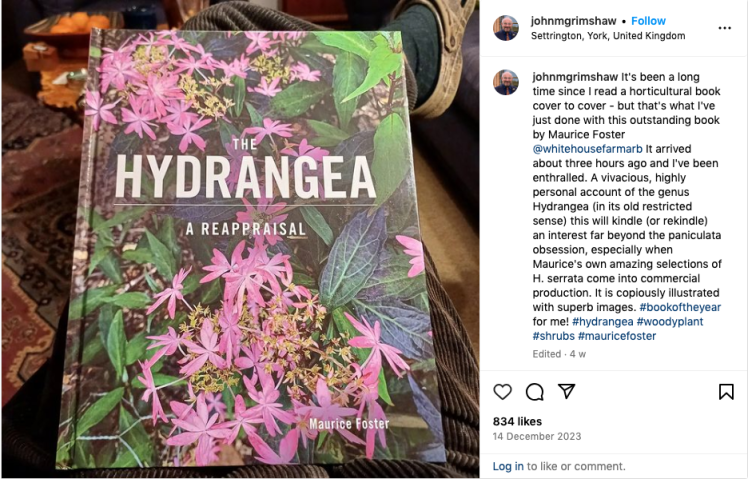
For those unable to make it in person, many of White House Farm’s hydrangeas are featured in Maurice’s recent book, ‘The Hydrangea: a Reappraisal.’
The book was written to capture the interest of both seasoned horticulturalists and beginning gardeners and garden designers: as John Grimshaw points out in his review for Hortus magazine, it shares a lifetime of practical knowledge of propagating, growing and observing these plants.* Everard Daniel in the RHS Rhododendron Camellia and Magnolia Newsletter has also reviewed the book and concluded …..’ this will certainly be the premier go-to Hydrangea reference book from now on’.
Our H. involucrata ‘Viridescens’, which is widely available, is demonstrating its astonishing freedom of flower in near 100% shade for something like its 30th year.
Come join us for a thorough discussion of hydrangea siting (crucial to their character), shade and sun tolerance, colour variation, and see the wonderful jewel-like variety of forms of rayflowers, especially among our some 57 Japanese and European serrata cultivars.
*If you order a copy at its RRP of £25 from us at whitehousefarmarb@gmail.com, £9 of the cost goes to the White House Farm Arboretum Foundation.
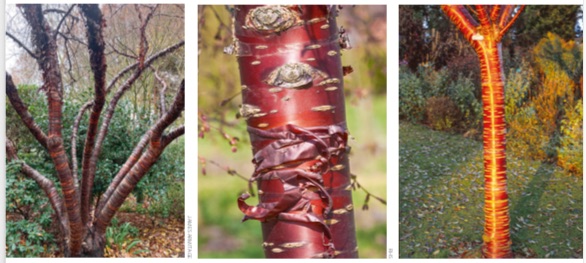
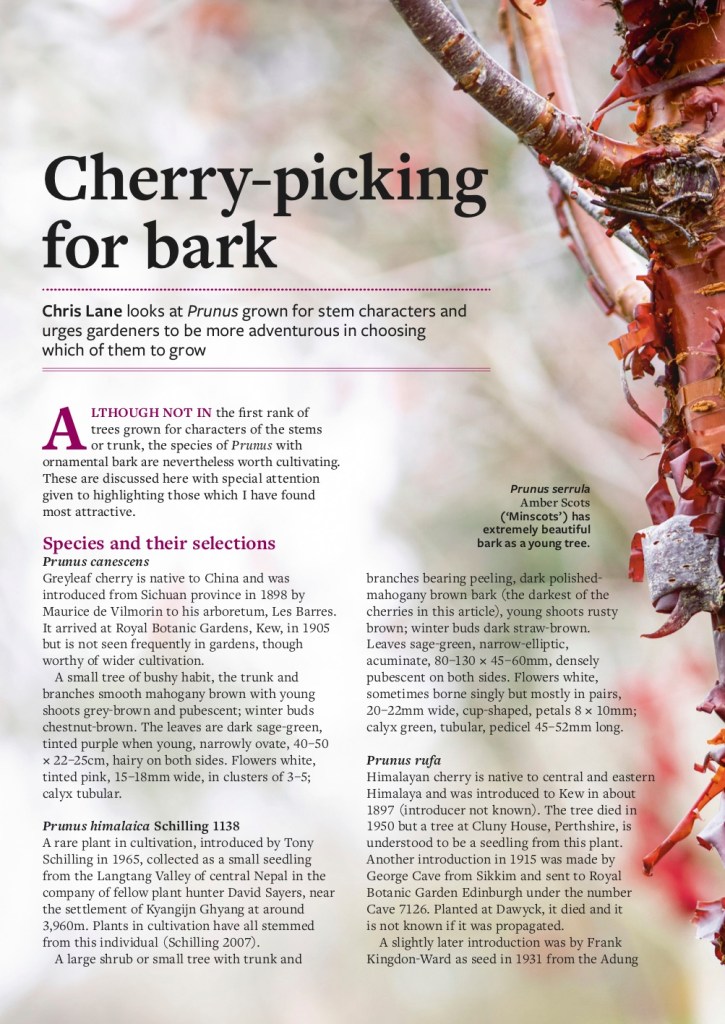
WHF Trustee Chris Lane, who holds the national collection of prunus at his Witch Hazel nursery suggests some Prunus worth growing for their beautiful trunks alone, with flowers the icing on the cake (or cherry on top….) Reproduced with the kind permission of the RHS Plant Review (March 2024).
Upcoming events at White House Farm in June, July and August:
-a WHF Hydrangea serrata Study Day on Saturday June 8th (9 places still available), email whitehousefarmarb@gmail.com for programme details and to reserve a spot;
-A Garden Masterclass ‘summer colour’ tour on Weds July 10th (book via Garden Masterclass website here)
-An IDS Study Day on the important ‘asperae’ subsection of Hydrangea (aspera and involucrata) on Weds August 21st (book via the IDS website here)
Jack Aldridge, WHF Trustee and Horticulturalist at RHS Wisley, gave a Thursday Garden Chat for Garden Masterclass about his work on Oakwood at Wisley; other recent talks range from ‘Woody Plants that Should be Better Known and Grown’ for Plant Heritage, and an overview of Camellia sasanqua for the International Camellia Society.
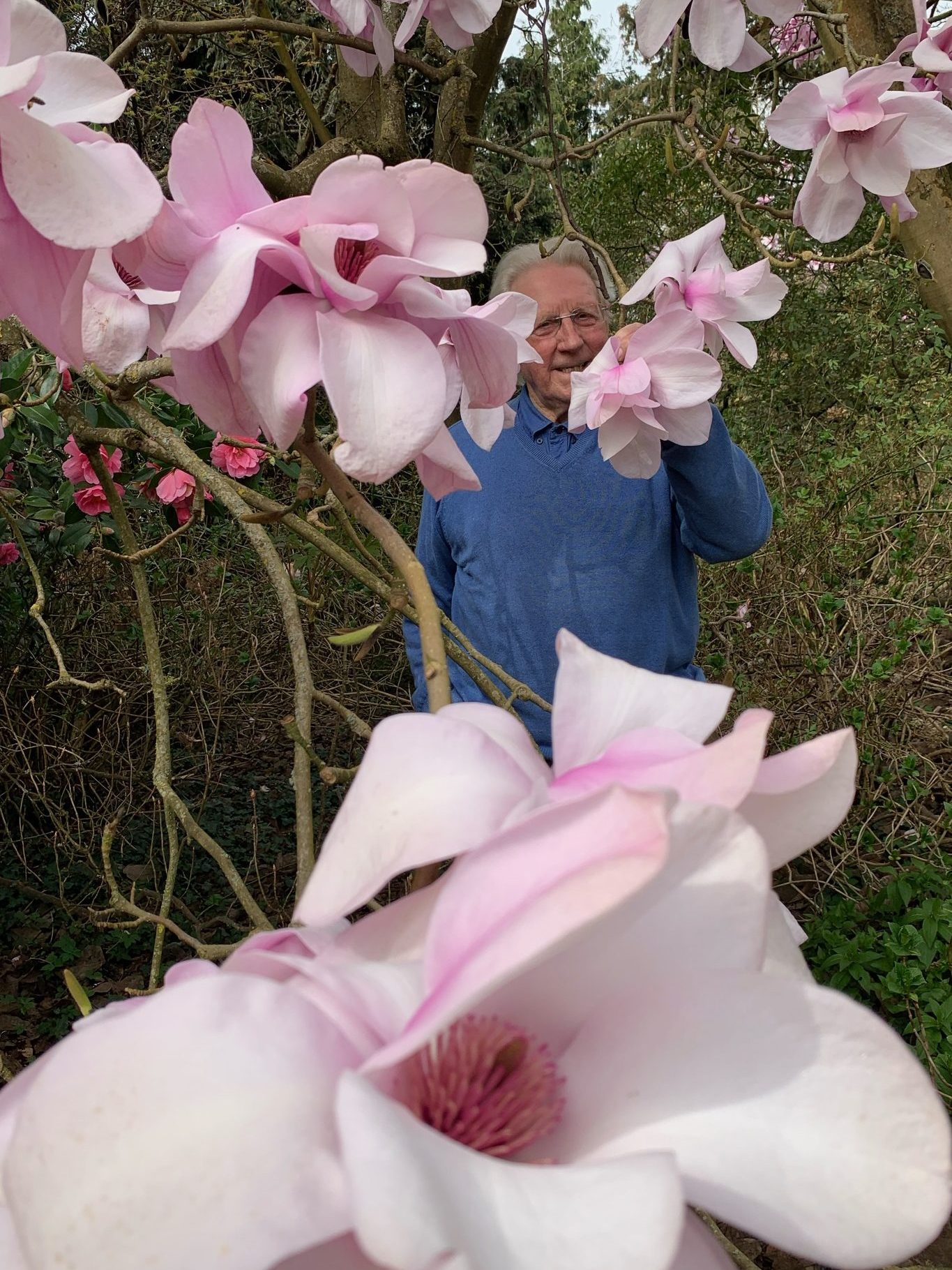
Jack has recently played a key role, along with Rod White, who has an unofficial national collection of Camellia reticulata, in identifying and labelling the camellia collection at White House Farm (some 100+ cultivars and 40+ species) which will be a feature of the April 4th guided tour and discussion; as will Magnolias (200+, some 50+ years old, including 12 national champions), which Maurice Foster is speaking about at a Wespelaar IDS Magnolia Study Day in Belgium next month.
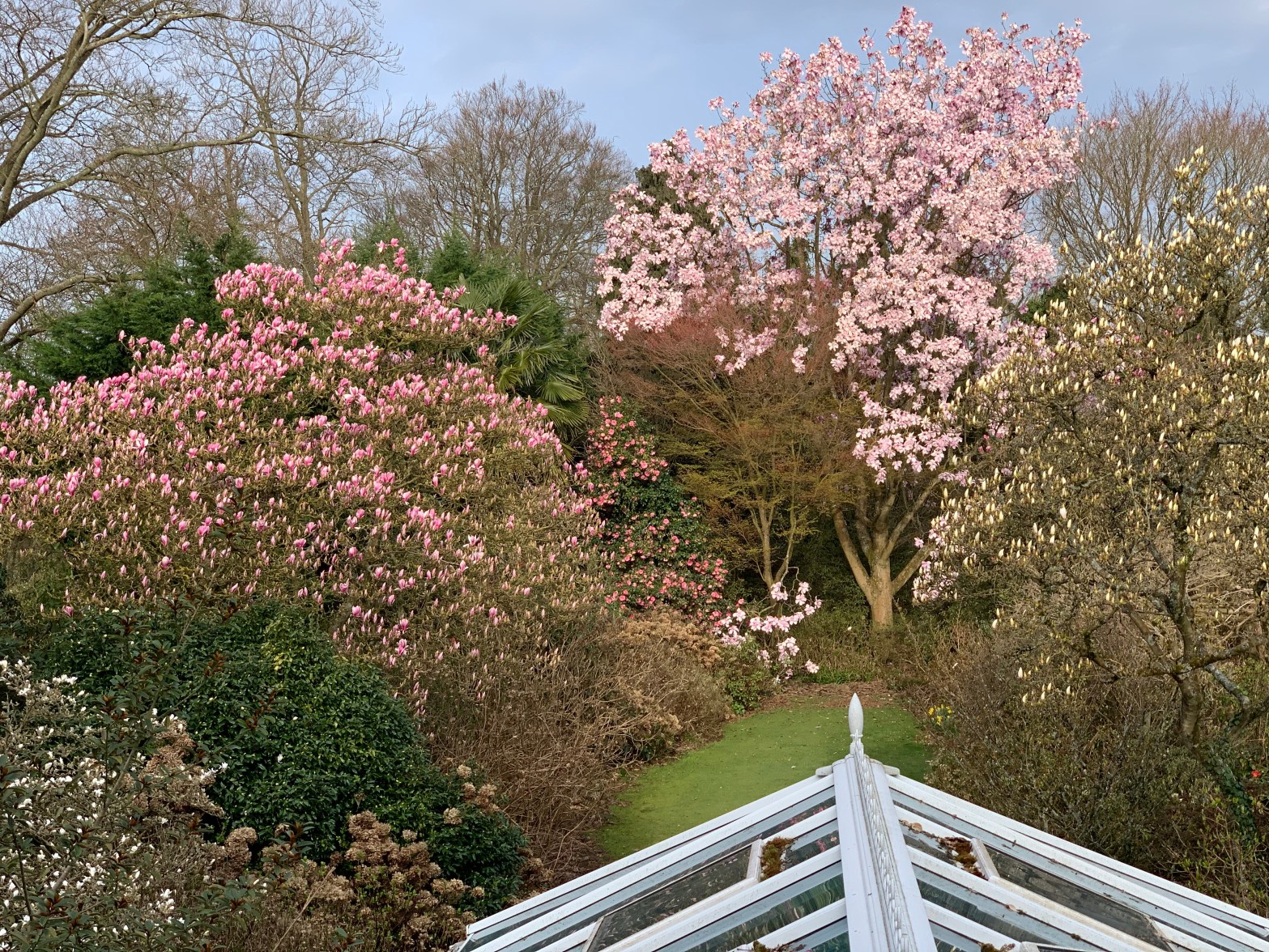
WHF is known for its use of Magnolias as canopy trees for underplanted camellias, rhododendrons and hydrangeas, along with other small trees of interest for their flower or foliage, from cornus, styrax, and corylopsis, to carpinus and euonymus, with clematis, wisteria and climbing roses joining in, wherever siting offers each plant its best combination of light and shade, space and protection. This tiered woody co-growing approach offers sequential colour but is also low maintenance, enabling colourful year-long effects achieved without a team of gardeners. As well as looking at the best spring-flowering plants, and others that deserve not to be rarities, these methods and more will be showcased discussed as design strategies at the April Garden Masterclass event – an informal guided tour designed to be directed by participants’ specific interests and questions.
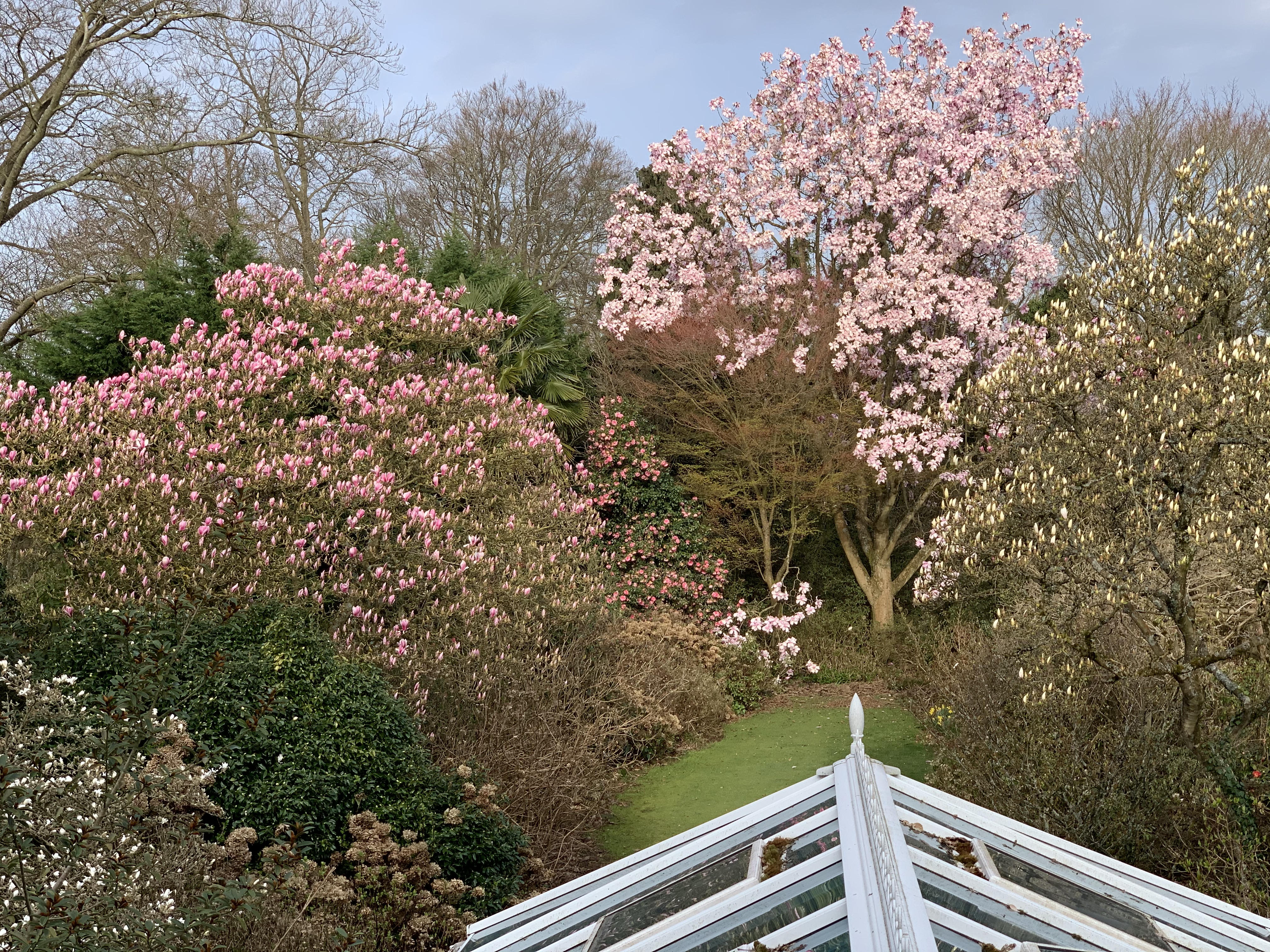
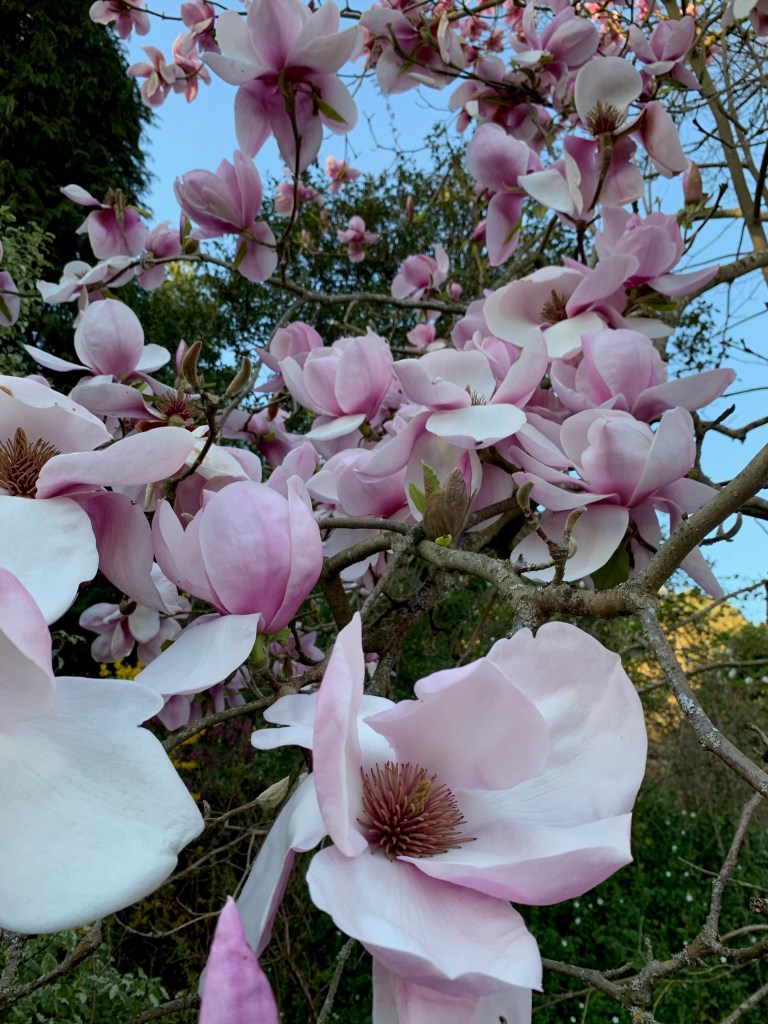
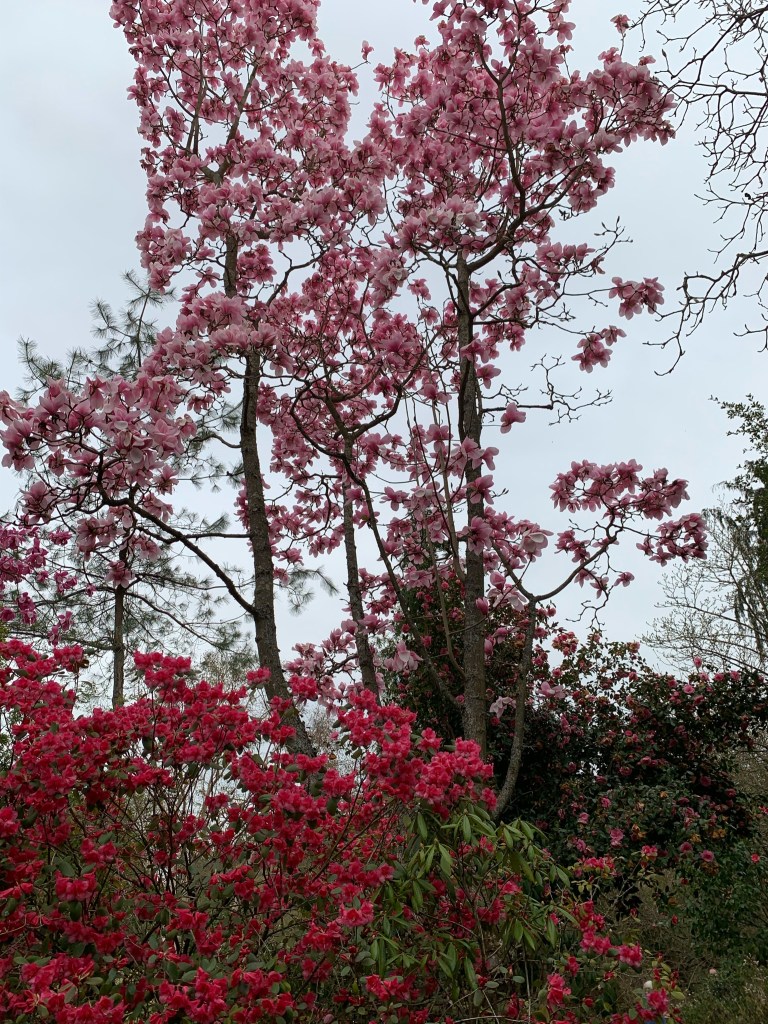
Spring at WHF is dominated by the spectacle of magnolias on all sides, set off by evergreen camellias and rhododendrons below, with conifers as high backdrops. But WHF is also known for the range of other often overlooked genera in spring gardens, such as Meliodendron, Staphylea and Berberis, as well as the colourful spring foliage of birches, maples, and hornbeams. A few places are still available for the April 4th event: for more information click here.
Jack is working on Cornus for Trees and Shrubs Online (TSO) and has an article in this month’s The RHS Plant Review about Cornus hybrids – an issue which also has contributions by two other WHF Trustees, Chris Sanders (on an overlooked clematis) and Chris Lane (on dark-stemmed flowering cherries).
Jack will join Maurice Foster and horticulturalist and gardening lecturer Caroline Jackson in leading the first of a series of Garden Masterclasses at White House Farm on Thursday April 4th, informal tours designed to be led by participants’ interests and questions – observing not just the best or some rare selections but also some growing and planning lessons learned over the past 50 years.
Maurice Foster shares some observations on some of the newer wild Camellia species growing at White House Farm.
The four seminal species behind the largely nineteenth-century development of literally thousands of cultivars are of course C. japonica, C. sasanqua, C. reticulata and C. saluenensis. Their relative merits as species are already well known, and their influence on the vast treasurehouse of garden camellia hybrids immense. C. cuspidata has also been quite widely grown for many years. But over the last 20 years several other camellia species have been brought into cultivation; some of the most promising of these for garden-worthiness are among the 48 Camellia species we grow here at White House Farm.
The total number of designated camellia species varies markedly depending on which taxonomist you favour. In 1958 Robert Sealy at Kew described some 82 species from the material then available; by 1981, with many more species newly discovered in China, H. T. Chang recognised no less than 280. T. Ming brought this back to a more sensible 119 in 2000 – but this back and forth itself shows there is a challenge here, and scope for more work, both in the field and the laboratory.
Whichever taxonomic classification you follow, about 80% of species are to be found in China, with some new species recently discovered in Vietnam and elsewhere in E. Asia. Most of these Chinese species are found in the warmer temperate zones of the south and south west, with inland populations often at relatively low altitude, meaning that cold hardiness has been seen as the principal limiting factor for successful cultivation in the UK. The vigour of WHF’s collection seems to disprove this concern. Of course we have had a good run of milder winters, and some botanists believe members of Theaceae, such as Camellia, and the closely related Ternstroemia and Polyspora, for example, have cold hardy genes in their makeup. But it may be, too, that as for so many other genera, siting is crucial.
C. pitardii – the best of our 4 seedlingsC. tunganica, introduced by White House Farm
Here, finding the right spot for planting is the first priority, and the key to success in creating optimum conditions for survival and good growth. Most of our species camellias are located in the wood, or as underplanting in the mature garden, with wind protection from the bitter North Sea winter winds to the north and the east to which we are exposed being on a hogsback of some 500ft. But the same slope protects against spring radiation frosts, because colder air, being heavier than warm air, sinks – this katabatic wind means sheltered slopes avoid frost pockets. Rainfall at WHF averages about 30” a year: drainage is another benefit of slopes, and there’s a balance to be struck between top cover, root competition, and good light, although I have found that once established, C. species cope especially well with this. Light woodland is ideal, with part shade, some humidity, and plenty of moisture during growth.
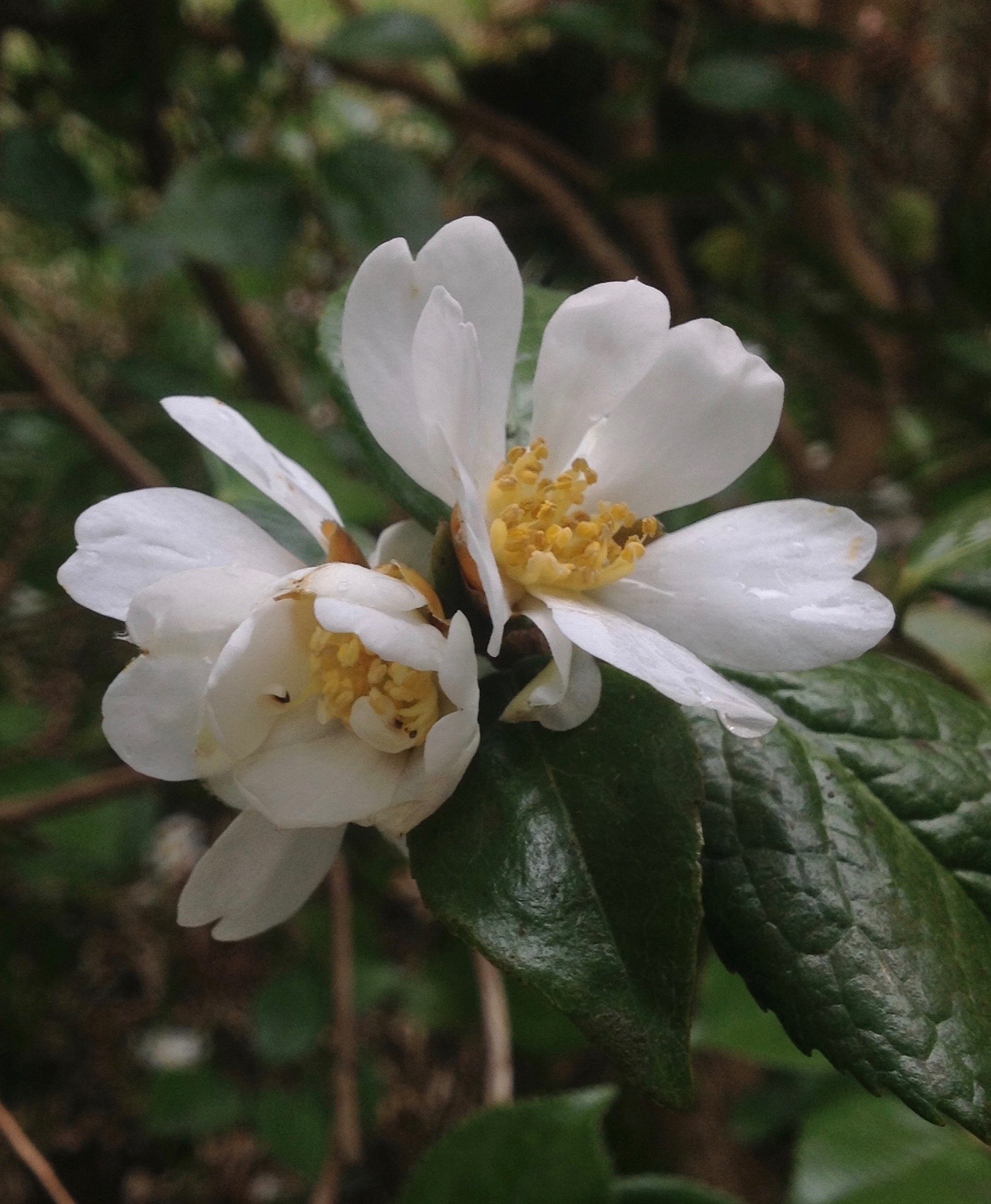
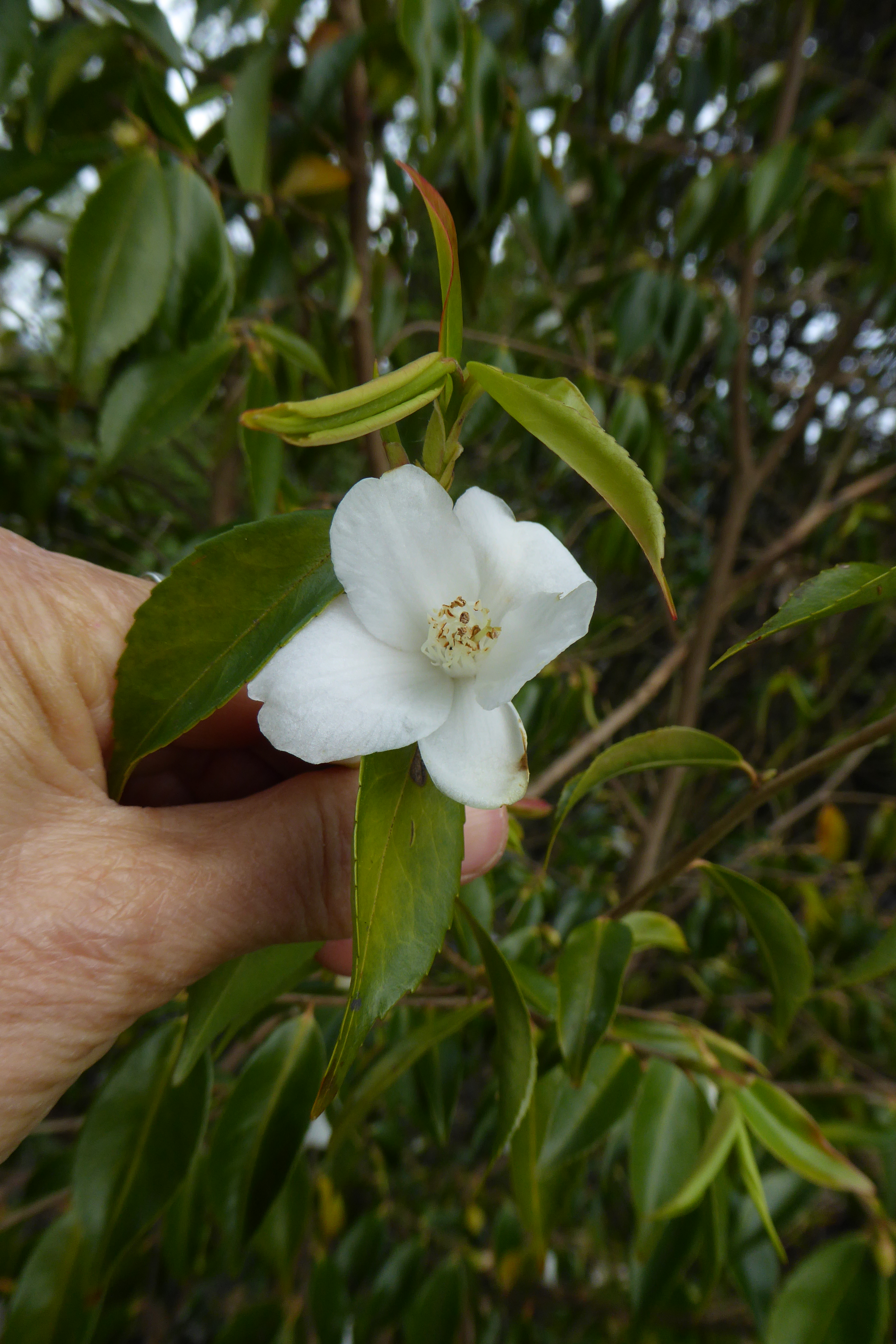
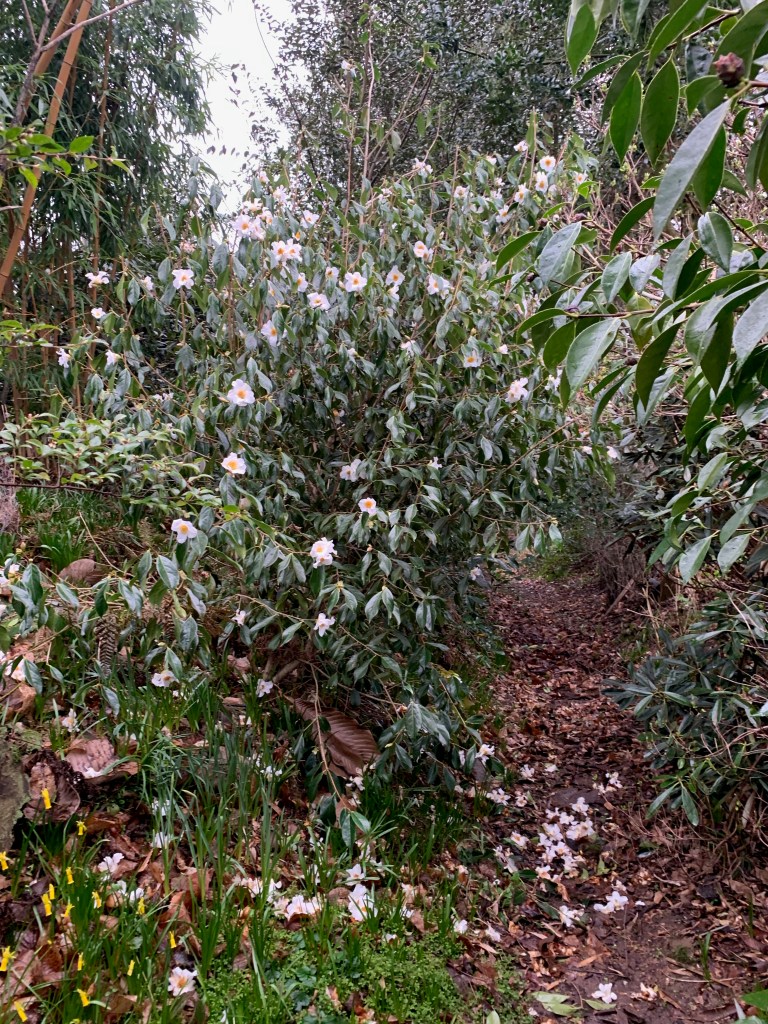
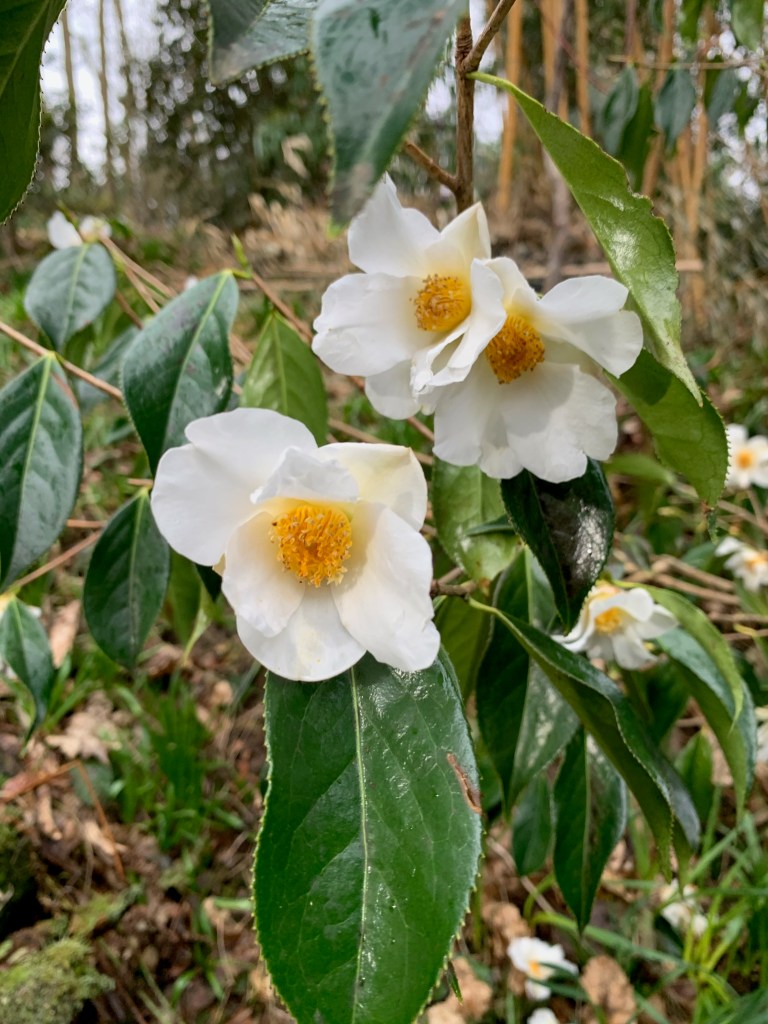
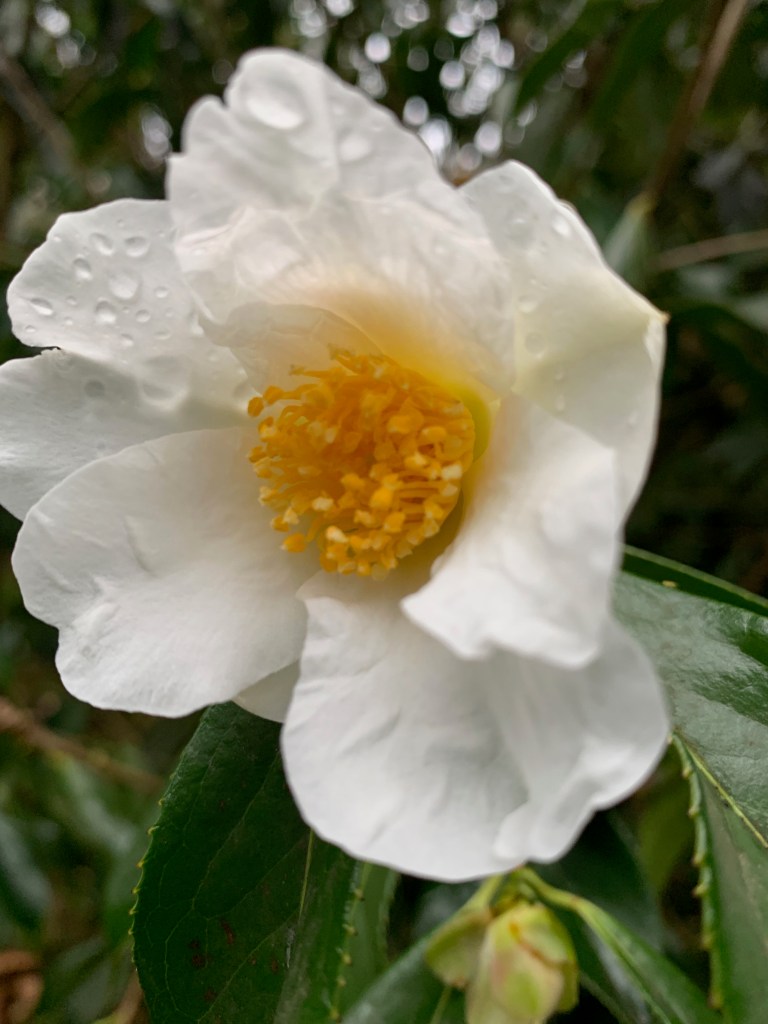
Certainly, winter hardiness appears to be less of a concern after 20 years growing experience here. Not only have these newer Camellia species not succumbed to frost, but last year C. tunganica, introduced by White House Farm some 15 years ago, maintained fresh white flowers in abundance after a series of -7C nights: freshness of flower already the standout quality of this species, which drops before browning, essential in a white.
C. tunganica
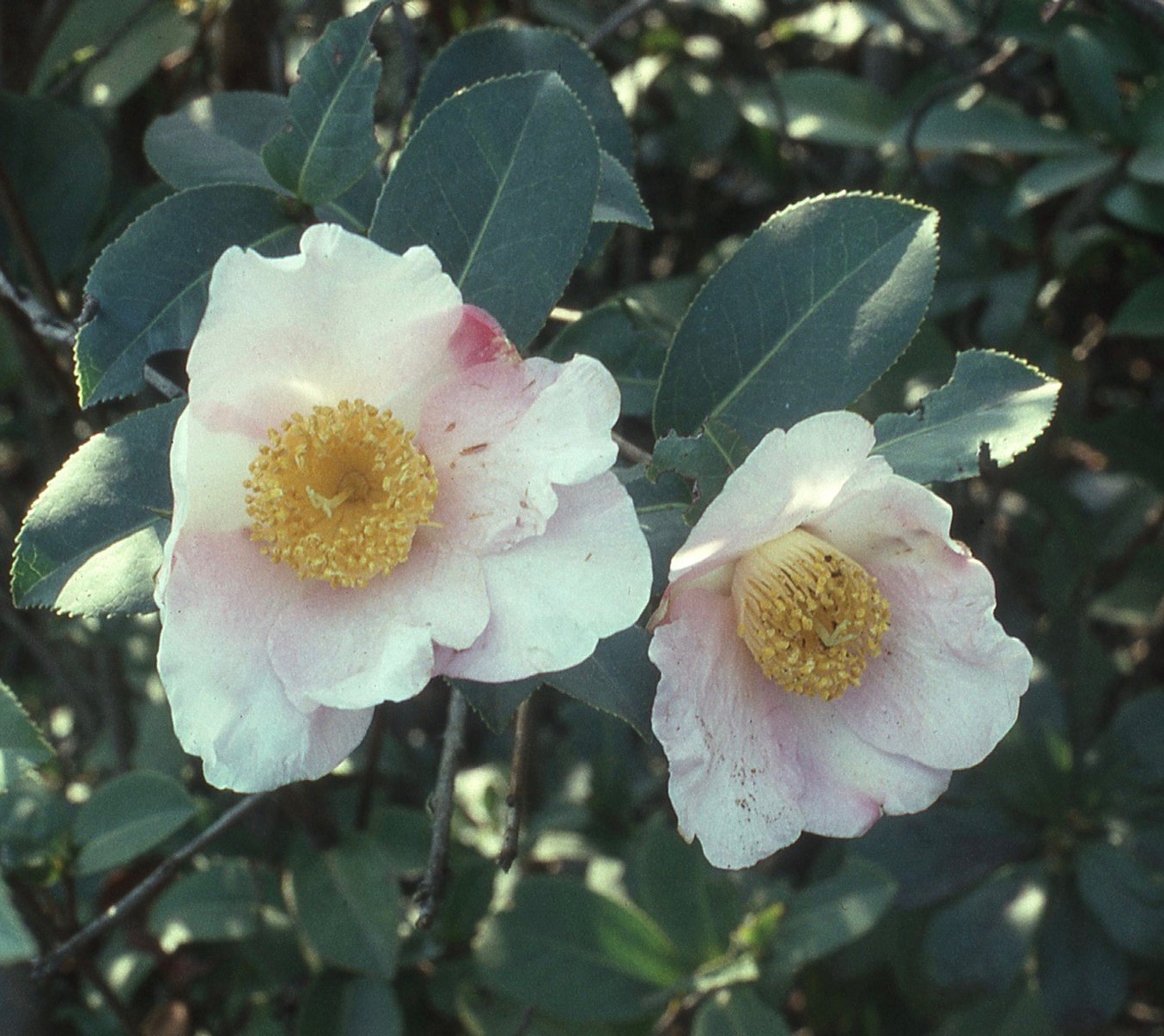
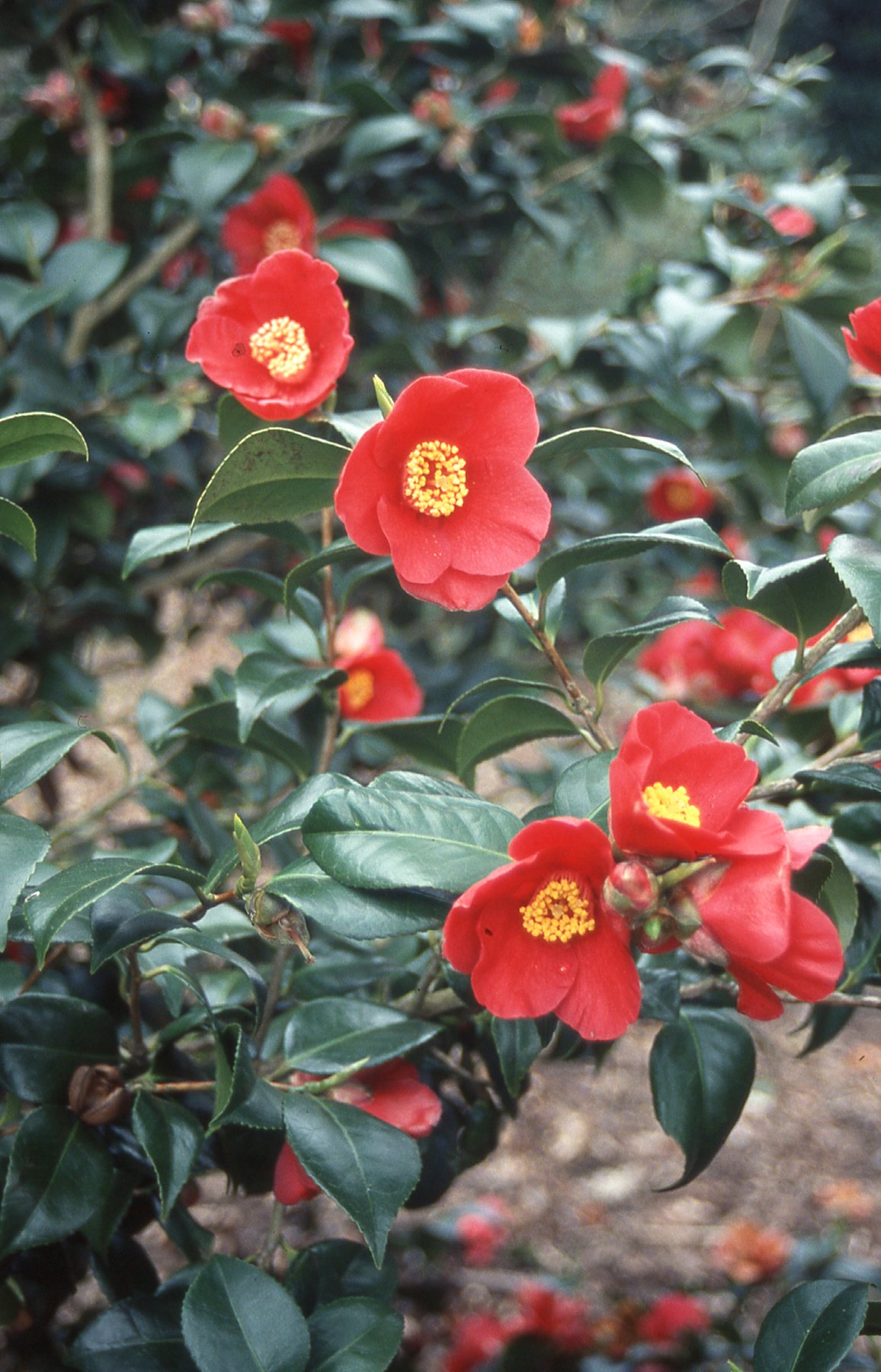
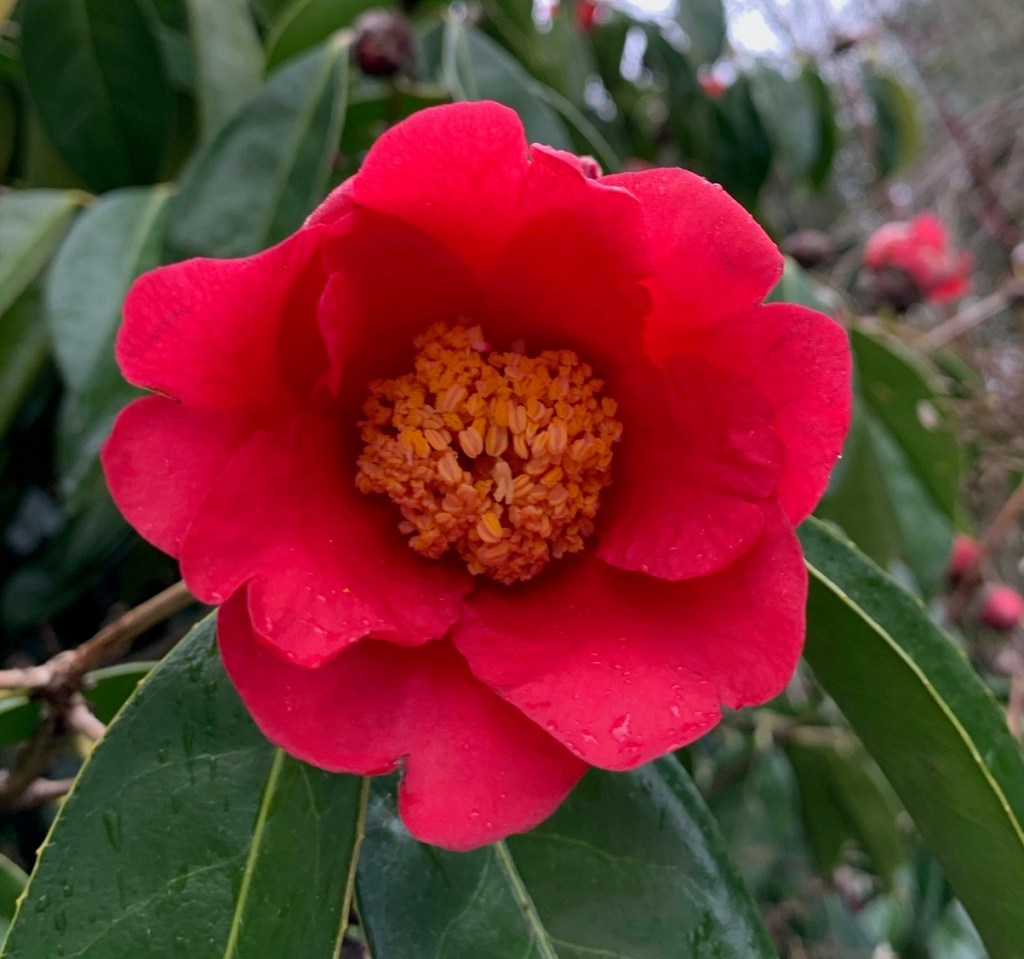
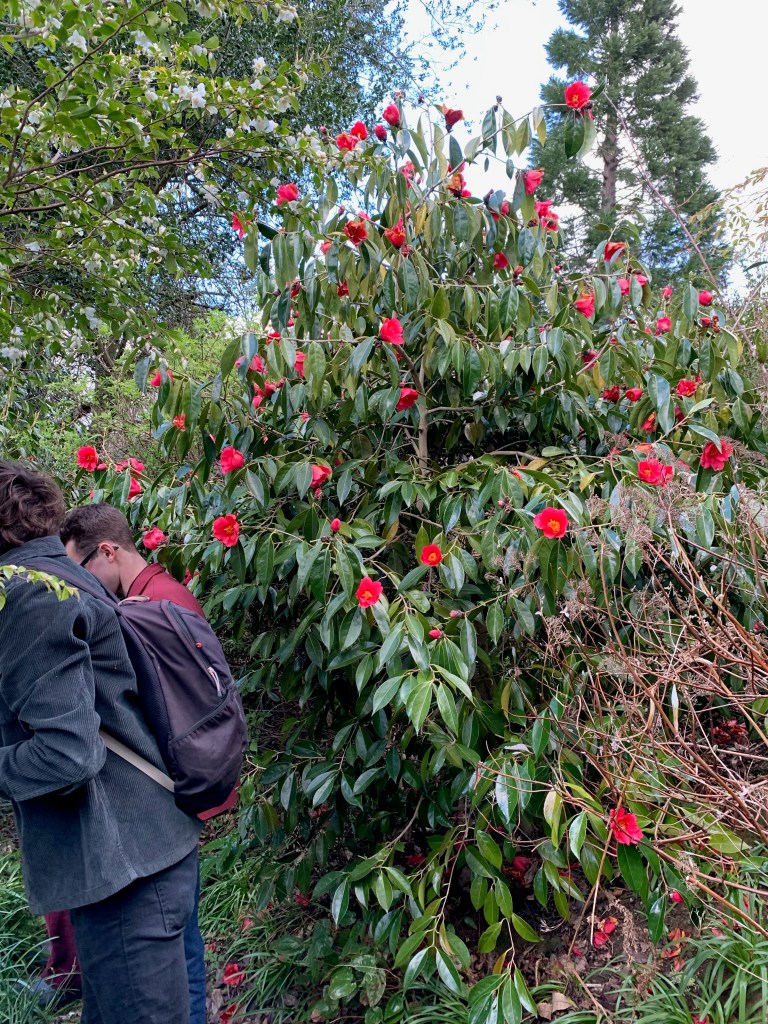
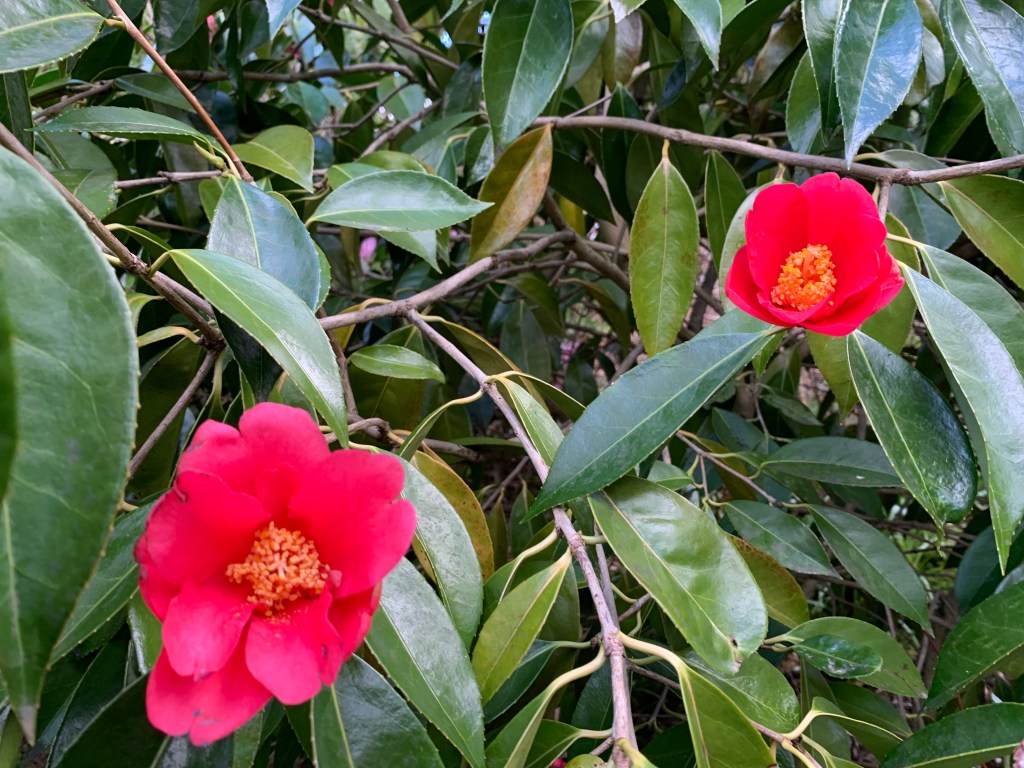
Bearing in mind that all species vary from seed, some of these species can clearly hold their own with the best of the garden hybrids in flower and foliage. Of three large flowered red species, the spectacular red flowers of C. chekiangoleosa warrant inclusion in any collection – and although I am now pretty sure that some of my open pollinated seedlings are contaminated with C. japonica and are natural hybrids, my plants still show what is distinctive about the species: a tough, vigorous pyramid of bold glossy large elliptic leaves ( typically 16x5cm) studded with large cupped flowers of a vivid clear blood red, significantly larger than those of typical C. japonica. It outperforms the reds C. polyodonta and C. semiserrata, which have also survived multiple cold winters here (-7C).
C. chekianoleosa – this form likely a wild hybrid with C. japonica
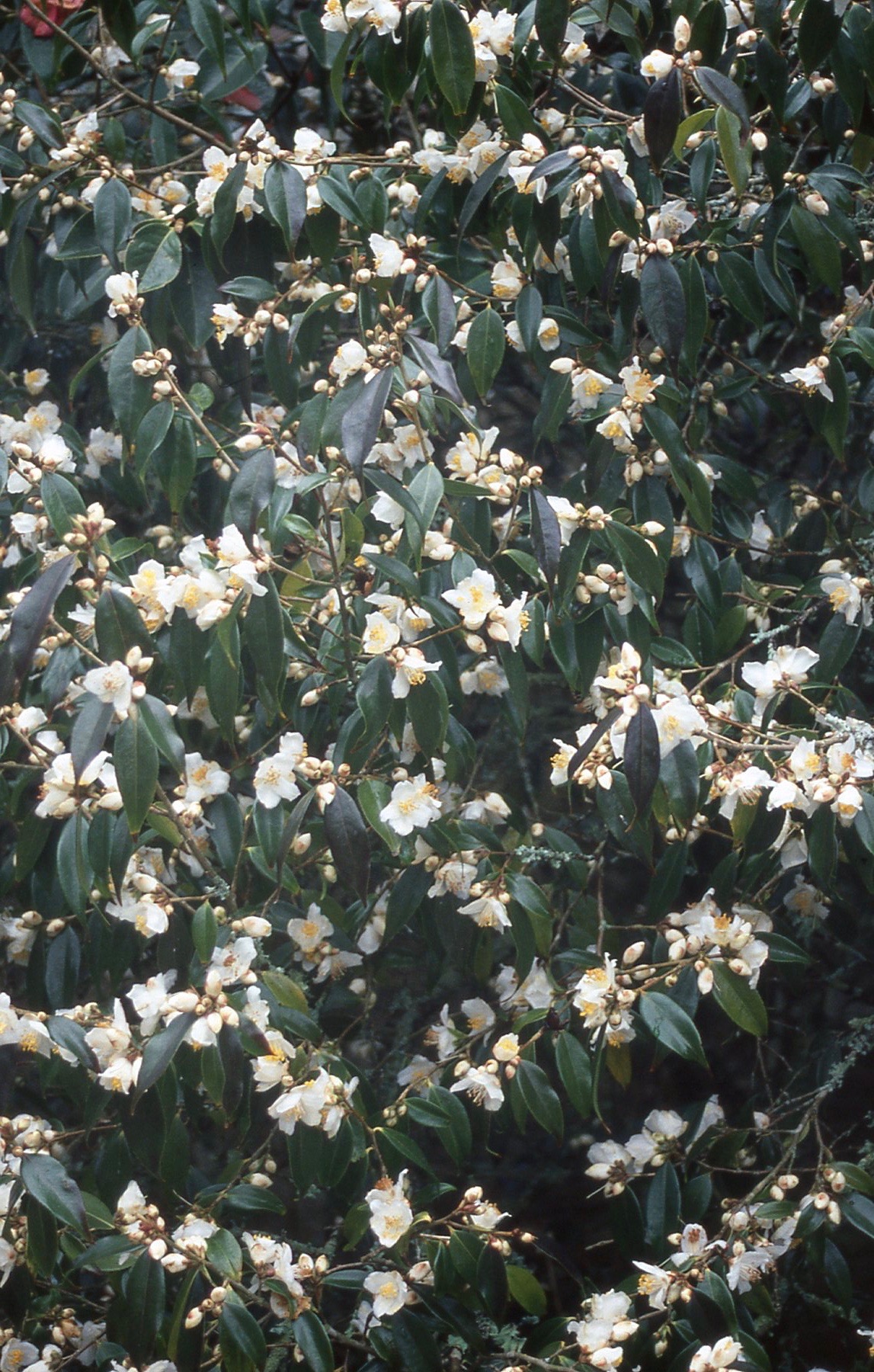
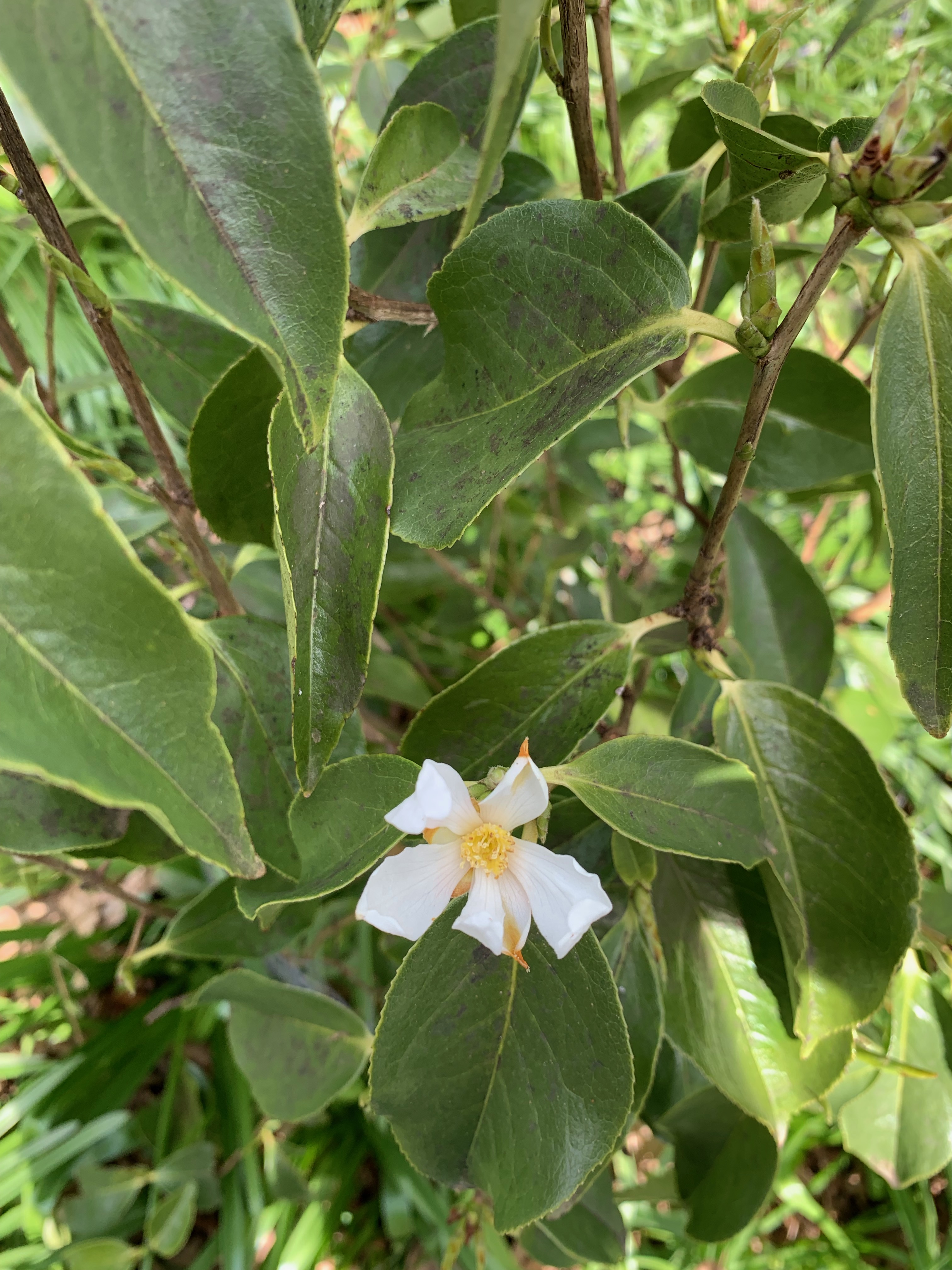
A species that should certainly be more widely grown is C. trichocarpa. From SE Yunnan and SW Guizhou at altitudes up to 2300m it is moderately hardy: here three plants have been growing strongly without problem for 17 years. The 5-6cm white flowers appear in early spring and have a large central boss of bright yellow spreading stamens, presenting themselves beautifully on an upright shrub (reaching about 3m) among green 11 x 5cm wavy edged leaves with deeply impressed veins, and attractive cinnamon bark.
See Maurice’s 2019 RCM Bulletin article on C. trichocarpahere:
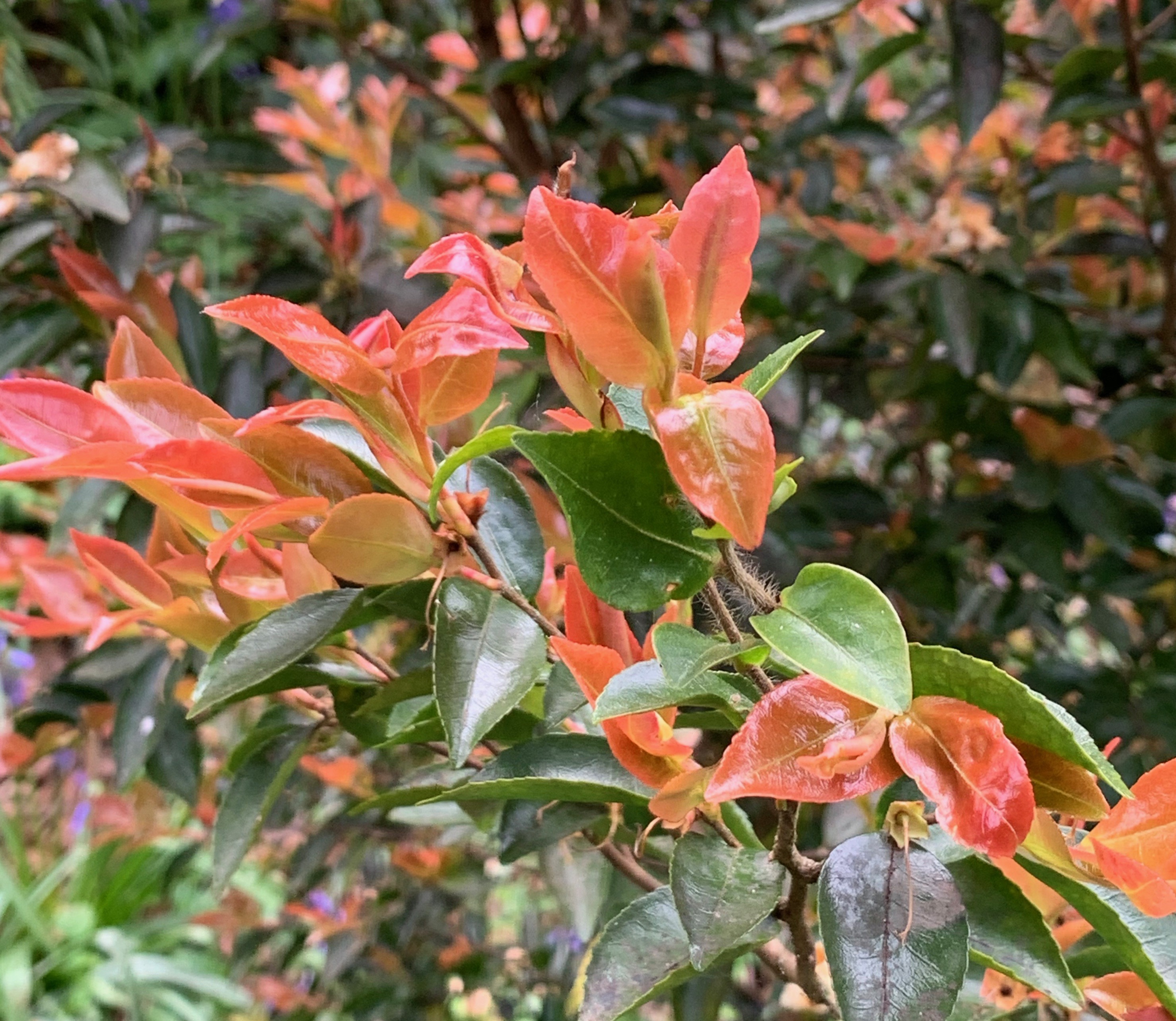
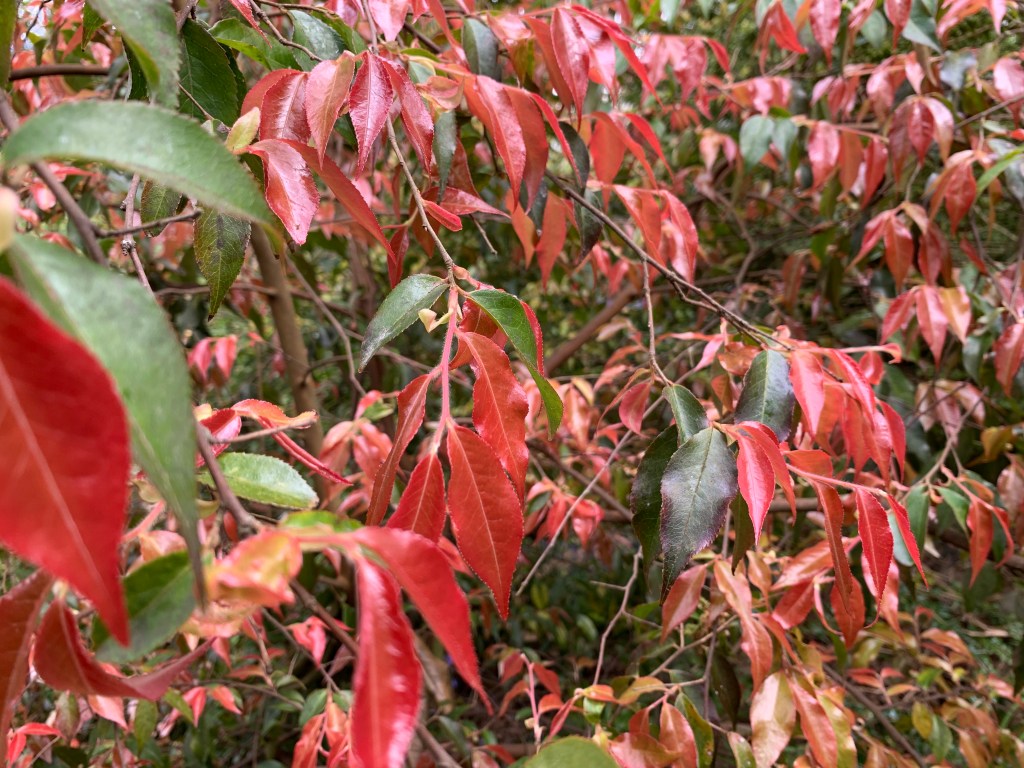
Ming reduced C. trichocarpa to a subspecies of C. henryana, but in cultivation the two are quite different. The flowers of the latter are much smaller, on a bush with a loose, spreading habit, and smaller, less impressively veined, acuminate 7x3cm lanceolate leaves more widely spaced on arching shoots. C. henryana is exceptional for its spring foliage: perhaps the best red young growth of all.
C. henryana – worth growing for its spring foliage display alone
Reddish coppery young growth is an attractive character of many species and is also a feature of C. yunnanensis, a species in turn often confused with C. henryana, as both flower from late October, and can continue over winter in milder weather into early spring. But C. yunnanensis flowers are relatively large, up to 8cm, produced both terminally and in the upper axils with the white petals reflexing to give still more prominence to the yolk-like shock of yellow stamens.
C. yunnanensis once mature (c. 10 years+) produces a good crop of conspicuous large fruits, like purple cheeked apples; as does C. tricocarpa, whose prominent apple-sized fruits, red where exposed to sun, are a valuable ornamental feature. I’ve found the seeds of this and most other camellia species also germinate, and the seedlings establish, very easily.
Also white-flowered but entirely different in character are C. forrestii, C. grijsii and C. brevistyla: all are small-flowered substantial shrubs, and all are proving to be hardy, achieving about 3m after 7-10 years. C. forrestii is particularly free flowering, terminally and in the leaf axils. The small flowers of some 3 – 4cms across are slightly cupped and slightly fragrant. Ovate petite leaves have a slight gloss on a bushy neat shrub. From Yunnan and found up to 2500m, it has been perfectly at home here and our two plants are fringed by dozens of self sown seedlings.
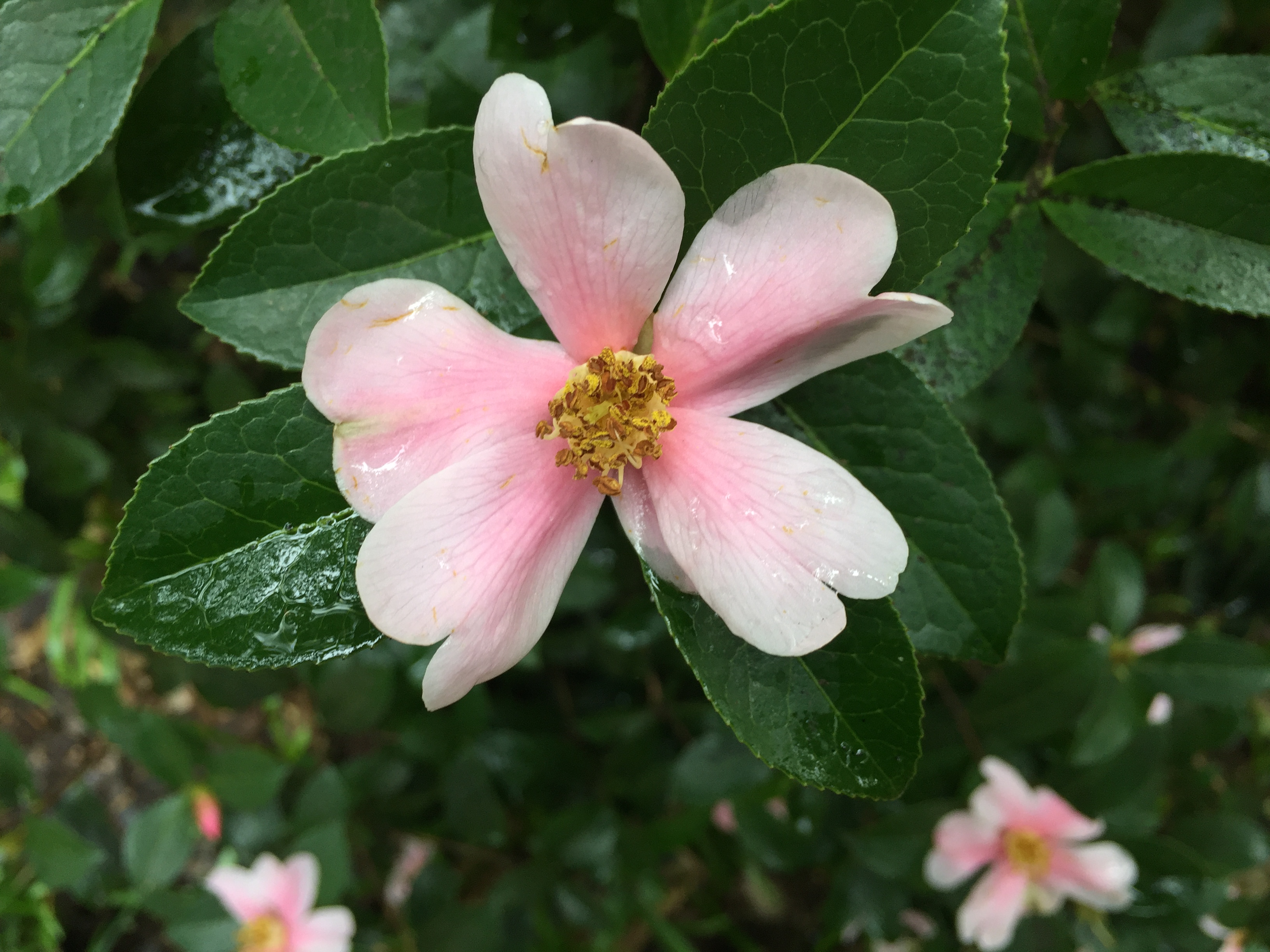
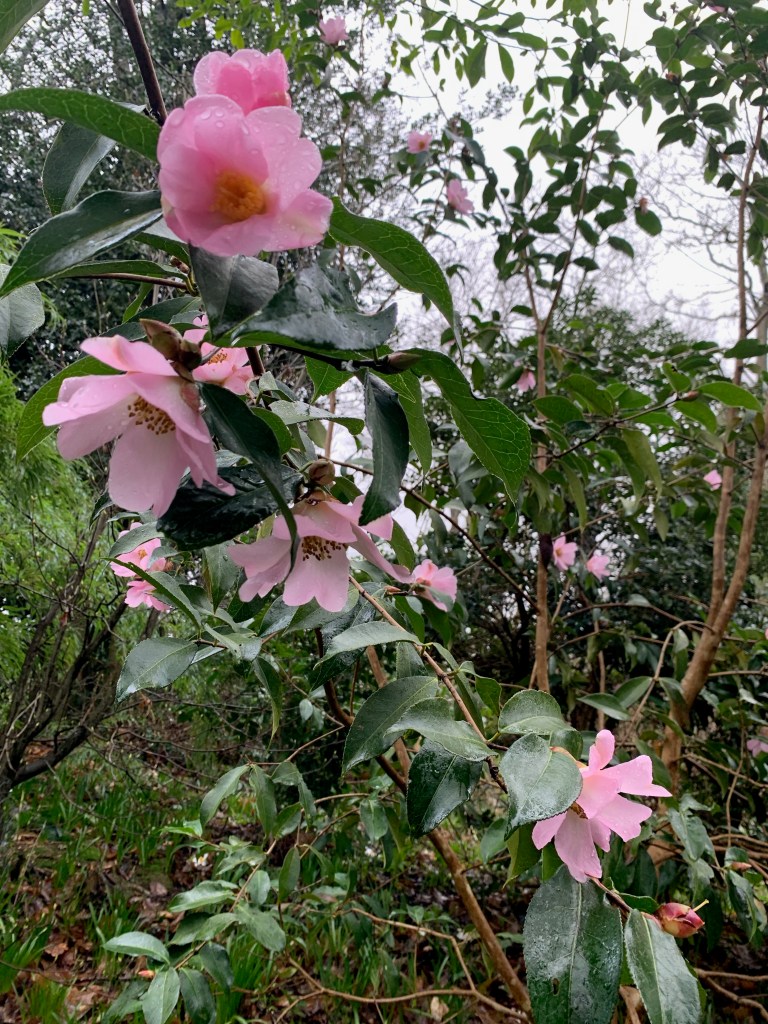
C. pitardii, with a wide distribution in China, is perhaps my favourite, variable in habit and in flower, with colour ranging from rich pink to white. In a good form flowers are of high quality, some specimens a clear shell pink, with little of the more typical vinous underlay. I have three different collections, all growing well after a decade; the best has an open habit and clustered flower buds, both terminal and axillary, with up to twelve buds on less than a foot of stem. The elegant open funnel shaped flowers are up to 8cm in diameter and open in succession over a long period from February onwards. It is an excellent plant often confused with C. saluenensis, parent of the great C. x williamsii race.
The Taiwanese species C. transnokoensis is now well known and frequently planted. It has turned out to be surprisingly hardy, and its dense bushy habit, small leaves and abundance of small flowers in spring make a great display. We grow 3 or 4 forms, the best with dark pink buds, the colour retained on the back of the outermost petals when open, particularly attractive. It is an excellent candidate for a small garden, or a specimen plant in a pot.
Many other new Camellia species are thriving in Cornwall – these notes offer a mere glimpse into a future full of exciting potential, and suggest what is already possible in Kent. This looks likely to be a continuously expanding new range of plants which are beginning to prove their value in gardens, and for hybridising, too. They certainly offer beauty and interest in a far more demanding range of garden conditions than their native origins might seem to allow.
References: Collected Species of the genus Camellia. An illustrated outline. By Gao Jiyin, Clifford R. Parks, Du Yueqiang.
See Maurice’s 2017 RCM Yearbook article on Camellia species here.
There will be an IDS Study Day on the genus Camellia on Saturday March 30th at White House Farm: for more information click here.
There will also be a Garden Masterclass guided tour of White House Farm Camellias and Magnolias on April 4th: for more information click here.






















 White House Farm Garden and Arboretum